
How to Read English Hallmarks on a Pocket Watch Case
You have an antique English pocket watch in your hand. You open the case back and spot a row of small stamped symbols — some in shield-shaped cartouches, some oval, some oddly shaped. What do they mean, and what can they tell you? This page walks you through the whole process, step by step, from first glance to a confident date and place of origin.
Where to Find the Hallmarks
On a pocket watch, hallmarks are struck on the case, not the movement. The movement maker and the case maker were typically different companies, and only the case metal required assaying. Look in these locations:
On the outer case
- Inside the back cover — the most common location; look just inside the rim
- On the band (the rim) — sometimes struck along the edge of the case body
- Inside the front bezel — particularly on hunter cases with an outer cover
What you need
- A loupe or magnifying glass (10× is ideal)
- Good angled light — raking light reveals struck marks clearly
- This page open beside you
The marks are small — typically 1–3 mm across — and on a well-worn case they may be partly rubbed. You will usually find a cluster of three to five marks side by side. On a hunter case, the inner case and the outer cover may each carry separate marks.
Reading the Marks: A Step-by-Step Method
Work through the marks in this order. Each step narrows down what you know about the watch.
-
Identify the standard mark — confirm the metal
The first thing to establish is whether the case is silver or gold, and its purity. For silver, look for the lion passant: a lion striding left, in an irregularly shaped cartouche. This mark has appeared on all English sterling silver since 1544, and its presence guarantees the case is at least 92.5% pure silver.

Lion passant
Sterling silver
(925 parts/1000)For gold, look for a crown above a number: Crown + 9 for 9 carat, Crown + 15 for 15 carat (very common in Victorian watch cases), Crown + 18 for 18 carat, and so on. This format was used 1844–1974.
If you find neither mark, the case may be gold-filled, silver-plated, or base metal — none of which carry hallmarks.
-
Find the assay office mark — identify the town
Each assay office used a distinctive symbol. This is often the most visually recognisable mark and the easiest to identify at a glance. The most commonly encountered offices on English pocket watch cases are shown below:

London
Leopard’s head
(crowned pre-1821)
Birmingham
Anchor
(from 1773)
Chester
(closed 1962)
Sheffield
Crown
(from 1773)
Edinburgh
Castle
(from c.1457)
Dublin
Hibernia
(from 1638)
Glasgow
Tree & Fish
(1819–1964)
Exeter
(closed 1882)
Newcastle
Three castles
(closed 1884)
York
(closed 1857)Knowing the assay office matters because each office used its own sequence of date letters with different shield shapes and typefaces — you must consult the correct office's table in the next step.
London tip: After 1821, London dropped the crown from the leopard's head. A crowned leopard's head dates the piece to 1820 or earlier; an uncrowned one is 1821 or later.
Crowned
pre-1821
Uncrowned
1821 onwards -
Read the date letter — find the year
The date letter is a single alphabetical letter stamped inside a shaped shield (called a cartouche). Each letter represents one year; the cycle runs A through U (omitting J), resetting every 20 years with a new shield shape and typeface. Reading it correctly is the trickiest part for three reasons:
- Each office changed its letter on a different day of the year — London changed in May, Birmingham in July, Sheffield in January
- The same letter in a different shield may be over a century apart in date
- You must use the table for the correct office — London's “D” and Birmingham's “D” are not the same year
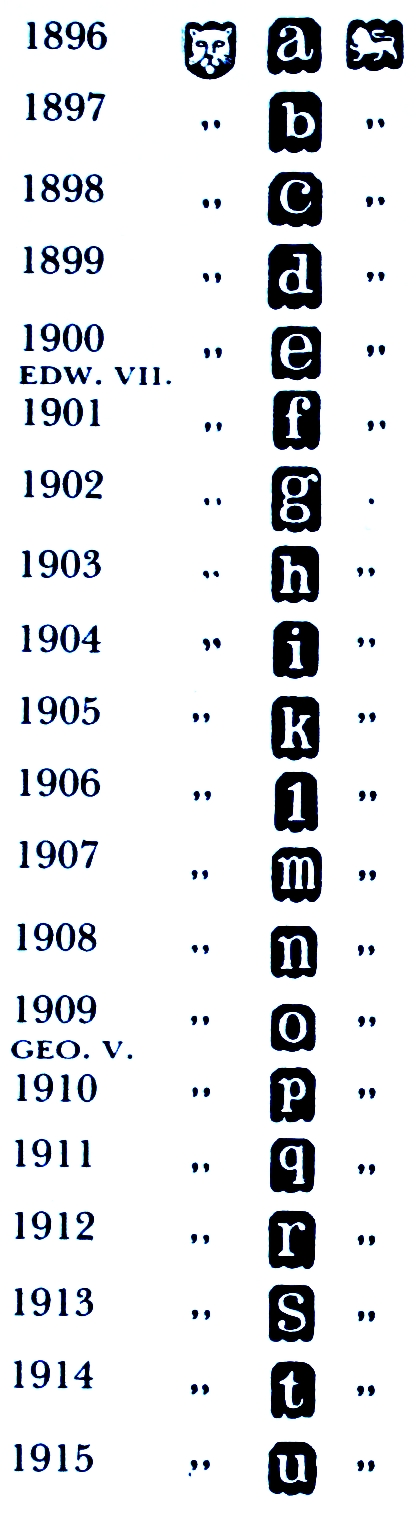
London date letters 1896–1915 — peak of antique pocket watch production 
London date letters 1916–1937 For complete date letter tables for every assay office from the 16th century onwards, see the English Hallmarks reference page — it includes scanned reference tables for London, Birmingham, Dublin, Edinburgh, Glasgow, Exeter, Newcastle, Sheffield, York and Norwich.

A date letter in its cartouche — note the shield shape as well as the letter -
Check for a duty mark — narrow the date further
Between 1784 and 1890, a tax on gold and silver plate was levied in Britain. The duty mark — a monarch's head in profile — was struck alongside the other marks to confirm tax had been paid. If your watch case carries a duty mark, it was assayed between those two dates. After 1890 the tax was abolished and the duty mark disappeared.

Duty mark
1784–1890 onlyDifferent monarchs appear depending on the date: George III, George IV, William IV, or Victoria. The specific monarch's head can help narrow the date to within a single reign, as a useful cross-check against the date letter.
-
Look for the maker's mark
The maker's mark is the initials of the person or company who submitted the piece for assay — usually the case manufacturer, not the watchmaker. It appears in a cartouche, often matching the shape of the other marks. On mass-produced watch cases it may be a company code traceable only through specialist directories. On higher-end cases it can sometimes be identified in references such as Grimwade's London Goldsmiths 1697–1837 or Culme's Directory of Gold & Silversmiths.
Quick Identification Reference
Use this table as a fast summary when you have a case in front of you:
| Mark | Image | What it means | Dates present |
|---|---|---|---|
| Lion passant | |
Sterling silver (92.5% pure). Present on all English silver from 1544. | 1544 to present |
| Crown + number | 👑 9 | Gold case: the number is the carat (9, 14, 15, 18, 22). 15ct is common in Victorian watch cases. | 1844–1974 |
| Leopard’s head crowned | |
London assay office mark — crowned form used pre-1821. | To 1820 |
| Leopard’s head uncrowned | |
London assay office mark — crown dropped from 1821. | 1821 onwards |
| Anchor | |
Birmingham assay office. Second most common office on antique watch cases. | 1773 onwards |
| Crown (alone) | |
Sheffield assay office. | 1773 onwards |
| Duty mark (monarch’s head) | |
Tax on plate was paid. Confirms the case was assayed within this date range. | 1784–1890 |
| Date letter (A–U in a shield) | |
Year of assay. Must be read against the correct office's table — the shield shape matters as much as the letter itself. | All periods |
Worked Examples
Example 1 — A Victorian silver hunter case
You find four marks on the inside of the back cover: a lion passant, an uncrowned leopard's head, a monarch's head, and a letter in a rectangular shield.
- Lion passant → sterling silver ✓
- Uncrowned leopard's head → London assay office, 1821 or later ✓
- Monarch's head present → assayed before 1890 ✓
- Date letter → look up in the London date letter tables for 1821–1890
Result: a London-assayed sterling silver case made between 1821 and 1890. The specific date letter gives the exact year.
Example 2 — An Edwardian gold open-face case
You find three marks: Crown + 9, an anchor, and a date letter. No duty mark.
- Crown + 9 → 9 carat gold ✓
- Anchor → Birmingham assay office ✓
- No duty mark → assayed after 1890 ✓
- Date letter → look up in the Birmingham date letter table (not London)
Result: a Birmingham-assayed 9ct gold case, post-1890. This combination is typical of Edwardian and early 20th-century production — exactly the era when the American railroad movement was at its peak, often fitted into English gold cases.
What Hallmarks Can and Cannot Tell You
A complete set of hallmarks gives you the metal standard, the assay office town, and the year of assay — usually to within a few months. What they cannot tell you:
- The movement maker. The movement and case were separate trades. A London-cased watch may contain a Swiss, American, or English movement fitted any time after the case was made.
- The retailer. Many cases were sold under a jeweller's name but manufactured by a different firm entirely.
- Where the watch was sold. A Birmingham-assayed case could have been retailed anywhere in Britain, or exported.
- Whether the movement is original to the case. Cases were sometimes re-cased or matched with replacement movements — a common practice in the trade.
For dating the movement, you need the serial number. See our look-up pages for Waltham, Hamilton, Illinois, Hampden, and Howard movements, or consult a specialist reference for English and Swiss calibres.
Related Pages
- English Hallmarks — Complete Reference (all assay offices, date letter tables, gold and silver standards explained in full)
- The Pocket Watch Case — hunter, half-hunter, open face and case construction
- Pocket Watch Values — how gold and silver cases affect price
- Pocket Watch Collecting Guide