
1876: The Centennial Exhibition and the American System
In the summer of 1876 the United States threw itself a hundredth birthday party, and the world came to watch. Among the ten million visitors who passed through the Centennial Exhibition in Philadelphia were two quiet Swiss watchmakers, sent to see whether the rumours were true. They were, and what they saw frightened them so badly that one of them sat down and wrote a report he believed would decide the fate of Swiss watchmaking. He was right.
The Centennial was where the American pocket watch announced itself to the world — not as a cheap curiosity, but as a precision instrument made by machine, in numbers no European workshop could match. For the collector, it is the single most important event in understanding why an antique Waltham, Elgin or Illinois watch exists at all, and why so many survive to be collected today.
A Hundredth Birthday in Philadelphia
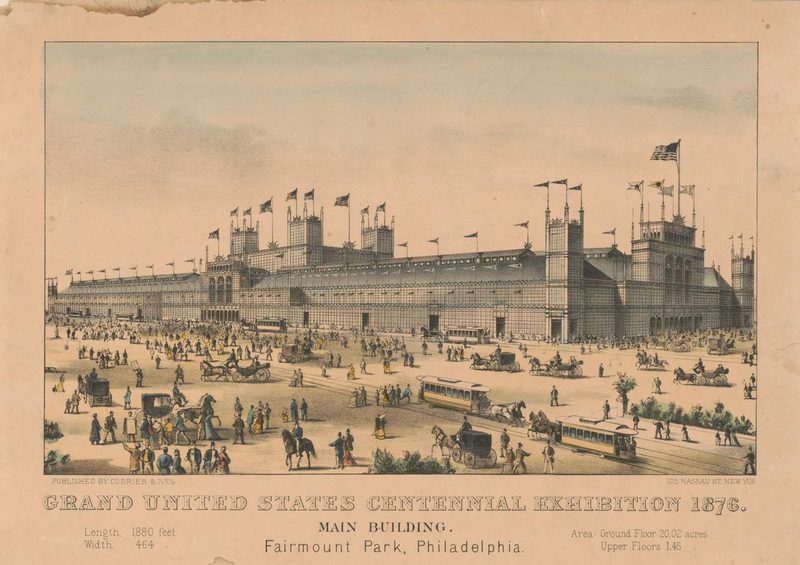
The Centennial International Exhibition opened in Fairmount Park, Philadelphia, on 10 May 1876 and ran until 10 November, marking the hundredth anniversary of the Declaration of Independence. It was the first official World's Fair held in the United States. Some thirty-seven nations took part, and very nearly ten million people — an extraordinary number for a country of fewer than fifty million — came to see what the modern age had to offer.
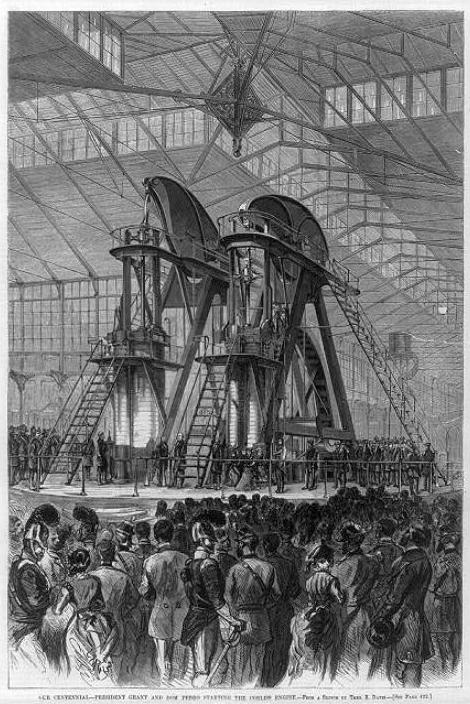
What it had to offer was, above all, machinery. The fair's beating heart was Machinery Hall, dominated by the gigantic Corliss steam engine that powered the whole building from a single source; President Grant and the Emperor of Brazil set it running on opening day. Among the marvels on display were Alexander Graham Bell's telephone and the first commercial typewriters. The Centennial was the moment the United States stopped being a supplier of raw materials and announced itself as an industrial power — and nowhere was that shift clearer than at the watchmakers' stands.
Watches Made by Machine
To understand why the watch exhibits caused such a stir, you have to understand how differently the two worlds made their watches. In Switzerland, watchmaking was organised around the établissage system: a network of small workshops and home workers, each making one component or performing one operation by hand, the parts gathered and finished by an établisseur. The results could be superb, but every watch was in a real sense unique, its parts hand-fitted to one another.
The Americans did something the Europeans thought impossible for an object so small and so fine. Borrowing the principles of the "armory system" developed for making firearms — interchangeable parts produced to such close tolerances by machine that any one would fit any watch of its model — they made watches the way Springfield made rifles. The vision belonged above all to Aaron Lufkin Dennison, the "father of American watchmaking", whose factory at Waltham, Massachusetts, had spent two decades perfecting it. By 1876 a Waltham watch was assembled from parts that were, to a remarkable degree, truly interchangeable.
This was not merely cheaper; it was faster, more consistent, and almost limitless in quantity. A handful of American factories could out-produce the whole of the Swiss Jura, and do it to a standard of accuracy that the visitors, testing the watches for themselves, could not deny.
The Exhibit That Stunned the Trade
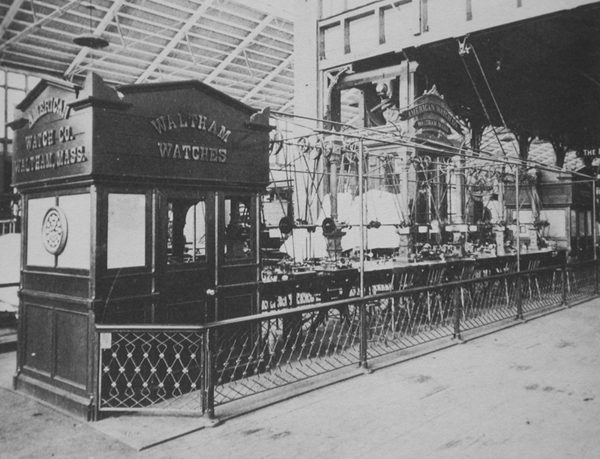
The American Watch Company of Waltham took the leading place, with the National Watch Company of Elgin close by. Their stands showed not only finished watches by the thousand but the machines that made them — automatic tools turning out screws, wheels and plates to tolerances finer than a human hand could hold. Visitors who had assumed that Americans merely assembled imported Swiss parts were confronted with the opposite: complete watches, made from raw metal to finished movement under one roof, by machine.
The timing could hardly have been worse for Switzerland. The Panic of 1873 had plunged the world into a long depression, and Swiss watch exports to the United States — one of their most important markets — had already collapsed, falling from more than eighteen million francs in 1872 to under five million by 1876. Now the Swiss could see the cause of that collapse standing in front of them, gleaming and turning out watches by the minute. Worse still, the American factories were beginning to export into markets the Swiss had long considered their own.
Jacques David and the Investigation
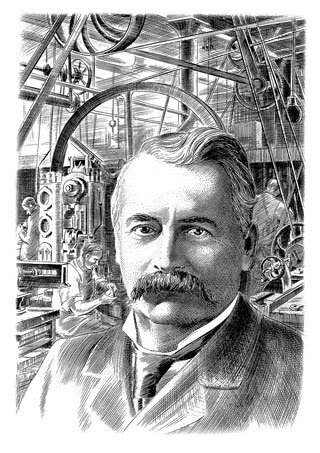
The Swiss watch trade did not panic blindly; it sent for evidence. The Intercantonal Society of Jura Industries despatched two men to Philadelphia: Jacques David (1845–1912), chief engineer of Longines and a relative of the firm's manager Ernest Francillon, and Théodore Gribi, who held a similar post at Borel & Courvoisier in Neuchâtel. Their instructions were blunt — to make a serious and detailed report of the organisation, tools, finances and methods of the American watch factories.
David and Gribi did their work thoroughly. They sat on the exhibition's jury, tested ten Waltham watches for accuracy at the fair's observatory, and then spent the months from August to November 1876 touring the American factories, Waltham and Elgin among them, sketching tools and machines and noting every detail of how the work was organised. They were helped by an insider: Ambrose Webster, Waltham's recently retired assistant superintendent, who had built many of the company's machines and now shared his knowledge freely.
It is often told as a tale of industrial espionage — "the Swiss spies who stole America's secrets" — and there is a grain of truth in it, for some of what David learned came from inside contacts. But the more sober reality, as the historian who translated David's report has pointed out, is that the Americans were largely open and cooperative; they regarded their Swiss visitors as respected peers, and indeed still bought a good many Swiss parts. The Swiss did not so much steal the American system as study it honestly — and take fright at what they found.
"Unless Immediate Action Is Taken"
Back in Switzerland, David wrote up his findings in a report of more than a hundred pages — a forensic account of American methods and a stark warning. His conclusion was that the Swiss watch industry, for all its skill, would be destroyed unless it abandoned the old cottage system and adopted American-style mechanisation and factory organisation without delay.
At first he was ignored. For two months his warning sat unheeded, until an exasperated David produced a second report rebuking his countrymen for failing to take the first one seriously. Slowly, the message sank in. Over the following years the Swiss did exactly what he urged: they mechanised, they built factories, they reorganised — while keeping the finishing skills and the taste for fine work that had always set them apart. Within a generation Switzerland had not merely survived but regained command of world watch production, a position it has never since wholly lost.
So sensitive was the document that only a few handwritten copies were ever made, and the Swiss kept it suppressed for fear of offending the Americans who had been so hospitable. It remained almost unknown for some hundred and fifteen years, until Longines published a facsimile in 1992 — at which point the modern watch world finally learned how close a run thing the survival of Swiss watchmaking had been.
A Lesson Ignored
The Swiss were not the only Europeans at Philadelphia. England, still home to some of the finest watchmakers alive — Charles Frodsham and Nicole Nielsen among those who exhibited — saw exactly what the Swiss saw. The difference is what they did about it. Where the Swiss, after their fright, mechanised and modernised, the English clung to the traditional methods and the hand-craft reputation that had served them so gloriously in the previous century.
It was a fateful choice. The very qualities that had made English watches the best in the world — individual craftsmanship, contempt for the machine — left the English trade unable to compete on price or quantity, and over the following decades it declined from world leadership to near-extinction. The Centennial offered the same warning to everyone who attended; only some chose to heed it.
The Watch in Your Hand
For anyone who collects American pocket watches, the Centennial is not distant history but the reason the watches exist. The interchangeable-parts system that astonished Philadelphia is why a Waltham or Elgin movement of a given model and grade can be serviced with parts from another example of the same; it is why these watches were made in their millions, and why so many good ones survive to be bought today at prices a Breguet collector could only dream of.
It is also why the American watch is so satisfying to study. Because the factories recorded what they made, serial number by serial number, an American movement can usually be dated to within a year or two, and its grade and jewel count tell you exactly where it sat in the maker's range — a precision of knowledge the hand-built European watch rarely allows. Every machine-made American pocket watch is a small descendant of the revolution that the Swiss came to Philadelphia to see.
Continue exploring. Read more on the American watch industry and the Swiss watch industry, trace the firm at the centre of it all on our Waltham Watch Company page, or date your own watch with the serial number lookup tool. Return to the History Library for more.