
The Ball Pocket Watch Company
The Ball Pocket Watch Company played a vital part in the safety of the American railroads.
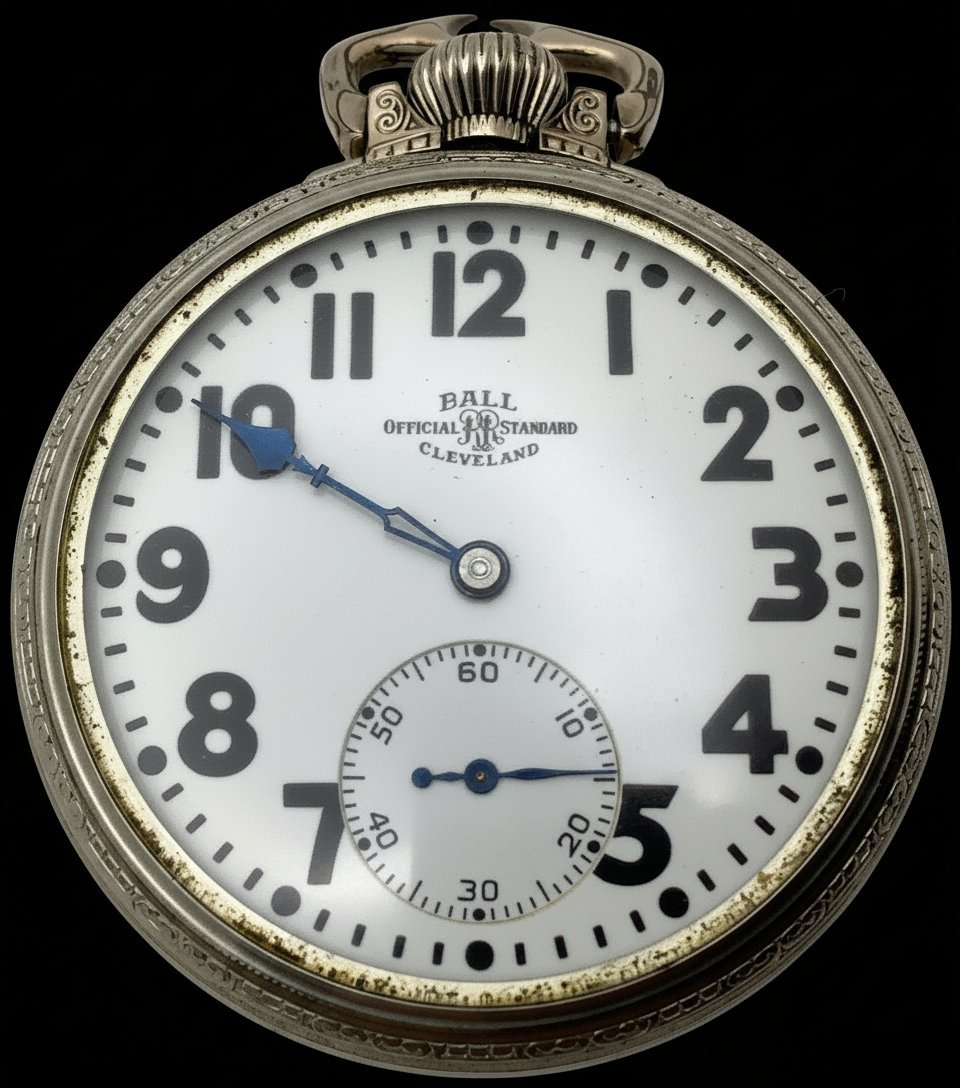
The Ball Watch Company was formed in 1879 in Cleveland, Ohio. Widely acknowledged for their role in developing the specifications for the Railroad Pocket Watch, the company did not actually produce any pocket watches of its own. After the horrific railroad crash at Kipton, Ohio in 1891, Mr. Webb C. Ball was commissioned and given the responsibility of producing standards for the measurement of employees' pocket watches throughout the railroad network.
The Jeweller Who Became an Institution
Webb C. Ball was a shopkeeper before he was anything else. In March 1879 he bought an interest in a Cleveland jewellery firm where he had been working as a clerk, bought out his partners in short order, and put his own name over the door. The business prospered on ordinary retail trade for a decade before the accident at Kipton turned him into a national figure.
What followed was less a watch company than a bureaucracy. As Chief Time Inspector — and eventually General Time Inspector for something over 125,000 miles of railroad across the United States, Canada and Mexico — Ball built a system of approved inspectors, certified repairers and written rating records that governed every watch carried on the lines he supervised. Selling watches was, in a sense, a side effect: he had defined what an acceptable watch was, so he was well placed to supply one.
The specification he wrote is set out in full on our railroad pocket watch page. In brief, an approved watch had to be open-faced and lever-set, 16 or 18 size, at least 17 jewels, adjusted to five positions and to temperature, and accurate to within thirty seconds a week — with a plain white dial and bold black Arabic numerals so that it could not be misread in poor light.
Who Made Ball Watches?
Companies that made Ball-signed watches included Elgin, Hamilton, Howard and Waltham. Although Ball did not produce any movements themselves, they began selling pocket watches in 1893. Unlike other companies of the era, Ball did not sell movements separately from cases — all Ball pocket watches were sold as complete units, though with a choice of dials.
All Ball watches were official railroad standard with 17, 19, 21, or 23 jewels, adjusted to 5 positions, in size 16 or 18, open face.
Hampden supplied the earliest Ball-signed movements, with Hamilton following from 1894 and Waltham and Elgin joining later; Hampden and Hamilton between them account for a large share of what survives. The arrangement suited everyone. The factories got guaranteed volume at a good price, Ball got movements built to a tighter specification than the makers' own catalogue grades, and the railroads got a single name they could trust without having to adjudicate between manufacturers.
Reading the Markings on a Ball
Because the movements came from several factories, the names on a Ball are the quickest guide to what you are holding. Official Railroad Standard — often abbreviated ORRS, and identifiable on the dial by an interlinked RR shield — is the top designation and the one collectors want. Official Standard sits below it, and Commercial Standard below that, on watches sold to the general public rather than to railwaymen. The earliest Hampden-made movements, and the first Hamilton ones of 1894–95, instead carry Ball's Standard, Superior Grade.
Identifying the actual manufacturer takes a little more looking. The movement layout is usually decisive to anyone familiar with the factories, but the dial helps too — the Arabic numerals on Waltham-made Ball dials use a font that Waltham used nowhere else. Grade numbers offer another route: a Ball Hamilton 999, for instance, is a Hamilton movement through and through, whatever the plate says.
Collecting Ball Watches
Ball watches are highly collectible due to their direct association with railroad safety history. The 21-jewel Official Standard grades are especially sought after. Because movements were made by major manufacturers to Ball's exacting specifications, the quality is outstanding — many examples found today keep excellent time after more than a century of service.
The premium a Ball commands over the equivalent unsigned movement is real, and that is precisely what makes caution worthwhile. A Ball-marked dial fitted to an ordinary Hamilton or Waltham movement is one of the more common deceptions in American pocket watches, and the marriage is not always deliberate — a century of repairs has separated a great many dials from the movements they started with. Look for agreement between dial, movement markings and case, and treat a watch where only one of the three says Ball with suspicion.
Ball After Webb Ball
Webb Ball died in 1922, by which time the railroads' grip on precision timekeeping was already loosening; the telegraph and, before long, the telephone and radio made the individual engineer's watch less critical than it had been. The company he founded continued, but the great era of contract-built American Ball watches wound down with the factories that supplied them.
The name survives. Ball Watch Company today is a Swiss firm based in La Chaux-de-Fonds, making wristwatches that trade explicitly on the railroad heritage. It is a legitimate continuation of the trademark rather than of the business, and it has no bearing on the antique market — a modern Ball and a 1905 Ball Waltham have a name in common and very little else.