
Hamilton Pocket Watch Serial Numbers
The serial number on a Hamilton watch is stamped on the movement, not the case. Open the back of the watch carefully to find it. Enter it below for an instant result.
Serial Number Lookup — Hamilton 1893–1942
This Hamilton serial number lookup covers 1893 to 1942. Hamilton movements commonly carry three separate numbers — the serial, the grade and the model — and only the first of them dates anything. A short number is usually the grade rather than the serial — but not always, because Hamilton’s own numbering only passed 16,000 in 1896, so a genuine serial from the first three years is short too. Check it against the grade table further down before assuming. And if your serial begins with a letter — C, S, 2B, 4C — it is a post-war movement and belongs to the letter-prefix tables, not to this one.
| Year | From Serial | Year | From Serial |
|---|---|---|---|
| 1893 | 1 | 1918 | 1,500,000 |
| 1894 | 5,000 | 1919 | 1,600,000 |
| 1895 | 11,500 | 1920 | 1,700,000 |
| 1896 | 16,000 | 1921 | 1,800,000 |
| 1897 | 27,000 | 1922 | 1,900,000 |
| 1898 | 50,000 | 1923 | 2,000,000 |
| 1899 | 74,000 | 1924 | 2,050,000 |
| 1900 | 104,000 | 1925 | 2,100,000 |
| 1901 | 143,000 | 1926 | 2,150,000 |
| 1902 | 196,000 | 1927 | 2,200,000 |
| 1903 | 260,000 | 1928 | 2,250,000 |
| 1904 | 340,000 | 1929 | 2,300,000 |
| 1905 | 435,000 | 1930 | 2,350,000 |
| 1906 | 500,000 | 1931 | 2,400,000 |
| 1907 | 580,000 | 1932 | 2,440,000 |
| 1908 | 680,000 | 1933 | 2,480,000 |
| 1909 | 750,000 | 1934 | 2,520,000 |
| 1910 | 790,000 | 1935 | 2,560,000 |
| 1911 | 860,000 | 1936 | 2,600,000 |
| 1912 | 940,000 | 1937 | 2,900,000 |
| 1913 | 1,000,000 | 1938 | 3,200,000 |
| 1914 | 1,100,000 | 1939 | 3,400,000 |
| 1915 | 1,200,000 | 1940 | 4,000,000 |
| 1916 | 1,300,000 | 1941 | 4,250,000 |
| 1917 | 1,400,000 | 1942 | 4,500,000 |
There is a deeper reason no list of this kind can be exact. The NAWCC notes that Hamilton did not assign serial numbers in strict chronological order — it allocated large blocks by watch size, so an 18-size and a 16-size run could be numbered far apart and made at the same time. Its ledgers show two 992s only twenty numbers apart being finished and sold nearly two years apart. A serial-to-year list is a gross indicator, and dates three years out are not unusual.
Notable Hamilton Pocket Watch Grades
| Grade | Size | Jewels | Adjusted | Notes |
|---|---|---|---|---|
| 940 | 18 | 21 | 5 positions | Common railroad grade |
| 946 | 18 | 23 | 5 positions | High-grade 18s |
| 947 | 18 | 23 | 6 positions | Rare, very valuable |
| 950 | 16 | 23 | 5 positions | Top 16-size grade |
| 992 | 16 | 21 | 5 positions | Most common Hamilton RR |
| 992B | 16 | 21 | 6 positions | Last & finest version |
| 993 | 16 | 21 | 5 positions | Open face, rare |
| 999 | 16 | 19 | 3 positions | General purpose |
Three Numbers, Only One of Them a Serial
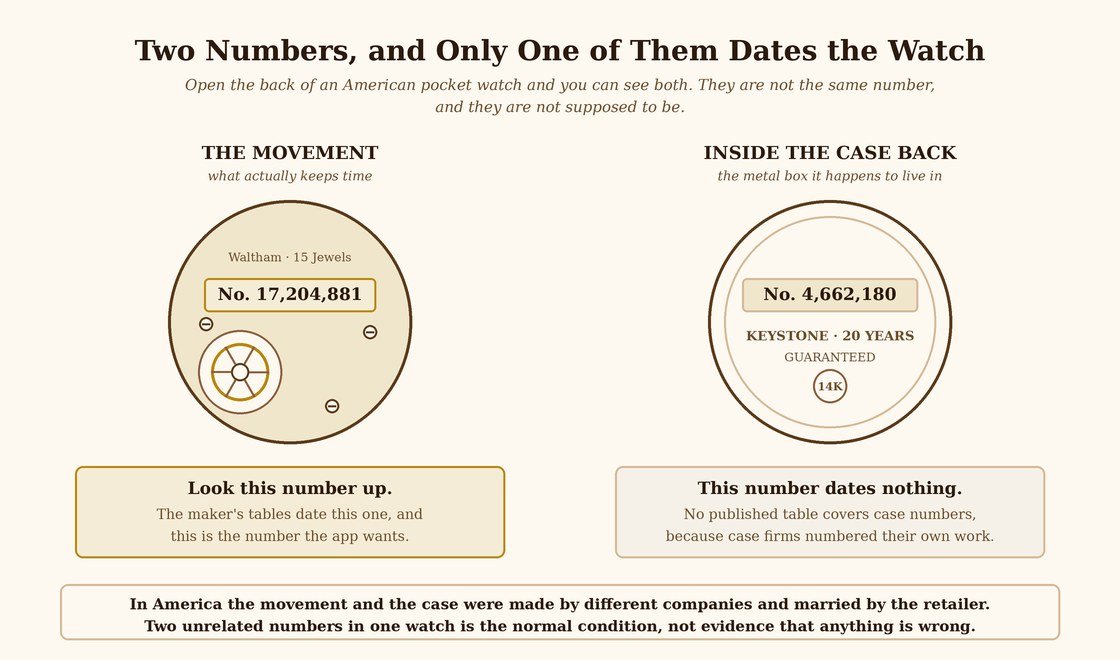
Hamilton owners have an extra trap to avoid, because there are usually three numbers in play rather than two. The one that dates the watch is on the movement, engraved on the plate beneath the balance, generally near the words Hamilton Watch Co. Lancaster, Pa. A second belongs to the case, and the quickest way to recognise it is by the company it keeps: Hamilton bought cases in, so that number sits beside somebody else's trademark — Keystone, Wadsworth, Philadelphia Watch Case Co. and Star are the names you will meet most often. A number accompanied by a trademark that is not Hamilton's is a case number, whatever else is stamped around it.
Hamilton sold movements and cases separately, as every American maker did, so the two numbers were never intended to match and a difference of several years between them is completely normal. There is a third number to be careful of as well: the grade number — 992, 950, 940 and so on — is also stamped on the movement, and is often mistaken for a serial. Grade numbers are three digits and appear in the grade table above; serial numbers run to seven digits by the 1920s, though watches from 1893 to 1896 carry serials of only four or five. If a short number matches a grade in that table, it describes the model rather than the individual watch — and if it does not, it may well be an early serial.
The Watch of Railroad Accuracy
Hamilton arrived late — the company was founded in Lancaster, Pennsylvania in 1892 on the remains of the Keystone Standard Watch Company — and built its reputation almost entirely on railroad-grade watches. By the early twentieth century The Watch of Railroad Accuracy was the company's slogan and, unusually for advertising, a fair description.
The railroads set genuinely demanding standards after a series of collisions caused by inaccurate timekeeping: an approved watch had to be at least 17 jewels, adjusted to five positions and to temperature, lever-set so it could not be reset accidentally by the crown, open-faced with an Arabic dial, and accurate to within thirty seconds a week. Hamilton's 992 became the archetype and probably the most widely used railroad watch in America.
Its successor, the 992B, is the one collectors chase. Introduced in the 1940s and made until the end of American production, it used an Elinvar Extra hairspring — an alloy far less affected by temperature and magnetism than steel — and is generally considered the finest railroad-grade watch the United States produced. A 992B in honest condition remains a genuinely accurate timekeeper today, which cannot be said of most watches of its age.
Hamilton's other wartime distinction is worth knowing: its Model 21 and Model 22 marine chronometers equipped the US Navy through the Second World War, and the company effectively took over chronometer supply for the Allies when European sources were cut off.
Watches Made After 1942
The table above runs to 1942, and there is a reason. Hamilton’s civilian numbering became irregular during the war, and pocket watch production afterwards was dominated by the 992B, made in comparatively small batches until 1969. A plain number will not place a post-war Hamilton — but a lettered one will, and that is what the next section is for. Check the movement for a grade stamped 992B, 950B or 4992B: any of the three is by definition post-war, and its serial will carry a letter in front of it.
Post-War Serial Numbers: The Letter Prefixes
Hamilton did not simply carry on counting after the war. The three post-war railroad grades were each given their own short sequence with a letter in front of it, restarting near 1, and those sequences are what date a late Hamilton. A movement stamped C215,000 is not the 215,000th Hamilton; it is the 215,000th 992B. The prefix tells you the grade before the number tells you the year.
Grade 992B — prefix C
| Year | From Serial | Year | From Serial |
|---|---|---|---|
| 1940 | C001 | 1950 | C350,000 |
| 1941 | C40,000 | 1951 | C390,000 |
| 1942 | C60,000 | 1954 | C420,000 |
| 1943 | C90,000 | 1956 | C455,000 |
| 1944 | C120,000 | 1959 | C500,000 |
| 1946 | C170,000 | 1964 | C520,000 |
| 1947 | C215,000 | 1969 | C529,000 |
| 1948 | C255,000 |
The sequence ends at C529,000 in 1969, which is a useful independent check: the NAWCC puts total 992B production at just over 520,000, and a sequence that starts at 1 and finishes near 529,000 is consistent with that.
Grade 950B — prefixes S and 2B
The 950B is the awkward one, because it ran under two prefixes at once. Both begin in 1941 and both begin near 1, so an early 950B can legitimately carry either a very low S number or a very low 2B number. Neither is a fake and neither is a misprint.
| Year | From Serial | Sequence |
|---|---|---|
| 1941 | 2B001 | 2B block |
| 1941 | S001 | S block |
| 1942 | 2B400 | 2B block |
| 1943 | 2B800 | 2B block |
| 1944 | S1,500 | S block |
| 1945 | S2,800 | S block |
| 1946 | S4,000 | S block |
| 1947 | S4,500 | S block |
| 1948 | S6,500 | S block |
| 1949 | S7,500 | S block |
| 1951 | S10,000 | S block |
| 1955 | S25,000 | S block |
| 1962 | S28,000 | S block |
| 1965 | S30,000 | S block |
The S block is the main commercial run and is the one nearly all 950Bs belong to — it advances slowly, reaching only about 30,000 in twenty-four years, which is a fair measure of how few of these were made. The 2B block is small, confined to the early 1940s, and is separately recorded in Hamilton’s ledgers as a 950B series in its own right.
Grade 4992B — prefix 4C
The 4992B is the navigation and military model, usually with a 24-hour dial. It was made in quantity for the armed forces, so the military association adds less to the price than owners tend to hope.
| Year | From Serial |
|---|---|
| 1941 | 4C — start of series, number not recorded |
| 1942 | 4C40,000 |
| 1944 | 4C90,000 |
| 1950 | 4C120,000 |
| 1968 | 4C135,000 |
| 1969–70 | 4C148,959 |
| 1971 | 4C146,900 |
The source this table comes from records that the 4C series began in 1941 but does not give its opening number, so the first row states the year only.
From Date to Value
Having a year is the easy part. A 992B and a 17-jewel general-purpose movement from the same period are separated by a wide margin, and nothing in the serial number signals which of them is sitting in your hand.
Those are grade above all — use the table above, since on a Hamilton the grade number does most of the work; the case metal, with solid gold well ahead of gold-filled or base metal; originality, meaning an unrestored dial with no hairline cracks, correct hands, and a movement that has not been re-plated or over-polished; and running order, because servicing a 23-jewel adjusted movement properly is an expensive job.
One caveat specific to Hamilton: production fell sharply through the Depression years — from 100,000 movements a year in the 1920s to 40,000 a year between 1931 and 1936 — so serials in that band were issued across much longer stretches than usual and dates there are correspondingly loose. Elsewhere, treat a result as accurate to within a year or two.
The grades and jewel counts reference explains what the adjustment markings mean in practice, pocket watch values covers the wider market, and the appraisal guide sets out when it is worth paying for a written valuation.
More on Hamilton Watches
The Hamilton Watch Company history page covers the Lancaster story from 1892 onward. For the railroad standards that shaped the 992 and its rivals, see the railroad watch guide; Hamilton's wartime work is touched on in military pocket watches.