
Antique Pocket Watch Value
Just want an appraisal? Go to our Pocket Watch Appraisal page.
Determining the value of a pocket watch is not straightforward. Age, condition, maker, number produced, and whether it actually runs all contribute to the final figure. Many well-known makers like Waltham, Elgin and Hamilton are fairly well documented, making valuation easier. Lesser-known watches traded infrequently are much harder to price.
Before valuing it, identify it. How to identify and date a pocket watch covers the movement serial, the grade beside it and the case marks, in the order that works.
How to Value Your Watch: A Step-by-Step Approach
One of the most common questions we receive is simply "how can I value my pocket watch?" A definitive figure needs expert knowledge of the specific piece, but any collector can follow these reliable steps.
Step 1 — Identify what you have. Before you can value a watch you must know exactly what it is. Start with the serial number, which on American watches is stamped on the movement, not the case — use the serial number tables to establish the maker and approximate date. Then note the grade (usually engraved on the movement), the size (measured in the American system from 0 to 23), the jewel count and the case material; each of these directly affects value.
Step 2 — Get the right reference book. No serious collector should be without The Complete Price Guide to Watches by Cooksey Shugart — over 10,000 watches listed with around 8,000 illustrations. Printed prices date quickly, but the relative rankings of rarity and quality stay accurate and give an excellent benchmark. See our recommended books for more.
Step 3 — Check current market prices. Finally, confirm against real-world sales using eBay's completed listings — covered in detail under Using eBay to Track Values below.
Sentimental vs Market Value
Sometimes the owner of a watch doesn't care about market value because the watch holds personal or family significance. This only becomes a problem at the point of sale, when accepting market value may be painful. A 1913 Waltham worth a couple of hundred dollars may be priceless to the family that inherited it — and that's perfectly fine.
Supply & Demand
As the price of precious metals increases, so does the value of pocket watches made from gold and silver. The unsettling reality for collectors is that when gold prices rise significantly, the metal value of a case can exceed the horological value of the complete watch — leading some owners to melt down irreplaceable antiques.
The good news: pocket watches are no longer being manufactured. Every year thousands are lost to accidents, floods, fires and melting. Supply is shrinking while collector demand grows. All things being equal, antique pocket watch values will increase over time.
Condition Grading
Condition moves the price of an antique pocket watch further than any factor except the name on the dial. This site uses one scale throughout — the six grades set out in the buyers checklist, which maps the NAWCC terms used in the American market onto the plain-English descriptions British dealers prefer. What follows is what each grade does to the price, rather than what each grade looks like.
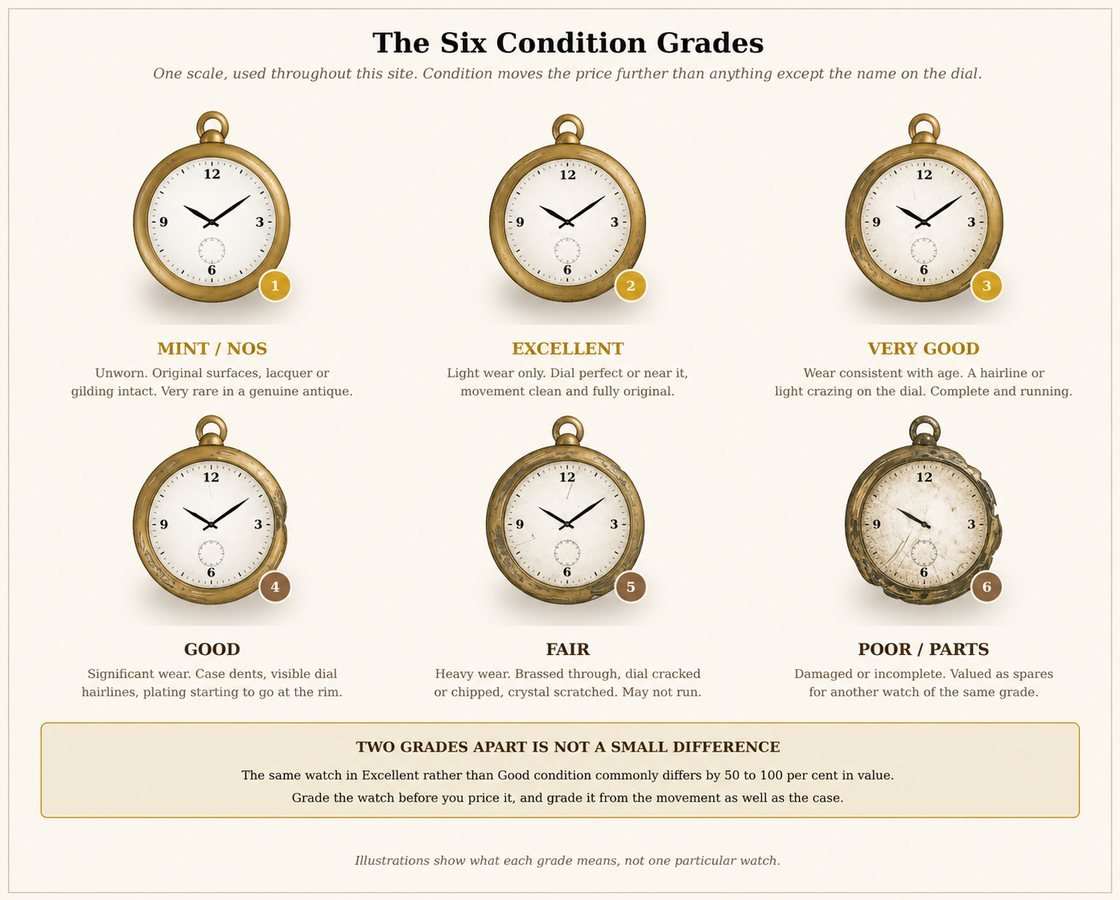
| Grade | What it does to the price |
|---|---|
| Mint / NOS | The largest premium, and the most optimistic descriptions. Genuinely unworn antiques are rare enough that the claim is worth verifying rather than accepting. |
| Excellent | The realistic ceiling for a watch a century old, and the grade collectors buying to keep will pay for. |
| Very Good | Where most well-kept antiques sit. Wear consistent with age does not by itself discount a watch heavily. |
| Good | A clear discount. Dents and dial hairlines show up in photographs, which is why this is the grade most often advertised as Very Good. |
| Fair | Priced against the cost of putting it right rather than against a clean example. A service, a dial restoration and a crystal can come to more than the watch is worth once done. |
| Poor / Parts | Valued as spares. Worth buying only if you need that particular movement, dial or case for another watch of the same grade. |
Key Value Drivers at a Glance
The factors below have the greatest influence on what a pocket watch is worth.
| Factor | Impact on Value |
|---|---|
| Maker (Patek Philippe vs generic Swiss) | Very High |
| Condition (Mint vs Fair) | Very High |
| Case material (solid gold vs base metal) | High |
| Jewel count and grade | Medium–High |
| Complications (repeater, chronograph) | High |
| Railroad-grade designation | Medium–High |
| Provenance / documented history | Variable |
| Original box and papers | Medium |
Using eBay to Track Values
The single best free tool for pocket watch valuation is eBay's completed listings filter. This shows what watches have actually sold for (not just asking prices). Study completed sales for your specific maker and grade over several weeks and you'll quickly build an accurate picture of current market prices.
Insurance Valuations
Insurance valuation is based on replacement value — what it would cost to replace the item from a retail source. This is generally higher than free-market value and should be sourced from a reputable price guide or professional appraisal.