
The Hamilton Pocket Watch Company
Look up your Hamilton serial number here.
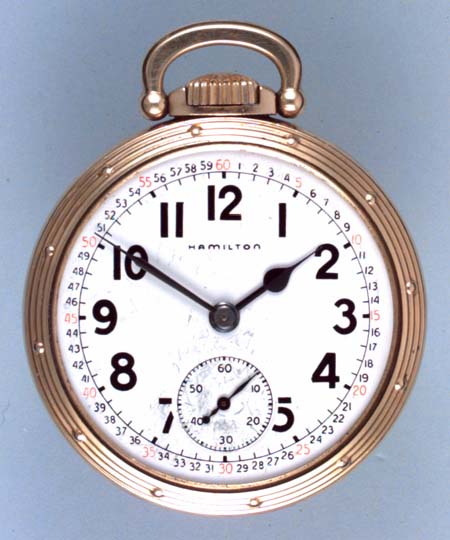
The Hamilton Pocket Watch Co started its long life in 1874, then known as the Adams & Perry Watch Manufacturing Co. E.F. Bowman made the first production movement in April 1876, and the company concentrated on an 18-size standard watch. The first Hamilton Pocket Watch rolled off the line after Charles Rood and Henry Cain formed the company in late 1892.
Built on Other Companies' Bones
Hamilton's origins are a catalogue of other people's failures. Adams & Perry could not make its production work and was reorganised as the Lancaster Watch Company in 1877; that in turn became the Keystone Standard Watch Company in 1886, selling watches of no great distinction. When a group of Lancaster investors bought Keystone's assets in 1892 they acquired a factory on Columbia Avenue that had already defeated two owners.
What they added was machinery from the Aurora Watch Company of Illinois, whose plant they bought and moved east. Hamilton therefore began life with tooling and expertise assembled from the wreckage of three previous concerns, and it is a fair measure of the management that this inheritance produced the most consistently excellent American watch factory of the twentieth century rather than a fourth failure.
Railroad Heritage
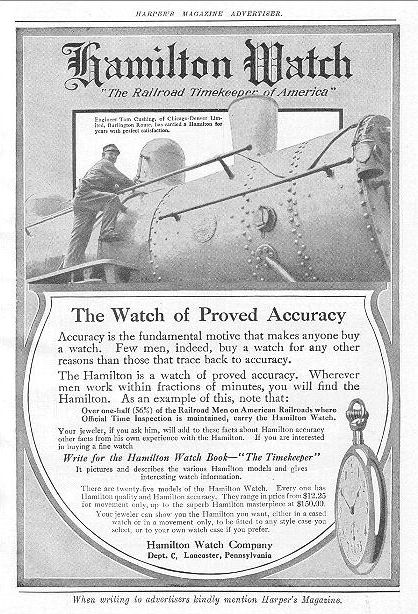
You can read the quality of Hamilton's watches in where they ended up. Most went to the railroads. By 1923 roughly 53% of total production was Railroad Grade, and most railroad watches carry a 42-hour mainspring.
Wristwatch Production
Hamilton ventured into wristwatches in the early 1900s. They arrived later than rivals Elgin, Waltham and Illinois, but their initial small offerings are quite rare today and pre-1920 examples are highly sought after. After acquiring the Illinois Watch Company in 1927, Hamilton produced a series of watches that proved enormously popular with the public, establishing them as one of the top prestige watchmakers from the late 1920s to the early 1950s.
The Illinois purchase is worth pausing on, because it shows what Hamilton had become. Paying over five million dollars for a competitor in 1927 was the act of a company with money and confidence at a moment when the American watch trade as a whole was beginning to contract. Hamilton kept Springfield running until 1932, brought the machinery to Lancaster, and went on using the Illinois name on Lancaster-built movements for most of the rest of the decade.
The 992B — Hamilton's Masterpiece
Hamilton continued producing fine quality pocket watches until about 1969, when it stopped production of its 992B 21-Jewel Railway Special — arguably the finest American railroad movement ever made. Hamilton still makes watches today, but all are Swiss-made.
Key Hamilton Railroad Grades
| Grade | Size | Jewels | Notes |
|---|---|---|---|
| 940 | 18 | 21 | Early railroad standard |
| 950 | 16 | 23 | Top-grade 16-size movement |
| 992 | 16 | 21 | The most common Hamilton RR grade |
| 992B | 16 | 21 | Final version; highly collectible |
| 950B / 950E | 16 | 23 | Rare and extremely valuable |
Lancaster's Company
For the better part of a century Hamilton and the city of Lancaster, Pennsylvania were difficult to separate. The factory was among the largest employers in the county, generations of the same families worked there, and the company's fortunes were the city's. That relationship shaped the product: a workforce that stayed put accumulated skill, and the consistency for which Hamilton movements are prized owes as much to that stability as to any machine.
The Second World War made the point emphatically. Hamilton stopped civilian production altogether and turned the entire factory over to military work — chronometers, navigational instruments and watches for the services — an abrupt conversion that a less experienced workforce could not have managed. It was the company's finest hour and, in a sense, the beginning of its difficulties, because the world it returned to in 1945 was one in which the wristwatch had won and cheap Swiss imports were arriving in quantity.
After the Pocket Watch
Hamilton's decline was slower and more dignified than most. The company was still innovating in the 1950s — the Ventura of 1957, with its asymmetric case and battery-powered movement, was the first electric wristwatch and remains the Hamilton most people can picture. But the economics were against it. Lancaster manufacturing wound down through the 1960s, and the company that followed was progressively Swiss-owned; Hamilton today belongs to the Swatch Group.
For collectors this gives Hamilton an unusually clean boundary. An American-made Hamilton has a defined beginning and a defined end, roughly 1893 to 1969, and everything within that window came out of one factory in one town to a standard that rarely wavered. That is worth remembering when a seller describes a modern Hamilton as an American watch — the name is the same and the manufacture is not. Our Hamilton serial number page covers how to place a movement within the American years.