
The E. Howard Pocket Watch Company
Look up your Howard serial number here.
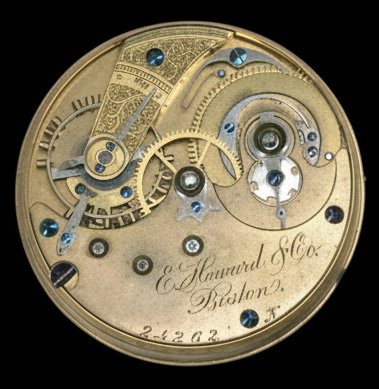
Edward Howard gained financial backing from Charles Rice in 1857 to construct a pocket watch company from the failed Waltham Watch Co. Unable to purchase the entire company, he secured the parts in production and all the tools and machinery, moving everything to Roxbury, Massachusetts.
The Clockmaker Who Turned to Watches
Edward Howard did not begin as a watchmaker at all, and understanding that explains almost everything peculiar about the watches that carry his name. He was apprenticed to Aaron Willard Jr, of the Willard family whose banjo clocks are among the finest things American horology ever produced, and in 1842 he went into business with David Davis making high-grade wall clocks. Within a year or so the partnership had added tower clocks to the range.
That clock business never went away. Through the whole period Howard was making pocket watches in Roxbury, the firm was also turning out regulators, marine clocks, watchman's clock systems and the tower clocks that still keep time in church steeples and railway stations across New England. A good many collectors come to Howard watches by way of a Howard clock, and the two halves of the business shared the same instinct: build it properly, price it accordingly, and let the customer decide.
E. Howard & Co — Innovations
In December 1858 Howard set up his own company — E. Howard & Co — introducing significant innovations:
- New "fast" or "quick-beat" train
- Top plate in two sections with 6 (instead of 4) pillars
- Compensated balance
- Size 18
- First American stem-wind movement
These movements were marked with the letter "N" for recognition purposes. Howard movements made until the early 1900s all had enamel dials and were marked "E. Howard & Co., Boston."
Why a Howard Cost So Much More
Howard's rivals were engaged in a race that Howard declined to enter. Waltham and, later, Elgin were pursuing interchangeability — parts made to such consistent tolerances that any escape wheel would fit any movement of the same grade, which is what made a watch cheap. Howard's methods pulled the other way. Batches were small, fitting was done by hand where hand-fitting produced a better result, and the finish was carried to a standard that no volume manufacturer could have justified.
The arithmetic tells the story plainly enough. In its first thirty years the Roxbury factory produced barely a hundred thousand movements. Waltham made millions over the same span. A Howard was accordingly an expensive watch when new — the sort of thing a prosperous professional man bought once — and that original scarcity is a large part of why the good ones hold their value now.
Edward Howard himself retired in 1881 and sold his interest, and the firm was reconstituted as a joint stock company at the end of that year. The watches carried on in the grades and styles he had established, but the founder's hand was off the tiller two decades before the name changed.
Keystone Watch Case Co
The company never produced its own watch cases. In 1902 the rights to the "Edward Howard" name were assigned to the Keystone Watch Case Co, which produced complete Howard watches bearing "Howard" on the dial and "E. Howard Watch Co, Boston, U.S.A." on the movement. Complete Howard watches as manufactured will therefore only be found from the Keystone period.
Company Chronology
- Warren Manufacturing Company, Boston — 1851–53
- Boston Watch Co, Boston — 1853–54
- Boston Watch Co & Waltham — 1854–57
- Howard & Rice, Boston — 1857–58
- E. Howard & Co, Boston — 1858–1904
- Keystone Watch Case Co, New Jersey — 1902–30
Living with a Howard
Two practical points come up again and again with these watches. The first is that Howard used its own sizing convention and its own series numbering, neither of which matches the rest of the American trade, so a Howard cannot be described in the usual shorthand without conversion. The Howard serial number page sets out what those markings mean and how to place a movement in the right era.
The second is servicing. A Howard is a rewarding watch to own and a demanding one to repair. The early split-plate designs in particular use an architecture that a watchmaker accustomed to Waltham and Elgin movements will not have seen before, parts are not interchangeable with anything else, and replacements essentially do not exist outside donor movements. Anyone contemplating a neglected Howard should establish what a competent overhaul will cost before buying, not afterwards — see our repair guide for what that work involves.
Set against that, the pleasure is real. Howard movements are among the handsomest American watches ever made, the finish rewards a loupe in a way that mass-produced work does not, and a properly serviced example keeps time that its makers would recognise as respectable.