
Illinois Pocket Watch Serial Numbers
Open the back of the watch and read the number engraved on the movement — the case number will not date anything. Enter it below for an approximate year of manufacture.
Serial Number Lookup — Illinois 1872–1948
This Illinois serial number lookup covers 1872 to 1948. Illinois sold enormous numbers of movements under names that are not its own — Burlington, Santa Fe Route, Bunn Special and others — so a movement signed with none of them may still be an Illinois, and the serial number is how you find out.
| Year | From Serial | Year | From Serial |
|---|---|---|---|
| 1872 | 1 | 1903 | 1,650,000 |
| 1873 | 20,000 | 1904 | 1,700,000 |
| 1874 | 50,000 | 1905 | 1,800,000 |
| 1875 | 75,000 | 1906 | 1,840,000 |
| 1876 | 100,000 | 1907 | 1,900,000 |
| 1877 | 145,000 | 1908 | 2,100,000 |
| 1878 | 210,000 | 1909 | 2,150,000 |
| 1879 | 250,000 | 1910 | 2,200,000 |
| 1880 | 300,000 | 1911 | 2,300,000 |
| 1881 | 350,000 | 1912 | 2,400,000 |
| 1882 | 400,000 | 1913 | 2,500,000 |
| 1883 | 450,000 | 1914 | 2,600,000 |
| 1884 | 500,000 | 1915 | 2,700,000 |
| 1885 | 550,000 | 1916 | 2,800,000 |
| 1886 | 600,000 | 1917 | 3,000,000 |
| 1887 | 700,000 | 1918 | 3,200,000 |
| 1888 | 800,000 | 1919 | 3,400,000 |
| 1889 | 900,000 | 1920 | 3,600,000 |
| 1890 | 1,000,000 | 1921 | 3,750,000 |
| 1891 | 1,040,000 | 1923 | 4,000,000 |
| 1892 | 1,080,000 | 1924 | 4,500,000 |
| 1893 | 1,120,000 | 1925 | 4,700,000 |
| 1894 | 1,160,000 | 1926 | 4,800,000 |
| 1895 | 1,220,000 | 1928 | 5,000,000 |
| 1897 | 1,290,000 | 1929 | 5,150,000 |
| 1898 | 1,330,000 | 1930 | 5,300,000 |
| 1899 | 1,370,000 | 1931 | 5,400,000 |
| 1900 | 1,410,000 | 1932 | 5,488,300 |
| 1901 | 1,450,000 | 1934 | 5,500,000 |
| 1902 | 1,500,000 | 1948 | 5,600,000 |
1896 and 1922 are deliberately absent. The published list gives figures for both that its own neighbouring rows rule out: each is lower than the year before it, which sequential numbering cannot do. A second published list supplies values for those two years, but they sit above the rows on either side here, so it is a different series running a year or more ahead rather than a correction to this one — and dropping two of its rows into this table would break the sequence in a new place. Rather than guess, the two years are left out and the look-up reads across the gap.
This remains a published list and not a factory record. The transcribed Illinois database compiled by Russell W. Snyder, distributed by NAWCC Chapter 149, is the only step up from it. Treat every year here as approximate.
If Your Watch Does Not Say “Illinois”
Start here, because it is the question we are asked most often about this maker. Illinois was by some distance the largest American producer of private-label watches — movements made in Springfield but marked with somebody else's name entirely. A jeweller, a distributor, a railroad supply house or a mail-order firm would order a batch and have their own name engraved on the movement and printed on the dial.
The result is that a great many Illinois watches carry no mention of Illinois anywhere. If your movement bears an unfamiliar name — a jeweller's, a city's, a brand you cannot trace — and the serial number lands sensibly in the table above, there is a fair chance you are holding an Illinois. The layout of the plates, the shape of the balance cock and the style of the damascening are what identify the maker, not the name.
This matters commercially, and not always in the direction people expect. A private-label Illinois is the same watch mechanically as its named equivalent, but it is usually worth less, because the grade is harder to establish and the market prefers a known name. The exception is a genuinely scarce private label with a documented history, which specialist collectors will chase.
Which Number Should You Be Reading?
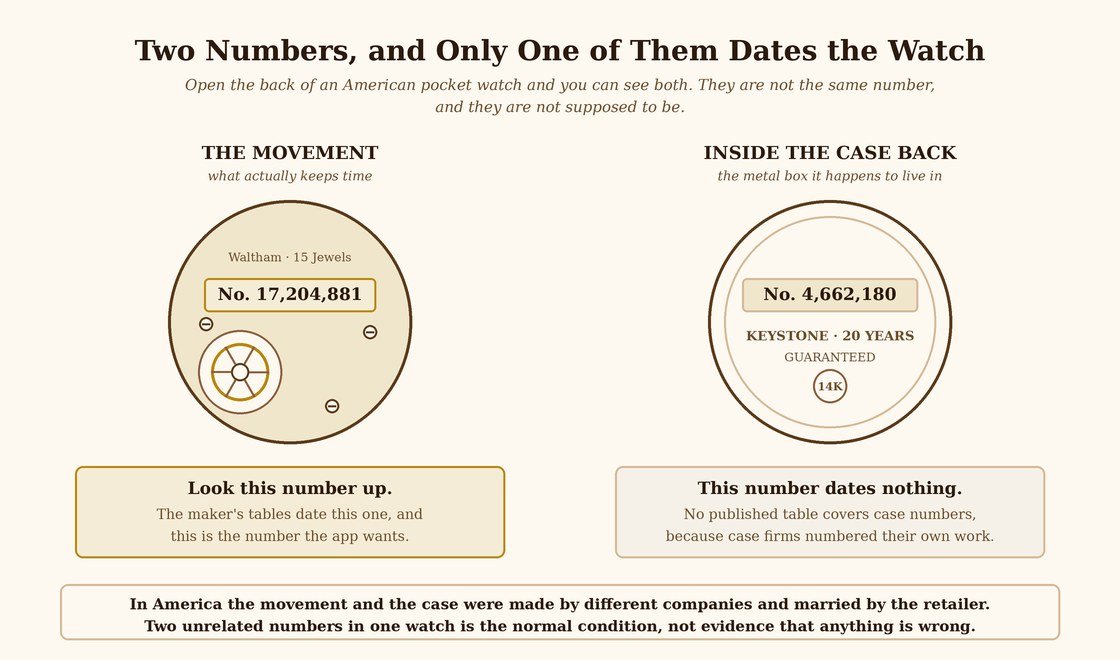
Expect to find two. The date lives in the movement number alone, and on an Illinois that is worth spelling out carefully, because the usual advice — look for the number next to the maker's name — fails on a private-label watch where the name is a jeweller's rather than the factory's. Go by position instead. The movement number is engraved on the working side of the watch, the side you expose by opening the back or swinging the movement out of its case. The other number is stamped into the metal of the case itself, and it belongs to whichever case firm supplied it.
Illinois, like most American makers, sold movements and cases separately — cases came from Keystone, Fahys, Dueber and others, and the customer chose one at the counter. The two numbers were never meant to correspond, and a case dated some years apart from its movement is entirely normal rather than a warning sign.
Illinois Grades and the Names on Them
Illinois named its grades after figures and places from Springfield, which gives the range an unusually local flavour. Stuart honours John T. Stuart, Abraham Lincoln's first law partner; Bunn takes the name of Jacob Bunn, the financier behind the company; and there was, inevitably, an A. Lincoln grade.
For collectors the names to know are at the top of the range. Bunn Special is the celebrated railroad grade — 21 or 23 jewels, adjusted to temperature and to five or six positions, and one of the most respected American railroad watches ever made. Sangamo and Sangamo Special, named for the Sangamon River, sit at the very top, finished to a standard that stands comparison with anything American factories produced. Below these, Benjamin Franklin, Getty, Miller and Currier cover the middle ground, with plainer grades beneath for everyday wear.
The wording of the company name is a second, independent check on the table. A movement reading Illinois Springfield Watch Co. belongs to the first decade, 1869 to 1879 or thereabouts; the reversed Springfield Illinois Watch Co. covers the six years that follow; and from 1885 the firm settled on plain Illinois Watch Co. for the rest of its independent life. Watches marked Illinois but made after the 1927 Hamilton acquisition are a slightly different animal — Hamilton kept the name alive into the late 1930s on movements that were no longer purely Springfield products.
What Decides an Illinois Watch's Price
The year is the least of it. A Bunn Special and a plain private-label movement that left Springfield in the same week can be an order of magnitude apart, and no amount of studying the serial number will distinguish them.
The deciding factors are grade and jewel count, the case metal — solid gold ahead of gold-filled, silver or nickel — originality, meaning an unrestored dial without hairline cracks, correct hands, and a movement that has not been re-plated or heavily polished, and condition and running order. On a Bunn Special or Sangamo, a proper service is a serious expense, so a watch sold “not running” should be priced accordingly.
One dating caveat specific to Illinois: output slowed markedly through the 1920s as the company wound down towards the Hamilton sale, so serials at the upper end of the table span longer periods than those in the company's busy years. A result from that era should be read as a rough decade marker rather than a precise year.
Because so much rests on the grade rather than the year, start with grades and jewel counts before anything else; pocket watch values puts the figures in context, and there is a separate appraisal guide for anyone who needs a valuation in writing.
More on Illinois Watches
The Illinois Watch Company history page tells the Springfield story in full, from the 1869 founding to the Hamilton takeover. The Bunn Special and its rivals are set in context in the railroad watch guide, and if you are trying to identify an unmarked movement the makers' marks reference is the place to start.
Other Serial Number Tables
- Waltham serial numbers
- Elgin serial numbers
- Hamilton serial numbers
- Hampden serial numbers
- Howard serial numbers
Or use the free serial number lookup app — all six makers together, installable on a phone and working offline at fairs and auctions.