
Elgin National Watch Co — Pocket Watch Serial Numbers
Elgin built more watches than any other American factory, and the movement number is how you date one. Open the case back, read the number engraved on the movement plate, and find it in the table below.
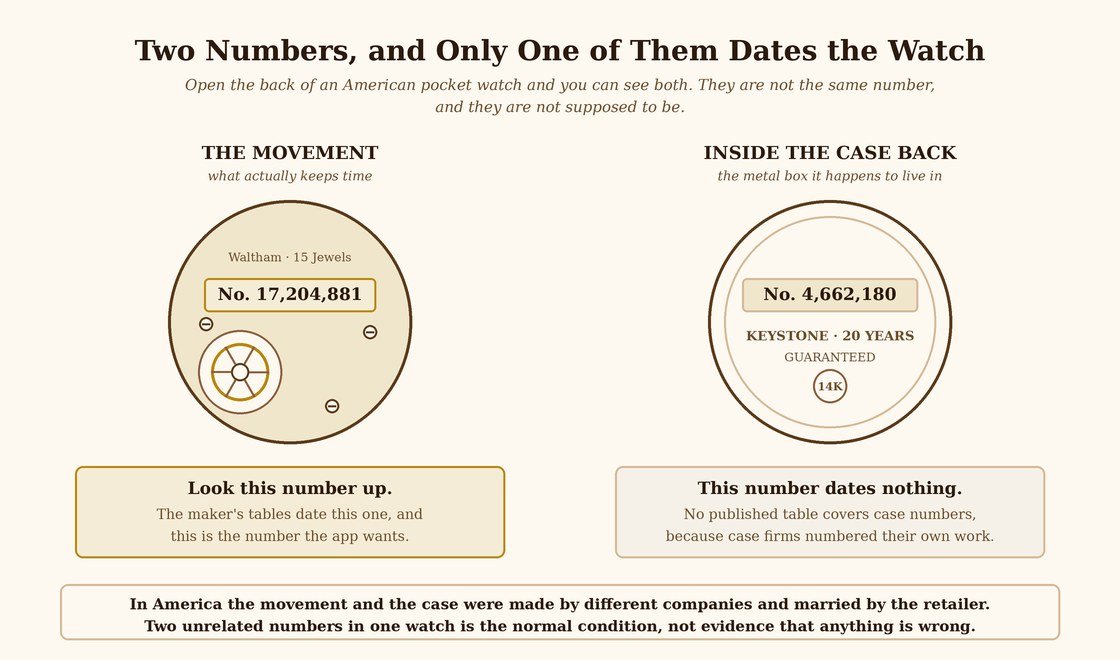
Then read the other number on that plate. If what you actually want to know is what your watch is worth, the serial number is close to useless for it and the grade number beside it is the answer — for reasons peculiar to Elgin that the next section explains.
Serial Number Lookup — Elgin 1867–1956
This Elgin serial number lookup covers 1867 to 1956, every year without a gap, and ends at 55,000,000 — close to Elgin's total output of about 55 million watches. It is the standard published list, and it is visibly rounded: many years fall on an exact million, and 1917 to 1927 runs at exactly 1,000,000 a year, which no factory achieved. Read the year as circa rather than exact.
Read down until you find the largest starting serial that is still below your number; the year beside it is your answer. Elgin allocated these numbers to production runs, so treat each figure as the point a year's output began rather than a hard cut-off.
| Year | From Serial | Year | From Serial |
|---|---|---|---|
| 1867 | 101 | 1912 | 17,000,000 |
| 1868 | 30,000 | 1913 | 17,500,000 |
| 1869 | 70,000 | 1914 | 18,000,000 |
| 1870 | 100,000 | 1915 | 18,500,000 |
| 1871 | 125,000 | 1916 | 19,000,000 |
| 1872 | 150,000 | 1917 | 20,000,000 |
| 1873 | 175,000 | 1918 | 21,000,000 |
| 1874 | 200,000 | 1919 | 22,000,000 |
| 1875 | 300,000 | 1920 | 23,000,000 |
| 1876 | 400,000 | 1921 | 24,000,000 |
| 1877 | 500,000 | 1922 | 25,000,000 |
| 1878 | 550,000 | 1923 | 26,000,000 |
| 1879 | 600,000 | 1924 | 27,000,000 |
| 1880 | 700,000 | 1925 | 28,000,000 |
| 1881 | 800,000 | 1926 | 29,000,000 |
| 1882 | 1,000,000 | 1927 | 30,000,000 |
| 1883 | 1,400,000 | 1928 | 32,000,000 |
| 1884 | 1,600,000 | 1929 | 33,000,000 |
| 1885 | 1,800,000 | 1930 | 33,300,000 |
| 1886 | 2,000,000 | 1931 | 33,500,000 |
| 1887 | 2,500,000 | 1932 | 33,700,000 |
| 1888 | 3,000,000 | 1933 | 34,000,000 |
| 1889 | 3,500,000 | 1934 | 35,000,000 |
| 1890 | 4,000,000 | 1935 | 35,500,000 |
| 1891 | 4,440,000 | 1936 | 36,000,000 |
| 1892 | 4,880,000 | 1937 | 37,000,000 |
| 1893 | 5,000,000 | 1938 | 37,500,000 |
| 1894 | 5,500,000 | 1939 | 38,000,000 |
| 1895 | 6,000,000 | 1940 | 39,000,000 |
| 1896 | 6,500,000 | 1941 | 40,000,000 |
| 1897 | 7,000,000 | 1942 | 41,000,000 |
| 1898 | 7,500,000 | 1943 | 42,000,000 |
| 1899 | 8,000,000 | 1944 | 42,500,000 |
| 1900 | 9,000,000 | 1945 | 43,000,000 |
| 1901 | 9,300,000 | 1946 | 44,000,000 |
| 1902 | 9,750,000 | 1947 | 45,000,000 |
| 1903 | 10,000,000 | 1948 | 46,000,000 |
| 1904 | 11,000,000 | 1949 | 47,000,000 |
| 1905 | 12,000,000 | 1950 | 48,000,000 |
| 1906 | 12,500,000 | 1951 | 49,000,000 |
| 1907 | 13,000,000 | 1952 | 52,000,000 |
| 1908 | 13,500,000 | 1953 | 53,500,000 |
| 1909 | 14,000,000 | 1954 | 54,000,000 |
| 1910 | 15,000,000 | 1955 | 54,500,000 |
| 1911 | 16,000,000 | 1956 | 55,000,000 |
Elgin numbered its movements in one continuous sequence from the first watch in 1867, across every grade and every size, which is what makes a single table workable at all. A maker that restarted its numbering for each product line — as several Swiss houses did — cannot be dated this way.
The Grade Number, Not the Serial, Is What Prices an Elgin
A great many people arrive at a page like this one having searched for an Elgin's value by its serial number. It is worth saying plainly that the search cannot succeed, and worth saying why, because the number that does answer the question is usually stamped an inch away on the same plate.
Elgin marked its movements with a grade number as well as a serial number. The serial is unique to your watch and fixes its date. The grade is shared by every movement of that specification and fixes what it is — the jewel count, the quality of the finish, whether it was adjusted for temperature and position, and therefore very nearly everything that decides the price. Two Elgins numbered within a hundred of each other, made the same week, can differ in value by a factor of thirty because one is a seven-jewel movement and the other is a twenty-three-jewel railroad grade.
So a serial number tells you when. A grade number tells you what. Only the second is a price signal, and any listing that quotes a value from a serial number alone is quoting a guess.
Elgin's own paperwork works exactly this way round. The company's Genuine Material Catalog of about 1927 carries a section headed Serial Numbers & Grades which runs for page after page of serial ranges — 4,395,001 to 4,397,000, and so on — giving against each one the grade number, the class, the size, the plate style, whether it winds by stem or key, how it is set, the series and the train. It carries no year column anywhere. The factory published that document so a watchmaker could identify what a movement was and order the right parts for it; the year it left the works simply did not matter for the job. That is the same distinction this page is drawing, made by Elgin itself.
Sixty Million Movements, and Why That Matters
Elgin's total output over a century of production is usually put at around sixty million movements, comfortably the largest of any American manufacturer and a substantial fraction of every antique pocket watch now in circulation. That scale has two consequences for anyone holding one.
The first is that the dating table is dependable. A factory running continuously at that volume left a numbering record with no significant gaps, which is why an Elgin serial can be placed in a year rather than a decade.
The second cuts the other way. Scarcity is part of what makes an antique valuable, and an ordinary Elgin is the opposite of scarce. The commonest grades were made in the millions and survive in very large numbers, so condition and grade have to do all the work that rarity does for a smaller maker. This is the single most common disappointment among people dating an Elgin for the first time: the watch is genuine, the date is right, and it is still an ordinary watch. The exceptions are real but they are exceptions, and they are identified by grade, not by age.
Names on an Elgin Plate and What They Signify
Elgin used names as well as numbers for its better grades, and a name on the plate is the quickest read on where a movement sat in the range.
| Name on the movement | What it indicates |
|---|---|
| B.W. Raymond | Elgin's railroad grade, and the name on its very first movement in 1867. Named for Benjamin Wright Raymond, a former mayor of Chicago and one of the company's founders |
| Veritas | A top-tier high-jewel grade, among the best work the factory did |
| Father Time | A railroad-standard grade sitting alongside the B.W. Raymond |
| Lord Elgin | A quality line, more often encountered on later and smaller watches |
| Lady Elgin | The corresponding line of smaller movements made for women's watches |
An unnamed movement is not necessarily a poor one, but the named grades are where the collector interest sits. Our guide to grades and jewel counts explains what the jewel numbers themselves mean, and the railroad watch guide covers the standards a grade had to meet to be accepted for railroad service.
Where the Table Stops, and Why
The table above runs to 1956 and then stops, which needs explaining because Elgin itself continued until 1968.
Elgin stopped putting serial numbers on its movements after 1956. That is the reason the table ends, and it is a change in the watches rather than a gap in the record: the numbering runs year by year to the end and finishes at 55,000,000, which is close to everything the company ever made. A later Elgin has to be dated by its model, its case and its movement design instead. Note also that a serial beginning with a letter belongs to this late period and cannot be looked up as a plain number.
More on Elgin Watches
The full history of the Elgin National Watch Company covers the 1864 founding as the National Watch Company, the factory that became the largest in the world, the observatory and watchmakers' college, and the long decline to closure in 1968 — including an eyewitness account of a visit to the works in 1869.
If the case rather than the movement is what interests you, pocket watch cases explains karat marks and case materials, and English hallmarks covers cases assayed in Britain. For what a watch is worth once you know its grade, see what drives pocket watch values and the appraisal guide.
Other Serial Number Tables
- American Waltham Watch Co Serial Numbers
- Hamilton Serial Numbers
- Illinois Serial Numbers
- Hampden Serial Numbers
- Howard Serial Numbers
Grade and classification details follow Elgin National Watch Co., Genuine Material Catalog, c.1927, section Serial Numbers & Grades — a factory publication. The serial-to-year figures in the table above are the standard published Elgin list, checked against a second independent published table before being used here; the two agree to within a single serial across most of the run. It is a published list rather than a factory record, and the accuracy note above the table says what that means in practice.
The serial number lookup app carries Elgin and the five makers above in a single tool. It installs to a phone home screen and runs without a connection, which is the point of it — saleroom basements and fairgrounds rarely have one.