
Pocket Watch Serial Numbers
Every American pocket watch made during the great factory era — roughly 1860 to 1960 — carries a serial number stamped into its movement. This number is your single most important tool for identifying a watch. It tells you who made it, when it left the factory, what grade it is, and how many jewels it has. A serial number lookup takes thirty seconds and can transform an unknown watch into a fully identified piece with a specific date of manufacture.
This page explains where to find your serial number, how to use it, and links directly to the serial number tables for the six major American makers covered on this site.
Enter a maker and serial number for an instant year estimate. Installable on your phone — works offline at fairs and auctions.
Go Straight to the Tables
The American Watch Co. began numbering from serial 50 in 1852. Over 40 million watches produced.
Waltham Serial Table →Elgin, Illinois, 1864–1968. Around 60 million movements — the largest American output of all.
Elgin Serial Table →Production began 1892. Famous for railroad grades 992, 950, and the Railway Special.
Hamilton Serial Table →Springfield, Illinois, 1869–1927. Bunn Special and A. Lincoln are the prestige railroad grades.
Illinois Serial Table →Founded in Springfield, Mass., moved to Canton, Ohio. New Railway and Special Railway top grades.
Hampden Serial Table →Boston's finest. Edward Howard's series-lettered movements are among the most collectable American watches.
Howard Serial Table →Not sure the serial number is the right place to start? How to identify and date a pocket watch sets out the whole order — movement first, case second — and explains why the number on the case will not date the watch.
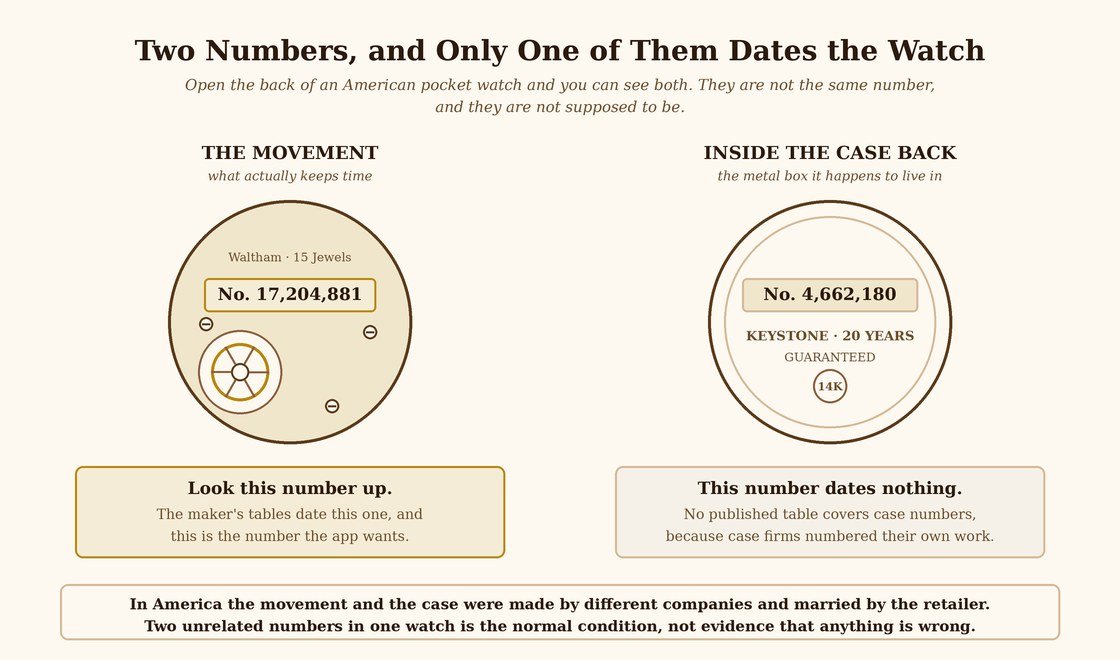
Where to Find the Serial Number
The serial number is stamped on the movement — never on the case. Case numbers are sometimes present on the inside of the case back, but these refer to the case manufacturer and are not useful for identifying the movement. You must open the watch to see the movement serial number.
American Full-Plate Movements
The serial number is stamped on the pillar plate — the main plate visible when the case back is opened. It is typically near the edge of the plate or adjacent to the balance wheel, and is accompanied by the maker's name and grade.
American Three-Quarter Plate Movements
On most three-quarter plate movements the serial number appears on the exposed portion of the pillar plate, near the barrel or between the barrel and the three-quarter bridge. Look near the six o'clock position.
Swiss Movements
Swiss serial numbers, where present, are typically on the pillar plate, the barrel bridge, or the back of the movement. Swiss numbering systems vary by maker and are less comprehensive than American tables.
English Movements
Older English movements may have no serial number at all, or a number on the pillar plate that relates to the watchmaker's own numbering system rather than a factory sequence. Dating relies primarily on hallmarks.
Case number vs movement number. Many cases have a number stamped inside the back — this is the case maker's number, not the movement serial number. The two are unrelated. Always read the number from the movement itself. If you see two different numbers, the one on the movement is correct for serial lookup.
How to Use a Serial Number Table
Open the watch. Press the release on the pendant (the knob at the top of the case) to open the front. On a hunter case there will be a front cover; on an open-face watch the crystal is directly in front of the dial. To access the movement, open the hinged back cover — press a thumbnail into the case lip at the three o'clock position, or use a case-opening knife. Some watches have a separate inner dome; press this open to expose the movement.
Find the serial number. It will be a 5–8 digit number stamped into the plate, usually with the maker's name nearby. Write it down exactly — do not confuse it with a grade number. The serial is typically longer (6–8 digits for Waltham, and four to seven for Hamilton depending on its age); the grade number may be shorter (3 digits for Hamilton, e.g. 992).
Note the maker's name. It will be engraved or stamped on the plate: "Waltham," "Hamilton Watch Co.," "Illinois Watch Co.," and so on. If you see a retailer's name on the dial (Sears, Dueber, Keystone), ignore it — look at the movement plate for the actual maker.
Go to the correct table. Use the links above or in the sidebar to reach the appropriate maker's serial number page.
Find your number in the range. The tables list serial number ranges with the corresponding year of manufacture and, for most makers, the grade and jewel count produced in that range. Your watch's serial will fall within one of these ranges.
What the Serial Number Tells You
A serial number lookup gives you the approximate year of manufacture — when the movement left the factory. For most American makers this is accurate to within one or two years. The serial tables also typically list the grade name or number and jewel count associated with serials in that range.
What the serial number does not tell you is the case material or style (the case was purchased separately from the movement), the retailer who sold it, or when it was actually purchased — a movement might sit in a jobber's stock for years before being cased and sold. For the history of the movement itself, the serial is definitive. For the case's history, look at the case hallmarks or maker's marks.
Elgin Serial Numbers
Elgin was the largest American watch manufacturer of them all, and its movements are numbered in one continuous sequence from the first watch of 1867, which makes them straightforward to date. Our Elgin National Watch Co serial number table covers 1867 to 1956 year by year, and explains why the grade number stamped beside the serial — not the serial itself — is what decides an Elgin's value.
Ball, Rockford, South Bend, Seth Thomas, and Others
Many other American makers — Ball, Rockford, South Bend, Seth Thomas, Hampden, New England Watch Company, and others — produced serial-numbered movements. Ball watches are particularly interesting because Ball did not manufacture movements itself; it contracted with various makers (Hamilton, Waltham, Elgin, Illinois) to supply movements meeting Ball's railroad specifications. A Ball serial number must be cross-referenced against the actual movement maker's tables using the grade information stamped on the movement.
For Rockford, South Bend, Seth Thomas, and other makers, serial number data is available through specialist horological databases and reference books. The standard printed reference is Roy Ehrhardt's American Pocket Watch Identification and Price Guide, which covers most American makers.
Swiss and European Serial Numbers
Swiss pocket watch serial numbers are far less systematically documented than American ones. The major Swiss firms — Patek Philippe, Vacheron Constantin, Longines, Omega — maintain records and can sometimes provide dating information for specific serial numbers on application. Longines in particular has publicly released serial number data covering most of its production.
For antique English and continental European pocket watches, serial numbers are rarely useful for dating. English movements are best dated by the hallmarks on the case and the stylistic features of the movement. See British Hallmarks and How to Read English Hallmarks.