
Pocket Watch Movement Types Explained
Open the back of a pocket watch and you see the movement — the mechanical heart of the timekeeper. Movements differ not only in the escapement they use and the number of jewels they carry, but in their fundamental architecture: the arrangement of the plates and bridges that support the gear train. Understanding movement types allows you to identify a watch's likely origin, period, and quality at a glance, and is one of the most useful skills a collector can develop.
This page covers the main plate configurations used in antique pocket watches, the individual components you will see in a movement, and what each tells you about the watch.
The Main Plate Types
A pocket watch movement consists of two main structural elements: the pillar plate (or bottom plate, or main plate) — the foundation of the movement on which everything is built — and one or more upper plates or bridges that sandwich the gear train between them. The configuration of these upper elements is the primary way movement types are classified.
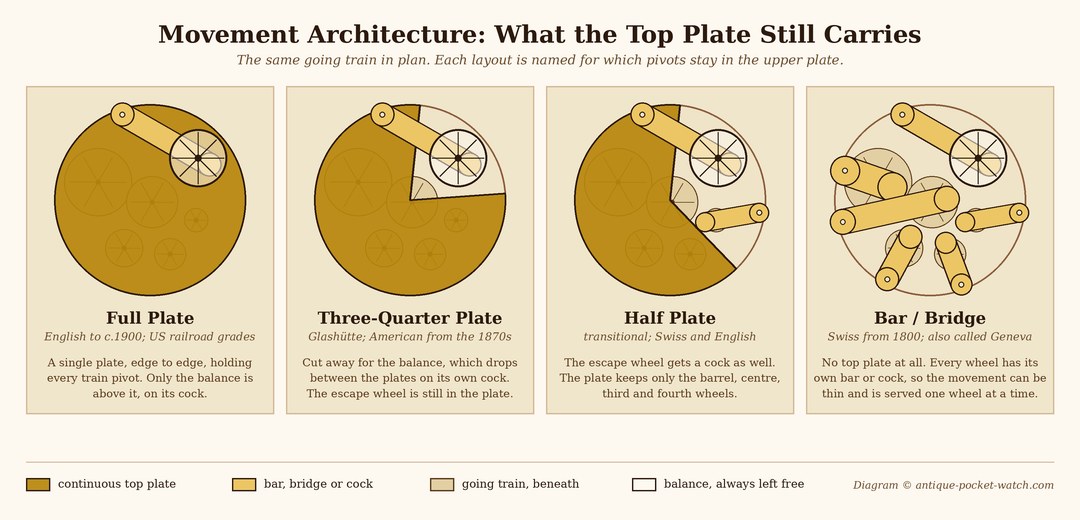
The names are not descriptions of area so much as of what is left in the plate. In a three-quarter plate movement the top plate still carries the pivots of the barrel, centre, third, fourth and escape wheels; only the balance is cut out, and it sits lower, on a cock mounted to the bottom plate. In a half plate the escape wheel is pivoted in a separate cock too, so the plate keeps just the barrel, centre, third and fourth. The reason for cutting the plate away at all was thinness — dropping the balance in between the two plates, instead of standing it on top of them, is what allowed the flat watch to develop.
A single top plate covers the entire movement from edge to edge, with only the balance wheel visible above it through the balance cock aperture.
- Characteristic of English watchmaking to c.1900
- Robust and rigid — ideal for railroad use
- Winding pinion accesses barrel from below
- Good Hamilton, Waltham grades often full plate
- Balance cock screws to top plate
A top plate covering three-quarters of the movement, leaving the balance and part of the train exposed and bridged separately.
- Characteristic of German watchmaking (Glashütte)
- Also widely used in American watches from 1870s
- Elegant, allows good visual access to train
- Elgin and Hamilton used this layout extensively
- Screws often blued, plates often gilt
A top plate covering roughly half the movement. Less common than full or three-quarter plate; a transitional form.
- Found in some Swiss and English movements
- Also called "two-thirds plate" in some references
- Less rigid than full plate; more accessible than bar movement
Each wheel of the train is individually bridged by a separate bar or cock, rather than a continuous plate covering multiple wheels.
- The dominant Swiss form from 1800 onward
- Very thin construction possible
- Each bar independently removable — easier service
- Patek Philippe, Vacheron, IWC use bar movements
- Also called pont construction
Similar to bar movement but with larger, more substantial bridges spanning multiple wheels. Often the same as bar movement in general usage.
- Term used interchangeably with "bar" in many contexts
- Bridges may be one-piece spanning two or three wheels
- Common in quality Swiss and German movements
Early verge and cylinder movements use pillars — small turned columns — to support the top plate above the bottom plate. The "pillar plate" terminology comes from this construction.
- Four or six brass pillars, screwed top and bottom
- Characteristic of 17th and 18th century movements
- The bottom plate (main plate) is the pillar plate
Parts of a Pocket Watch Movement
Whether a movement uses a full plate or a bar configuration, the individual components are common to all mechanical pocket watches. Understanding these is essential both for identifying a movement and for understanding what a watchmaker means when discussing service or repair.
| Component | What It Is | What to Look For |
|---|---|---|
| Pillar plate | The main base plate of the movement, on which all other components are mounted. Also called the bottom plate or main plate. | The maker's signature, grade number or name, and jewel count are typically engraved here. In American movements this information is on the top plate (the side facing the dial). |
| Top plate / back plate | The upper plate(s) that sandwich the gear train with the pillar plate. In full-plate movements, a single plate covers virtually the whole movement. | In American full-plate movements the top plate may be decorated with damascening — a fine wavy engraved pattern applied by machine. Higher grades typically have finer damascening. |
| Mainspring barrel | A cylindrical drum containing the coiled mainspring. The barrel rotates as the spring uncoils, driving the going train. The barrel arbor is the central pivot on which the spring is wound. | In fusee movements the barrel is connected to the fusee by chain or gut. In going-barrel movements (most American and Swiss) the barrel drives the train directly. |
| Centre wheel | The first wheel of the going train, driven by the mainspring barrel. Its arbor usually carries the minute hand (hence "centre" — it is at the centre of the movement). | One revolution per hour. On movements with centre seconds, a separate centre seconds wheel is added. |
| Third wheel | The second wheel of the going train, driven by the centre wheel pinion. | Intermediate wheel — no hand is usually mounted on it. |
| Fourth wheel | The third wheel of the going train; its arbor typically carries the seconds hand. Makes one revolution per minute. | Look for a pinion (small toothed cylinder) meshing with the third wheel above and the escape wheel below. |
| Escape wheel | The final wheel of the going train, whose teeth engage the escapement. Its shape varies by escapement type: a cylinder escape wheel has upward-pointing teeth; a lever escape wheel has club-shaped teeth. | In a lever movement the escape wheel is visible as a small, fine-toothed wheel near the balance. Its condition is critical — bent or worn teeth cause erratic timekeeping. |
| Balance wheel | The oscillating regulating element — a weighted wheel that swings back and forth, controlling the rate. Its period of oscillation determines the watch's beat rate. | In temperature-compensated movements (railroad standard) the balance rim is split (bimetallic), with brass outer and steel inner sections. Plain uncut balances are found in lower grades. |
| Hairspring | A fine spiral spring attached to the balance wheel collet, giving the balance its natural oscillating frequency. Also called the balance spring. | Breguet overcoil hairsprings (the outer coil elevated above the plane of the rest) indicate a high-grade movement. A flat hairspring is the simpler, more common form. |
| Pallet fork | In a lever escapement: a pivoted lever with two jewelled pallet stones that alternately lock and unlock the escape wheel. Driven back and forth by impulse from the balance. | Not present in verge or cylinder movements. Its presence confirms a lever escapement. |
| Balance cock | A shaped bridge, screwed to the top plate, that supports the upper pivot of the balance staff. In early watches it is a single asymmetric pierced and engraved piece; in later movements it is a plain functional bridge. | In antique pair-cased and early cylinder watches the balance cock is the most decorative element of the movement. Its style is a primary indicator of date and origin. |
| Regulator | The index or curb-pin assembly that allows the effective length of the hairspring to be adjusted, altering the rate. Moves between F (fast) and S (slow) on most American movements. | High-grade movements have a micrometric regulator — a fine-pitch screw allows precise rate adjustment. Railroad-grade Hamilton 992B movements use a lever-set system with a separate precision regulator. |
| Click and ratchet wheel | The click is a spring-loaded pawl that engages the ratchet wheel on the mainspring arbor, preventing the mainspring from unwinding during winding. The ratchet wheel is turned by the winding mechanism. | A broken click causes the mainspring to release suddenly when winding — potentially damaging. Check that the click spring is intact and the click engages fully. |
| Jewel holes | The synthetic ruby or garnet bearings set into the plates and bridges at each pivot point. See Grades & Jewels Explained for full detail. | Jewel holes should be clean, undamaged, and correctly set. Cracked or chipped jewels, or jewels that have been knocked out of their settings, cause increased wear at those pivots. |
Identifying Origin by Movement Style
The plate configuration, finish, and layout of a movement give strong clues to its national origin and period, even before reading the signature.
American Movements (1860–1960)
American movements are typically full-plate or three-quarter plate, with a going barrel (no fusee). The top plate carries the maker's name, grade, and jewel count engraved or stamped. Blued steel screws, a micrometric or index regulator, and a cut bimetallic balance are characteristic of quality grades. The finish on higher-grade American movements is excellent — polished pivots, chamfered edges, and fine damascening on the plates.
Swiss Movements (1800–1970)
Swiss movements are typically bar or bridge construction — individual bars for each wheel — giving a clean, open appearance. Swiss movements of the luxury tier have elaborately finished bridges, often with Geneva stripes (Côtes de Genève) — a pattern of parallel burnished lines on the bridges and plates that is one of the most distinctive decorative finishes in watchmaking. The pillar plate of a fine Swiss movement may be engraved, gilded, and jewelled throughout.
English Movements (1700–1900)
English movements, particularly before 1850, are full-plate with a fusee. The pillar plate carries the maker's name and town. Balance cocks are individually engraved and pierced in earlier examples. Finishing is typically high on London work — polished and chamfered edges, blued screws, engraved pillar plate. Provincial English work is more variable.
Damascening. Many American pocket watch movements from the 1880s onward feature damascening — a machine-applied decorative pattern of wavy lines on the top plate and bridges, resembling the pattern of Damascus steel. It has no functional purpose but is strongly associated with quality American railroad movements. The fineness and regularity of the damascening is often used as a rough indicator of grade — finer patterns on better movements — though this is not an absolute rule.
For a visual reference to named movement parts, see the Pocket Watch Parts Diagram with its 55 labelled components. For the full parts glossary see Pocket Watch Parts A–Z.