
Hampden Pocket Watch Serial Numbers
Look for the number on the movement rather than the case — it is engraved on the plate among the wheels, and you will need to open the back to see it. Type it into the box below and the table will return an approximate year.
Serial Number Lookup — Hampden 1877–1927
This Hampden serial number lookup covers 1877 to 1927. Hampden is the maker where reading the wrong number is easiest to do: it shared an owner with the Dueber case works, so movement and case often left the same combine, and a Dueber case number sitting beside a Hampden movement looks far more authoritative than it is. Hampden’s factory records were destroyed, so a published list is the best that exists for this maker anywhere — but a published list is what this table now is, and it was not before.
| Year | From Serial | Year | From Serial |
|---|---|---|---|
| 1877 | 59,000 | 1903 | 1,768,000 |
| 1878 | 70,000 | 1904 | 1,896,000 |
| 1879 | 100,000 | 1905 | 2,024,000 |
| 1880 | 140,000 | 1906 | 2,152,000 |
| 1881 | 180,000 | 1907 | 2,280,000 |
| 1882 | 215,000 | 1908 | 2,400,000 |
| 1883 | 250,000 | 1909 | 2,520,000 |
| 1884 | 300,000 | 1910 | 2,650,000 |
| 1885 | 350,000 | 1911 | 2,700,000 |
| 1886 | 400,000 | 1912 | 2,760,000 |
| 1887 | 480,000 | 1913 | 2,850,000 |
| 1888 | 560,000 | 1914 | 2,920,000 |
| 1889 | 640,000 | 1915 | 3,000,000 |
| 1890 | 740,000 | 1916 | 3,100,000 |
| 1891 | 805,000 | 1917 | 3,240,000 |
| 1892 | 835,000 | 1918 | 3,390,000 |
| 1893 | 865,000 | 1919 | 3,500,000 |
| 1894 | 900,000 | 1920 | 3,600,000 |
| 1895 | 930,000 | 1921 | 3,700,000 |
| 1896 | 970,000 | 1922 | 3,750,000 |
| 1897 | 1,000,000 | 1923 | 3,800,000 |
| 1898 | 1,120,000 | 1924 | 3,850,000 |
| 1899 | 1,255,000 | 1925 | 3,900,000 |
| 1900 | 1,384,000 | 1926 | 3,950,000 |
| 1901 | 1,512,000 | 1927 | 3,980,000 |
| 1902 | 1,642,000 |
What has changed is the class of list printed above. Until August 2026 this page carried figures interpolated between a handful of anchor points — arithmetic filling in the years nobody had a number for. It has been replaced by the standard published Hampden list, and the two disagree by a mean of about eight years. The replaced table also contradicted itself at the turn of the century, running 1902 = 910,001 immediately followed by 1903 = 900,001, numbers going backwards where sequential production cannot; the 1902 row had to be withheld for that reason and is now restored at 1,642,000, between its neighbours as it should be.
A published list is the best class of source Hampden will ever have, so treat the years here as good but approximate — and treat any source presenting a Hampden date as exact with suspicion.
Case Number, Movement Number, and the Dueber Difference
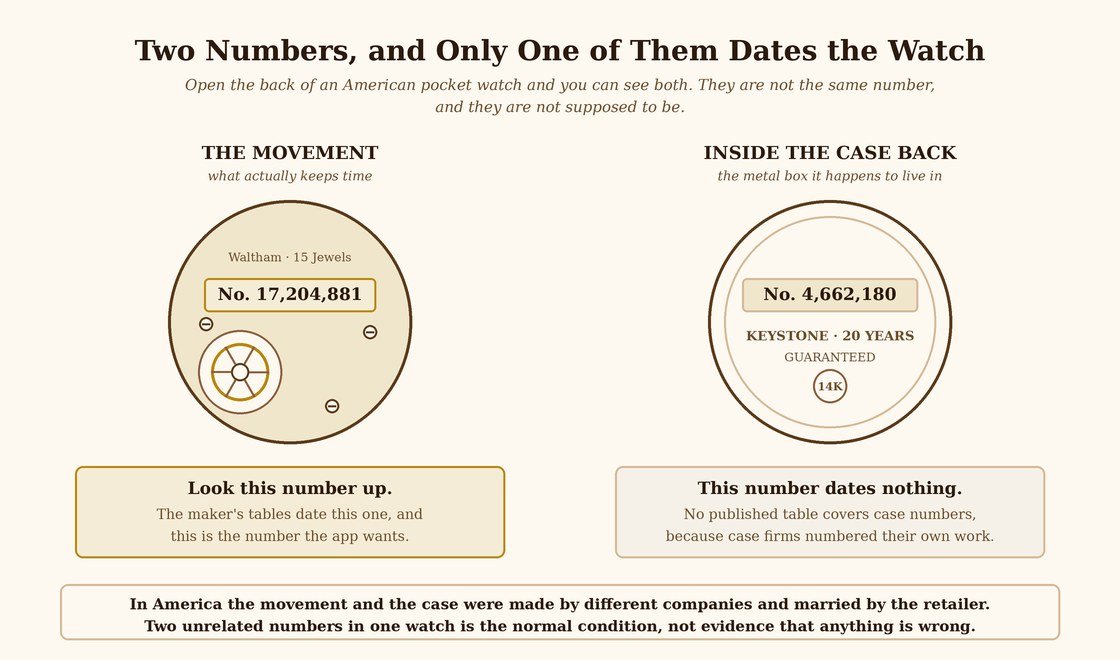
There will almost certainly be two numbers in your watch, and it is the movement number that carries the date. Hampden makes this harder to sort out than it ought to be, for a reason peculiar to this maker: after the Dueber takeover, one firm was producing the cases and the movements alike, so both numbers can appear under the same Dueber name. Elsewhere the name beside a number tells you which is which; on a Dueber-Hampden it tells you nothing. What separates them is depth — the movement number is engraved into a finished plate carrying the grade name, while the case number is struck into the case metal, and struck hard enough to read by touch.
Hampden is the interesting exception to the usual rule here, and it is worth understanding. At most American makers the case and the movement came from entirely different firms, so their numbers have no relationship at all. Hampden was different: from 1886 the company was owned by John C. Dueber, already the largest watch-case manufacturer in America, and after the move to Canton, Ohio the same business made both halves of the watch.
That makes a Dueber case around a Hampden movement a genuine factory pairing rather than a marriage of convenience — one of the few American watches where the case is as much part of the original object as the movement. If your Hampden sits in a Dueber-marked case, that is a point in its favour, and replacing it would be a mistake. The two numbers still will not match, but the combination is right.
Hampden Grades Worth Knowing
Hampden built for every pocket and every purse, so a date on its own leaves you knowing very little. The grade name engraved on the movement is the more informative marking by some distance.
At the top sit the railroad grades — Special Railway, New Railway and Railway — high-jewel movements adjusted to temperature and to five positions, built to satisfy the railroads' inspection standards. The Wm. McKinley and John Hancock grades are solid, well-finished watches that turn up regularly and are among the more collectable mid-range American movements. Dueber Grand and John C. Dueber carry the proprietor's own name. Below these came plainer grades for everyday use, decent watches but without the adjustment or the finish.
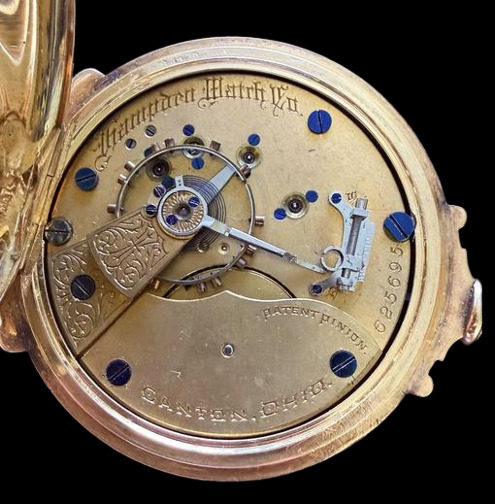
The name on the movement matters less than the city beneath it. New York Watch Co. predates 1877; no city, or Springfield, means before 1888; and Canton, Ohio means 1888 or later, whichever name sits above it. Dueber took a controlling interest in 1886 and moved the works in 1888, but the two firms stayed legally separate for decades, so a great many Canton movements are signed simply Hampden Watch Co. Read Dueber-Hampden or Dueber Watch Works as confirmation of the Canton era rather than a requirement of it; the Dueber name belongs to the cases and the grade names more than to the dating. If the marking and the serial date disagree badly, check that you have read the movement number rather than the case.
The Watches That Went to Moscow
Hampden has an ending no other American watch company can claim, and collectors should know it. When the firm failed at the end of the 1920s, its machinery was not scrapped. It was crated up, sold to the Soviet Union, and shipped to Moscow along with a small group of Hampden workers who went out to install it and train Soviet staff.
The plant became the First Moscow Watch Factory, and the earliest Soviet watches were made on Canton, Ohio tooling, to Hampden designs. It is why the first generation of Russian pocket watches bears such a striking family resemblance to American ones — they are, mechanically speaking, the same watches. This does not add to the value of your Hampden, but it makes it the ancestor of an entire national watch industry, which is a decent thing for a watch to be.
Dating a Watch Is Not Valuing It
Knowing the year is useful, but it settles almost nothing about worth. Hampden's range ran from plain everyday movements to adjusted railroad grades, and two watches a few weeks apart in the ledger can sit at opposite ends of the price scale.
Those factors are grade and jewel count, since a 21-jewel Special Railway and a 7-jewel everyday movement are different propositions entirely; the case, with solid gold well ahead of gold-filled, silver or nickel; originality — an unrestored dial without hairline cracks, correct hands, and a movement that has not been re-plated or over-polished; and whether it runs properly, because servicing a high-grade movement is not cheap.
Bear in mind too that Hampden's output fell away sharply in its final years as the company slid towards bankruptcy, so serials near the top of the table cover longer stretches of time than those in the middle. Allow a margin of a year or two either side of whatever the table returns.
A Hampden is usually worth what its grade and its condition say it is worth, so the two pages to read next are grades and jewel counts and pocket watch values. Insurance or a sale is a different matter, and the appraisal guide covers that.
More on Hampden Watches
The Hampden Watch Company history page covers the New York Watch Company origins, the Dueber takeover and the move to Canton in full. Hampden's railroad grades are set in context in the railroad watch guide.
Other Serial Number Tables
- Waltham serial numbers
- Elgin serial numbers
- Hamilton serial numbers
- Illinois serial numbers
- Howard serial numbers
Or use the free serial number lookup app, which covers all six makers, installs on a phone and works offline — handy at a fair or auction.