
Pocket Watch Serial Number Lookup
Enter the serial number from your pocket watch movement and select the maker for an instant year estimate, grade information, and links to live eBay prices for comparable watches. Covers Waltham, Hamilton, Elgin, Illinois, Hampden, and E. Howard.
This page installs as an app on your phone and then works offline — which is the point of it, because saleroom basements and fairgrounds rarely have a signal. It takes about ten seconds, and the steps are different on iPhone and Android.
On an iPhone or iPad
There is no “Install” button anywhere on iOS, and no prompt will ever appear. Apple does not offer one. You add it by hand:
- Open this page in Safari.
- Tap the Share button — the square with an arrow pointing up out of it. On iPhone it sits in the bar at the bottom of the screen; on iPad it is at the top right.
- Scroll down the list that slides up. The option is below the row of apps and is easy to miss.
- Tap Add to Home Screen, then Add at the top right.
Since iOS 17 the same Share-sheet route also works in Chrome and Edge on iPhone. It has never worked from a browser menu — if you have been looking there, that is why you could not find it.
On an Android phone
- Open this page in Chrome.
- Tap the ⋮ menu at the top right.
- Tap Install app, or Add to Home screen on older versions, then confirm.
Chrome sometimes offers this by itself in a banner, but usually not until your second or third visit, so use the menu rather than waiting for it.
On a computer
In Chrome or Edge, look for the small install icon at the right-hand end of the address bar. Safari on the Mac uses File → Add to Dock.
Once it is on your home screen it opens without browser chrome and the lookup runs with no connection at all. The eBay price links still need a signal, but the dating tables do not.
⌚ Serial Number Lookup
Date • Grade • eBay Prices • Works offline
Refine your eBay search
Prices shown are live eBay listings for comparable watches — not a formal valuation. Condition, provenance, and case metal significantly affect final prices.
Why is this only an estimate? Serial numbers were assigned in production batches, but a movement could sit in stock for a year or two before being cased and sold. The year given here is when the movement was made — the watch may have been sold and engraved slightly later.
Coverage
| Maker | Serial Range | Years | Table |
|---|---|---|---|
| Waltham | 50 – 35,000,000 | 1852–1957 | View |
| Hamilton | 1 – 4,500,000 | 1893–1942* | View |
| Elgin | 101 – 55,000,000 | 1867–1956 | View |
| Illinois | 1 – 5,600,000 | 1872–1948 | View |
| Hampden | 59,000 – 3,980,000 | 1877–1927 | View |
| E. Howard (Keystone) | 850,000 – 1,500,000 | 1902–1930† | View |
| Ball | Uses movement maker’s range — see below | Maker | |
†Keystone only. E. Howard & Co. of Roxbury, 1858–1904, is not in the app and cannot be. That company allocated serials in blocks by series and watch size with overlapping date ranges, so it is not a year series at all; its factory record is printed on the Howard serial page. Keystone restarted numbering at 850,000 in 1902, above every Roxbury serial, so the two can never be confused by a number.
*Hamilton only. Movements made after 1942 — the 992B, 950B and 4992B — restart from near 1 under a letter prefix and are not covered by the app. See the letter-prefix tables.
Answers Without the App
The look-up above needs JavaScript and a serial number. The figures below need neither. They are the same data the app uses, printed, so the question can be answered from this page alone.
Where each maker’s numbering had reached, by decade
| By | Waltham | Elgin | Hamilton | Illinois | Hampden | E. Howard (Keystone) |
|---|---|---|---|---|---|---|
| 1860 | 20,000 | — | — | — | — | — |
| 1870 | 500,000 | 100,000 | — | — | — | — |
| 1880 | 1,500,000 | 700,000 | — | 300,000 | 140,000 | — |
| 1890 | 4,700,000 | 4,000,000 | — | 1,000,000 | 740,000 | — |
| 1900 | 9,500,000 | 9,000,000 | 104,000 | 1,410,000 | 1,384,000 | — |
| 1910 | 17,900,000 | 15,000,000 | 790,000 | 2,200,000 | 2,650,000 | 980,000 |
| 1920 | 23,400,000 | 23,000,000 | 1,700,000 | 3,600,000 | 3,600,000 | 1,340,000 |
| 1930 | 27,100,000 | 33,300,000 | 2,350,000 | 5,300,000 | — | 1,500,000 |
| 1940 | 30,250,000 | 39,000,000 | 4,000,000 | 5,500,000 | — | — |
| 1950 | 33,560,000 | 48,000,000 | — | — | — | — |
Read a cell as “numbering had reached about this figure by the start of that year”. An em dash means the maker was not yet producing, or had stopped. All six now rest on published serial lists or better, and E. Howard & Co.’s series table — on its own page, not in this column — is a factory record, the only one on this site. Until August 2026 three of these columns were interpolated between a handful of anchor points instead, and the corrections moved some figures by millions: Waltham’s 1900 cell alone goes from 6,900,001 to 9,500,000. A published list is not a factory record, and these are rounded in places — Hamilton’s across 1913–1936, Elgin’s at exactly 1,000,000 a year from 1916 to 1927, and Illinois’s last cells read across wide gaps, because after 1928 Hamilton was finishing Springfield stock rather than making watches. The Howard column is Keystone only and starts in 1902: the Roxbury company that made Howards before then numbered by series and size rather than by date, so it has no place in a decade table and used to be shown here as a rising sequence it never was.
What each table actually covers
- Waltham — 106 year points, 1852 to 1957 with no gaps at all, the only complete run of the six. Serial 50 is 1852; the highest number in the table is 35,000,000, reached in 1957.
- Elgin — 90 year points, 1867 to 1956. Serial 101 is 1867; the highest number in the table is 55,000,000, reached in 1956, which is close to Elgin's total output of about 55 million watches. Elgin stopped putting serial numbers on its movements after 1956, so a later Elgin cannot be dated this way.
- Hamilton — 50 year points, 1893 to 1942. Serial 1 is 1893; the highest number in the table is 4,500,000, reached in 1942. Post-war Hamiltons are numbered differently — a 992B, 950B or 4992B carries a letter prefix (C, S, 2B or 4C) and a sequence of its own, tabled on the Hamilton serial page. The app cannot read those.
- Illinois — 60 year points, 1872 to 1948. Serial 1 is 1872; the highest number in the table is 5,600,000, reached in 1948. 1896 and 1922 are absent — the published list contradicts itself on both, so they are left out rather than guessed, and the look-up reads across each gap.
- Hampden — 51 year points, 1877 to 1927. The table starts at 59,000 in 1877, because Hampden continued the New York Watch Co. numbering rather than restarting; the highest number in the table is 3,980,000, reached in 1927.
- E. Howard (Keystone) — 8 year points, 1902 to 1930. Serial 850,000 is 1902; the highest number in the table is 1,500,000, reached in 1930. The app holds this sequence only. Watches marked E. Howard & Co. came from the Roxbury company, which numbered 124,388 movements between 1858 and 1904 in 18 blocks allocated by series and watch size — overlapping in date, so not a year list. Those blocks are tabled on the Howard serial page and nothing below 850,000 should be looked up here.
Where to Find the Serial Number
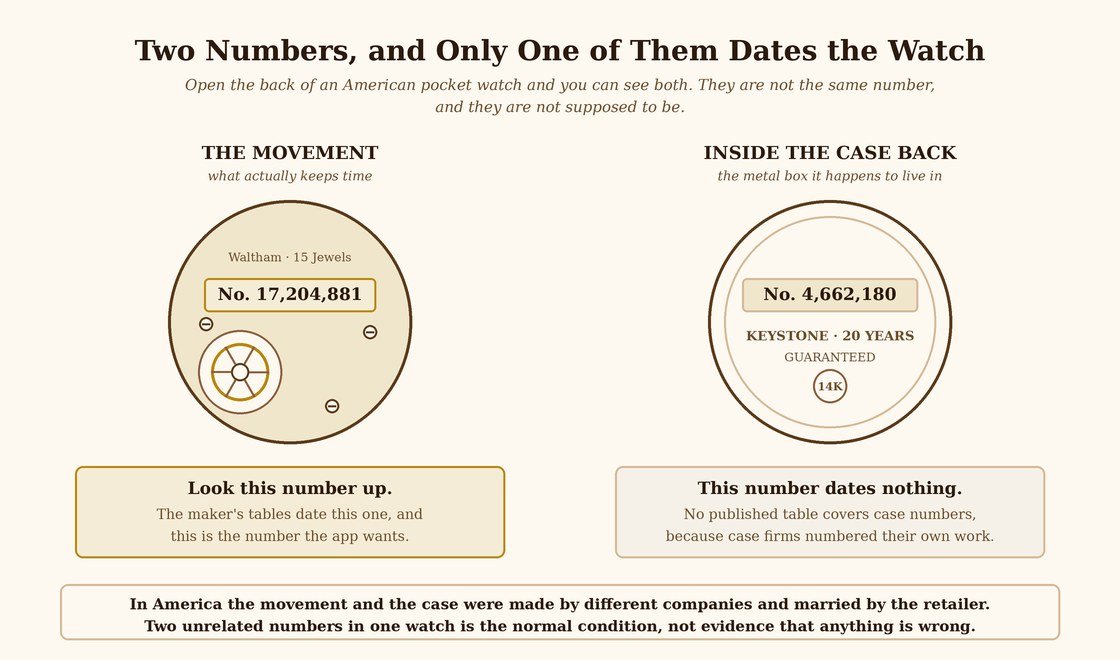
Open the case back. The serial number is stamped on the movement plate — a 5–8 digit number near the maker’s name. It is not the number inside the case back, which identifies the case maker. Full guidance with photos: Serial Numbers Hub.
Ball Watches
Ball Watch Co. did not manufacture movements. Ball-signed watches use movements by Hamilton, Waltham, Elgin, or Illinois. Identify the actual movement maker from the movement plate and select that maker above. Selecting “Ball” in the app will explain this and link to the correct tables.
Other Makers
For Rockford, South Bend, Seth Thomas, and Swiss movements, see the Serial Numbers Hub.