
Howard (E. Howard) Pocket Watch Serial Numbers
Howard serial numbers are engraved on the movement — the mechanism inside, not the metal case around it. Ease the back open, read the number off the plate, and type it into the box below.
Howard is the one American maker where the serial number alone will not give you a year, and no amount of care with the number changes that. The company used two numbering systems that have no relationship to each other, and the earlier of the two was never chronological in the first place. E. Howard & Co. of Roxbury allocated blocks of numbers to a series and a watch size, not to a date, so its blocks run in parallel and their date ranges overlap: serial 100,001 was made in 1874 and serial 50,001 in 1869, but serial 50,001 belongs to a series that ran until 1899. Reading a Howard therefore means finding the block first and the date second.
Serials below 850,000 are read against the E. Howard & Co. series table; 850,000 and above against the Keystone year table.
Serial Number Lookup — E. Howard & Co. 1858–1904
This is the factory record of E. Howard & Co.’s serial number blocks, 18 of them, covering every movement the Roxbury company numbered between 1858 and 1904 — 124,388 in total across forty-six years, which is fewer watches than Waltham could make in a good month. Serial order is not date order here. Find the block your number falls in; the years beside it are the years that block was in production.
| Years | Serial Block | Series (size) | Produced |
|---|---|---|---|
| 1858–1860 | 113–1,900 | I (18S) | 1,788 |
| 1860–1861 | 1,901–3,000 | II (18S) | 1,100 |
| 1861–1862 | 3,001–3,100 | K (14S) | 100 |
| 1861–1863 | 3,101–3,300 | Reserved for experimentals | 200 |
| 1861–1863 | 3,301–3,400 | III (18S) | 100 |
| 1861–1863 | 3,401–3,500 | I (10S) | 100 |
| 1861–1871 | 3,501–28,000 | III (18S) | 24,500 |
| 1868–1883 | 30,001–50,000 | IV (18S) | 20,000 |
| 1869–1899 | 50,001–71,500 | V (16S) | 21,500 |
| 1874–1878 | 100,001–105,500 | VI (6S) | 5,500 |
| 1883–1899 | 200,001–227,000 | VII (18S) | 27,000 |
| 1893–1894 | 227,001–230,000 | VII (18S) | 3,000 |
| 1884–1899 | 300,001–309,000 | VIII (18S) | 9,000 |
| 1895–1903 | 309,001–310,000 | VIII (18S) | 1,000 |
| 1890–1895 | 400,001–405,000 | IX (18S) | 5,000 |
| 1892–1899 | 500,001–501,500 | X (12S) | 1,500 |
| 1895–1903 | 600,001–601,500 | XI (16S) | 1,500 |
| 1896–1904 | 700,001–701,500 | XII (16S) | 1,500 |
E. Howard Watch Co. (Keystone), 1902–1930
In 1902 the Howard name was bought by the Keystone Watch Case Company, and the watches made from then on are marked E. Howard Watch Co. Keystone did not continue Roxbury’s numbering. It started again at 850,000, and it numbered by date in the ordinary way, so this second table behaves like every other maker’s on this site and the one above does not. The industry treats the two as separate manufacturers, and so should you: the Pocket Watch Database lists E. Howard & Co. and E. Howard Watch Co. (Keystone) as different companies.
The two overlap in time but not in numbering. Roxbury’s last block, Series XII, ran until 1904, two years after Keystone had begun numbering at 850,000. Both companies were putting numbers on movements in 1902, 1903 and 1904 — which is exactly why running the two sequences together into a single rising list, as this page did until August 2026, produces a date that is wrong by decades at the top.
| Year | From Serial |
|---|---|
| 1902 | 850,000 |
| 1903 | 900,000 |
| 1909 | 980,000 |
| 1912 | 1,100,000 |
| 1915 | 1,285,000 |
| 1917 | 1,340,000 |
| 1921 | 1,400,000 |
| 1930 | 1,500,000 |
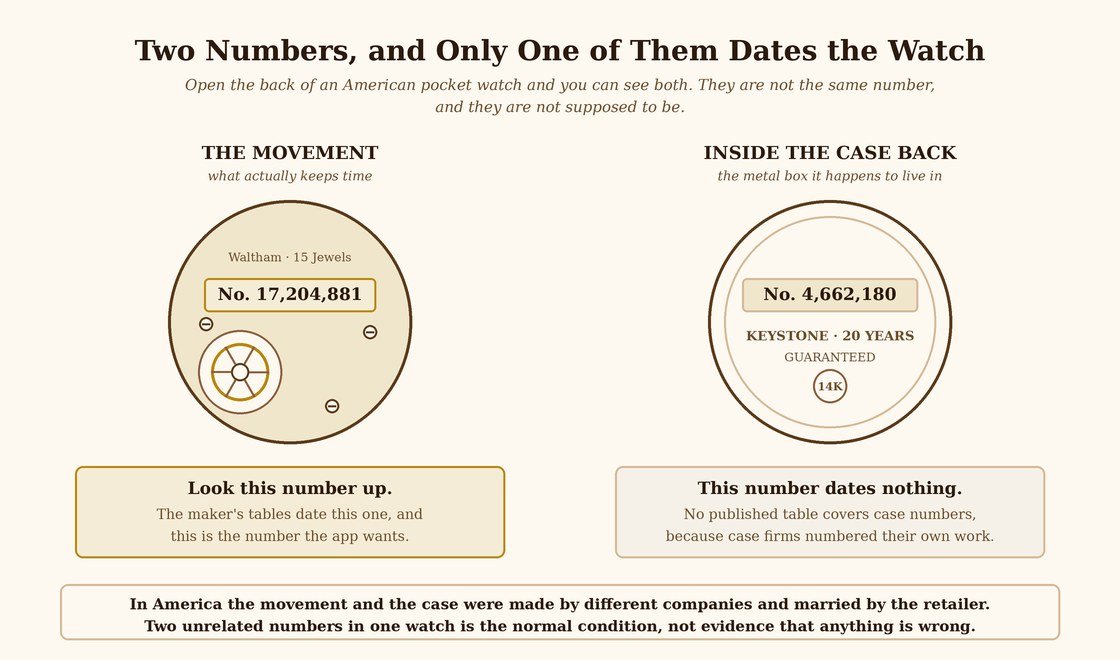
Two Numbers, and No Relationship Between Them
Most Howards carry a number in the case as well as one on the movement, and confusing the two is the commonest reason an owner gets a date that makes no sense. The movement number is the one that dates the watch. The case number dates the case, and on a Howard that is genuinely a different object with a different history.
The case number belongs to whoever made the case, which for a Howard was very often a completely separate firm — Keystone, Fahys, Dueber or a jobbing jeweller. Because Howard supplied so many movements loose, a Howard case number and a Howard movement number have no relationship at all. A case made in 1905 sitting around a movement made in 1898 is not evidence of tampering; it is simply how these watches were sold.
There is a particular trap here that belongs to Howard alone. Keystone was a case company before it was a watch company, so a Howard movement of any era may well sit in a Keystone case, and the case will carry a Keystone case number running in its own sequence. A Keystone case number on a Roxbury movement means nothing more than that somebody bought a case.
Telling the two apart is easier on a Howard than on most American watches, because a Howard movement announces itself. The plate you are looking for carries a good deal besides the number: the firm’s name in full, a letter size, and on later watches a Series marking in Roman numerals. If the number you have found sits in that company, it is the movement number and it is the one that dates the watch. A number floating on a plain metal surface with nothing horological around it is a case number.
Howard’s Letter Sizes
Howard refused the sizing convention every other American maker used. Where the trade said 18-size or 16-size, Howard stamped a letter, and the letters run from D at the small end to N at the large. There is no M. If a seller describes a Howard by a number size they are converting, and the conversion below is the one they should have used.
| Letter | Diameter | Metric | Trade equivalent |
|---|---|---|---|
| N | 1 13/16 in | 46.04 mm | 18-size |
| L | 1 11/16 in | 42.86 mm | 16-size |
| K | 1 10/16 in | 42.27 mm | 14-size |
| J | 1 9/16 in | 39.69 mm | 12-size |
| I | 1 8/16 in | 38.10 mm | 10-size |
| H | 1 7/16 in | 36.51 mm | 8-size |
| G | 1 6/16 in | 34.93 mm | 6-size |
| F | 1 5/16 in | 33.34 mm | 4-size |
| E | 1 4/16 in | 31.75 mm | 2-size |
| D | 1 3/16 in | 30.16 mm | 0-size |
The letter is worth reading alongside the series, because the series table above allocates blocks by size. A Series VII movement is an 18-size watch and a Series XI is a 16-size, so the letter on the plate is a free check that you have identified the block correctly — if the size does not match the block, you have the wrong block.
Reading Your Howard Beyond the Date
Knowing which era your watch belongs to tells you more than the year alone.
The Boston era (1858–1904) covers watches marked E. Howard & Co., made in Roxbury, Massachusetts. These are the watches collectors generally mean by “a real Howard”. They were expensive when new, finished to a standard well above the ordinary factory watch, and produced in genuinely small numbers — 124,388 movements in forty-six years, against millions at Waltham over the same period. Scarcity is a large part of why Howards hold their value, and the series table above is the arithmetic behind it.
From 1902 the name belonged to Keystone, and watches marked E. Howard Watch Co. are that company’s. These Keystone-era Howards are good watches, but they are not Boston Howards, and the market prices them accordingly. The wording on the movement is the quickest way to tell which you have: & Co. is Roxbury, Watch Co. is Keystone.
Finally, look for a Series marking, given in Roman numerals. E. Howard & Co. numbered its series I to XII, and the series tells you the movement’s design generation and grade. Series XI is the 16-size railroad-grade movement and is the one most sought after; the earlier split-plate designs are prized for their finish rather than their timekeeping.
What the Year Will Not Tell You
Owners often arrive at a date and assume the hard part is done. It is not. Two Howards finished in the same month can be ten times apart in price, and nothing in the serial number hints at which one you are holding.
What matters far more is grade and jewel count, since a railroad-grade Series XI and a modest low-jewelled movement are different watches entirely; the case, because a solid gold Howard case is a substantial object in its own right and gold-filled cases sell for a fraction of the price; originality, meaning an untouched dial, hands of the correct pattern, and a movement that has not been re-plated or over-polished; and whether it runs, cleanly and to time, which on a watch of this quality is expensive to put right if it does not.
And on a Roxbury Howard, remember what the table can and cannot do. A block that ran sixteen years cannot be narrowed to a year by the number alone, and no source will narrow it for you; the movement’s own features — the setting arrangement, the plate layout, the style of the signature — are what close the gap. Keystone-era serials behave normally and can be read to within a year or two.
For a fuller picture of what drives price, see our guides to movement grades and jewel counts and pocket watch values. If you intend to sell or insure the watch, the appraisal guide explains when a formal valuation is worth the cost.
More on Howard Watches
The E. Howard & Co. history page covers the company’s founding, Edward Howard’s role in the birth of American factory watchmaking, and the models worth seeking out. Because Howard movements were so often sold loose, the guide to cases and hallmarks is unusually useful for this maker, and the identification walkthrough explains how to work from the movement when the number will not settle it.
Other Serial Number Tables
- Waltham serial numbers
- Elgin serial numbers
- Hamilton serial numbers
- Illinois serial numbers
- Hampden serial numbers
There is also the serial number lookup app, free and installable, which holds every maker’s table on your phone and needs no connection once loaded. The app carries the Keystone sequence, because it is the only one of Howard’s two that is a genuine year series; for a Roxbury serial, use the series table above.