
Pocket Watch Grades and Jewels Explained
When you pick up an antique pocket watch and open the case back to read the movement, you will likely see a name, a grade number or name, and a jewel count. "21 jewels, adjusted 5 positions." "17-jewel, adjusted 3 positions." "7 jewels." These markings are not decoration — they are a precise specification of the movement's quality, accuracy, and intended use.
Understanding what grades and jewels mean is one of the most useful skills a pocket watch collector can develop. It allows you to assess any American pocket watch at a glance, compare like with like, and understand why one movement commands ten times the price of a superficially similar one.
What Is a Grade?
A grade is a manufacturer's designation for a specific movement design, built to a specific standard of quality. The grade specifies — at minimum — the number of jewels, the type of regulator, the balance wheel design, and the adjustment standard. It may also specify the pillar plate material, the finishing quality, and whether the movement is intended for railroad, commercial, or general use.
American watch companies expressed grades in two ways: by number (Hamilton Grade 992, Waltham Grade 845) or by name (Hamilton Railway Special, Waltham Vanguard, Elgin Veritas). Named grades were typically the prestige top of the range; numbered grades often covered a broader spectrum from budget to premium. The same movement might be sold under different names depending on whether it was destined for a jeweller's case, a railroad supply house, or a mail-order catalogue.
Same movement, different names. The same Waltham movement was frequently sold under various retailer's names — Sears, Dueber, Keystone, and many others would put their own name on the dial while the movement remained a standard Waltham grade. This practice is called private labelling. Always identify the movement by its grade, not the dial name.
What Are Jewels — and What Do They Do?
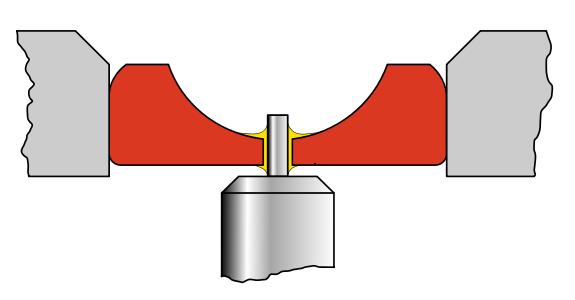
The jewels in a watch movement are not ornamental. They are synthetic ruby or garnet bearings — extremely hard, smooth, and dimensionally stable — used at the points in the movement where metal-on-metal friction would otherwise be greatest. Their purpose is threefold: to reduce friction (improving timekeeping), to reduce wear (extending service life), and to reduce the movement's sensitivity to variations in lubricating oil.
Natural rubies were used until the twentieth century, when synthetic corundum (aluminium oxide) became standard. The hardness of these stones — 9 on the Mohs scale, second only to diamond — means that a properly jewelled pivot will outlast steel many times over. Well-made Swiss and American pocket watches from the 1890s are still running on their original jewels today.
Where Are the Jewels?
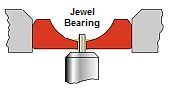
The jewels are placed at the pivot holes of the gear train — the points where the rotating arbors of the wheels and pinions run — and at the impulse and locking faces of the escapement. In a 7-jewel movement, only the most critical points are jewelled. In a 23-jewel movement, every pivot in the going train and escapement carries a jewel, plus additional jewels are added for the setting mechanism and the mainspring barrel arbor.
Escape wheel pivots (2)
The escape wheel runs at the fastest speed in the train. Jewelled pivots here dramatically reduce wear and friction at this critical point.
Pallet fork pivots (2)
The fork rocks back and forth with every beat of the balance. Jewelled pivots here and jewelled pallet stones (impulse & locking) are essential.
Balance staff pivots (2)
The balance oscillates continuously. Upper and lower jewels support its pivots; a jewelled impulse roller receives energy from the pallet fork.
Train wheel pivots
Centre, third, and fourth wheel pivots benefit from jewelling. In higher grades, every train pivot is jewelled, upper and lower.
Cap jewels
Additional flat jewels placed over the end-stone jewels at the balance and escape wheel. They prevent end-shake and reduce wear at the pivot tips.
Extra jewels (21+)
In 21- and 23-jewel movements, extra jewels are added to the setting mechanism, the click work, and the mainspring barrel arbor.
The Standard Jewel Counts
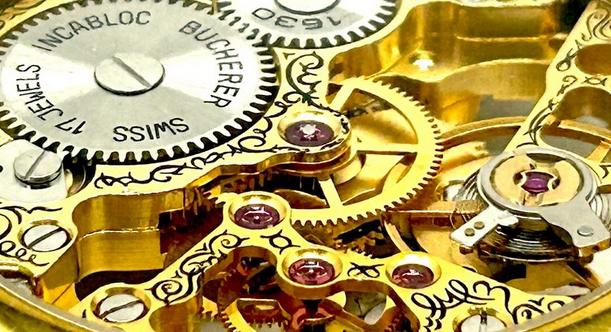
American pocket watch movements were made in several standard jewel counts, each associated with a broad quality level. The jewel count alone does not determine quality — the adjustment standard and finishing matter equally — but it is a reliable first indicator.
| Jewel Count | Typical Use | Notes |
|---|---|---|
| 7 jewels | Budget commercial | Minimum practical count. Escapement jewelled; train pivots run in brass holes. Ingersoll, Waterbury, Timex-era movements. |
| 11 jewels | Mid-range commercial | Adds jewels to the third and fourth wheel. Serviceable everyday watch for the general public. |
| 15 jewels | Good commercial | Full train jewelling. Reliable, well-made. The standard for a decent working man's watch from the major makers. |
| 17 jewels | Quality commercial / entry railroad | Adds cap jewels to the balance. The minimum for railroad use in most standards. An extremely common count in quality American movements. |
| 19 jewels | High-grade | Adds further jewels to the setting mechanism. Less common; marks a genuine step above 17-jewel quality. |
| 21 jewels | Railroad / precision | Full jewelling including setting work. The standard count for railroad-approved pocket watches. Hamilton 992, Waltham 845. |
| 23 jewels | Finest precision grade | The highest practical count. Additional jewels in the mainspring barrel and click work. Hamilton 950B, Waltham Vanguard 23J. |
More jewels is not always better. Beyond 17 jewels, additional stones provide diminishing returns in timekeeping. Some later Swiss movements advertised absurd jewel counts — 25, 29, even 100 — many of which served no mechanical purpose and were purely a marketing device. With American railroad watches, a 23-jewel movement is genuinely superior to a 17-jewel one. But a 17-jewel movement adjusted six positions may keep better time than a 21-jewel unadjusted movement.
Adjustments — What They Mean
An adjustment is a process carried out at the factory by a skilled watchmaker to correct the movement's rate under specific conditions. An unadjusted watch runs at whatever rate it happens to keep — often acceptable, but not tested under controlled conditions. An adjusted watch has been measured, corrected, and certified to run within specified limits under the stated conditions.
Positions
A pocket watch is carried and stored in many different positions: dial up, dial down, crown up, crown down, crown left, crown right. Gravity acts differently on the balance staff and its jewels in each position, causing slight variations in rate. Adjustment to positions means the movement has been tested and regulated in each position until the rate variation between them falls within specification.
- Unadjusted — tested in one position only, or not at all.
- Adjusted 3 positions — dial up, dial down, and one pendant position. Minimum meaningful adjustment.
- Adjusted 5 positions — all pendant positions (up, down, left, right) plus dial up. The standard railroad minimum.
- Adjusted 6 positions — all five plus dial down. The mark of a premium movement.
Temperature
A hairspring changes its elasticity with temperature. A watch that keeps excellent time at 18°C may gain or lose several seconds per day in very cold or very hot conditions. Temperature adjustment (sometimes called compensation) involves fitting a bimetallic compensation balance — a split balance wheel with weighted arms of two metals that flex to alter the effective moment of inertia as temperature changes, counteracting the hairspring's thermal error. Railroad standards required adjustment to temperature as well as positions.
Isochronism
An isochronous watch keeps the same rate whether the mainspring is fully wound or nearly run down. This requires careful matching of the hairspring's shape and the pallet geometry. Adjustment to isochronism is the most demanding of all and marks the finest movements. It is noted on some high-grade American movements as "adjusted to isochronism" or simply included in a general statement of adjustment.
Quality Spectrum: A Practical Guide
Reading the Movement — What to Look For
When you open the case back of an American pocket watch, the movement will typically display its maker's name, the grade name or number, and the jewel count engraved on the pillar plate or top plate. The adjustment information may be engraved separately, or it may be part of the grade description stamped on the movement. Some movements also bear the number of adjustments: "Adj. 5 Pos." or "Adjusted" alone (implying the minimum, usually three positions).
Swiss movements of the same era used different terminology. "15 Rubis" means 15 jewels. "Réglé" or "Réglage" means regulated or adjusted. "Chronomètre" on a Swiss movement means it has been tested to chronometer standards — a meaningful designation when genuine. Movements marked "Swiss Made" without further detail are typically mid-range commercial grades.
Grade Tables for Major American Makers
Hamilton
| Grade | Jewels | Adj. | Size | Notes |
|---|---|---|---|---|
| Grade 936 | 17 | 3 pos. | 18s | Early production, 1893 onward |
| Grade 940 | 21 | 5 pos., temp. | 18s | Standard railroad grade, long production |
| Grade 950 | 23 | 6 pos., temp., isochronism | 16s | Finest 16-size movement |
| Grade 950B | 23 | 6 pos., temp., isochronism | 16s | Upgraded 950 with better regulator |
| Grade 992 | 21 | 5 pos., temp. | 16s | The classic Hamilton railroad grade |
| Grade 992B | 21 | 5 pos., temp. | 16s | Improved 992 with barrel bridge |
| Railway Special | 21 or 23 | 6 pos. | 16s | Top-of-range branded grade |
Waltham
| Grade | Jewels | Adj. | Size | Notes |
|---|---|---|---|---|
| Grade 810 | 7 | Unadj. | 16s | Economy line |
| Grade 820 | 15 | 3 pos. | 16s | Mid-range commercial |
| Grade 845 | 21 | 5 pos. | 16s | Premium railroad grade |
| Crescent Street | 21 | 5 pos. | 18s / 16s | Long-running quality grade, named after factory street |
| Vanguard | 19, 21 or 23 | 6 pos., temp. | 16s | Waltham's flagship; 23J version finest |
| Model 1892 | 17 | Various | 16s | Very long production; many sub-grades |
Elgin
| Grade / Name | Jewels | Adj. | Notes |
|---|---|---|---|
| Grade 270 | 7 | Unadj. | Economy grade |
| Grade 312 | 15 | 3 pos. | Standard commercial |
| Father Time | 21 | 5 pos. | Railroad icon; named grade, long production |
| Veritas | 21 or 23 | 6 pos. | Elgin's finest; 23J extremely rare |
| B.W. Raymond | 17 or 21 | 5 pos. | Named for Elgin founder; railroad grade |
Grades and Value
For the collector, understanding grades translates directly into understanding value. A 23-jewel Hamilton 950B adjusted to six positions in a solid gold case is worth many times more than a 7-jewel movement in a gold-filled case — even if both look broadly similar from the outside. The grade tells you what is inside.
High-grade railroad movements — 21 or 23 jewels, adjusted five or six positions — are the most sought-after by American pocket watch collectors. They were expensive when new and are relatively rare now, having often been worn hard by the railwaymen who carried them. A fine example in original condition commands a significant premium over its lower-grade counterparts.
That said, the finest unadjusted movement in perfect condition is always more desirable than a railroad grade that has been poorly repaired, jewel-polished, or tampered with. Original condition, a clean and original dial, and an intact case are as important as the grade specification.
For help researching a specific movement, see the Waltham, Hamilton, Illinois, and Hampden serial number tables, which list grades produced in each serial range.