
American Waltham Watch Co — Pocket Watch Serial Numbers
The company signed its movements three different ways over a century — American Watch Co., then American Waltham Watch Co., then plain Waltham Watch Co. — and all three are the same Massachusetts factory. Whichever name is on your plate, the movement number dates it, and the name itself is a useful second opinion.
To date your Waltham pocket watch, open the case back to reveal the movement. The serial number is stamped on the movement plate — not on the case. Enter it in the box below for an instant result, or scroll down to read the full table.
Serial Number Lookup — Waltham 1852–1957
This Waltham serial number lookup runs from 1852 to 1957, every year in between, and it is the standard published Waltham list rather than the reconstruction this page carried until August 2026. The old table advanced by exactly 600,000 movements a year for thirty-one consecutive years, which no factory ever did; the steps here vary from twenty thousand to several hundred thousand, which is what output actually looks like. Treat the result as a bracket of a year or two. Where the movement is signed, the company name narrows it independently.
Find the range that includes your serial number. The date shown is the approximate start of that production block.
| Year | From Serial | Year | From Serial |
|---|---|---|---|
| 1852 | 50 | 1905 | 14,300,000 |
| 1853 | 400 | 1906 | 14,700,000 |
| 1854 | 1,000 | 1907 | 15,500,000 |
| 1855 | 2,500 | 1908 | 16,400,000 |
| 1856 | 4,000 | 1909 | 17,600,000 |
| 1857 | 6,000 | 1910 | 17,900,000 |
| 1858 | 10,000 | 1911 | 18,100,000 |
| 1859 | 15,000 | 1912 | 18,200,000 |
| 1860 | 20,000 | 1913 | 18,900,000 |
| 1861 | 30,000 | 1914 | 19,500,000 |
| 1862 | 45,000 | 1915 | 20,000,000 |
| 1863 | 65,000 | 1916 | 20,500,000 |
| 1864 | 110,000 | 1917 | 20,900,000 |
| 1865 | 180,000 | 1918 | 21,800,000 |
| 1866 | 260,000 | 1919 | 22,500,000 |
| 1867 | 330,000 | 1920 | 23,400,000 |
| 1868 | 410,000 | 1921 | 23,900,000 |
| 1869 | 460,000 | 1922 | 24,100,000 |
| 1870 | 500,000 | 1923 | 24,300,000 |
| 1871 | 540,000 | 1924 | 24,550,000 |
| 1872 | 590,000 | 1925 | 24,800,000 |
| 1873 | 680,000 | 1926 | 25,200,000 |
| 1874 | 730,000 | 1927 | 26,100,000 |
| 1875 | 810,000 | 1928 | 26,400,000 |
| 1876 | 910,000 | 1929 | 26,900,000 |
| 1877 | 1,000,000 | 1930 | 27,100,000 |
| 1878 | 1,150,000 | 1931 | 27,300,000 |
| 1879 | 1,350,000 | 1932 | 27,550,000 |
| 1880 | 1,500,000 | 1933 | 27,750,000 |
| 1881 | 1,670,000 | 1934 | 28,100,000 |
| 1882 | 1,835,000 | 1935 | 28,600,000 |
| 1883 | 2,000,000 | 1936 | 29,100,000 |
| 1884 | 2,350,000 | 1937 | 29,400,000 |
| 1885 | 2,650,000 | 1938 | 29,750,000 |
| 1886 | 3,000,000 | 1939 | 30,050,000 |
| 1887 | 3,400,000 | 1940 | 30,250,000 |
| 1888 | 3,800,000 | 1941 | 30,750,000 |
| 1889 | 4,200,000 | 1942 | 31,050,000 |
| 1890 | 4,700,000 | 1943 | 31,400,000 |
| 1891 | 5,200,000 | 1944 | 31,700,000 |
| 1892 | 5,800,000 | 1945 | 32,100,000 |
| 1893 | 6,300,000 | 1946 | 32,350,000 |
| 1894 | 6,700,000 | 1947 | 32,750,000 |
| 1895 | 7,100,000 | 1948 | 33,100,000 |
| 1896 | 7,450,000 | 1949 | 33,500,000 |
| 1897 | 8,100,000 | 1950 | 33,560,000 |
| 1898 | 8,400,000 | 1951 | 33,600,000 |
| 1899 | 9,000,000 | 1952 | 33,700,000 |
| 1900 | 9,500,000 | 1953 | 33,800,000 |
| 1901 | 10,200,000 | 1954 | 34,100,000 |
| 1902 | 11,100,000 | 1955 | 34,450,000 |
| 1903 | 12,100,000 | 1956 | 34,700,000 |
| 1904 | 13,500,000 | 1957 | 35,000,000 |
It is still a published list rather than a factory record, and for Waltham alone that distinction can be closed. Waltham's own handwritten ledgers and its printed serial list survive and are digitised in the NAWCC's Waltham serial number database, which records each production run individually and marks which of its rows come from the ledgers and which from the printed list. No other American maker on this site has anything comparable. Until this table is rebuilt from it, treat the years here as approximate to a year or two.
Which of the Two Numbers Is the Serial?
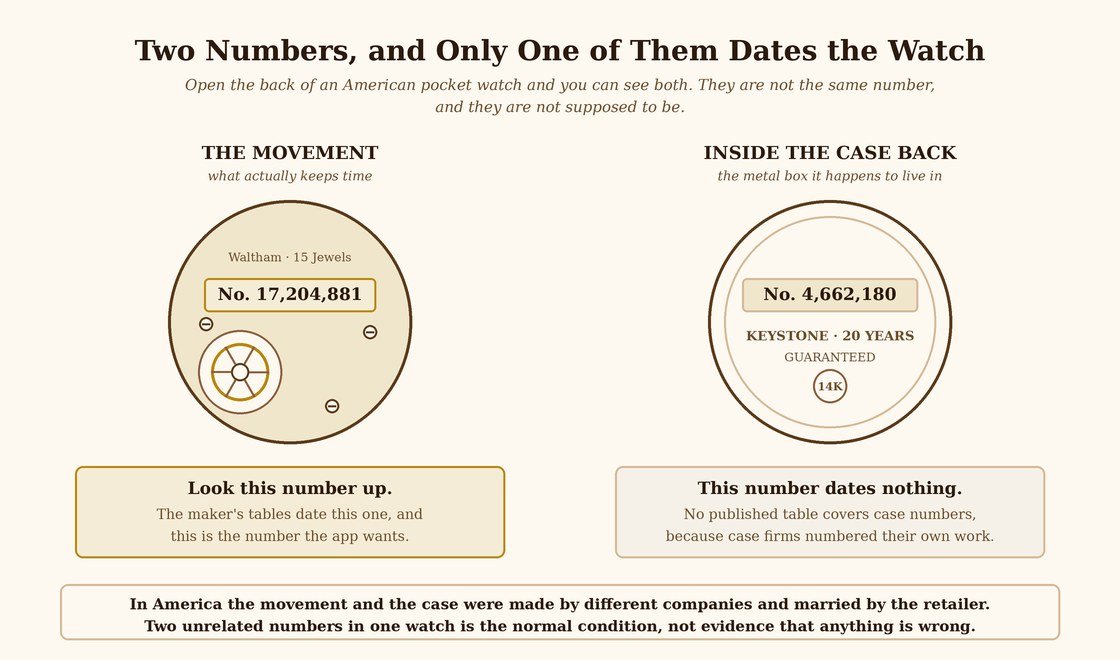
Nearly every query we receive about a Waltham that “dates wrongly” comes down to this. There are two numbers in the watch — one struck inside the case, one engraved on the movement that appears when you open the back or lift the dust cover. Dating works from the movement number and from nothing else.
The case number belongs to the case manufacturer, which was usually a separate company altogether — Keystone, Fahys, Dueber or Philadelphia Watch Case Co. among many others. American watches were routinely sold as a movement and a case chosen separately at the jeweller's counter, so the two numbers were never intended to match. A case and movement of different dates is completely normal and is not, on its own, a sign that a watch has been interfered with.
You can tell them apart at a glance. The movement number lies on the metal plate among the wheels and screws, usually near the words Waltham Mass. or American Waltham Watch Co. and often a grade name. The case number is stamped inside the case back, near hallmarks, a fineness mark such as 14K or a wear guarantee such as Warranted 20 Years, and the case maker's trademark.
A five- or six-digit number when you expected seven is usually the giveaway: Waltham movement numbers climbed past one million by 1870 and past twenty million by 1920, so a low number on a watch that plainly is not Victorian almost always means you are reading the case.
Which Waltham Company Name Is on Your Movement?
The name signed across the plate is the quickest check you have on the number you have just looked up, because the company renamed itself twice and the marking changed with it. All three names belong to the same factory at Waltham, Massachusetts.
| Name on the movement | Roughly when it was used |
|---|---|
| American Watch Co. | c. 1859–1885 |
| American Waltham Watch Co. | c. 1885–1907 |
| Waltham Watch Co. | 1907 onwards |
Read it as corroboration rather than as a date in its own right. The changeovers were not clean — plates were made in batches and stock already engraved with the old name went on being cased for a while afterwards — so treat the boundaries as approximate by a year or two in either direction.
If the name and the serial number disagree sharply, read the number again. A movement signed American Watch Co. that appears to date to 1915 almost always means the case number has been read instead of the movement number, which is the single commonest mistake in dating a Waltham. The words Waltham Mass. appear alongside the company name for most of the period and do not narrow the date on their own.
Grade and Model — What the Number Cannot Tell You
Waltham was the largest American watch manufacturer, producing something in the order of 35 million movements between 1852 and 1957. That scale is why the dating tables are so dependable, and also why the year alone tells you remarkably little. In any given year Waltham was turning out everything from cheap seven-jewel movements to railroad-grade instruments costing a working man's monthly wage.
What separates them is the grade, usually named rather than numbered, and generally marked on the movement. Working roughly upward: Bond Street and Sterling were the modest everyday grades; P. S. Bartlett and Appleton, Tracy & Co. the solid middle; Riverside a genuinely good watch; and Crescent Street, Vanguard and Riverside Maximus the railroad and top grades, adjusted to temperature and to five or six positions. A Vanguard and a Bond Street of the same year are not comparable objects.
Waltham also organised its production by model year — 1857, 1870, 1877, 1883, 1888, 1892, 1899, 1908 and 1912 among the principal ones. Confusingly, the model year describes the design, not the year of manufacture: a Model 1883 movement might well have been made in 1905. If a seller quotes a model number as the age of the watch, they have misunderstood it.
Why Two Walthams of the Same Year Differ Tenfold
The gap between knowing a date and knowing a value is wider for Waltham than for almost any other maker, precisely because the company made so many watches across so wide a range. A common 1900 seven-jewel movement in a worn gold-filled case is worth very little; a 1900 Vanguard in a solid gold hunter case is a serious watch. The serial number cannot tell them apart.
The things that actually decide the figure are grade and jewel count, the case metal — solid gold, gold-filled, silver, silveroid or nickel, in descending order of value — originality, meaning an unrestored dial free of hairline cracks, correct hands, and a movement that has not been re-plated or heavily polished, and condition and running order, since a full service on a high-grade movement is not cheap.
Two dating caveats specific to Waltham. Numbers were allocated to production runs in blocks and were not always used in strict chronological order, so a watch can be a year or two out in either direction. And movements sometimes sat in stock before being cased and sold, meaning the year of manufacture may precede the year the watch reached its first owner by a season or more. Read the table's answer as a close approximation rather than a birthday.
Our guides to grades and jewel counts and what drives pocket watch values go into this properly, and the appraisal guide explains when a formal valuation is worth paying for.
About Waltham Watches
Read the full history of the American Waltham Watch Company, including famous grades and models, or the story of the Waltham factory itself — the plant that invented mass-produced watchmaking and taught the trick to the world. Waltham's railroad-grade watches are covered in the railroad watch guide.
Other Serial Number Tables
- Elgin Serial Numbers
- Hamilton Serial Numbers
- Illinois Serial Numbers
- Hampden Serial Numbers
- Howard Serial Numbers
Or use the free serial number lookup app — all six makers in one place, installable on a phone and working offline, which is useful at a fair or auction where there is no signal.