
The Illinois Pocket Watch Company
Look up your Illinois serial number here.
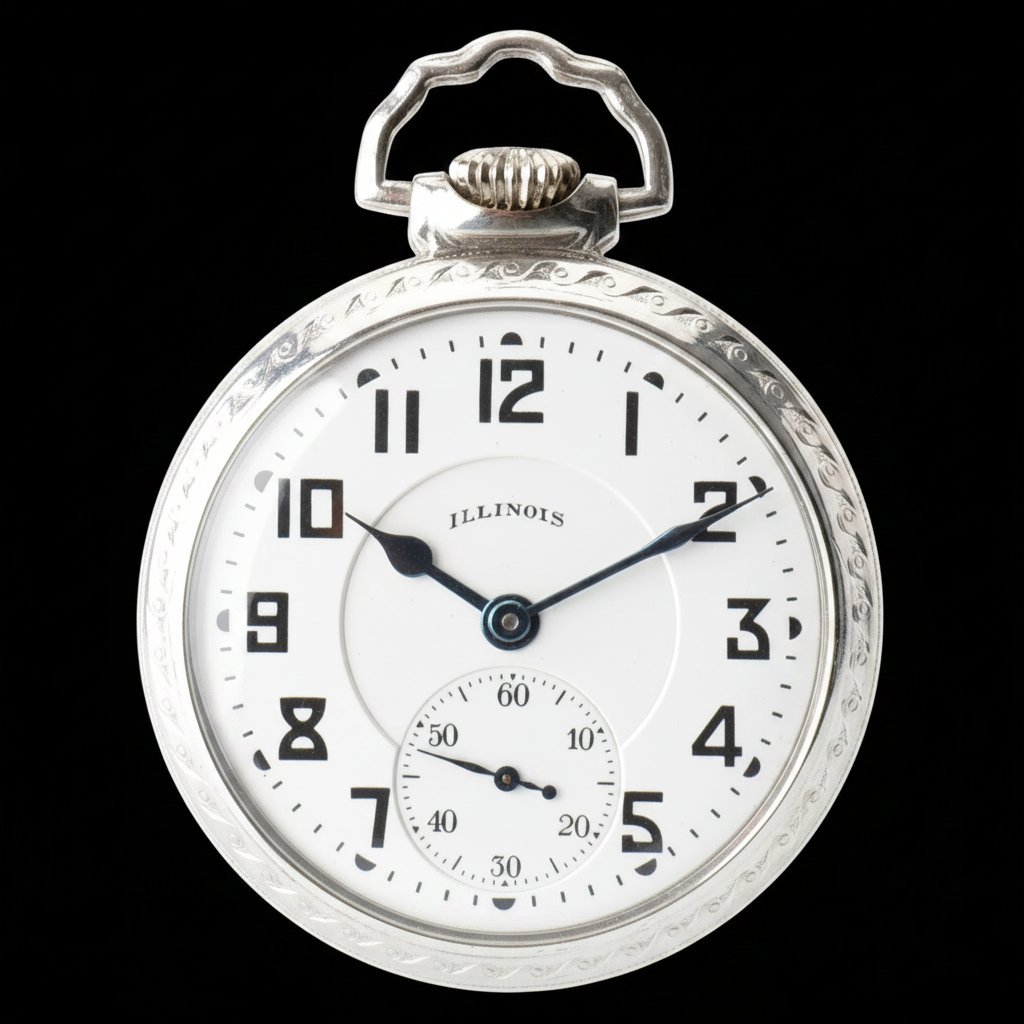
In 1869 a number of public-spirited citizens and capitalists of Springfield, Illinois were shown the advantages of establishing a watch-manufacturing industry in their city. John C. Adams formed the Springfield Watch Company in 1869 with a capital stock of $100,000.
From Springfield to Illinois Watch Company
After struggling through the panic of 1873 and multiple reorganisations, the company was renamed the Illinois Watch Company in 1878 under Jacob Bunn as President. From this stable base the company grew steadily, introducing new sizes and grades throughout the late 19th and early 20th centuries.
By 1903 the company discontinued making cheap movements entirely, concentrating on high-grade 17, 19, 21 and 23-jewel movements. Of 11 watches accepted in a competitive examination at the National Naval Observatory in Washington DC, 10 were Illinois movements — extraordinary testimony to their quality.
Six Million Watches from One Town
It is easy to underestimate what the Springfield works actually was. Over the sixty-one years it operated, the factory turned out close to six million watches — a figure that puts Illinois behind Waltham and Elgin in sheer volume, but comfortably ahead of most of the American trade. For a city better known for Lincoln and state politics, the watch factory was one of the largest employers in town, and a good deal of Springfield's respectable middle class earned its living at a bench there.
The decision to abandon cheap movements in 1903 was a genuine gamble rather than a piece of marketing. Most American factories were moving in the opposite direction, chasing volume at the bottom of the market where Ingersoll and Waterbury were selling watches for a dollar. Illinois went the other way, and the consequence for collectors today is unusually pleasant: there is very little Illinois rubbish about. A random Illinois movement pulled out of a box at a fair is far more likely to be a decent seventeen-jewel watch than the seven-jewel filler that turns up under other names.
The Range, from Everyday to Extraordinary
Illinois grades run from plain nickel movements meant for shop counters to finished watches that stand comparison with anything made in America. The names below are the ones worth recognising on a movement plate:
- Sangamo Special — the top of the range; 21 or 23 jewels, superbly finished, and scarce
- Bunn Special — the celebrated railroad grade, 21 to 23 jewels and adjusted to five or six positions
- Bunn — the older and plainer railroad-service grade that preceded it
- A. Lincoln — a high-grade 21-jewel movement trading, unashamedly, on the local name
- Benjamin Franklin — 17 to 21 jewels, a solid grade below the railroad range
- Stuart — an early grade, uncommon and sought after for its age rather than its accuracy
Note that a great many Illinois movements carry no Illinois name at all, having left the factory badged for a jeweller or a distributor. The Illinois serial number page explains where those grade names came from and how to identify a watch that does not announce itself.
Acquisition by Hamilton
The Illinois Watch Company was purchased by the Hamilton Watch Company in 1927. Production continued for a few years under the Illinois name before being fully integrated. The Illinois factory in Springfield was closed.
The sale price was above five million dollars, which tells you what Hamilton thought the name and the tooling were worth. Springfield kept working until 1932, so watches made in Illinois by Illinois hands continue for five years after the company technically ceased to be independent. The machinery then went east to Lancaster, and Hamilton carried on stamping the Illinois name onto movements built in its own factory until about 1939.
This matters more than it sounds. A watch marked Illinois is not necessarily a Springfield watch, and the later Lancaster-built examples — perfectly good watches in their own right — do not carry the same premium with collectors. The date is the thing that separates them.
Buying an Illinois Watch Today
Illinois occupies an agreeable position in the market: respected enough to be worth owning, obscure enough that prices have never run away in the manner of Hamilton's railroad grades. A clean seventeen-jewel Illinois in a decent case is one of the better ways into American pocket watches without spending seriously.
Three things are worth checking before you buy. Look at the dial first, because Illinois enamel dials are prone to hairlines and a genuinely perfect one adds real money. Then look at the movement finish — Illinois damascening is distinctive and crisp, and a plate that looks dull or scrubbed has usually been through an over-enthusiastic cleaning. Finally, be sceptical of a Bunn Special offered cheaply; it is the grade most often faked by swapping plates or dials from lesser movements, and the jewel count stamped on a plate is not by itself proof of anything.