
Pocket Watch Repair — Tools & Techniques
A pocket watch is a small machine. Hundreds of parts, most of them no bigger than a breadcrumb, all turning together to a tolerance you can barely see with the naked eye. And sooner or later — after forty years in a waistcoat or sixty in a sock drawer — it'll ask for attention. This guide is about two things. When it's sensible to put your own hands on a movement. And what ought to be sitting on the bench before you do.
Contents
Should You Attempt Your Own Repairs?
I'll be straight with you. Without proper training, don't go past careful cleaning and a good long look. Movement parts are tiny, and they don't forgive. Drop a balance staff or kink a click spring and you've turned a pleasant Saturday into a costly errand. But with the right tools and a steady hand, a beginner can safely:
- Open the case to read the serial number and grade
- Clean the exterior of the case and crystal
- Wind the mainspring gently and test whether the movement runs
- Remove and replace the hands (with the correct tools)
- Identify what is wrong and decide whether professional help is needed
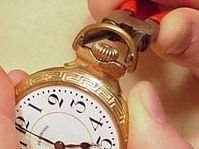
It all starts here: getting the case open without leaving a mark on it. American watches turn up in a handful of styles — snap-back, screw-back, hinged hunter — and every one of them wants a slightly different touch.
Case Opener / Case Knife
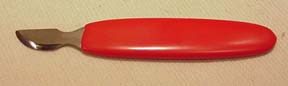
The case knife has a thin, springy blade. Find the little notch on the lip of a snap-back, slide the blade in, and give it the gentlest twist — the back lifts away clean. Never reach for a screwdriver or a penknife. The blade skates off, and then you're nursing a scored case and a cut thumb. A proper case knife costs a few pounds. Just buy one.
The bow opener (left photo) grips and turns screw-back cases. It also pulls the bow — that's the ring up top that the chain runs through — when you need the case fully apart.
Rubber Ball Case Opener
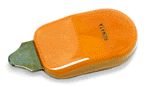
Don't underestimate the rubber ball. It's one of the handiest things on my bench. Press it flat against the case back, twist, and the high-friction surface bites and gives you enough turn to free even a stubborn screw-back — no scratches, no drama.
It earns its keep on stiff hinged hunter backs too, the ones where you've got the knife in but the lid won't quite swing clear. Cheap, grippy, and near enough impossible to wear out.
Working on a movement without proper magnification is just asking for grief. The parts are minute. The tolerances run to hundredths of a millimetre. And damage you do while squinting blind is the hardest kind to put right.
The Watchmaker's Loupe
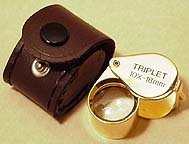
If you buy one tool, buy a good loupe. It's the thing you'll reach for constantly — sizing up a watch on a fair table, reading a serial number, hunting for damage on a movement. Get a 10× triplet loupe (a three-element lens) in a metal housing. The triplet design kills the colour fringing you get from cheap single lenses and gives you a flat, clean field right to the edge.
Here's the trick most beginners miss. Hold the loupe against your eye socket and bring the work up to it — don't bend your neck down to the watch. You get a far steadier view that way. A loupe in a little leather case, like the one shown, drops into a coat pocket nicely too, which you'll be glad of at an auction.
Desk Magnifier & Head Visor
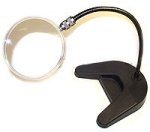
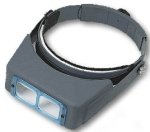
When the job needs both hands free, you want a clip-on desk magnifier or a head-mounted visor (OptiVisor). The desk magnifier clamps to the bench edge and floats a magnified view over your work — grand for cleaning and for picking over parts laid out on a movement tray.
The OptiVisor sits on your head like a headband and flips down over your eyes, giving you 2× to 3.5× across the whole field. Plenty of working watchmakers wear the visor for general bench work and keep a loupe handy for the close stuff. Run the two together and you've got every magnification you'll ever need.
Watchmaker's Screwdrivers
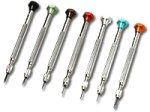
Watch screws are tiny, and cut to fine tolerances. Put the wrong driver in the slot and you'll burr it — sometimes badly enough that the only way out is to drill the screw. So a proper set of watchmaker's screwdrivers, usually six to eight graduated sizes with swivelling tops, isn't optional. It's the price of admission.
That swivelling cap on top does real work. It lets you press down with a fingertip while you turn with thumb and forefinger, so the blade stays planted in the slot and doesn't jump. Keep the tips sharp, too — touch them up on an Arkansas stone the moment they go rounded. A blunt driver is more dangerous to a movement than no driver at all.
The colour-coded handles in the photo just mark the different blade widths. Daft as it sounds, it's a real time-saver — you grab the right size without thinking.
Watchmaker's Tweezers
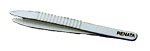
A good pair of anti-magnetic stainless tweezers matters as much as the loupe. Watch parts must never meet bare fingers. The oils in your skin start corrosion, and frankly your fingertips are far too clumsy for components measured in fractions of a millimetre.
Renata and Dumont are the names you'll see on professional benches. Buy two pairs at least. One fine-pointed (Style 2 or 3) for lifting small parts, and one with a slightly broader tip (Style 7) for bridges and plates. Keep the points clean and dead in line. A crossed tip flings parts across the room at exactly the wrong moment — ask me how I know.
Hand Remover & Hand-Setting Press
Pulling and refitting the hands is one of the jobs you'll do most. It's also one of the easiest to botch if you haven't got the right tools.
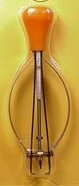
The hand remover — some call it a hand puller or lifter — slips two little prongs under the hand, one each side of the cannon pinion. A gentle, even lift and the hand comes straight up, no bend, no strain on the pinion. Never lever a hand off with a screwdriver. You'll kink the hand and chew up the dial doing it.
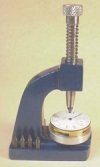
The bench-mounted hand-setting press works the other way. Hollow punches drop over the hands and press them down square onto the cannon pinion under controlled screw pressure. That gets each hand seated at the right height, dead flat — which is what lets them clear one another as the watch runs.
Watchmaker's Hammer & Mallet
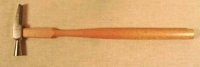
A small watchmaker's hammer — steel head, polished face — is for driving movement holders, tapping staking punches, and seating parts that want a firm, deliberate knock. The head's a fraction of the size and weight of anything from the toolbox in the shed.
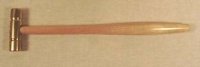
The mallet, faced in rawhide or nylon, lands a softer blow that won't mark a polished surface. That's your tool for closing a snap-back, settling a bezel, anything where the thing you're striking mustn't show a dent. Between the two, you've got every tap the bench will ever ask for.
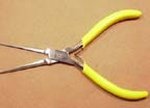
Long-Nose Pliers
You'll want a pair of fine-tipped long-nose (needle-nose) pliers for the jobs that need more grip than tweezers give but more finesse than ordinary pliers. Shaping a click spring. Tweaking the set of a cannon pinion. Holding the winding stem as it comes out. Coaxing a mainspring bridle into line.
Go for smooth jaws, not serrated. Serrations bite into soft brass and leave their teeth-marks behind. Proper watchmaker's pliers are thinner and better made than the electrician's sort, and the few extra pounds are money well spent.
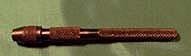
Pin Vise
The pin vise is a little hand-held chuck. It grips pins, drills, broaches and pivot-polishing sticks by the shank so you can spin them with fingertip control. I reach for one to open a pivot hole to size, to polish a pivot, to drive a small pin, or to hold a fiddly part I'd rather not touch with my fingers.
Three or four of them in graduated collet sizes will cover the lot. The knurled barrel grips nicely, and the spinning cap on top lets you drill with a single finger. Cheap tool. Does far more than its price suggests.
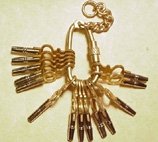
Pocket Watch Winding Keys
Before keyless winding came in over the 1860s and '70s, every pocket watch was wound and set with a loose key. A key-wind, key-set watch has a square arbor at the back to wind it and another up front, under the dial, to set the hands. The set shown here — graduated, on a split ring — spans the sizes the American and European makers used.
Pick up a key-wind watch and you'll need the right key for it. Too small and you'll round off the arbor square; too big and it simply won't bite. You want a snug fit, no wobble. A full set like this one will see you right on just about any key-wind watch you'll come across.
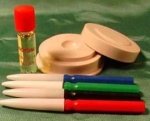
Watch Oil & Oiling Tools
Lubrication is one of the most important things you can get right — and the thing people neglect most. Leave a watch ten years or more without oil and it runs on dry pivots, quietly grinding away parts you can't replace with every single tick.
Watch oils come in grades, each meant for a different part of the movement:
- Moebius 9010 — thin oil for pallet stones and escape wheel teeth
- Moebius 9020 — medium oil for train wheel pivots
- Moebius D5 — grease for the keyless works and winding gears
- Moebius 8300 — mainspring grease for the barrel
You lay it on with a fine oiling stick or a syringe — one tiny drop at each pivot, and not a smidge more. Too much is every bit as bad as too little. Over-oil and it creeps onto the balance spring and the pallet stones, and your timekeeping goes to pot. The wooden stand shown keeps the bottles upright and the sticks where you can find them.
A Complete Service — What's Involved
A proper overhaul follows a set order. There's no shortcutting it. Here's what a qualified watchmaker actually does, start to finish:
- Case opening — remove movement from case using case knife and bow openers
- Hands and dial removal — lift hands with hand remover; unscrew dial feet
- Keyless works disassembly — remove winding stem, crown wheel, setting lever
- Complete movement disassembly — let down mainspring safely; remove bridges, wheels, balance
- Ultrasonic or peg-wood cleaning — every part degreased and cleaned
- Inspection — check all pivots under magnification; replace worn parts
- Mainspring replacement — old mainsprings are often set or corroded
- Reassembly with correct lubrication — each pivot oiled as the movement goes back together
- Timing and regulation — test on a timing machine in six positions; adjust regulator
- Case cleaning and crystal replacement — return movement to a clean case
A good overhaul runs £60–£150 in the UK, or $80–$200 in the States, depending on the watchmaker and how complicated the movement is. On a high-grade railroad watch worth a few hundred dollars, it's money you'll never regret. It buys reliability, and it adds to the watch's value besides.
Finding a Qualified Watchmaker
Look for someone certified by the British Horological Institute (BHI) here in the UK, or the American Watchmakers-Clockmakers Institute (AWCI) over in the States. Those members have sat hard practical exams and work to a professional standard. And before you hand over anything you care about, ask straight out how much antique pocket watch work they've done. A good one won't mind the question.