
Watch Papers: The Hidden Art Inside the Case
Open the outer case of an old English pair-cased watch and you may find, resting against the movement, a little round disc of paper no bigger than a coin. It might carry an engraved advertisement, a scrap of verse, a faded shop address, or a column of pencilled dates in a long-dead watchmaker's hand. This is a watch paper — one of the smallest, most personal and most overlooked objects in all of horology, and a charming collecting field in its own right.
For most of the eighteenth and nineteenth centuries almost every quality pocket watch carried one. They were never meant to survive; they were working ephemera, replaced whenever a watch went in for cleaning. Yet thousands did survive, tucked away and forgotten inside the cases that protected them, and today they offer the collector a direct, often touching window onto the watch trade and the people who carried watches. This page explains what watch papers were for, how they evolved from plain packing into miniature works of the printer's art, and how to date, read and collect them.
What Is a Watch Paper?
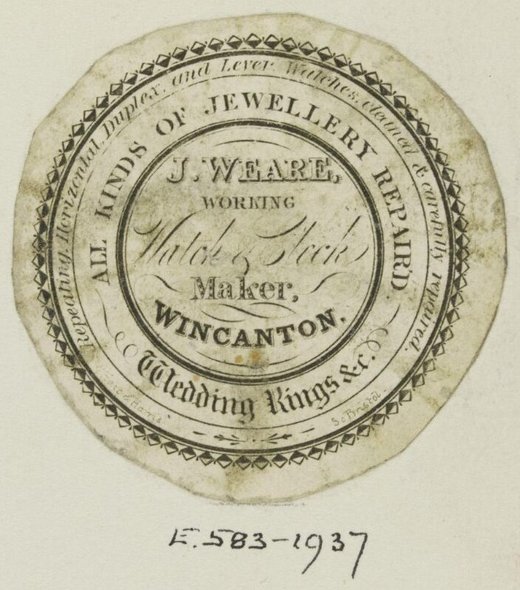
A watch paper is a small circular insert — usually paper, but sometimes linen, silk or other fabric — placed inside the case of a pocket watch. In the type of watch where they are most often found, the pair-cased watch, the movement sits in an inner case, and a second, plain outer case slips over it for protection. The watch paper lived in the small space between the two: laid over the back of the inner case, hidden completely when the outer case was closed.
Because they were sized to fit snugly inside the case back, watch papers are nearly always round, and nearly always small — commonly between about three and five centimetres across, depending on the size of the watch. The earliest were simply cut from whatever suitable material came to hand, including, on occasion, snippets of old printed books or plain rag. As the practice settled into a trade custom, purpose-made discs of coloured or printed paper became standard.
The crucial point for the collector is that a watch paper is not part of the watch's mechanism at all. It is an accessory — closer in spirit to a trade card or a bookplate than to a balance or a mainspring. That is exactly why it is so revealing: it records not how the watch worked, but who made it, who mended it, who owned it, and sometimes what they felt.
Why the Watch Needed a Paper
The first and most practical reason for a watch paper was protection. An antique pair-cased watch is wound and set with a key, and the key is pushed through a small hole in the back of the outer case. That keyhole is an open door for dust, grit and lint to work their way toward the movement — and in a delicate verge and fusee mechanism, dust is the great enemy, thickening the oil and wearing the pivots. A disc of paper laid over the inner case formed a simple barrier across that path.
The paper served a second, equally useful purpose as packing. The fit between an inner and outer case was never perfectly tight, and without something to take up the slack the inner case could rattle and shift. A folded or layered paper acted as a cushion, holding the movement snug and absorbing some of the everyday knocks of a watch carried in a waistcoat pocket. Some collectors describe the paper as a shock absorber and even as a wicking element, helping to manage the small amounts of moisture and excess oil inside the case.
This humble cushioning role explains a curious thing collectors often notice: a single old watch may contain several papers stacked together. Each time the watch was serviced over a long life, the watchmaker might add a fresh paper without troubling to remove the old ones. One well-documented English watch of 1787 was found to contain no fewer than nine papers, among them a piece of khaki silk thought to be original to it. Far from being a fault, such a stack is a treasure: a layered archive of every shop the watch ever visited.
In short. A watch paper had three everyday jobs: keep dust out through the winding keyhole, cushion the inner case against the outer, and — once printers got involved — advertise the maker. The decorative and sentimental uses came later, layered on top of the practical ones.
From Plain Disc to Printed Advertisement
Watch papers began life as the plainest of things: a disc of linen or undyed paper with no decoration at all. The eighteenth-century writer Roland Knaster, whose 1948 essay "Watchpapers: A Neglected Deceit" remains one of the few serious studies of the subject, described how the early discs were cut from linen before white paper — and then pink, green and yellow paper — became the usual choice. Only later were they engraved and decorated, often with a horological motto or a few lines of verse trapped inside a circular border.
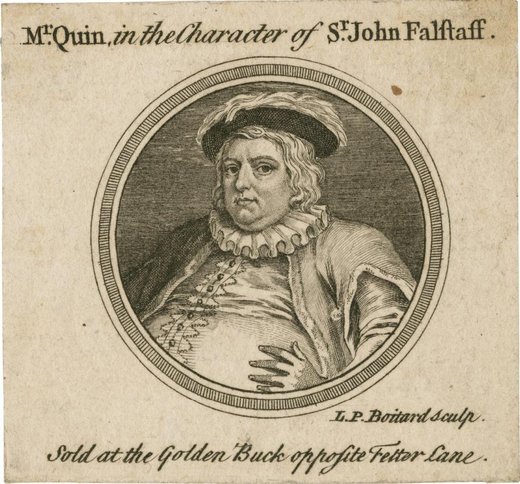
By the middle of the eighteenth century, two quite different industries had taken an interest in this little disc. The first was the print trade. Engravers and print-sellers realised that a fashionable customer might enjoy a pretty picture to slip inside the watch, and they began publishing purely decorative watch papers — small engravings of allegorical figures, theatrical portraits and emblems, sold ready-cut to size. A London print-seller's catalogue of 1774 listed a whole range of such designs; one surviving example shows the actor James Quin in the role of Falstaff, engraved by Louis-Philippe Boitard. These decorative prints were bought simply because they were charming, the way one might buy a greetings card today.
The fashion for purely pictorial watch papers did not last. By the close of the eighteenth century, buyers had largely lost interest in paying for a picture to hide inside their watch. But just as the decorative trade faded, a second use was rising fast — and it would dominate the watch paper for the next hundred years. The watchmakers and repairers themselves had discovered that the disc was the perfect advertisement.
An Advertisement You Carried Everywhere
The logic was irresistible. Every time the owner of a watch opened the case to wind or set it, there was the watchmaker's name, staring back. Better still, when a watch needed mending, the owner naturally returned to the name printed inside it. A watch paper was, in effect, the eighteenth-century equivalent of the garage sticker on a modern car windscreen — a small, permanent reminder of who to call. From the later 1700s, watchmakers and jewellers began ordering custom papers in quantity, printed or engraved with their own details.
A typical advertising watch paper carried the maker's or repairer's name and shop address, and often the sign by which the shop was known — "at the Dial and Crown", "opposite the church", and so on — from the days before street numbering was universal. Around this central text the engraver worked a decorative border, and frequently a small emblem suited to the trade: a dial, a pair of watches, an hourglass, or the figure of Father Time with his scythe. Allegorical women representing the virtues, classical motifs and elaborate scrollwork all appear. The grander examples even depicted the shopfront itself, or the factory where the watch was made.
In America the custom took hold strongly. The earliest known American watch-paper printing dates to a watch sold by the Boston watchmaker Samuel Bagnall in 1740 or 1741. Most remarkable of all to collectors, the celebrated patriot and silversmith Paul Revere engraved a watch paper for the clockmaker Aaron Willard in 1781 — a tiny print now prized as a genuine work from Revere's own hand, and a reminder that the same engravers who produced fine silver and bookplates also turned out these miniature trade cards.
The Repair Record Hidden Inside
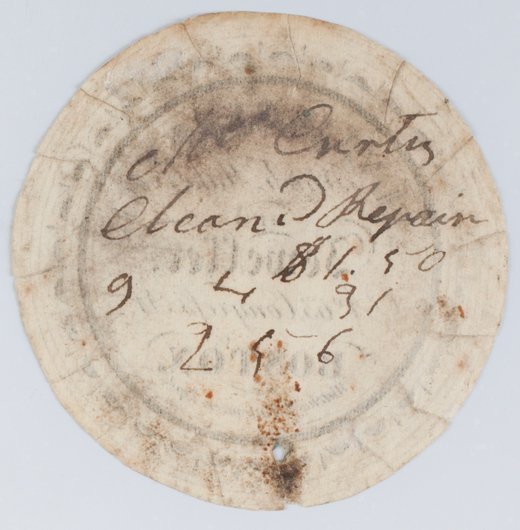
If the printed face of a watch paper is the advertisement, its blank reverse is often the most fascinating side of all. Watchmakers used it as a service log. When a watch came in for cleaning, the repairer would note the date on the back of the paper — and the next repairer would add his own line below, and the next his, sometimes across decades. A well-used paper can carry a column of dates recording every cleaning, oiling and spring-replacement the watch ever had.
For the modern collector this is pure gold. A printed advertisement tells you where a watch was bought or last serviced; a column of manuscript dates tells you how often it was used, how long it stayed in one place, and roughly how old the case must be. It is one of the very few sources of a genuine, contemporaneous service history for an antique watch — the equivalent of finding the original logbook with a vintage car. Where the notes name different towns or shops, they trace the watch's travels through a succession of owners.
Reading these pencilled lines is part of the pleasure and the challenge. The hands are often hurried, the abbreviations cryptic, and the ink or pencil faded. But patience is frequently rewarded with a small, vivid human detail: a repair noted in a year of war, a gap of twenty years suggesting the watch lay in a drawer, a final date after which the watch fell silent for good.
Tokens of Sentiment — and the Occasional Secret
Because a watch paper was small, private and seen only by the owner, it became a natural home for sentiment. Beyond the trade cards and repair logs, collectors find watch papers used as keepsakes: tokens of love and friendship, birthday and New Year greetings, mourning memorials for the dead. A paper might carry a verse, a pair of clasped hands, a heart, or the words of an affectionate motto. Occasionally a lock of hair, sometimes finely woven, was sequestered behind the paper — a Victorian keepsake hidden where only its owner would know to look.
The privacy of the hiding place lent itself to discretion. Because the lettering on a watch paper could be made very small, a few examples carry messages clearly meant for the owner alone — declarations of love, sometimes set as a rebus or puzzle, that the casual observer would never see. In America, where paper-cutting was a folk art, especially among the Pennsylvania Dutch, finely cut and embroidered watch papers became a recognised way of expressing affection.
These sentimental survivals are among the most evocative objects a watch collector can own. A maker's advertisement is interesting; a hand-cut valentine tucked silently inside a watch for two centuries is something else entirely — a fragment of a private life, preserved by accident in the one place no one thought to look.
The Great Collections
Watch papers survive at all largely thanks to collectors who saw value where others saw rubbish. The most important institutional holding, at the American Antiquarian Society, runs to more than six hundred American examples dating from the 1790s to about 1910. The core of that collection has a charming origin story: it was assembled by a New England dentist named Bemis, who gathered up old watches — reputedly to melt their gold cases for dental fillings — and, being a man who threw nothing away, carefully preserved the papers he found inside, including his own father's handsomely engraved watchmaker's advertisement.
The Society later published a descriptive catalogue of its watch papers, and other institutions hold their own groups: the Folger Shakespeare Library, for instance, keeps a collection of eighteenth-century pictorial watch papers, valued as much for their engraving and their theatrical and literary subjects as for their connection to horology. Private collectors have done just as much to keep the field alive, and named private holdings appear regularly in the literature.
What unites these collections is the recognition that the watch paper sits at a crossroads of several worlds: horology, of course, but also the history of printing and engraving, of advertising and trade, of folk art and of everyday sentiment. A single disc can be of interest to a watch collector, a print collector, a social historian and a genealogist all at once.
How to Date and Read a Watch Paper
Dating a watch paper is a satisfying piece of detective work, and it can help date the watch around it. Several lines of evidence work together:
- The maker's address. If the paper names a watchmaker and a shop address, trade directories and rate books can often pin down the years that maker traded from that exact address. A shop that is known to have moved in a given year sets a clear limit on the paper's date — one of the most reliable clues available.
- The shop sign. Before house numbering, shops were identified by signs ("at the Sign of the Dial"). These too can sometimes be traced and dated.
- The material and colour. The earliest papers tend to be plain linen or undyed paper; coloured papers and finely engraved designs point to later in the sequence.
- The style of engraving. Lettering, border styles and decorative motifs followed fashion, and an experienced eye can place a paper to within a few decades.
- Manuscript dates. The pencilled repair dates on the reverse give a firm earliest point — the watch and its paper must be at least as old as the oldest date written on it.
- The watch itself. The hallmarks on a silver or gold case, and the serial number and style of the movement, give an independent date to check the paper against.
One important caution, hinted at in the very title of Knaster's "Neglected Deceit": a watch paper is loose, and loose things move. A paper found inside a watch is not guaranteed to have started life there. Papers were swapped, added and re-used; a charming engraving may have been slipped into a watch it never originally belonged to. Treat the paper as evidence to be weighed against the watch, not as proof on its own.
Collecting Watch Papers Today
For the collector, watch papers have a rare combination of virtues: they are historically rich, visually charming, take up almost no space, and — best of all — remain genuinely affordable. While a fine antique pocket watch may run to four or five figures, most watch papers change hands for very modest sums, putting together a serious collection within reach of almost any budget. They are the ideal companion field for anyone who already collects the watches themselves.
Where do they turn up? The happiest source is inside a watch you already own: many a collector has opened a newly bought pair-cased watch to find a forgotten paper still in place. Beyond that, watch papers are sold by dealers in ephemera and printed antiques, at paper-collectors' fairs, and through general antique and online auctions, often filed under ephemera or advertising rather than horology — which is precisely why bargains are still to be had by those who know to look.
Value, when it rises above the modest baseline, is driven by a handful of factors:
- The engraver or maker. A paper by a celebrated hand — the Paul Revere engraving is the classic example — or advertising a famous watchmaker commands a strong premium.
- Decorative quality. Fine pictorial engravings, especially early ones, are sought by print collectors as well as horologists.
- Condition. These are fragile survivors. Clean, uncreased, uncut papers with strong impression and colour are far scarcer than tatty ones.
- Sentiment and content. Love tokens, cut-paper work, locks of hair and unusual messages add human interest and value.
- Provenance. A paper that can be tied to a named owner or a documented watch — occasionally a watch with a famous former owner — is worth more than an anonymous one.
Care is simple but important. Watch papers are paper (or fragile fabric) and should be handled and stored as such: kept flat, away from light, damp and heat, ideally in acid-free sleeves rather than left to acidify quietly inside a case. If you remove a paper from a watch for study, note carefully which watch it came from — that association is part of its value, and easily lost. And resist the urge to "clean" a paper; the pencilled repair notes and gentle toning are the history, not the dirt.
Why Watch Papers Matter
It is easy to walk straight past a watch paper. It is small, it is fragile, and it was never meant to be admired — it spent its working life hidden in the dark. But that is exactly what makes it precious. The grander objects of horology were made to impress; the watch paper was made to be forgotten, and so it tells the truth. In its printed face you can read the everyday commerce of the watch trade; on its back, the working life of a single watch; and in its rarer forms, the private affections of people two centuries gone.
For the collector, that is the whole appeal in miniature. A pocket watch keeps time; a watch paper keeps memory. Next time you open an old pair-cased watch, look before you close it again — there may be a small round world inside, waiting two hundred years for someone to read it.
Continue exploring. See where watch papers lived in our guide to the pair-cased pocket watch and the wider pocket watch case; learn how the repair notes on their backs came to be written in our pocket watch repair guide; and date the watch around the paper with English hallmarks and serial numbers. Return to the History Library for more.