
Pair-Cased Pocket Watches
The pair-cased pocket watch is the defining form of English horology from the Restoration to the Regency — roughly 1650 to 1820. Two cases, one inside the other: an inner case of silver or gold that holds the movement, and an outer case of leather, shagreen, tortoiseshell, or precious metal that protects it. To open the watch, you press the inner case out from the back of the outer, then press the pendant to spring the inner case open and read the dial.
For the collector, pair-cased watches offer a unique combination of mechanical interest, decorative beauty, and historical depth. They carry English silver hallmarks that can date and attribute them precisely. They were made by identifiable craftsmen whose names are recorded in historical registers. And they represent the pinnacle of English watchmaking before the lever escapement swept all before it.
The Inner Case
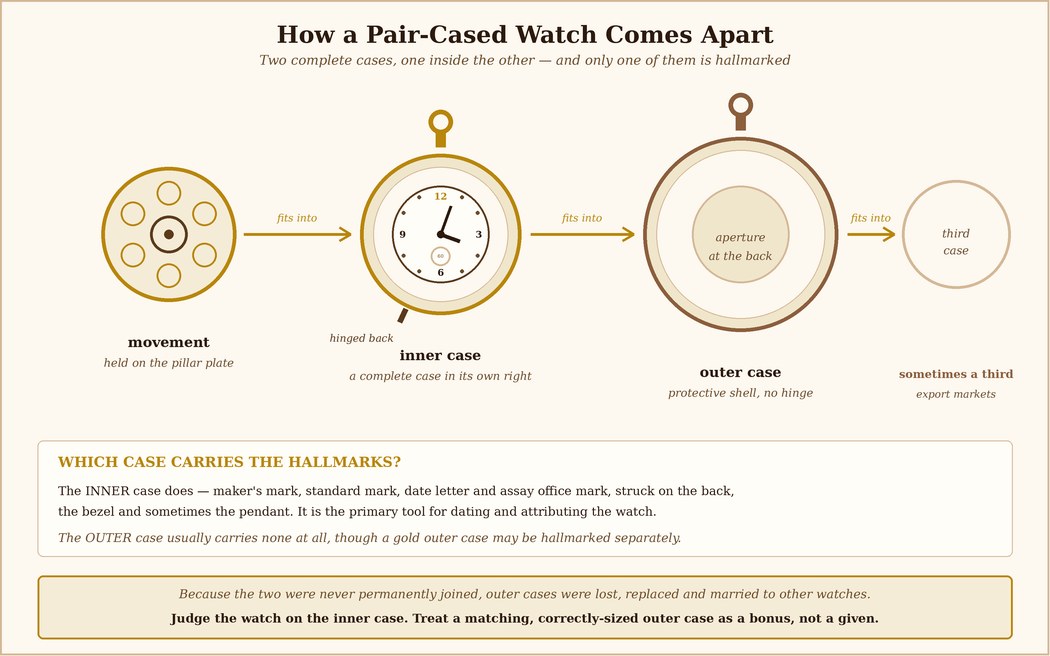
The inner case — sometimes called the inner dome — is a complete case in its own right. It has a bezel (the ring that holds the crystal and dial), a back that hinges open to expose the movement, and a pendant and bow for suspension. The movement sits inside it, held by a movement ring or cocked directly against the pillar plate. To open the inner case, press the pendant knob: this releases a catch and allows the back to spring open on its hinge.
The inner case carries the English assay office hallmarks: maker's mark, standard mark, date letter, and assay office mark. These are struck on the back, the bezel, and sometimes the pendant, and they are the primary tool for dating and attributing a pair-cased watch.
The Outer Case
The outer case is essentially a protective shell into which the inner case is pressed — there is no hinge connecting them. To remove the inner case, you press it out from the front through the aperture at the back of the outer case, or use a thin implement to release it from the side. The outer case has its own pendant hole, which aligns with the inner case pendant when assembled.
The outer case bears no movement and carries no hallmarks of its own in most instances, though a gold outer case may be separately hallmarked. Its function is purely protective and decorative.
The triple case. Some pair-cased watches — particularly those made for export to the Ottoman Empire, Persia, or India — were fitted with a third outer case, giving three layers of protection for long sea voyages and extreme climates. Turkish-market triple-cased watches are a well-established collecting speciality and often feature elaborate enamel decoration on the second outer case aimed at the tastes of the destination market.
What the Outer Case Is Made From
The material of the outer case is one of the first things a collector notes, as it significantly affects value and indicates the watch's original quality level.
Shagreen
The skin of a ray or shark, with its natural granular texture. Dyed green (occasionally black or red) and stretched over the outer case. The most common outer case material on quality English pair-cased watches, 1680–1780. A fine, even grain indicates a good example.
Fish skin / Ray skin
Similar to shagreen but sometimes used loosely to describe any granular-textured skin covering. The terms are often used interchangeably in auction descriptions.
Leather
Plain or patterned leather, often with a pinchbeck (gilt brass) or silver outer rim. More common on later or less expensive examples, or watches made for hard working use.
Tortoiseshell
Genuine hawksbill turtle shell, sometimes inlaid with silver or gold piqué work. Warm amber colour with dark mottling. Trade in antique tortoiseshell items is now regulated; check current rules before importing or exporting.
Silver
Repousséd, engraved, or plain silver outer cases indicate a higher-grade watch. A silver outer case will carry its own hallmarks. Repousséd silver — embossed with scenes, figures, or foliage — is highly decorative and much collected.
Gold
The finest pair-cased watches have gold inner and outer cases, sometimes with enamel miniatures set in the outer case back. These are the most valuable pair-cased watches and appear principally at specialist horological auctions.
Reading the Inner Case Hallmarks
English silver pair-cased watches carry four or five hallmarks struck on the inner case. These marks are indispensable for dating the watch and are one of the great advantages of collecting English silver watches over continental pieces, which are often poorly or inconsistently marked.
| Mark | What It Shows | Notes |
|---|---|---|
| Maker's mark | The initials (and sometimes symbol) of the silversmith or case maker who submitted the case for assay. | This is the case maker, not the watchmaker. The watchmaker's name appears on the movement and dial. Both names can often be traced in historical records. |
| Standard mark | Confirms the metal's purity. A lion passant for sterling silver (925 parts per 1,000). Britannia figure for Britannia standard (958 parts per 1,000), compulsory 1697–1720, optional thereafter. | Britannia standard marks indicate a case made between 1697 and c.1720, or a deliberate choice of the higher standard after that date. |
| Date letter | A letter of the alphabet in a distinctive shield, changed each year by the assay office. Each office used a different letter cycle and shield shape. | The date letter is the primary dating tool. Combined with the assay office mark, it gives the year of assay to within twelve months. Full date letter tables are in How to Read English Hallmarks. |
| Assay office mark | Identifies which assay office tested and marked the case: London (leopard's head), Birmingham (anchor), Sheffield (crown), Chester (three wheat sheaves and sword). | The great majority of pair-cased watch cases were assayed in London. Chester and Birmingham marks are less common; they indicate either a provincial watchmaker or a case made and submitted locally. |
| Sovereign's head | A duty mark struck 1784–1890, showing that excise duty had been paid on the piece. | Presence of the sovereign's head dates the case to between 1784 and 1890. Its absence on a case that otherwise appears to be from this period warrants closer examination. |
For a complete guide to reading these marks, with date letter tables for all assay offices, see British Hallmarks and How to Read English Hallmarks.
The Movement Maker vs the Case Maker
A point that confuses many new collectors: the name engraved on the dial and pillar plate is the watchmaker — the person who made or signed the movement. The hallmarks on the case record the case maker, a separate craftsman who was often not the same person. In the London trade, the division of labour was strict: watchmakers, case makers, dial painters, spring makers, wheel cutters, and finishers were all separate specialists. A Thomas Mudge movement might be in a case by an entirely unknown case maker, and a case beautifully marked with a known maker's mark might contain a movement by a lesser hand.
The watchmaker's name is far more important to value than the case maker's. Research the movement name first; the case hallmarks then tell you when and where it was cased.
Using Hallmarks and Style Together
Date letters give a precise date for the case. The movement may have been made at the same time or earlier — watchmakers sometimes fitted movements into new cases years after they were made, either to update a customer's watch or because the original case was damaged. A movement and case that are close in date (within five to ten years) are most likely original to each other. A larger discrepancy suggests re-casing.
Case style also helps. Early pair cases (pre-1700) tend to have a projecting pendant and relatively plain bezel. The early eighteenth century saw a fashion for repousséd outer cases with elaborate figured scenes — mythological subjects, hunting scenes, pastoral landscapes — that are strongly characteristic of the 1720s to 1760s period. Later cases become plainer and more refined as neo-classical taste supplanted baroque exuberance.
Movement Features by Period
The movement inside a pair case is almost always a verge-fusee in earlier examples and a cylinder-fusee in later ones. The balance cock — the pierced and engraved bracket bridging the balance wheel — is the most telling stylistic feature. Early cocks (pre-1700) have a small foot and an elaborate asymmetric pierced table. By the 1720s the cock has grown to cover most of the top plate, with symmetrical piercing and a tulip or floral centre. Post-1750 cocks are larger still, often with engraved rather than pierced decoration, and post-1800 they become plain and functional as taste changed.
The pillar plate (the main movement plate) carries the watchmaker's signature, usually engraved as "Tho. Mudge London" or similar — name and place. Identifying and researching this signature is central to establishing the movement's origin and value. G.H. Baillie's Watchmakers and Clockmakers of the World is the standard reference.
What to Look For
| Feature | Good Signs | Watch Out For |
|---|---|---|
| Inner & outer case match | Pendants align; hallmark dates are consistent; case sizes fit neatly without play | Mismatched cases from different periods; outer case too loose on inner (wrong pairing) |
| Hallmarks | Clear, complete, identifiable date letter and office mark on inner case | Rubbed or worn marks; suspiciously bright marks on otherwise aged cases (possible transposition) |
| Outer case covering | Shagreen or leather in good condition, evenly grained, firmly adhered | Missing sections of covering, replaced leather that does not match the period, re-covered outer case |
| Balance cock | Original to the movement; piercing intact; foot securely pinned; engraving consistent with movement date | Replaced cock from a different movement (check that screw hole aligns and style matches period) |
| Dial | Original enamel dial; numerals crisp; no cracks, chips, or restoration; hands original to period | Restored or repainted dial; replaced hands from wrong period; numerals retouched |
| Movement signature | Clearly engraved maker's name and town; verifiable in historical records | Suspiciously famous name (Tompion, Graham) without supporting provenance — both were widely faked |
Beware of prestigious signatures. Thomas Tompion, George Graham, and Daniel Quare are the most frequently forged signatures in antique watchmaking. A watch signed by any of these makers requires independent expert examination and, ideally, reference to the maker's surviving records before any significant sum is paid.
Values
Pair-cased watches span an enormous value range. A plain, unsigned verge movement in a shagreen outer case with legible but undistinguished hallmarks might be acquired at a provincial auction or antique fair for a few hundred pounds. A signed movement by a named London maker in original repousséd silver cases, with a complete and unrestored enamel dial and original hands, will reach well into four figures at a reputable sale — and examples by the great names of the period (Tompion, Graham, Quare, Mudge) will exceed five figures at specialist horological auctions.
The outer case material matters: a gold outer case on a signed movement represents the highest tier of the market. Repousséd silver outer cases are the next step down but are very actively collected in their own right for their decorative quality. Plain shagreen or leather is the most common and the most accessible entry point.
For guidance on hallmark reading see British Hallmarks. For the history of the verge escapement used in these watches see Verge & Fusee Pocket Watches.