
History of the Pocket Watch
The pocket watch is one of the great achievements of European craftsmanship — a clock so miniaturised it could be worn on the body, carried in a pocket, and trusted to keep time through the demands of daily life. Its story spans five centuries: from the crude iron spring-driven clocks of Renaissance Germany, through the extraordinary precision of the English and Swiss masters, to the golden age of American mass production, and finally to the abrupt end brought by the quartz revolution of the 1970s.
No other object concentrates so much mechanical ingenuity into so small a space. To understand the antique pocket watch is to understand the history of precision engineering itself.
From Tower to Table — the Mainspring Revolution
The mechanical clock had existed since the late thirteenth century, driven by falling weights suspended on ropes or chains. Such clocks were fixed in towers or churches — immovable objects tied to their weights by gravity. The invention that changed everything was the mainspring: a coiled strip of steel that stores energy when wound and releases it gradually as it uncoils. With a mainspring, a clock needed no fixed location. It could be small, portable, and carried anywhere.
The mainspring almost certainly emerged in the workshops of Flanders or southern Germany in the early fifteenth century. By 1430, records suggest spring-driven tabletop clocks were being made in Burgundy. Within a generation, German craftsmen — particularly in Nuremberg — had refined the technology sufficiently to produce clocks small enough to hold in the hand.
Peter Henlein and the Nuremberg Egg
Tradition credits Peter Henlein (c. 1485–1542), a Nuremberg locksmith and clockmaker, with creating the first true portable clock small enough to be worn. A 1511 account by the humanist Johannes Cochlaeus describes Henlein making "small devices out of a little iron which can be carried in the purse and indicate the hours without any weight for forty hours, even when carried on the breast or in the bag." This is the earliest clear description of a portable spring-driven timekeeper.
The "Nuremberg egg" myth. Surviving early German portable clocks are drum-shaped, flat cylindrical or spherical — not egg-shaped. The name is a mistranslation: Eierlein, little eggs, is a corruption of Ueurlein, little clocks, and it reaches print in Johann Fischart's 1571 German version of Rabelais. Oval cases became fashionable only around 1580, some forty years after Henlein's death, and the claim that he invented the watch begins with Johann Gabriel Doppelmayr in 1730. The full story, and the forged watch that settled it.
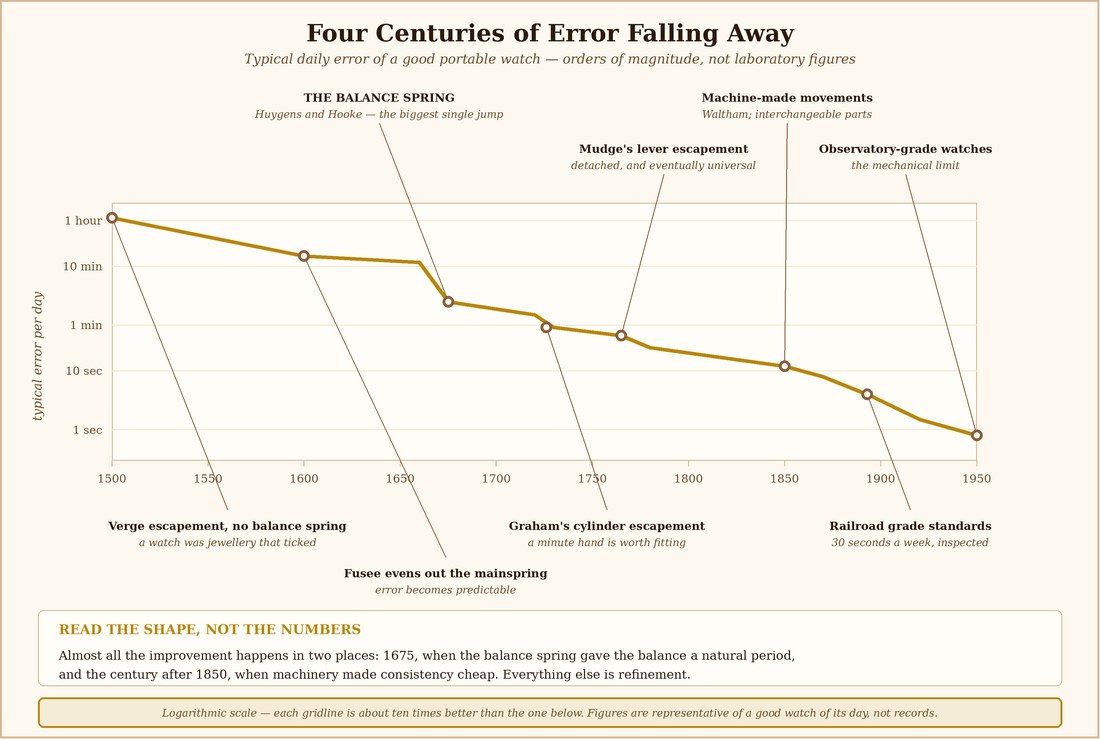
These earliest portable clocks were not pocket watches in any modern sense. They were too large to sit in a pocket, had only one hand (an hour hand), and kept time so poorly — gaining or losing fifteen minutes or more per day — that they functioned as jewellery and status symbols as much as practical timekeepers. Accuracy was less important than the marvel of the mechanism itself. They were owned exclusively by royalty, wealthy nobles, and the Church.
The Stackfreed, the Fusee, and the Search for Even Power
The great technical problem of the spring-driven clock was inconsistency: a fully wound mainspring delivers far more force than a nearly run-down one. This uneven power delivery caused the timekeeping to vary throughout the running period. Two devices emerged to address it.
The stackfreed was a German solution — a snail-shaped cam mounted on the mainspring arbor, pressed against by a strong spring. As the mainspring ran down and its force decreased, the stackfreed cam's profile changed the resistance, compensating partially. It was crude and introduced considerable friction, but it worked well enough for early portable clocks.
The fusee was the superior solution, probably developed in the Low Countries around 1500. A cone-shaped pulley — the fusee — is connected to the mainspring barrel by a chain or gut line. When fully wound, the line pulls from the narrow end of the cone, giving mechanical advantage and reducing the mainspring's excess power. As the spring runs down, the line migrates to the wider end, compensating for the loss of power. The result is a nearly constant turning force on the train throughout the running period. The fusee remained in use in the finest English pocket watches until the 1900s — a four-century lifespan that speaks to how perfectly it solved the problem.
The Verge Escapement
Every mechanical clock and watch requires an escapement — a device that allows the gear train to advance only in controlled, measured steps, releasing one tooth of the escape wheel at a time while simultaneously receiving energy to keep the regulating element oscillating. The earliest portable clocks used the verge escapement, inherited from medieval tower clocks.
The verge escapement consists of a crown wheel (a toothed wheel with teeth set at right angles to its rim) and a vertical rod — the verge — with two pallets set at angles. The pallets engage alternately with the crown wheel's teeth, causing the verge to oscillate back and forth and releasing the crown wheel one tooth at a time. Paired with a foliot (a bar with adjustable weights) or later a balance wheel, the verge governed the rate of the watch.
The verge was robust and well understood, but it had serious drawbacks. It was highly sensitive to variations in motive power — exactly the problem the fusee was designed to solve — and it could not be made accurate enough for demanding use without the fusee's compensating effect. It also had significant recoil, meaning the escape wheel was pushed briefly backwards with each beat, wasting energy. Nevertheless, the verge-and-fusee combination dominated watchmaking for nearly two centuries and produced some extraordinarily beautiful movements.
Cases, Form, and Fashion (1550–1650)
By the mid-sixteenth century, portable clocks had shrunk to a size that could genuinely be carried on the person — typically hung from a chain around the neck or worn at the waist. The single hour hand was now standard, and cases had evolved into elaborate works of art: rock crystal, silver, and gold, engraved, enamelled, and set with gemstones. The movement was of secondary importance to the case's decorative magnificence for the wealthy patron.
Centres of fine watchmaking established themselves across Europe: Augsburg and Nuremberg in Germany; Geneva, Blois, and Paris in France; and — crucially — London, which would come to dominate the highest levels of horological craft for a century and a half.
The Balance Spring: Everything Changes
The single most important development in watchmaking history occurred in the 1670s: the invention of the balance spring (also called the hairspring). A fine spiral spring attached to the balance wheel gave it a natural frequency of oscillation, dramatically reducing the balance's sensitivity to variations in driving force and position. The result was a transformation in accuracy — watches that had previously struggled to keep time within fifteen minutes a day could now, in skilled hands, be regulated to within a minute or two.
Priority for the invention is contested. Robert Hooke in England claimed to have conceived the idea as early as 1658, while Christiaan Huygens in the Netherlands independently developed a working balance spring watch in 1675. The London clockmaker Thomas Tompion made the first English balance spring watches, and it was English makers who most rapidly exploited the invention's potential.
With the balance spring came the minute hand — now that watches could be trusted to keep the time within a few minutes, indicating minutes became worthwhile. The single-hand watch was rapidly superseded. By 1700, most quality watches had both hour and minute hands.
The Cylinder Escapement
The verge escapement was incompatible with the flat, thin watch cases that fashion was beginning to demand in the early eighteenth century. The crown wheel of the verge stood upright, requiring a deep case. The cylinder escapement, invented by Thomas Tompion around 1695 and perfected by George Graham in the 1720s, solved this by using a horizontal escape wheel with teeth that engaged a hollow cylinder on the balance staff. The cylinder escapement was thinner, smoother, and required no oil on the impulse faces — important virtues. Its weakness was delicacy: the thin cylinder walls wore and broke easily, and the escapement was difficult to make and repair. It was widely used in English and especially French and Swiss watches until the mid-nineteenth century.
The Lever Escapement — the Watchmaker's Masterpiece
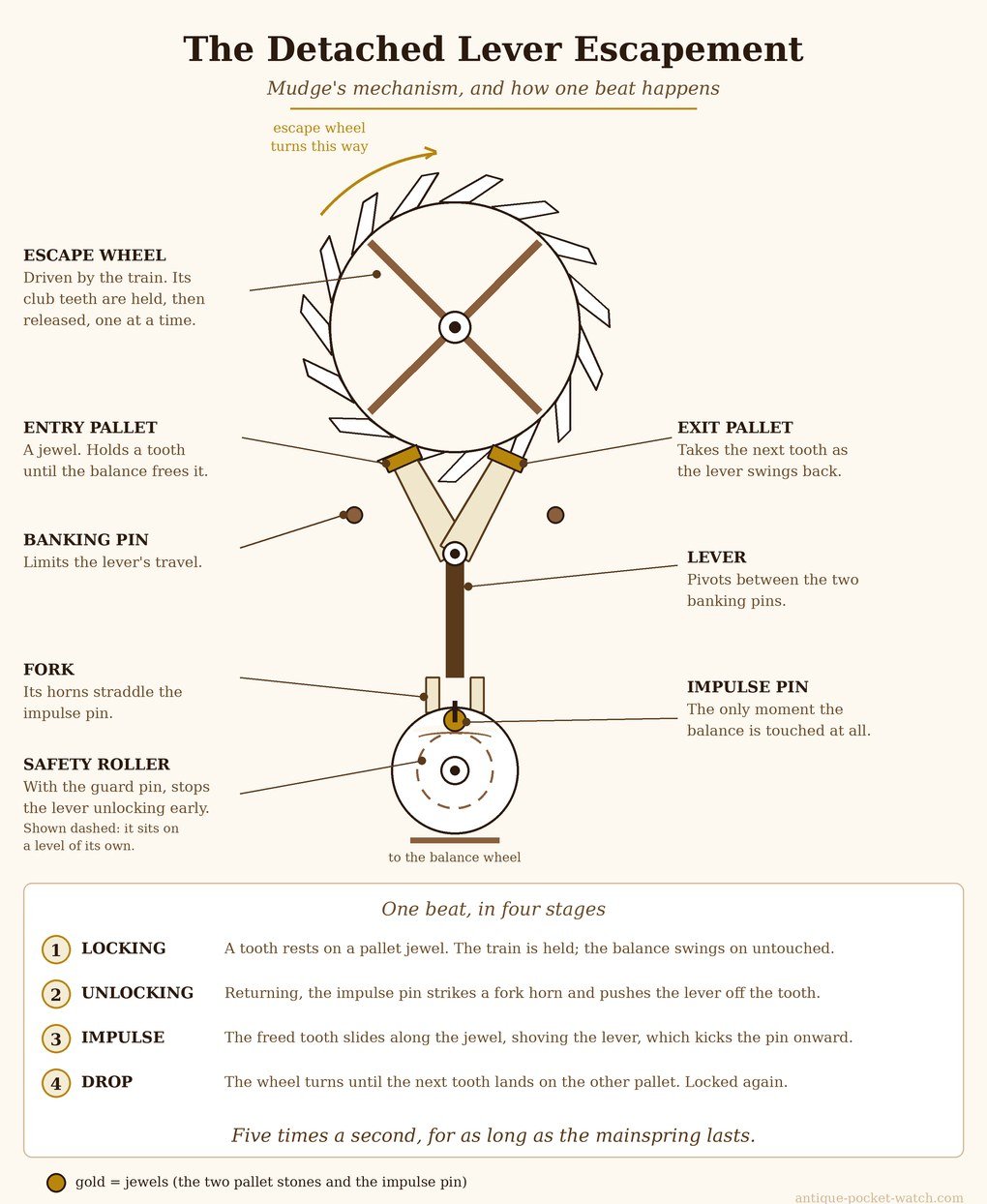
The invention that underpins every mechanical watch made to this day came from Thomas Mudge, who presented the first lever escapement to Queen Charlotte in 1769. Mudge himself regarded it as unsuitable for general production and did not commercialise it. It was left to later makers — particularly Josiah Emery in London, and subsequently Swiss and American manufacturers — to develop the lever escapement into the supremely practical, reliable, and accurate device it became.
The lever escapement uses a pivoted lever with two pallets that engage the teeth of an escape wheel, driven back and forth by an impulse from the balance wheel via a notch in the lever. Crucially, it is a detached escapement — the balance is free of the lever for most of its swing, receiving an impulse only briefly at each beat. This freedom from continuous interference makes it far more accurate than the verge or cylinder, and its safety action makes it virtually impossible to trip accidentally. By 1850 the lever had all but replaced every other escapement in quality watches worldwide.
English Watchmaking at Its Peak
The late eighteenth century saw London watchmaking reach extraordinary heights. The great names of the period — John Arnold, Thomas Earnshaw, Abraham-Louis Breguet (though French-born, he worked extensively in London) — pushed timekeeping accuracy to levels previously thought impossible. Their work on chronometers for marine navigation was directly connected to their pocket watch work: the same innovations in escapement design, temperature compensation, and regulation applied to both.
The English system of production was built on division of labour among specialist craftsmen — the movement maker, the wheel cutter, the springer, the jeweller, the finisher, the case maker — coordinated by a master who assembled and regulated the finished watch. This cottage industry produced superb watches but was inherently slow and expensive. It would prove unable to compete when a radically different system emerged across the Atlantic.
Swiss Watchmaking Takes Root
Switzerland's watchmaking industry had its roots in Geneva, where the Calvinist ban on jewellery in the mid-sixteenth century prompted the city's goldsmiths to turn to watchmaking as a related but permissible trade. By 1600, Geneva had an established watch guild. Over the following century, the trade spread into the Jura mountains — the Vallée de Joux, the Neuchâtel region, and the towns of La Chaux-de-Fonds and Le Locle — where farming communities took up watchmaking as a winter occupation.
The Swiss mountain watchmakers developed a cottage industry even more dispersed than the English system, with families specialising in individual components: one household made only balance wheels, another only mainsprings, another only jewels. A établisseur — an assembler-entrepreneur — would gather these components and assemble them into finished watches. The efficiency of this network allowed Swiss makers to undercut English prices while maintaining acceptable quality, and by 1800 Switzerland was the world's largest exporter of watches.
Abraham-Louis Breguet
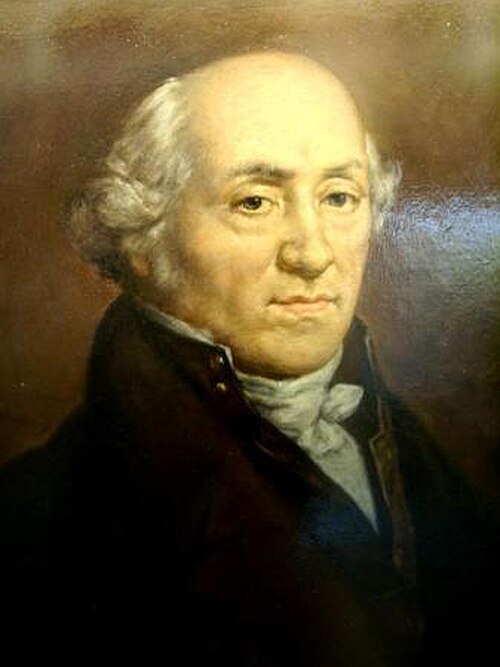
No account of watchmaking history can omit Abraham-Louis Breguet (1747–1823), whose inventions transformed the art. Born in Neuchâtel, trained in Paris, his workshop became the most celebrated in Europe. Among his innovations: the tourbillon (1801), which mounted the escapement in a rotating cage to average out positional errors; the pare-chute shock protection system; the overcoil hairspring; the self-winding (perpétuelle) watch; and the subscription watch — a simplified, inexpensive design made in series. He also invented the Breguet hand — the distinctive hollow-tipped hand still used in his name today.
Breguet's customers included Napoleon Bonaparte, the Empress Josephine, George III of England, and the Tsar of Russia. His pocket watches remain the most sought-after at auction of any maker, with major examples regularly achieving hundreds of thousands of pounds.
Waltham and the Machine-Made Watch
In 1850, Aaron Lufkin Dennison — an American watchmaker who had visited English factories and studied their methods — convinced a group of Boston investors to fund a radical experiment: a factory in which watches would be made entirely by machine, with parts so precisely interchangeable that any component from any watch of a given model could be fitted to any other. The American Watch Company (later the Waltham Watch Company) opened in Waltham, Massachusetts, and changed watchmaking forever.
The key insight was the application of American System manufacturing — the same principle then being applied to rifles at the Springfield Armoury and to locks in Connecticut — to watchmaking. Purpose-built machine tools, precision gauges, and rigid quality control produced parts of a consistency impossible to achieve by hand. A watch movement assembled from machine-made parts required far less hand-fitting by skilled craftsmen, dramatically reducing labour costs.
Initial quality was poor and the enterprise nearly failed. But by the late 1850s the system was working, and the Civil War created enormous demand for inexpensive, reliable watches. Soldier's watches, officers' watches, sutler's watches — the Union Army's need for timekeeping drove Waltham's output to levels previously unimagined. By 1870, Waltham was producing hundreds of thousands of watches per year at prices that undercut Swiss and English competitors who still relied on hand methods.
Elgin, Illinois, Hamilton, and the American Industry
Waltham's success inspired competitors. The National Watch Company (later Elgin) opened in Elgin, Illinois in 1864. The Illinois Watch Company followed in Springfield in 1869. The Hamilton Watch Company, founded in Lancaster, Pennsylvania in 1892, would become pre-eminent in railroad-grade watches. Dozens of smaller companies entered and left the market over the following decades.
The American companies competed fiercely on grade, price, and distribution. They developed an elaborate grading system — assigning each movement a grade number that specified the number of jewels, the quality of the regulator, the type of balance, and the finishing standard. A collector buying a "23-jewel, adjusted five positions, Waltham Vanguard" knew precisely what they were getting. This transparency was a powerful marketing tool and has since become the foundation of antique watch research and valuation.
The Railroad Standard and American Precision
The 1891 Kipton, Ohio rail disaster — in which an engineer's defective watch caused a head-on collision — prompted the development of the General Railroad Timepiece Standards. These demanded watches of 18 or 16 size, a minimum of 17 jewels, adjustment to at least five positions and temperature, a maximum variation of 30 seconds per week, a lever escapement with a steel escape wheel, and specific case and dial requirements. Only the best American movements could meet these standards, and the railroad trade drove the development of the finest American pocket watches ever made.
Swiss Industrialisation
Confronted by American machine-made competition, the Swiss watchmaking centres of La Chaux-de-Fonds and Le Locle industrialised rapidly. By the 1870s and 1880s, Swiss factories were producing ebauches (raw movements) by machine in large quantities, sold to établisseurs for finishing and casing. The Swiss adapted rather than abandoned their cottage industry model: the factories made the basic movement components, while specialist firms continued to handle decoration, complication work, and casing.
Switzerland's advantage lay in the quality of its complicated and luxury work. While American factories excelled at volume production of practical watches, Swiss firms like Patek Philippe, Vacheron Constantin, Audemars Piguet, and Jaeger-LeCoultre dominated the market for repeaters, chronographs, perpetual calendars, and tourbillons. The pocket watches produced by these firms for wealthy private clients in the late nineteenth and early twentieth centuries represent the absolute pinnacle of the watchmaker's art.
Patek Philippe and the Grand Complication
The Patek Philippe Calibre 89, commissioned in 1989 to mark the firm's 150th anniversary, contained 1,728 components and 33 complications — it was the most complex pocket watch ever made. But Patek's golden age was the period 1880–1930, when the firm produced extraordinary pocket watches for American robber barons and European aristocracy. The Henry Graves Supercomplication, completed in 1933 and containing 24 complications, was made for the New York banker Henry Graves Jr. and sold at auction in 1999 for over eleven million dollars. It remains one of the most celebrated timepieces in existence.
The First World War and the Wristwatch
The wristwatch had existed as a ladies' bracelet watch since the 1880s, but it was considered effeminate for men. The First World War changed this entirely. Artillery officers synchronising barrages, pilots needing to keep hands free, infantry officers coordinating attacks — all found the wristwatch infinitely more practical than fumbling for a pocket watch under fire. By 1918, the wristwatch was established as masculine and military, and it never looked back.
Through the 1920s and 1930s, the wristwatch eroded the pocket watch's dominance steadily. Pocket watches persisted in the railroad industry — railwaymen continued to carry them until well into the 1960s — and among older men who disliked the change in fashion. But the young and the fashionable had moved to the wrist. The great American pocket watch factories diversified into wristwatch production or faced declining orders.
The Last Great Pocket Watches
The American manufacturers produced some of their finest movements in the 1940s and 1950s, serving the railroad and precision instrument markets. Hamilton's 950B, 992B, and the extraordinary 21-jewel 992E were among the best pocket watch movements ever made anywhere in the world. Waltham's Model 1892 and Vanguard remained benchmarks of quality. But production volumes were falling year by year as the railroad companies modernised and the wristwatch completed its conquest of everyday timekeeping.
The Quartz Revolution
The development of the quartz oscillator as a timekeeping element — accurate to within seconds per month rather than the seconds per day of a fine mechanical watch — had been underway since the 1920s. The first quartz wristwatches appeared in 1969: the Seiko Astron, launched on Christmas Day, was the first commercially available quartz watch. By the mid-1970s, inexpensive quartz movements from Japan and Switzerland had destroyed the market for mechanical watchmaking at every price level below the luxury segment.
The American watch industry collapsed with devastating speed. Hamilton made its last pocket watches in 1969. Elgin closed in 1968. Waltham had already ceased movement production by 1957. Factories that had employed thousands of skilled workers were shut or converted to other uses within a decade. Swiss firms fared little better — the number of employees in the Swiss watch industry fell from nearly 90,000 in 1970 to under 30,000 by 1984.
Why the Pocket Watch Endures
The mechanical pocket watch survived the quartz revolution as a collectible and a symbol. Freed from the need to be the most accurate or convenient timekeeper, it could be appreciated for what it always was: a marvel of miniature engineering, a work of decorative art, and a physical connection to five centuries of craftsmanship. The weight of a gold hunter case in the hand, the sound of a movement's beat, the view through a display case back of a decorated three-quarter plate or a jewelled lever — these are pleasures that no digital display can replicate.
Today, fine antique pocket watches are collected worldwide. The great American railroad grades are sought by collectors who prize precision engineering and historical connection. Swiss complications command astonishing prices at the major auction houses. English fusee movements by named London makers attract those who appreciate the craftsmanship of the pre-industrial era. And for those beginning the hobby, the sheer range and relative affordability of the mass-produced American pocket watch of the 1880s to 1940s offers a perfect entry point.
Whether a plain three-jewel Ingersoll Dollar Watch or a 23-jewel Hamilton in a solid gold case, every antique pocket watch carries within it the accumulated knowledge of five centuries of the clockmaker's art.