
Verge and Fusee Pocket Watches
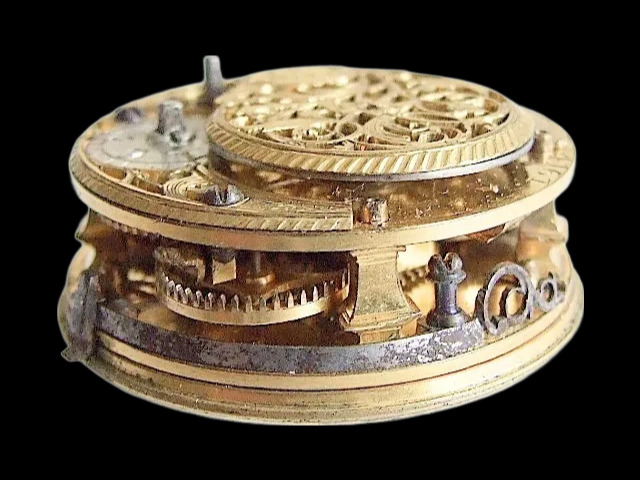
The verge and fusee pocket watch is the ancestor of every mechanical timekeeper in existence. When you hold one — a silver pair-cased watch from the reign of George II, or an early German tambour case from the 1600s — you are holding one of the oldest forms of portable machinery ever made. The mechanism ticks with the same escapement principle that governed the first mechanical clocks of the thirteenth century, refined and miniaturised over two hundred years into an object that fits in a waistcoat pocket.
Verge-fusee watches are the most historically significant pocket watches a collector can own. They require knowledge to buy well, skill to service, and care to preserve — but they connect their owner to five centuries of the clockmaker's art in a way that no later watch can match.
The Verge Escapement
The escapement governs the rate at which the gear train runs, releasing it one step at a time and taking from it the energy that keeps the oscillating element in motion. The verge escapement — so called because of the Latin virga, a rod — is the oldest known escapement, appearing in European tower clocks by the late thirteenth century and adapted for portable watches in the fifteenth.
In a verge watch, the escapement consists of two main elements: the crown wheel and the verge. The crown wheel is a toothed wheel whose teeth project at right angles to its rim — giving it a crown-like silhouette. The verge is a vertical rod, the balance staff, with two small plates or flags — the pallets — set at roughly 90–105 degrees to each other along its length.
As the crown wheel turns, its teeth push alternately against the upper and lower pallet, causing the verge to oscillate back and forth. Each oscillation allows one tooth of the crown wheel to escape — hence the term. The crown wheel simultaneously gives a small impulse to the pallet, keeping the balance in motion. The balance wheel (or foliot, in early watches) is mounted on the top of the verge and provides the inertial element that controls the rate of oscillation.
The Crown Wheel
A wheel with an odd number of teeth (typically 13) set perpendicular to its plane. Driven by the going train. The vertical orientation of its teeth is what makes the verge escapement necessarily tall — the crown wheel stands upright, requiring a deep case.
The Pallets
Two small projecting flags on the verge staff, positioned to engage alternately with the crown wheel teeth. Their angle relative to each other determines the arc of the balance — a critical adjustment made by bending them during setting-up.
The Balance
A wheel mounted at the top of the verge staff. Its moment of inertia (determined by its size and the position of its weighted arms) governs the period of oscillation. Before the balance spring, the rate was adjusted by moving weights along the balance arms.
The Balance Spring
Added to verge watches from c.1675. A small spiral spring attached to the balance wheel gives it a natural frequency, dramatically improving accuracy. Pre-balance-spring verge watches may be 30 minutes per day inaccurate; post-spring examples with good regulation, a few minutes.
The Fusee
The great weakness of the spring-driven watch was inconsistency of power. A freshly wound mainspring exerts much greater force than one that is nearly run down, causing the rate to vary throughout the running period. The fusee was devised to compensate for this — and it did so with such elegance that it remained in production for four centuries.
The fusee is a cone-shaped pulley, typically with a helical groove cut into its surface. It is connected to the mainspring barrel by a length of gut or — from the eighteenth century onward — fine chain. When the watch is fully wound, the chain or gut is wrapped entirely around the narrow end of the fusee cone. As the mainspring runs down, the chain migrates up the cone to the wider end.
This simple geometry provides variable mechanical advantage: when the mainspring is at full power and pulling hardest, it acts through the narrow end of the cone, where it has the least leverage. As it weakens, it acts through the wider end, where it has greater leverage. The two effects cancel out, delivering an approximately constant torque to the going train throughout the watch's running period — typically 24 to 36 hours for a well-made verge watch.
The click-spring and maintaining power. When a fusee watch is being wound, the chain is pulled back from the going train to the fusee, briefly interrupting the power supply. To keep the watch running during winding, many fine fusee watches incorporated maintaining power — a secondary spring that keeps the train in motion for the seconds needed to complete winding. Its presence in a movement is always a mark of quality.
The Early Period (1500s–1650)
The earliest portable verge clocks, made in Nuremberg and Augsburg from around 1500–1530, were drum-shaped or cylindrical and worn on the person rather than carried in a pocket. They had a single hour hand, no balance spring, and a foliot regulator — a bar with weighted arms rather than a wheel. Regulation was achieved by moving the foliot weights inward or outward to alter its moment of inertia. Accuracy was poor: fifteen to sixty minutes per day was typical.
Cases in this period were made of iron or brass, often elaborately engraved or pierced to allow the bell (most early portable clocks also struck the hours) to be heard. Rock crystal cases were made for the very wealthy, as were cases of gold, silver-gilt, and enamelled copper. The movement was the cheaper part; the case was where the patron's wealth was displayed.
By 1600, the form had settled into something recognisable as a pocket watch: oval or round, thin enough to carry in a pocket or on a chain, with a single hand and a pierced case back. Centres of production had established themselves in London, Paris, Blois, and the German cities.
The Balance Spring and Improvement (1675–1750)
The invention of the balance spring around 1675 — attributed independently to Robert Hooke and Christiaan Huygens — transformed the verge watch. With a hairspring giving the balance a natural frequency, regulation became possible with fine screws and index pins, and accuracy improved dramatically. The minute hand became worthwhile and appeared almost universally. The second hand followed on fine movements.
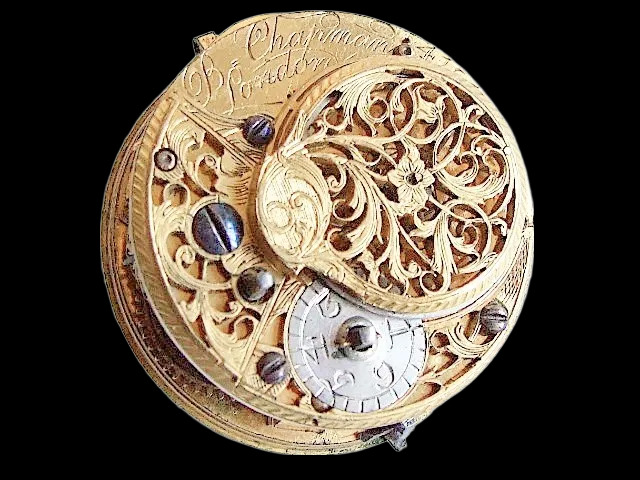
English makers — particularly in London — took the lead in developing the balance-spring verge watch to its highest level. The great names of this period include Thomas Tompion, George Graham (who simultaneously developed the superior cylinder escapement but continued to make verge watches for clients who preferred them), Daniel Quare, and Edward East. Their movements were signed on the pillar plate, often beautifully engraved, and cased in silver or gold pair cases.
The Pair Case
The pair case — the characteristic case form of English verge watches from roughly 1650 to 1800 — consists of an inner case that holds the movement and a separate outer case of leather, tortoiseshell, or shagreen into which the inner case is pushed. The outer case has no hinge; the inner case is pressed out of it from the back. The inner case opens by pressing the pendant to release a catch, exposing the dial.
Pair cases served the practical purpose of protecting the inner case and movement from dust and knocks. They also provided a second surface for decoration: the outer case might be covered in repousséd silver, fish-skin (ray or shark skin, used for its texture as a grip), tortoiseshell inlaid with silver or gold, or — in the finest examples — gold set with diamonds and enamel miniatures.
Some watches were made in triple cases — an inner case, an intermediate case, and an outer case — especially those made for the Turkish or Indian markets, where extra protection was required for long journeys and extreme climates. Triple-cased verge watches made for the Ottoman market are a well-established collecting speciality.
The Decline of the Verge (1750–1820)
The verge escapement was inherently limited. It was sensitive to variations in motive power (hence its perpetual pairing with the fusee), had significant recoil, and required a deep case because the crown wheel stood upright. As the cylinder escapement — thinner, smoother, and requiring no fusee — became established in the mid-eighteenth century, and as the lever escapement (invented 1769, commercialised from the 1780s) began to demonstrate its superiority, the verge's days were numbered.
English watchmakers continued to produce verge-fusee watches into the early nineteenth century, partly by tradition and partly because conservative customers — particularly in export markets — still preferred them. The last verge watches were made in England by provincial makers well into the 1830s; a very few examples are known from after 1840. By that point the lever had completely superseded all rival escapements in quality work.
What Makes a Good Example
Verge-fusee watches vary enormously in quality and originality. At the top are signed London movements by named makers in original cases with unaltered mechanisms. Below that lies a broad spectrum of provincial English, Dutch, French, and German work — some of it excellent, much of it competent, and some (particularly later, cheaper work) crude. Understanding where on this spectrum a particular watch sits is the essential collector's skill.
| Feature | What to Look For | Significance |
|---|---|---|
| Signature | Engraved name on the pillar plate or balance cock. Should match known maker's records if claiming a specific maker. | Signed movements by known makers command a significant premium. Research the name in Baillie's Watchmakers and Clockmakers of the World. |
| Balance cock | The pierced and engraved bracket that bridges the balance wheel. Should be original to the movement. Check that the engraving style is consistent and that it is not a replacement from a different movement. | The balance cock is the most decorative element of a verge movement. Fine piercing and engraving — especially when signed — greatly increases value. |
| Fusee chain | The chain (or gut line) connecting fusee to barrel. Gut line indicates an older piece; fine chain indicates later or replacement. Chain should be intact and correctly tensioned. | A broken or replaced chain affects function. Original gut line is extremely rare; chain replacement is expected in a working watch. |
| Case integrity | Inner and outer cases should be a matched pair — check that bezels, pendants, and hallmarks are consistent. Many verge watches have been re-cased in later or non-original cases. | Original matched cases add significantly to value. A movement in a period but non-original case is worth less than a fully matched example. |
| Hallmarks | British silver and gold cases carry hallmarks from the relevant assay office (London, Birmingham, Chester). Date letter and maker's mark help date and attribute the case. | Hallmarks allow precise dating of the case. The movement and case dates should broadly correspond — a 1720s movement in a 1790s case indicates re-casing. |
| Dial | Early dials are enamel on copper, or occasionally silver with engraved chapter ring. Should be original to the movement. Check for cracks, restoration, and replaced hands. | Original enamel dials in good condition are increasingly rare. A replaced or restored dial reduces value. |
| Movement condition | Look for missing jewels (verge watches typically have none, or one or two), replaced parts, bent or broken teeth, and evidence of amateur repair. The verge and crown wheel are particularly vulnerable. | Verge watches are difficult to service correctly. Poor past repair is common and can reduce a movement to scrap value. Seek a specialist opinion before buying. |
Servicing and Running
A verge-fusee watch is not difficult to run — but it is very difficult to service correctly. The verge escapement is unlike any modern escapement, and few contemporary watchmakers have the training and experience to work on it. Fitting a new gut line or chain, cleaning and lubricating the movement, and adjusting the rate all require specific knowledge of the verge's quirks.
Always seek a specialist. Do not take a verge watch to a general jeweller or watch repairer who has not specifically worked on verge escapements. The most common damage to verge movements comes from well-intentioned but incorrect servicing — particularly improper adjustment of the pallet flags and over-oiling of the escapement. In England, the British Horological Institute can advise on qualified restorers.
A well-regulated verge-fusee watch with a good balance spring can keep time to within two or three minutes per day — perfectly acceptable for its era. Without the balance spring (pre-1675 examples), a running rate of five to fifteen minutes per day variation is typical. These are not precision instruments by modern standards, but they are not supposed to be: they are mechanical marvels from an age when any portable timekeeper at all was a wonder.
Values
Values for verge-fusee pocket watches range enormously. A plain, unsigned, later English or European verge movement in a worn silver pair case might be bought at a provincial auction for a modest sum. A signed London movement by a named maker — Thomas Tompion, George Graham, Daniel Quare — in original gold pair cases will reach five figures or more at a specialist horological sale. Between these extremes lies a vast range of interesting, historically significant, and aesthetically beautiful watches at every price level.
The finest verge-fusee watches are handled by specialist horological auctioneers: Bonhams, Christie's, and Fellows in the United Kingdom, and Antiquorum and Sotheby's internationally. For more modest examples, local general antique auctions and specialist dealers are good sources. Always buy with a return option if possible, and have any significant purchase examined by an independent specialist before committing.
For further reading on the history of early pocket watches, see History of the Pocket Watch. For guidance on hallmarks on British cases, see British Hallmarks and How to Read English Hallmarks.