
The Open-Face Pocket Watch
The open-face pocket watch is the most widely collected type of antique pocket watch. Its dial is exposed — protected by a crystal of glass or mineral, with no metal cover over the face. The winding crown sits at the twelve o'clock position, directly opposite the six. It is practical, easy to read, and was the preferred choice of working men, railwaymen, and anyone who needed to check the time quickly and reliably.
Open-face watches account for the great majority of American pocket watches made between 1880 and 1940, and virtually all railroad-grade watches. Understanding what distinguishes them from hunter cases — and from each other — is essential knowledge for any collector.
Open-Face vs Hunter Case
The two principal case types in pocket watch collecting are the open-face and the hunter (sometimes called full hunter). The fundamental difference is the presence or absence of a hinged metal cover over the dial.
- Dial always visible through crystal
- Crown at 12 o'clock position
- No front cover to open
- Time read at a glance
- Movement accessed via hinged back
- Generally thinner case
- Preferred for railroad use
- Usually less expensive than equivalent hunter
- Hinged metal cover over the dial
- Crown at 3 o'clock position
- Press the crown to spring the cover open
- Dial protected when closed
- Double-hinged back for movement access
- Deeper case to accommodate front cover
- Often more elaborately decorated
- Favoured for dress and presentation use
There is also a half-hunter (or demi-hunter): a hunter-style case with a small window cut through the front cover, allowing the time to be read without opening it. Sometimes a chapter ring is painted or engraved on the cover to aid reading through the aperture. Napoleon Bonaparte is said to have owned a half-hunter pocket watch and to have introduced the style to the court — though the watch survives and the story may be apocryphal.
The 3/0 Rule — Why Crown Position Matters
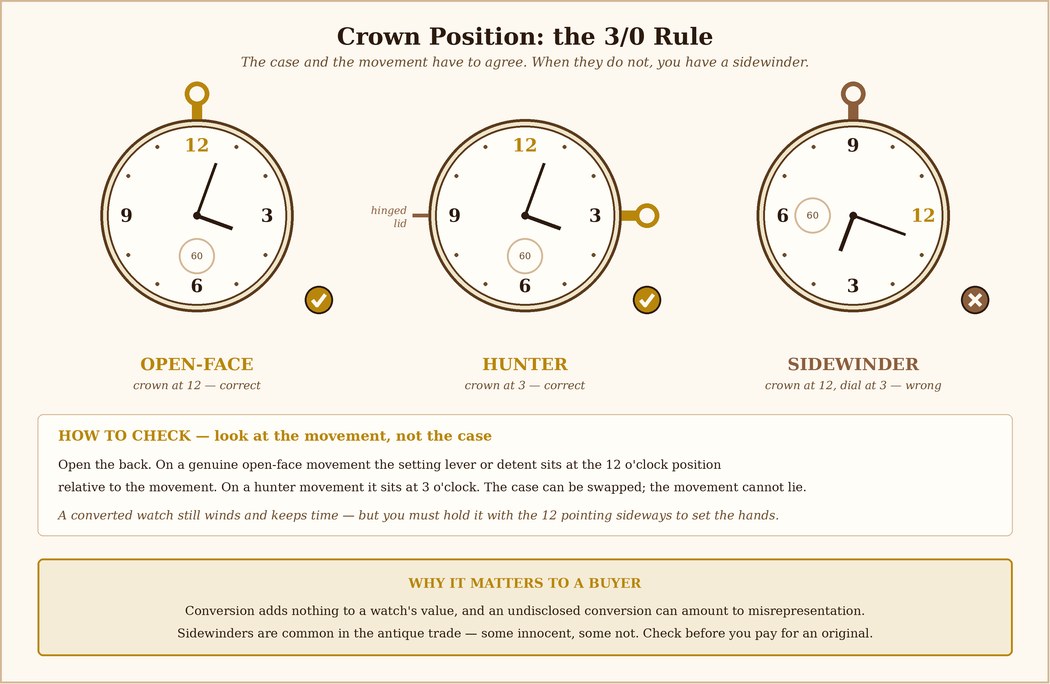
An important and often misunderstood point: the position of the crown and the type of case are linked by the movement's setting. An open-face movement has its setting (time-setting) mechanism positioned so that it operates with the crown at 12 o'clock. A hunter movement has its setting mechanism oriented for the crown at 3 o'clock.
If a hunter movement is placed in an open-face case (or vice versa), the crown will be in the wrong position relative to the dial. The watch will function — it will wind and keep time — but to set the hands you will need to hold the watch with the crown at 3 o'clock and the 12 pointing to the right. This is called a converted watch, and it is fairly common in the antique market. Converting a watch adds nothing to its value and, if not disclosed, can be considered misrepresentation.
How to check. Hold the watch with the 12 at the top. If the crown is at 12, the movement should be set for open-face. Open the back and look at the setting mechanism: on a genuine open-face movement, the setting lever or detent will be at the 12 o'clock position relative to the movement. On a hunter movement incorrectly cased, it will be at the 3 o'clock position.
Why the Railroad Industry Chose Open-Face
The American General Railroad Timepiece Standards of 1891 — prompted by the Kipton disaster — effectively mandated the open-face watch for railroad use. There were practical reasons for this. A railwayman needing to check the time precisely did not want to fumble with a spring-loaded cover. An open-face watch could be read in a fraction of a second, one-handed, without removing it from the waistcoat pocket. The time was immediately visible.
The standards also specified that railroad watches must have a lever setting rather than the usual pin-set mechanism. In a lever-set watch, the time is set by pulling out a small lever recessed under the bezel or in the movement itself — not by pulling the crown. This prevented accidental resetting if the crown was bumped. On an open-face lever-set movement, this lever is typically accessible via a small slot at the edge of the movement, inside the case but without needing to remove the movement.
Open-Face Case Styles and Materials
Open-face cases from the American golden age (1880–1940) were made in a wide range of materials and finishes. Understanding these is important for assessing value.
| Material | Description | Collectibility |
|---|---|---|
| Solid gold | 14k or 18k throughout. Stamped with karat mark and assay mark. Heavy and warm to the touch. | Highest — significant scrap and collector value combined |
| Gold-filled | A layer of gold mechanically bonded to a base metal core. Marked "GF", "Gold Filled", "Guaranteed 20 Years" etc. Quality varies by thickness of gold layer. | Good — the most common quality case for mid-range watches |
| Rolled gold | Thinner gold layer than gold-filled, rolled onto base metal. Often marked "RGP" (Rolled Gold Plate). | Moderate — typically lower grade |
| Silver | Sterling (925) or coin silver (900) cases, common in British and European watches. Some American examples. | Good — especially for hallmarked British silver cases |
| Nickel silver / white metal | A copper-nickel-zinc alloy with a silver appearance. Not precious metal. Often used for economy watches. | Lower — base metal case, but movement quality still matters |
| Chrome / stainless | Later cases, 1930s onward. Practical and durable but not precious. | Moderate — depends on movement quality |
Case Decoration on Open-Face Watches
The most common form of decoration on open-face cases is engine turning — a lathe-cut geometric pattern on the case back. The barleycorn pattern (a dense cross-hatch), the wave pattern, and the sunburst pattern are all forms of engine turning, and they vary considerably in fineness and depth. High-quality engine turning from the Dueber, Keystone, and Boss case companies is extremely crisp and regular; cheaper cases have shallower, less precise patterns.
Many open-face case backs also feature a cartouche — a plain oval or shield at the centre of the case back, left unengraved for the customer to have a name, initials, or presentation inscription engraved. A well-engraved cartouche with a personal inscription — "To William, from the men of the Lake Shore & Michigan Southern, 1903" — adds both provenance and human interest to a watch. An empty cartouche is often a candidate for personalisation that never happened.
The Swing-Out Movement
Some open-face watches — particularly later Hamilton and other quality American movements — use a swing-out case construction. Rather than having the movement held in a separate inner dome, the movement is mounted on a hinged plate that swings out of the case when the back is opened and a small lever released. This gives full access to both sides of the movement without removing it from the case, greatly simplifying service. It is a sign of a quality watch.
Identifying Open-Face Watches by Size
American pocket watches are measured in sizes — a system derived from the Lancashire gauge, where size 0 is approximately 1⅛ inches (28.6mm) in diameter, and each size adds 1/30 of an inch. The most common sizes in open-face watches are:
| Size | Approx. Diameter | Common Use |
|---|---|---|
| 18 size (18s) | 47mm | The standard man's size until c.1900; heavy and robust |
| 16 size (16s) | 43mm | Standard from c.1900 onward; the classic railroad size |
| 12 size (12s) | 40mm | Thinner, flatter case; popular in dress watches 1900–1930 |
| 6 size (6s) | 35mm | Ladies' and slim gentlemen's watches |
| 0 size (0s) | 29mm | Small pocket/dress size |
Buying an Open-Face Pocket Watch
Open-face pocket watches are among the most accessible antiques for a new collector. A good-quality 16-size, 17-jewel American movement in a gold-filled case can be found for a modest sum, and a fine 21-jewel railroad grade in original condition remains affordable compared to equivalent wristwatches of similar quality.
When buying, check: the crystal for chips or crazing; the dial for hairline cracks, chips at the winding arbor hole, and faded or touched-up numerals; the case for dents, worn hinge pins, and legibility of hallmarks; and the movement for replaced or mismatched parts, evidence of rough service, and correct crown position for the case type.
The best open-face watches to collect are those that retain all original components — original dial, hands, movement, and case — and have been worn but not abused. A watch with a replaced dial or non-original hands is worth considerably less than a fully original example in the same condition.
For valuation guidance, see Pocket Watch Values. For help reading a movement's grade and jewel count, see Grades & Jewels Explained.