
The Cylinder Escapement Pocket Watch
The cylinder escapement was the bridge between the medieval verge and the modern lever. From its perfection by George Graham in the 1720s to its gradual displacement by the lever escapement after 1800, the cylinder dominated quality English watchmaking for nearly a century and remained the Swiss preference for thin, elegant watches well into the 1860s. Its legacy is the flat, slim pocket watch — for the cylinder, unlike the verge, needed no fusee and allowed the watch to be made thin enough to slip into a waistcoat pocket with barely a perceptible bulge.
Cylinder watches occupy a distinct and rewarding collecting niche: technically sophisticated, historically important, and — partly because they are less well understood than later lever-escapement watches — often undervalued relative to their quality.
The Mechanism
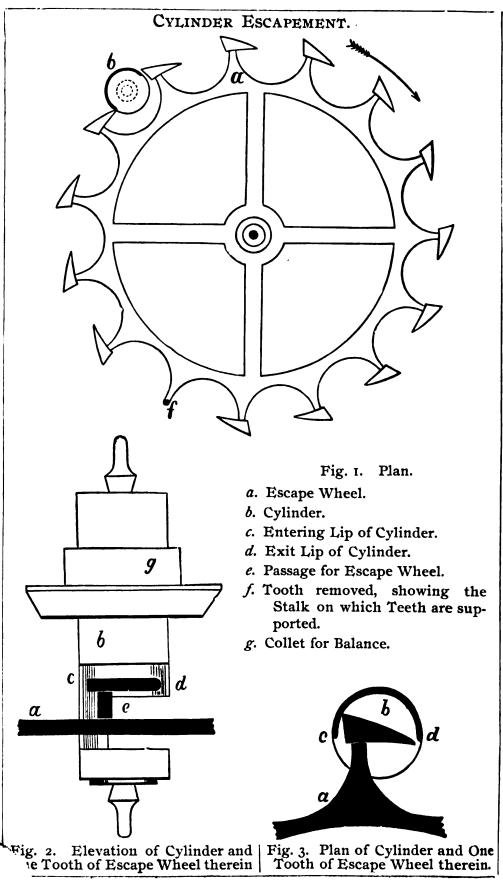
In a cylinder escapement, the escape wheel is horizontal — lying flat in the same plane as the other wheels of the going train. The teeth of the escape wheel are not cut in the conventional sense; they project upward from the rim at an angle, like a series of angled points arranged around the wheel's circumference.
The regulating element is the cylinder itself — a hollow tube of hardened steel mounted on the balance staff, with a slot cut through its wall. As the escape wheel rotates, its teeth enter and leave this slot alternately, each tooth passing through the cylinder wall, giving a small impulse to the balance as it does so, then locking against the outside of the cylinder until the balance swings back and allows the next tooth to enter.
Because the escape wheel lies flat, the entire escapement occupies very little vertical space. This was the cylinder's great practical advantage: it allowed watches to be made dramatically thinner than was possible with the upright crown wheel of the verge. It also operated without the recoil that characterised the verge — the escape wheel advanced only forward, never backward, giving a smoother action.
Weaknesses of the Cylinder
The cylinder escapement had two fundamental problems that eventually ended its dominance. First, it was a frictional rest escapement — the balance was in continuous sliding contact with the escape wheel teeth throughout its arc, unlike the lever escapement in which the balance is free for most of its swing. This continuous friction required oil at the contact points, and as oil dried or degraded, timekeeping suffered. A dry cylinder escapement runs poorly; an unworn one properly cleaned and oiled can keep excellent time.
Second, the cylinder walls were thin and vulnerable. The hardened steel tube could crack from a sharp blow or from the stresses of heavy-handed winding. Broken cylinders are the most common fault in cylinder watches and one that requires specialist skill to repair, since replacement cylinders must be turned to fit each individual escape wheel.
Ruby cylinders. From the mid-eighteenth century, fine watchmakers began making the cylinder from synthetic ruby (corundum) rather than steel. A ruby cylinder is harder, more dimensionally stable, and — crucially — requires less oil at the contact faces, improving long-term timekeeping. Ruby cylinders are a mark of a quality movement and are visible as a pale pink-red element when the movement is examined under magnification.
Tompion, Graham, and the English Cylinder
The cylinder escapement is generally attributed to Thomas Tompion, who is believed to have conceived the basic principle around 1695. His nephew and successor George Graham refined and perfected it, presenting a fully developed cylinder escapement to the Royal Society in 1726. Graham's version — with the escape wheel's upward-pointing teeth engaging a carefully proportioned hollow cylinder — became the standard English form and remained essentially unchanged for the rest of the escapement's working life.
Graham himself made cylinder watches of extraordinary quality throughout his long career. His movements, signed "Geo. Graham London" on the pillar plate, are among the most sought after of all English pocket watches. He was followed by a generation of London makers who adopted the cylinder as their preferred escapement for quality work: Ellicott, Mudge (before his lever work), Recordon, and many others.
The English Cylinder Watch
A typical quality English cylinder watch of the 1730–1800 period has several characteristic features. The movement is full-plate — a single top plate covering most of the dial side of the movement, supported on brass pillars. The going train uses a fusee connected to the mainspring barrel by gut or chain, providing even power delivery. The balance is a plain steel or brass wheel without compensation; temperature compensation came later. The dial is white enamel with Roman numerals, and the case is silver, sometimes in a pair-case arrangement though the cylinder's thinner profile also allowed single cases.
English cylinder watches were typically wound through the dial — the winding key engages a square on the front of the movement, inserted through a hole in the dial at the six o'clock position or via the pendant. This key-wind arrangement is characteristic of the period and distinguishes these watches from later keyless-wind movements.
The Swiss Cylinder Watch
While English makers moved steadily toward the lever escapement from the 1790s onward, the Swiss industry in Geneva and the Jura took a different path. Swiss watchmakers — particularly those working for the luxury and export markets — continued to develop the cylinder escapement throughout the first half of the nineteenth century, producing watches of exceptional thinness and elegance that the lever could not easily match.
- Full-plate movement, fusee
- Typically key-wind through dial
- Silver pair case or single case
- Plain enamel dial, Roman numerals
- Steel or ruby cylinder
- 1726–c.1820 main period
- Signed London makers most valued
- Three-quarter or bar-movement; often no fusee
- Key-wind or later keyless crown-wind
- Very thin gold or silver cases
- Engine-turned or enamel dial, often with seconds
- Ruby cylinder preferred
- 1780–c.1870 main period
- Geneva and Le Locle makers dominant
The Swiss cylinder watch reached its artistic peak in the period 1800–1860, when Geneva ateliers produced extraordinarily thin watches — some barely 4mm from back to crystal — with engine-turned gold cases, elaborate enamel dials, and impeccably finished movements. These watches were luxury objects of the first order, owned by the wealthy across Europe and the expanding export markets of Asia and the Americas.
Abraham-Louis Breguet, though primarily associated with his own escapement inventions, made significant use of the cylinder in his early work and contributed refinements to its construction. His montres souscription — subscription watches made in series for economy — used the cylinder and demonstrate that it was suited to simplified as well as elaborate production.
The Decline of the Cylinder
The lever escapement — invented by Thomas Mudge in 1769 and commercialised from the 1780s onward — was decisively superior to the cylinder in almost every practical respect. It was more accurate (a detached escapement, free from continuous friction), more robust (the cylinder's thin walls were easily damaged), more repairable (cylinders required specialist turning; levers could be replaced with standard parts), and equally suited to thin cases once construction was refined.
English makers had largely abandoned the cylinder by 1820. Swiss makers held on longer, partly from conservatism and partly because they had perfected the cylinder to a degree that made it genuinely competitive in their specific market — ultra-thin luxury watches — where the lever's slight additional thickness was a real disadvantage. By the 1860s, however, improved lever design had overcome even this objection, and the cylinder disappeared from new production.
How to Identify a Cylinder Watch
Several features distinguish a cylinder watch from a verge or lever example without needing to disassemble the movement.
- No fusee on many Swiss examples — Swiss cylinder watches often dispensed with the fusee that English cylinder and verge watches always used. The absence of the cone-shaped fusee pulley in a pre-lever movement suggests a Swiss cylinder.
- Flat escape wheel — visible through the top plate or balance cock aperture. A flat wheel with upward-pointing teeth, rather than the crown wheel of a verge, identifies the cylinder.
- No visible pallet fork — lever watches have a prominent pivoted fork between the escape wheel and balance. Cylinder watches have no such component; the escape wheel engages the balance staff directly.
- Very thin case profile — particularly on Swiss examples, which were engineered for minimum thickness.
- Key-wind — most cylinder watches are key-wound. A pocket watch that is key-wound and predates c.1870 is almost certainly either verge, cylinder, or an early lever.
Servicing and Running
A cylinder watch in good condition, properly cleaned and oiled, is a reliable and satisfying timekeeper. Unlike the verge, the cylinder escapement is not especially difficult to regulate, and a skilled watchmaker familiar with the type can set up a good example to run within a minute or two per day.
Cylinder repair requires a specialist. The most common fault — a cracked or broken cylinder — requires turning a new cylinder to match the existing escape wheel, which is precision lathe work beyond the capability of most general repairers. A broken cylinder in an otherwise excellent movement is not a reason to pass it by, but budget for specialist repair. In England, the British Horological Institute can advise on watchmakers competent to work on cylinder escapements.
Values and What to Buy
Cylinder watches remain somewhat overlooked compared to verge-fusee pieces of similar age and quality, which makes them excellent value for the knowledgeable collector. A signed London cylinder by a named maker — Ellicott, Recordon, Perigal — in a silver case with a good dial can be found at auction for a fraction of what a comparable signed verge would cost. Swiss luxury cylinders in gold cases are more actively collected and priced accordingly, but still represent good value relative to their craftsmanship.
Condition is paramount. Prioritise original dials (no cracks or restoration), original hands (period-appropriate form), matching case and movement dates (check hallmarks on English examples), and a movement that has not been butchered by incompetent repair. A non-running cylinder with a broken cylinder staff is a reasonable purchase if priced accordingly and you have access to a specialist repairer.
For related reading see Verge & Fusee Pocket Watches, Pair-Cased Watches, and History of the Pocket Watch.