
Deck Watches — Naval Precision Timekeepers
A deck watch is a precision pocket watch used at sea to transfer Greenwich Mean Time from the ship's marine chronometer — secured below decks in its gimballed box — to the officer taking a celestial observation on the open deck. The chronometer was too valuable and too sensitive to be carried about the ship; the deck watch, checked daily against it, was the instrument that actually went aloft with the sextant.
To determine a ship's longitude, a navigator needed to know the exact time at Greenwich at the moment of observing the sun or stars. A deck watch error of four seconds corresponds to a longitude error of one nautical mile at the equator. The deck watch therefore needed to be accurate, consistent, and robust — a working instrument of precision, not a dress accessory. The finest deck watches are among the most accurate portable timekeepers ever made.
Why Precise Time Mattered at Sea
The problem of finding longitude at sea — knowing how far east or west a ship had sailed — defeated navigators for centuries. Latitude could be determined by the height of the sun or Pole Star above the horizon. Longitude required knowing the time at a reference meridian (Greenwich, for British navigators) at the moment of observation: the difference between local solar time and Greenwich time, converted at fifteen degrees per hour, gives the longitude directly.
The solution — a timekeeper accurate enough to keep Greenwich time across weeks at sea — was the marine chronometer, developed through the extraordinary efforts of John Harrison in the mid-eighteenth century. Harrison's H4 of 1759, a large pocket watch rather than a clock, demonstrated that a spring-driven timekeeper could keep time at sea to the accuracy required by the Longitude Act. His work, and the subsequent improvements by John Arnold and Thomas Earnshaw in the 1780s, established the marine chronometer as the navigator's essential instrument.
For the full story of Harrison's achievement, see John Harrison and the Longitude Problem.
The Role of the Deck Watch
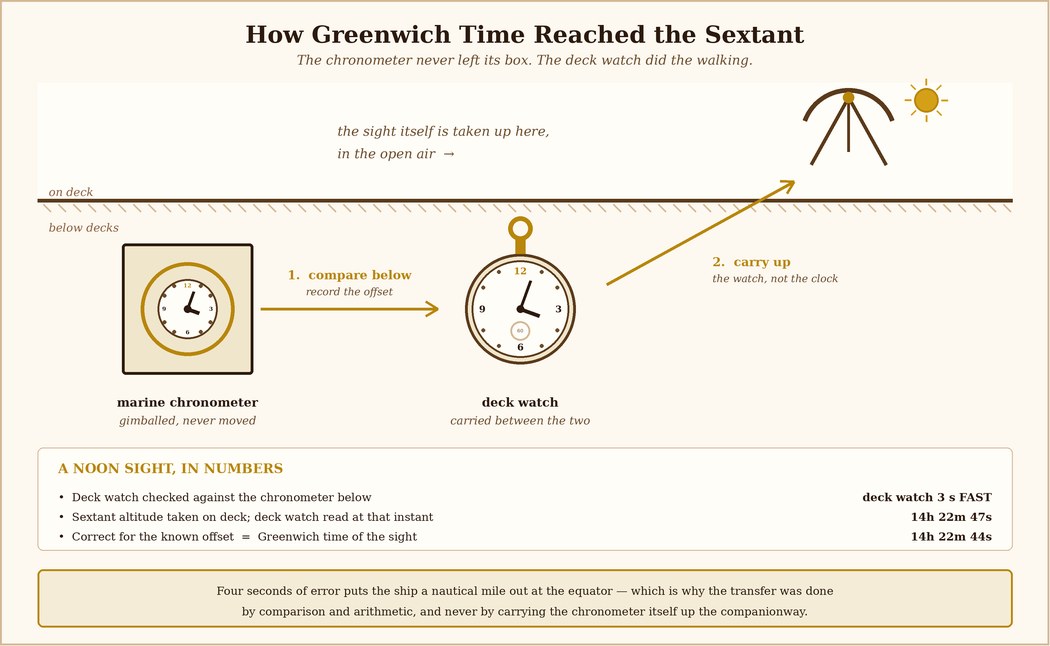
Once the chronometer was established as the standard method of finding longitude, a practical problem arose: the chronometer was kept below decks, in a gimballed box that allowed it to remain level regardless of the ship's motion, in the most stable temperature environment the ship could provide. Taking the chronometer on deck to use alongside the sextant would expose it to shock, spray, and temperature variation — the very conditions it had been so carefully protected from.
The deck watch was the solution. The navigator would note the exact chronometer time below decks, carry the deck watch — set to within a known error of the chronometer — to the observation point, record the time of observation on the deck watch, and then correct the reading for the known offset. Alternatively, two officers would work together: one taking the sextant observation, the other calling out the deck watch time at the moment of observation.
What Makes a Deck Watch
A deck watch looks, at first glance, like a large open-face pocket watch. It typically measures 55–65mm in diameter — considerably larger than a standard pocket watch — and is housed in a plain, heavy-duty case of silver, chrome, or stainless steel with a hinged back. The dial has Arabic numerals, a prominent seconds hand (usually centre seconds or a large subsidiary seconds at six o'clock), and often a 24-hour scale to avoid AM/PM ambiguity at sea.
Internally, the deck watch is a far more sophisticated instrument than an ordinary pocket watch. Quality examples carry 15 to 21 jewels, adjustment to five or six positions and temperature, and a lever escapement regulated to the highest standard. Many have a detent escapement — the same type used in marine chronometers — which is more accurate than the lever but fragile if jarred. Military-issue deck watches typically specify lever escapements for their greater robustness.
| Feature | Typical Specification |
|---|---|
| Size | 55–65mm diameter; heavier and thicker than a dress pocket watch |
| Case | Plain silver, chrome, or stainless steel; heavy bow for security on a lanyard; hinged back |
| Dial | White enamel, Arabic numerals, 24-hour ring, prominent seconds indication |
| Escapement | Lever (most military issue) or detent (finest quality) |
| Jewels | 15–21 jewels; finest examples 19 or 21 |
| Adjustment | 5–6 positions, temperature; finest adjusted to isochronism |
| Running time | Typically 56 hours (two days plus reserve) |
| Seconds hand | Centre seconds or large subsidiary at 6 o'clock; dead-beat seconds on the finest examples |
The hack feature. Many deck watches — and all serious precision watches used for time transfer — have a hacking mechanism: pulling the crown stops the seconds hand dead, allowing the watch to be synchronised to an external time signal to the exact second. Releasing the crown restarts the movement. The presence of a hack feature on a deck watch is functionally important and a mark of serious horological intent.
English Deck Watches
Britain's long naval supremacy created the world's largest market for marine precision timekeepers, and the great English chronometer makers naturally produced deck watches as part of their range. Firms such as Thomas Mercer, Dent, Kullberg, and Frodsham supplied both the Royal Navy and merchant marine with deck watches that were rated and certified before issue. Many carried Admiralty broad arrow marks stamped into the case, indicating naval property.
Thomas Mercer of St Albans — founded 1858 and still producing marine chronometers today — is the most commonly encountered English name on antique deck watches. Mercer supplied the Royal Navy throughout both World Wars and into the 1970s; a broad-arrow-marked Mercer deck watch in its original carrying tin is a complete and highly collectable piece of British naval history.
Swiss Deck Watches
Switzerland's precision watchmaking tradition made its firms natural suppliers of deck watches to navies worldwide. Ulysse Nardin of Le Locle was the pre-eminent Swiss name in marine precision timekeeping and supplied deck watches and chronometers to over fifty national navies. A Ulysse Nardin deck watch with its original certificate and tin is the most sought after Swiss example at auction.
Longines, Omega, IWC, and Zenith all produced precision deck watches, typically to military contracts during the First and Second World Wars. These wartime instruments were made in quantity, are more commonly encountered, and represent an accessible entry point for the collector who wants a genuine naval timekeeper without paying premium prices for a Mercer or Ulysse Nardin.
German and Russian Deck Watches
The Imperial German Navy and Kriegsmarine both issued deck watches, typically from makers such as Wempe and Lange & Söhne. German naval deck watches of both World Wars are actively collected, particularly those retaining original military markings and cases. Soviet and Russian naval deck watches from the Cold War period — often based on pre-war German designs — are plentiful and inexpensive, offering good entry-level precision instruments for the collector on a budget.
American Deck Watches
The United States Navy issued deck watches from American makers including Hamilton and Waltham. Hamilton's Model 22 and related grades were produced specifically for US Navy use during the Second World War, to the highest specifications the American industry could achieve. Hamilton's Model 22 is a 21-jewel movement adjusted to six positions, in a heavy chrome case — a superb working instrument and an important piece of American horological and military history.
What to Look For
Completeness is paramount in deck watch collecting. A deck watch that retains its original carrying tin or box, its original certificate or rating document, and any service records is worth considerably more than a watch alone. The certificate often gives the date of manufacture, the movement's adjusted rate in multiple positions, the maker's test results, and the issuing authority — irreplaceable provenance.
Military-marked examples — broad arrow (British), US Navy eagle, German Kriegsmarine markings — are more sought after than civilian equivalents of the same mechanical quality. Authenticity of these markings should be verified; military collecting attracts fakes and enhanced examples.
The movement should be examined by someone competent to assess precision instruments. A deck watch that runs but runs poorly may have suffered damage to the regulator or balance spring that affects its rate consistency — the one quality that matters above all others in these watches. A clean, accurate, original example in a plain case is always preferable to a cosmetically fine watch that keeps poor time.
For related reading see John Harrison and the Longitude Problem, Military Pocket Watches, and Grades & Jewels Explained.