
How to Identify a Pocket Watch, in the Right Order
Almost everybody starts in the same place, and it is the wrong place. The case is what you can see, it is where the gold marks are, and it usually carries a number. So that is where people begin — and it is the one part of an antique pocket watch that will not tell you what the watch is or when it was made.
This page is the order to work in. Each step says what to look at, what it settles, and what it cannot settle, then points at the page on this site that goes into it properly. It is deliberately short: it is a map, not the territory.
Why the Case Is the Wrong Place to Start
For most of the period collectors care about, an American pocket watch was not sold as one object. The movement was made by one firm — Waltham, Elgin, Hamilton, Illinois — and the case by another, such as Keystone, Fahys or Dueber. They were brought together by the jeweller at the point of sale, to the customer’s budget. A watch could be re-cased at any time in the following century, and many were.
The short version: the case serial number identifies the case and the firm that made it. It does not identify the watch and it will not date the watch. Only the number on the movement will do that. If the two disagree, that is normal and not evidence of a fake.
British and Swiss practice differs, and the exceptions matter — a British case carries an assay office’s date letter and can genuinely be dated to the year, which is the one case marking that beats the movement for precision. That is step four. Get the movement read first anyway, because it tells you what the watch is.
The Order to Work In
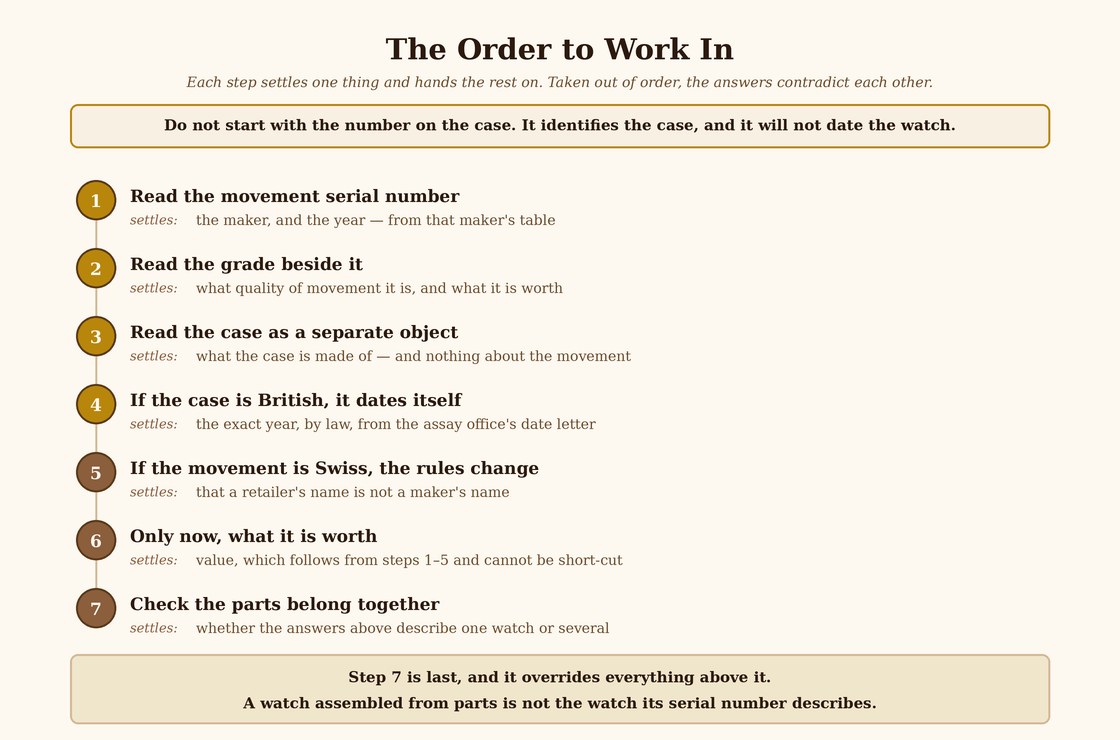
| Step | Where to look | What it settles | What it cannot settle |
|---|---|---|---|
| 1 | Movement serial number | Maker and approximate year | Value; whether the case is original |
| 2 | Grade name or number beside it | Quality tier, jewel count, what it is worth | Age |
| 3 | Marks inside the case back | What the case is made of | The age of the movement |
| 4 | British hallmarks, if present | The assay year of the case, exactly | The age of the movement |
| 5 | Swiss or European maker’s mark | The maker, sometimes | A production year — no Swiss equivalent of the American tables exists |
| 6 | Grade, metal, condition together | A realistic value range | What any one buyer will pay |
| 7 | Dial, hands, movement fit | Whether the parts belong together | Nothing — do this before believing steps 1 to 6 |
1. Read the Movement Serial Number
Everything else on this page depends on getting this one number, and it is inside the watch rather than on it. The engraving on the movement plate is what the maker’s year tables are indexed by; on an American watch it will usually also carry the maker’s name, which settles step one and the question of who made it in the same glance.
Six American makers have published year tables: Waltham, Elgin, Hamilton, Illinois, Hampden and E. Howard & Co. Five of the six rest on published serial lists — derived from company records, rounded in places, and reprinted for decades — so treat the year as an estimate of a year or two either way rather than a fact. E. Howard is the exception and needs reading differently: it numbered by series and watch size rather than by date, so two Howards with very different serials can be the same age.
› Pocket watch serial numbers — the six tables, and how accurate each one actually is · the serial number look-up app
2. Read the Grade Beside the Serial
Stamped near the serial number there is usually a grade — a name such as Riverside, Vanguard or Crescent Street, or a bare number, plus a jewel count. The grade is easy to overlook, and it moves the price further than the date does.
The serial number dates the watch; the grade prices it. That is why this step is not optional. Ask a collector what a watch is worth and the first thing they will ask for is the grade, not the year — and a sale listing that gives a serial number but no grade is usually a listing written by somebody who never opened the back.
› Pocket watch grades and jewels explained · railroad-grade standards, which are the top tier
3. Now Read the Case, as a Separate Object
Having got the movement settled, treat the case as its own question. The marks stamped inside the back tell you what it is made of, and that is a different claim from what it looks like. America never had an assay office, so an American case mark is the maker’s own statement about its own product rather than an independent guarantee.
For identification the case answers exactly two questions: what it is made of, and which firm made the case. Both are worth knowing and neither one dates the watch. Do not settle either by eye — the alloys were named to be mistaken for silver and gold, and judging a case by its colour is the commonest way an inherited watch gets mispriced. Read the actual stamps.
› Pocket watch case markings — a decoder for 34 markings in 155 spellings · case types, sizes and how they open
4. If the Case Is British, It Dates Itself
This is the exception to everything above. A British silver or gold case was assayed by law at one of eleven independent offices, each of which struck a date letter that changed annually. Where those marks survive, the case can be dated to the year — more precisely than any American movement table will date a movement.
Read four marks in order: the standard mark (what the metal is), the town mark (which office), the date letter (which year), and the maker’s mark. The date letter only means a year once you know which town struck it — the same letter recurs in different years at different offices.
› How to read English hallmarks · a look-up covering all eleven offices at once · hallmarks on watch cases
5. If the Movement Is Swiss, the Rules Change
Swiss and Continental movements were made in enormous variety by firms that often did not sign their work, and were frequently sold under a retailer’s name rather than the manufacturer’s. Expect to identify a Swiss watch by its maker’s mark, its calibre layout and its case marks rather than by a serial table.
There is no Swiss equivalent of the American serial-number year tables. A Swiss serial number will very often not produce a year at all, from any source. This is a real limit, not a gap in the research.
› Makers’ marks — illustrated guide · the Swiss industry · movement types
6. Only Now, What It Is Worth
Value follows from the first five steps and cannot be short-cut past them. It is a function of grade, metal, condition and originality, roughly in that order, and it is the reason step two matters more than step one for anybody thinking about selling.
› What an antique pocket watch is worth · getting one appraised · what they have actually sold for
7. Check the Parts Belong Together
Do this last, and then let it override everything else. A re-cased watch is ordinary and honest. A watch with a replaced dial, a swapped movement or a modern reproduction case is a different proposition, and the identification you have just done will describe a watch that never existed as a single object.
› Fake and married pocket watches · a buyer’s guide to spotting them
Further Reading
- Pocket watch serial numbers — six makers’ tables, with an honest account of where each one came from.
- Pocket watch grades and jewels — the part of the movement that decides the value.
- Pocket watch case markings — a decoder for the stamps inside the case back.
- English silver hallmarks — all eleven assay offices, 1559 to 1924.
- Collecting antique pocket watches — where to start if the watch turns out to be interesting.