
Pocket Watch Auction Records
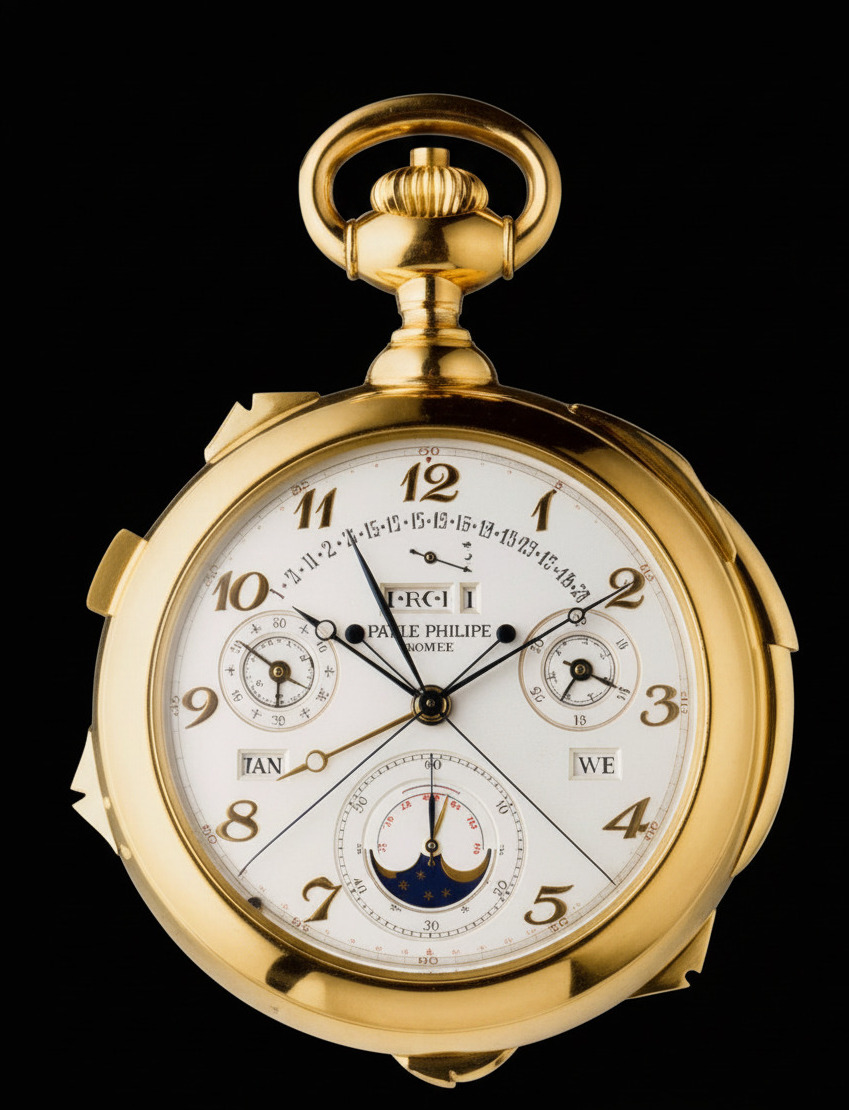
The finest antique pocket watches sell at auction for sums that astonish those who think of them merely as old timekeepers. The world record for a pocket watch — a Patek Philippe grande complication — exceeds twenty million dollars. The reasons are not mysterious: the best pocket watches are simultaneously triumphs of mechanical ingenuity, works of decorative art, and objects with compelling historical provenance. No other category of antique combines these qualities in quite the same way.
This page covers the landmark auction results that define the top of the pocket watch market, and explains the factors that drive values at every level — from museum-grade complications to the finest American railroad watches.
The Henry Graves Supercomplication — the Ultimate Pocket Watch
The Patek Philippe Henry Graves Supercomplication is the most celebrated pocket watch ever made. Commissioned in 1925 by Henry Graves Jr., a New York banker and passionate collector, it was completed in 1933 after six years of design and construction. The watch contained 24 complications, including a perpetual calendar, a minute repeater, a grande and petite sonnerie, a split-seconds chronograph, an equation of time, a sunrise/sunset display, and a celestial chart of the night sky as seen from Graves's New York apartment at 834 Fifth Avenue.
At the time of its completion it was the most complicated pocket watch ever made — a record it held until 1989, when Patek Philippe's own Calibre 89 surpassed it with 33 complications. The Graves Supercomplication sold at Sotheby's Geneva in 1999 for $11 million — then a world record for any timepiece. It sold again at Sotheby's Geneva in November 2014 for $23.98 million, a record for a pocket watch that stands at the time of writing.
The Packard and the Graves — a rivalry in complications. The Graves Supercomplication was not made in isolation. James Ward Packard, founder of the Packard Motor Company, had commissioned a pocket watch from Patek Philippe in 1927 with 16 complications — including a star map of the night sky above Warren, Ohio. Packard died before it was delivered. The rivalry between Packard and Graves had been a significant stimulus to both commissions. The Packard watch later sold at auction for $21 million.
Major Auction Records — Swiss Pocket Watches
| Watch | Sale | Price (approx.) |
|---|---|---|
| Patek Philippe Henry Graves Supercomplication — 24 complications, yellow gold, 1933 | Sotheby's Geneva, 2014 | $23.98 million |
| Patek Philippe James Ward Packard — 16 complications, yellow gold, 1927 | Sotheby's New York, 2016 | $21 million |
| Patek Philippe Calibre 89 — 33 complications, created 1989, one of four examples | Antiquorum, 2009 | CHF 5.1 million |
| Patek Philippe Reference 912 Perpetual Calendar — minute repeater, split-seconds chronograph, gold, c.1900 | Christie's, 2012 | CHF 3.8 million |
| Vacheron Constantin Tour de l'Île — pocket watch version, 16 complications | Antiquorum | CHF 1.5 million |
| Breguet No. 2667 — ruby cylinder, circa 1800, signed movement with original case | Christie's | CHF 800,000+ |
| A. Lange & Söhne Grande Complication — perpetual calendar, rattrapante, minute repeater | Phillips, 2018 | €1.3 million |
Note: figures are approximate hammer prices. Final buyer's premiums add 20–25% to these amounts. Currency fluctuations mean CHF/USD/EUR comparisons vary by date.
American Pocket Watch Records
The finest American railroad-grade pocket watches do not approach the stratospheric prices of grand complications, but at the upper end of the American market, exceptional examples in original condition command very significant sums.
| Watch | Notes | Price Range |
|---|---|---|
| Hamilton Grade 950B, 23J, adj. 6 pos., solid gold case | The finest Hamilton — exceptional examples with original dials and cases | $2,000–$8,000+ |
| Waltham Vanguard 23J, solid gold case, original condition | Waltham's finest; 23J examples rare in solid gold | $1,500–$6,000+ |
| E. Howard Series I or II, original case, high grade | The earliest and rarest Howard series; Boston's finest work | $3,000–$12,000+ |
| Elgin Veritas 23J, solid gold case | Extremely rare; 23J Veritas one of the rarest standard American grades | $2,500–$9,000+ |
| Illinois Bunn Special 23J, solid gold case | Top Illinois grade; 23J extremely scarce | $2,000–$7,000+ |
| Ball 999 or 999B, adjusted 6 pos., original case | Ball's highest specification; all movements by third-party makers | $1,500–$5,000+ |
American pocket watch values are notably sensitive to condition. An identical grade in an original, unpolished, untouched case with a perfect original dial may be worth three or four times an equivalent movement in a worn case with a replaced or restored dial.
The Value Factors
Maker
Patek Philippe, Vacheron, Audemars Piguet command premiums that dwarf the raw mechanical quality of the watch. For American watches, Hamilton, Howard, and original-series Elgin are at the top.
Complications
Each additional complication adds value, but not linearly. A minute repeater alone is valuable; add a perpetual calendar and split-seconds chronograph and the value multiplies. The three grand complications together — what collectors call a "grande complication" — represent the highest tier.
Grade & Jewels
For American watches, 23-jewel movements adjusted to six positions are worth a substantial premium over 21-jewel adjusted-five examples. The difference between a 17-jewel and a 21-jewel movement in similar cases can be two to three times the value. See Grades & Jewels.
Case Material
Solid gold cases — 14k or 18k — add both collector and intrinsic metal value. Gold-filled cases are valued for the watch; solid gold cases add the metal premium on top. A solid gold case on a fine movement is always significantly more valuable than gold-filled.
Originality
The single most important value factor below the top tier. A watch with its original dial, original hands, original matched case, and no replaced parts is always worth more than a mechanically equivalent watch that has been restored, re-dialled, or re-cased. Untouched patina beats restoration.
Provenance
Documentation of a watch's history adds value, particularly for important pieces. A presentation inscription from a notable employer, a letter of service for a railway company, or an auction provenance from a famous collection all strengthen value. Faked provenance is unfortunately common at the top end.
Condition
Distinct from originality. A watch can be original but worn; another can be original and in near-mint condition. Pristine condition — sharp case edges, crisp engine turning, perfect dial, unworn movement — commands a premium at every level of the market.
Rarity
Some grades were made in tiny numbers relative to their quality. The Hamilton 950B, the Elgin 23J Veritas, and the Waltham 23J Vanguard are all rarer than their 21-jewel equivalents. Serial number research and production records help establish relative rarity.
Where the Best Results Are Achieved
The highest prices for important pocket watches are achieved at specialist horological auctions rather than general antique sales. The principal houses for significant watches are Phillips Watch Auctions (Geneva and New York), Christie's, Sotheby's, Antiquorum (Geneva), and Bonhams in the United Kingdom. In the United States, Heritage Auctions handles American pocket watches effectively and has produced strong results for fine Hamilton, Waltham, and Howard pieces.
For everyday buying and selling of American pocket watches, eBay remains the most active marketplace. See eBay Pocket Watch Auctions for the current live listings, and Buying Pocket Watches for a complete guide to buying at all price levels.