
English Silver Hallmarks: How to Identify and Date a Piece
A silver spoon, a christening mug, a teapot and a pocket watch case are all marked the same way, by the same offices, under the same Acts. If you can read one you can read all of them. The marks are not a maker’s decoration: they are the residue of a compulsory test, struck by a public office that had assayed the metal and found it up to standard.
Nearly every guide prints a single national chart of date letters. That chart is the reason so many pieces get dated wrongly, because there was never one national cycle. There were eleven separate offices running eleven separate alphabets, changing them on different days of the year, dropping different letters, and occasionally not marking anything at all. This page holds 1,822 lettered years across 86 cycles and 11 offices, 1559 to 1924, transcribed from Sir Charles James Jackson’s tables of 1921 — and a lookup that answers all 11 at once.
Start With the Town Mark, Never the Letter
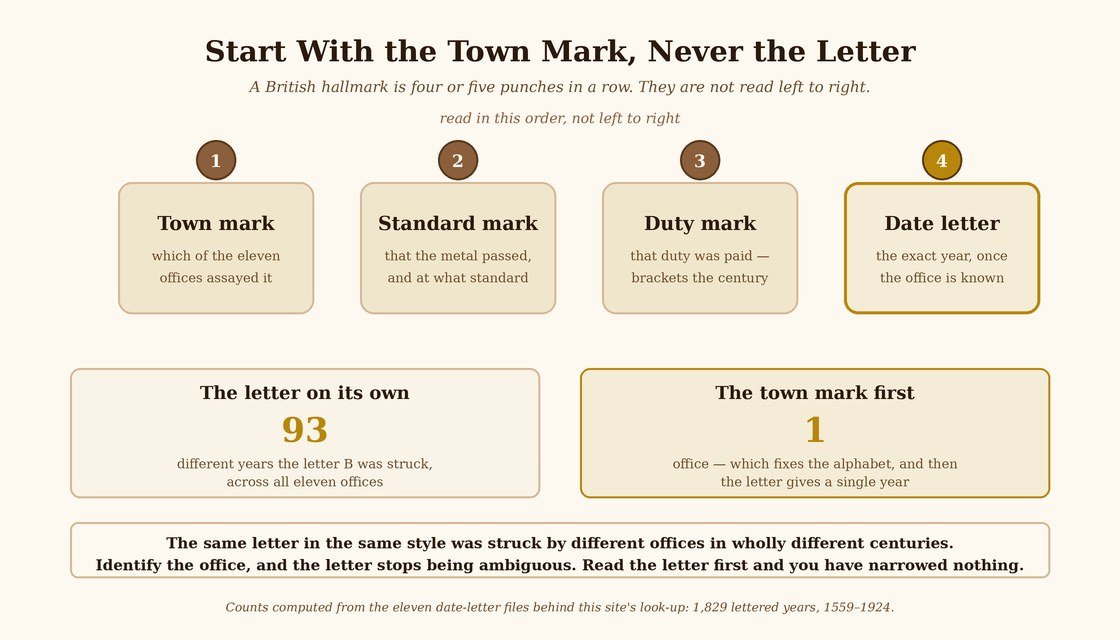
The date letter is the last mark you should read, not the first. On its own it is close to worthless: the same letter in the same style was struck by different offices in wholly different centuries. What narrows a piece to one alphabet is the town mark — the symbol of the office that tested it. Find that, and the letter becomes a date.
| Office | Town mark | Covered here | Lettered years | Gaps in the record |
|---|---|---|---|---|
| London | A leopard’s head — crowned to 1821, uncrowned after | 1678–1919 | 242 | continuous |
| Birmingham | An anchor | 1773–1924 | 152 | continuous |
| Sheffield | A crown; the York rose on gold from 1904 | 1824–1920 | 97 | continuous |
| Chester | Three wheatsheaves with a sword, from 1779 | 1695–1921 | 222 | 1698–1700 |
| Exeter | A triple-towered castle; a crowned X before 1701 | 1701–1882 | 182 | continuous |
| Newcastle | Three separate castles | 1721–1883 | 163 | continuous |
| York | A cross charged with five lions, from 1700 | 1559–1856 | 231 | 1714–1775 |
| Norwich | A castle over a lion | 1565–1697 | 50 | 1585–1623; 1644–1687 |
| Edinburgh | A three-towered castle | 1755–1921 | 167 | continuous |
| Glasgow | A tree, a fish and a bell | 1681–1921 | 128 | 1706–1818 |
| Dublin | A crowned harp — the standard mark, not a town mark | 1638–1920 | 188 | 1678–1772 |
Follow the office link and you get that office’s own two-way lookup, its plates photographed from Jackson, and the history that explains why its tables look the way they do. Use the tool below first if you are not yet sure which office you are holding.
Three Offices Used a Castle, and They Are Not Alike
The commonest misreading in provincial silver is a castle. Three offices used one, and a chart that prints them at thumbnail size will not separate them:
- Edinburgh struck one castle with three towers, and had done since 1485.
- Newcastle struck three separate castles in a shield, the arms of Newcastle upon Tyne.
- Exeter, from 1701, struck a triple-towered castle of its own — the arms of that city. Before 1701 it used a crowned letter X instead.
Count the towers, then count the castles. One castle with three towers is Edinburgh or Exeter; three castles arranged in a shield is Newcastle. Separating Edinburgh from Exeter is then easy on any piece after 1759, because Edinburgh adds a thistle and Exeter does not. Getting this wrong does not shift a date by a year — it moves the piece to a different country and a different alphabet.
Look Up a Year Across All Eleven Offices at Once
Every other date-letter tool on the web asks you to pick an office first. This one does the opposite: give it a year and it shows you what every office was striking that year, so you can match the letter you are actually looking at. Give it a letter and it shows you how many different years, in how many different towns, could have produced it.
All-office date-letter lookup
The lookup reads the same 11 data files the individual office pages read, so it cannot disagree with them. Where an office has no row for a year, it says so rather than guessing.
Why the Same Letter Means Eleven Different Things
Run a common letter through the tool above and the result is usually somewhere between forty and seventy candidate years. That is not a defect in the data; it is the actual state of the evidence, and it is what a single national chart conceals.
Three habits make it worse than simple repetition would:
- The offices disagreed about which letter to leave out. The rule everyone quotes is that cycles omit J. Birmingham ran two cycles that used the full twenty-six letters, and its 1824–1848 cycle did the opposite of the convention entirely: it dropped I and kept J. Chester’s 1726–1750 cycle does the same.
- Letter forms came round again. Chester’s cursive cycle of 1726–1750 was reused almost unchanged in 1901–1925. Only the other marks separate them — the later cycle carries no crowned leopard’s head.
- Some cycles printed both cases at once. Seven rows of one Chester cycle read B or b, D or d, I or i. In that cycle the case of the letter dates nothing at all.
The practical method is therefore the reverse of what the letter invites you to do. Read the town mark to fix the office; read the standard mark and the duty mark to bracket the century; then use the letter, and check its shape against the photographed plate on that office’s page rather than against a modern redrawing.
The Assay Year Is Not the Calendar Year
This is the error that quietly costs a year on a great many pieces. An office’s letter did not change on 1 January. It changed on the day that office elected its wardens or held its annual meeting, and every office picked a different day. A piece assayed in February wears the letter of the year that began the previous summer — which is why the tables print 1875–6 rather than 1875.
| Office | Letter changed | Detail |
|---|---|---|
| London | End of May | Britten gives 30 May; Jackson dates the older assay years from 29 May. |
| Birmingham | July | The Guardians met annually in July. The change moved to 1 January only in 1975. |
| Chester | July, then 5 August, then 1 July | July to 1839, 5 August to 1889, 1 July afterwards. |
| Exeter | After 7 August | The letter was appointed at the first Hall meeting after the wardens were elected on 7 August. |
| York | 29 July, from 1585 | Before 1585 the searchers were elected in January and the letter is taken to have changed with them. |
| Norwich | Michaelmas, 29 September | Each letter therefore served three months of one year and nine of the next. |
What this means in practice. A date-letter answer is a range that straddles two calendar years, not a point. If a piece must be dated to a single year — for a probate valuation or an insurance schedule — the honest answer is the pair, written as 1875–6. Any source that hands you one bare year has thrown information away.
The Standard Mark Is Not a Lion Everywhere
English sterling carries the lion passant, a lion walking with its right forepaw raised. Between 1697 and 1720 that lion was replaced by Britannia and a lion’s head erased, when the sterling standard was raised to stop silver coin being melted for plate. Both marks appear in the tables for London, York and Exeter.
North and west of that, the standard mark changes entirely:
- Edinburgh used no symbol at all before 1759 — the standard was guaranteed by a named person, the deacon, and from 1681 the assay master, whose own mark stood for it. The thistle arrives in 1759.
- Glasgow had no prescribed standard mark before 1819 and struck the letter S, sometimes O, instead. The lion rampant was prescribed from 1819 and a thistle added alongside it in 1914.
- Dublin has never had a separate town mark. The crowned harp is its standard mark, doing both jobs. Hibernia, added in 1730 and often mistaken for the city’s emblem, is a tax stamp for a duty on plate.
- Norwich used a crowned rose from 1581, the assay master’s oath binding him not to strike it on anything below standard.
The sovereign’s head duty mark is the most useful single mark on the piece for narrowing a date quickly, because it was struck only while the duty existed: from 1784 until its repeal in 1890. No duty mark on a piece that should carry one is as informative as the letter itself, and the reverse traps a good many reproductions.
Where a Hallmark Was Never Struck at All
The most useful thing these tables record is where the marking stops being a hallmark. Three cases matter, and no summary chart shows any of them:
- Norwich, for most of its history, had no working assay office. Jackson is explicit that the Norwich marks of those periods were in no sense hall marks but merely marks struck by the makers. A castle-over-lion is not evidence that anything was tested. That is why Norwich contributes only 50 lettered years to the table above out of more than a century and a half of marked silver.
- Exeter before 1701 had no statutory existence, and Jackson finds no evidence of a regular assay by cupel there before that year. A pre-1701 Exeter mark records who made a piece, not that anyone tested it. He believed Exeter used date letters earlier and argued the case — then deliberately refused to set them out in a column, so that his contention should not appear to gain support from any factitious aid.
- York’s town mark is frequently missing. Jackson’s own tables leave the York column blank row after row, so a genuine York piece may carry no York mark at all.
A chart that fills those spaces in has invented them. Where the record is silent, these pages say so — which is less satisfying than a complete grid, and considerably more useful when the question is whether a piece is what it claims to be.
Further Reading
- How to read English hallmarks — the step-by-step method with worked examples, mark by mark.
- Hallmarks on pocket watch cases — the same marks as they appear on cased watch work, with the gold and silver standards in full.
- Pocket watch case markings — what to do when the marks are not hallmarks: karat figures, gold-filled fractions, year guarantees and American case-maker trademarks, decoded.
- London hallmarks — the largest set of tables here, 1678–1919, and the office every other one was measured against.
- Chester hallmarks — the office the Liverpool watch-case trade used, and the longest provincial record on the site.
- Makers’ marks — the fourth mark, and the one that names a person.
- Pocket watch cases — materials, construction and how to tell silver from plate.
All date-letter tables on this site are transcribed from Sir Charles James Jackson, English Goldsmiths and Their Marks, 2nd edn, Macmillan, 1921 — public domain. Each office page reproduces the plates the transcription was made from, so any answer given here can be checked against the printed punch rather than taken on trust.