
Sheffield Hallmarks: the Crown, the Rose and the Sheffield Plate Trap
Sheffield's mark is a crown, and the single most expensive mistake made with Sheffield silver has nothing to do with reading it. Sheffield plate is not Sheffield silver. It is copper with a skin of silver fused to it, and it carries no hallmark at all — because it legally cannot. Jackson was careful enough about the confusion to head his tables Marks on Sheffield Silver Wares, explaining that the term Sheffield plate had been "misappropriated" to the town's old plated goods.
So the first question about a Sheffield piece is not what year. It is is this silver at all — and the marks answer that before the date letter is even reached.
A Crown for Silver, a Rose for Gold
The crown was adopted in 1773 and served as the town mark for two centuries. Tradition has it chosen at the same London tavern that gave Birmingham its anchor — the Crown & Anchor in the Strand, where the two delegations lobbied for their Act together. The office's remit was defined geographically rather than civically: Sheffield and twenty miles around it.
Gold is a later and separate story. Sheffield was not authorised to assay gold until the Act of 3 Edward VII, and began doing so on 1 March 1904. Gold assayed at Sheffield is not marked with the crown. It carries the York rose, which does for gold exactly what the crown does for silver.
A crown can appear on Sheffield gold, and it does not mean Sheffield. Jackson is explicit about it: on 22 and 18 carat gold a crown is struck alongside the figures 22 or 18 as part of the standard mark, and it has no connection with the crown stamped on silver. On a gold piece, look for the rose to place the office — not the crown. The five gold standards Sheffield marked were 22, 18, 15 (·625), 12 (·5) and 9 (·375) carat.
There is a neat irony in the later history. When the Hallmarking Act of 1973 took effect, the crown was retired and a rose became Sheffield's town mark for silver too. The rose had already meant "assayed at Sheffield" for seventy years — just on gold.
Sheffield Plate Is Not Sheffield Silver
The plating process was developed in Sheffield around 1742 by the cutler Thomas Bolsover: a sheet of silver fused to a copper ingot, then rolled out together so the silver stretched with the copper. The result looks like silver, wears like silver for a generation, and costs a fraction of it. It was made in enormous quantity, and it is genuinely collectable in its own right — but it is not sterling, and it never passed an assay office.
How to tell them apart on the bench:
- A full hallmark settles it. Lion passant, crown, date letter and maker's mark mean the piece was assayed. Plated wares carry none of that — using assay marks on them was prohibited precisely because they imitated the real thing so well.
- Look at wear points. Rims, high spots and handle edges are where the silver skin goes first, and copper shows through warm and pink against the white of the silver.
- Beware marks designed to look like hallmarks. Plate makers used their own device stamps, sometimes in a row of little shields, which read at a glance like an assay sequence. A row of marks is not the same as a hallmark.
For pocket watch collectors the practical point is narrower: a silver-cased watch will carry a proper hallmark inside the case back, so a Sheffield-marked case is silver by definition. Plated watch cases exist in quantity, but they are marked with makers' trade names and warranty claims rather than assay marks — a distinction covered on our page about the pocket watch case.
Fifty Years of Date Letters in No Order at All
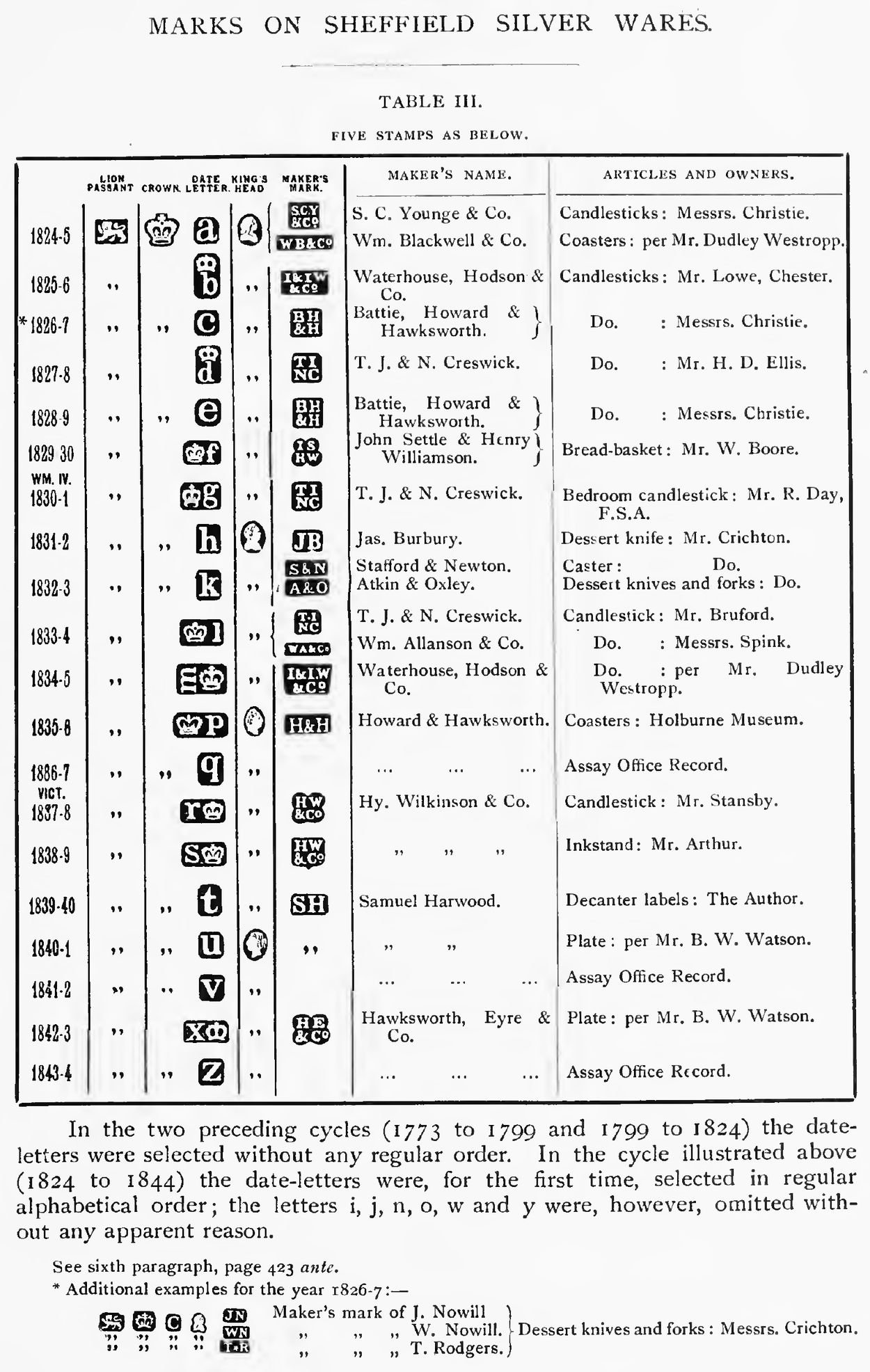
This is where Sheffield stops behaving like any other office. For its first two cycles, 1773 to 1824, the date letters were not in alphabetical order. They were chosen arbitrarily by the guardians at their annual meeting, and Jackson says so plainly: the letters "were selected without any regular order".
The opening run gives the flavour — 1773–4 is E, 1774–5 is F, 1775–6 is D, 1776–7 is R, 1777–8 is H. The E is traditionally explained as a compliment to the Earl of Effingham, who had led the Sheffield case in Parliament.
There is no method that will date those fifty years from the letter. No formula, no counting from a start year, and no general chart can help, because there is no rule to apply. The letter has to be matched against the plate. That is why the lookup below begins at 1824, and why Tables I and II are here as images to be read rather than as data to be queried. A tool that pretended to answer for those years would be guessing.
Date a Sheffield Crown Mark
Covers 1824 to 1920 — from the first cycle Sheffield put in alphabetical order to the end of Jackson's record. Enter a year before 1824 and the lookup will show you the right plate instead of an answer.
Sheffield date-letter lookup
The date letter changed on the first Monday in July, when the wardens for the coming year were elected, so every entry spans two calendar years. That held until 1974; from 1975 the change moved to 1 January.
The Cycles You Can Look Up
Even after Sheffield adopted alphabetical order it kept dropping letters, and never twice the same way.
| Jackson's table | Years | Letters | Omitted |
|---|---|---|---|
| I | 1773–1798 | No order at all — plate only | |
| II | 1799–1823 | No order at all — plate only | |
| III | 1824–1843 | 20, lower case | i, j, n, o, w, y |
| IV | 1844–1867 | 24, capitals | J and Q |
| V | 1868–1892 | 25, capitals | I |
| VI | 1893–1917 | 25, blackletter lower case | j |
| VII | 1918–1920 | 3 recorded, lower case | — |
Jackson could not explain the 1824 cycle either. Six letters — i, j, n, o, w and y — were dropped, in his words, "without any apparent reason". The next cycle omitted J and Q; the one after that omitted I but kept J.
The Crown Upside Down, 1815 to 1819
For five years the Sheffield crown was struck inverted. It looks like a blunder by a careless assay master and it was nothing of the kind. Jackson's explanation is that it was done deliberately, to separate letters being used again from their earlier appearances.
His example is exact: X is the date letter for both 1797–8 and 1817–18 — and in the later year the crown is upside down. On an office whose early letters ran in no order, that inverted crown is sometimes the only thing standing between a piece of 1797 and a piece twenty years younger.
Two more quirks of the Sheffield punches are worth knowing before you decide a mark is wrong:
- From 1780 to 1853 the crown and the date letter were often combined in a single punch on small items, so they appear together in one shield rather than as two marks. The practice was discontinued and never resumed.
- The enclosing shield is not consistent. Jackson notes that in some years it is oval and in others oblong. Shield shape distinguishes cycles at most offices; at Sheffield it is a weaker signal than you might expect.
Sheffield is one of the four British offices still assaying today, alongside London, Birmingham and Edinburgh. Unlike Chester, which closed in 1962, a Sheffield mark gives you no upper bound — only the letter, its style and the crown-or-rose question will narrow it.
Further Reading
- English hallmarks on pocket watch cases — the five marks and every assay office symbol.
- How to read English hallmarks — the step-by-step method, with worked examples.
- Birmingham hallmarks and the anchor mark — the office founded by the same Act, in the same tavern, on the same day.
- Chester hallmarks and date letters — the office the Liverpool watch-case trade used.
- What your pocket watch is worth — how a confirmed date affects value.
Plates: Sir Charles James Jackson, English Goldsmiths and Their Marks, 2nd edn, Macmillan, 1921 — public domain. The inverted crown, the combined punch and the omitted letters are Jackson's own notes on those plates; the first-Monday-in-July changeover, the twenty-mile remit and the 1975 change from crown to rose follow the Sheffield tabulation at silvermakersmarks.co.uk.