
York Hallmarks: The Mark That Changed Twice
York is the oldest assay town in this section, and its mark is on record in the city's own archive twelve years before the Act that authorised it. It is also the only town mark in the section that the leading nineteenth-century authorities described in three incompatible ways, with a fourth of them changing his mind twice — while every one of them was looking at real silver.
That disagreement is the practical problem with dating York plate: the thing that says York is not one mark but three, in three periods, and knowing which one you are holding narrows the date before you have read the letter at all.
Which York Mark Are You Looking At?
Jackson prints eleven York tables. They run from 1559 to 1856, with a fifty-nine-year hole in the middle where the office was shut and nothing was marked at all. The lookup below covers every lettered year in all eleven, and tells you which of the three town marks should be beside the letter.
York date-letter lookup
A letter alone will usually give you several York years, because eleven cycles share twenty-six letters. The town mark is what separates them, and after 1811 so does the letterform: blackletter small letters mean 1812–1836, Roman capitals mean 1837 or later.
The cycle buttons change the plate above. Stepping through them from 1559 to 1856 is the quickest way to watch the town mark change, which is what the rest of this page is about.
A Touch Twelve Years Before the Statute
Most assay offices begin with an Act. York's begins with a row about staffing.
A document in the city archives records a dispute among the York goldsmiths over whether there should be three searchers or only two — the officers whose job was to examine wares and mark the defective ones. The Mayor, Aldermen and citizens settled it on 5 March 1411: two searchers and no more, both to be English-born, chosen and duly sworn. Goldsmiths were required to bring their touch and mark as the statute directed, and anyone who had no mark was to make himself a punch. Sell a piece of gold or silver before “le comune touch de la dite cite” and the maker's mark were properly struck on it, and you forfeited six shillings and eightpence.
The common touch of the city is therefore on record in 1411. Statutory recognition arrives twelve years later, when the Act of 1423 — 2 Henry VI, c. 14 — refers to “the touch ordained in the City of York, according to the ordinance of its Mayor”. Parliament was not creating a York mark. It was acknowledging one the city had already made for itself, and Jackson gives York precedence over every other provincial guild for exactly that reason: it is the first town the Act names.
Goldsmiths worked there long before either date. York-made spoons appear in a will of 1366, and the earliest known reference to a York goldsmith is a late twelfth-century Latin document naming a man called Robert aurifaber.
Half a Leopard and Half a Lily
A York city minute of 1560 describes the mark in words, and the phrase is worth having exactly: “the halfe leopard head and half flowre de luyce”. A minute of 1606 repeats it. Those are the only two express descriptions of the old York mark in the record, and they are the reason we can name it at all.
What that means in practice is a single circular punch holding two half-devices joined down the middle: half a leopard's head and half a fleur-de-lys, dimidiated and conjoined, as Jackson puts it. From 1411 to about 1560 that mark and the maker's own were the whole of a York hallmark: two punches, no date letter.
The date letter arrives at about the 1560 minute, and Jackson is candid that the date is an inference rather than a record. There is no express mention of adopting one. What there is instead is a single object: a seal-top spoon in his own collection, struck with the old York mark, the maker's mark of Robert Gylmyn, and the letter D — a letter which, as he puts it, “cannot well be ascribed to any other year than 1562-3”. Count back three years from that spoon and you get the A of 1559–60 at the head of Table I.
The first three years of York dating rest on arithmetic. Jackson prints the A, B and C of 1559–62 in ordinary type rather than as illustrations of punches, because he had no example of any of them — the row simply reads Date-letter conjectured. Twelve of Table I's twenty-four rows read that way. The lookup on this page says so on every affected year, which a printed chart cannot do once the letters have been reset in a single typeface.
Four Experts, One Mark, and All of Them Right
For most of the nineteenth century the leading authorities on English plate could not agree what the York mark actually showed, and each of them was describing silver he had in front of him.
- Octavius Morgan
- “the Leopard's head crowned and fleur-de-lis dimidiated and joined together on one shield”.
- Chancellor Ferguson
- “a fleur-de-lis dimidiating a crowned rose in a circular stamp” — found on a large number of York examples.
- Wilfred Cripps
- Used Morgan's description, dropped it for Ferguson's, then went back to Morgan's when the city minutes came to light.
- William Chaffers
- “half lis and half rose crowned”, and stuck to it.
Jackson's verdict on the four of them is one of the best sentences in his book: “the strange thing about these varying descriptions is that they are each right and each wrong”.
The explanation is that the mark changed in 1632 and nobody recorded the fact. From 1562 down to 1631 the sinister half is a half leopard's head, exactly as the 1560 minute says. From 1632 until the office closed in 1698 that half is a crowned rose instead. Morgan and Chaffers had each described a real York mark; they had simply looked at silver from opposite sides of the change. Jackson notes that his own example for 1631–2 is much worn and might have been struck with the earlier stamp, but that in every later example the crowned rose can be distinguished with certainty. As to how the change came about, he writes plainly that “there appears to be no record of it”.
So the practical rule for a pre-1698 York piece is this: look at the half of the town mark that is not the fleur-de-lys. A leopard's head puts you before 1632. A crowned rose puts you after it. That is a seventy-year cut you can make from the town mark alone, with the date letter still unread.
A Cross Charged with Five Lions
The second change was legislated, and it swept the old mark away entirely.
The Act of 1696–7 raised the standard to Britannia and suspended the statutory existence of every English provincial assay office. Jackson's York letters run on to the S of 1699–1700 and then stop — and that final S survives not on a piece of silver but stamped on a small brass plate from the assay office itself. When York was re-established by the Act of 1700–1, the distinguishing mark was changed in compliance with it, and the city put up its own arms instead: a cross charged with five lions passant. Britannia and the lion's head erased were added to mark the higher standard while it was compulsory, and the maker's mark became the first two letters of the surname, as in London. Three punches became five.
Look again at the lead plate above and you can see what that did to the shape of the thing. The old York mark was a circle. The new one is cut as a cross — the punch outline follows the charge. It changes shape twice more afterwards without changing its content at all: an angular shield on the pieces of the 1770s and 1780s, and from 1787 an oval stamp. Same five lions, same cross, three different silhouettes.
| Period | What the town mark is | Shape of the punch |
|---|---|---|
| c.1560–1631 | Half leopard's head, half fleur-de-lys, conjoined | Circular |
| 1632–1698 | Half crowned rose, half fleur-de-lys, conjoined | Circular |
| 1700–1717 | Arms of the city: a cross charged with five lions passant | Cut as a cross |
| c.1776–1786 | The same arms | Angular shield |
| 1787–1856 | The same arms | Oval |
One further caution, because it catches people out in the other direction. The Sheffield Assay Office took the white rose of York as its town mark in 1975. It has no connection whatever with the York office, which had been shut for more than a century by then and never used that mark. A rose on modern Sheffield silver is a Sheffield mark; see Sheffield hallmarks and the crown for what it replaced.
The York Mark Is the One Most Often Missing
On York silver, the town mark is the punch most likely not to be there — an awkward fact on a page about the town mark.
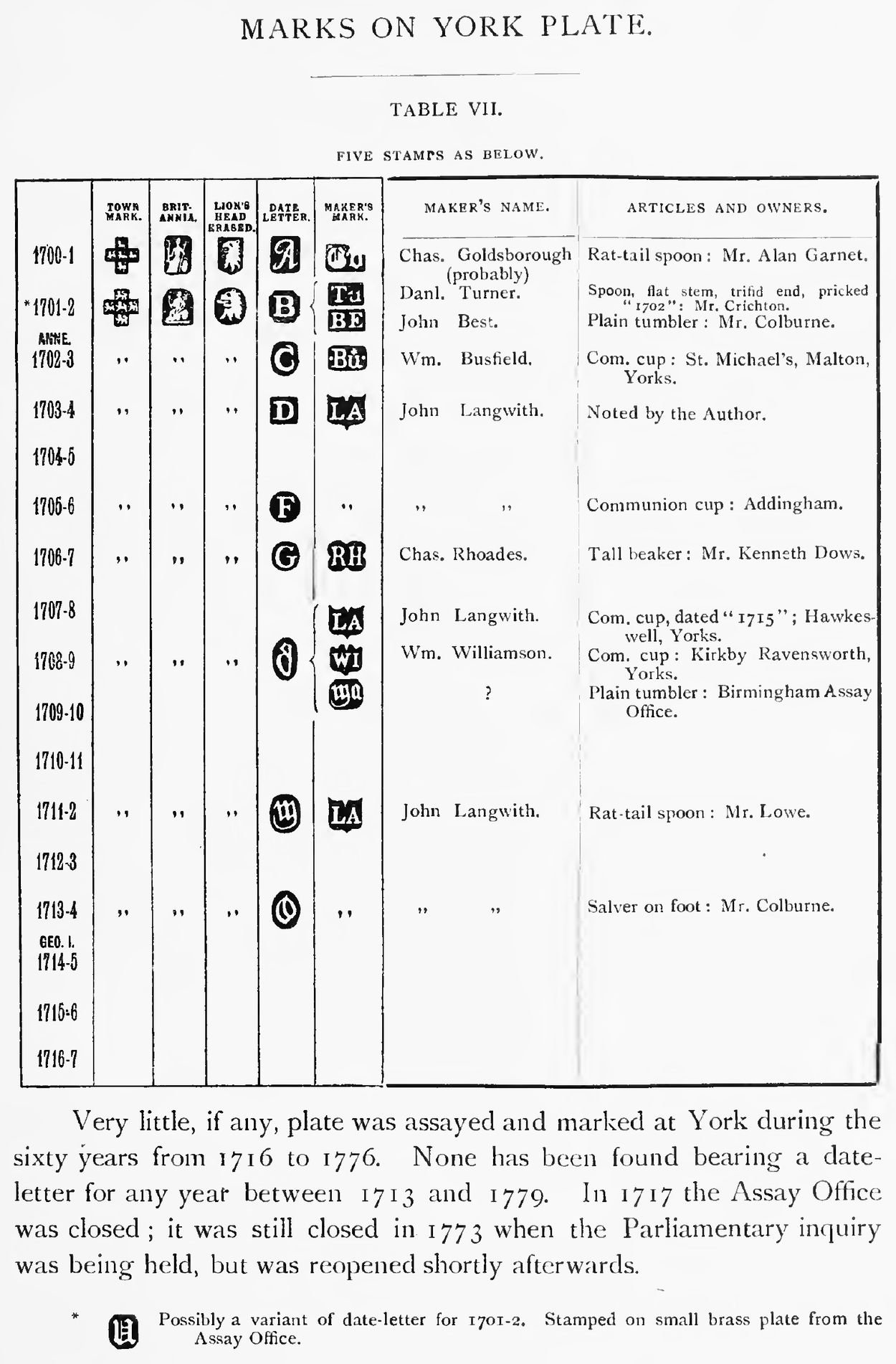
Both modern references consulted for this page say the city mark was omitted more often than not, particularly on smaller items and flatware, and Jackson's own tables show it: run down the town-mark column of Table VII or Table VIII and it is blank for row after row. One of his Table VIII entries — a communion cup at Huntington, near York — carries the flat annotation (no town mark) against an otherwise fully marked piece.
The consequence for a buyer is direct. A genuine York piece may carry a lion passant, a date letter and a maker's mark and nothing at all that says York, in which case the attribution rests on the letterform and the maker — and the maker is the more reliable of the two, because York's later output is concentrated in very few hands. It also means a missing town mark is not by itself a reason to doubt a York piece, which is not the advice that applies at most other offices.
Fifty-Nine Years With No York Table At All
Table VII is a cycle dying in public. Seventeen year rows; nine letters; and against the other eight Jackson prints the year and leaves the cell empty rather than guessing. His prose accounts for it exactly: no other letters of that cycle have been found “except those for 1708-9, 1711-12 and 1713-14”. Then the table stops, and there is no next table for fifty-nine years.
What happened is documented. Assaying at York was discontinued in 1717. John Langwith and Joseph Buckle, then the principal goldsmiths in the city, made an agreement with the Newcastle Goldsmiths' Company to have their plate assayed at Newcastle and struck with the Newcastle marks, paying an annual fee for the privilege — a detail that matters if you are looking at early Georgian silver by a York maker and wondering why the marks say Newcastle. Jackson does not say how long the arrangement ran; later research puts it at about five years.
The office was still closed in 1773, when Parliament held its inquiry into the provincial assay offices — York and Norwich were the two that had nothing to give evidence about — and it reopened shortly afterwards, at about 1776. For the years between 1714 and 1779 Jackson reports that no York-marked plate has been found, and concludes that probably no assays were made there in that entire period.
If you have a piece that looks like York and dates to the middle of the eighteenth century, it almost certainly is not. There is no York cycle between 1717 and 1776 because there was no assay office, and the lookup above will tell you so rather than offering a letter. Silver made by a York goldsmith in those years went to Newcastle and wears Newcastle's three castles.
Eleven Tables, and Five Different Alphabets
Nine offices into this section, one question keeps coming up: does an English date-letter cycle skip J, or I, or both? York answers it on its own, without leaving the city.
| Table | Years | Letterform | Letters | What it skips |
|---|---|---|---|---|
| I | 1559–1582 | Roman capitals | 24 | J and U |
| II | 1583–1606 | Blackletter small | 24 | j and v |
| III | 1607–1630 | Blackletter capitals | 24 | J and V |
| IV | 1631–1656 | Italic small | 26 | nothing — i, j, u and v all appear |
| V | 1657–1681 | Cursive capitals | 25 | I, and it keeps J |
| VI | 1682–1699 | Blackletter capitals | 18 | I; cut short at S by the Act of 1696–7 |
| VII | 1700–1716 | Mixed; Court letters late | 9 of 17 | eight years are simply blank |
| VIII | 1776–1786 | Roman capitals | 11 | I; ends at L |
| IX | 1787–1811 | Capital, then small, then capital | 25 | J |
| X | 1812–1836 | Blackletter small | 25 | j |
| XI | 1837–1856 | Roman capitals | 20 | J and U; stops at V |
Read down the last column. One town, eleven cycles, and five incompatible conventions: skip J and U; skip J and V; skip nothing at all; skip I and keep J; skip J alone and keep both U and V. Table I keeps V and drops U; Table II does the exact reverse sixty years later. Any rule about I and J that could survive York does not exist, and the only safe method is the one used to build this page — put the year column and the letter column side by side on the same plate and read them.
Two of the cycles need saying out loud because they are not really alphabets. Table VII loses eight of its seventeen years, and Table IX changes case in the middle: a capital A in 1787, small letters b to k, then capitals again from M. The year of the switch, 1797–8, is the one row Jackson will not settle — he prints it as l or L in plain type, with no punch illustrated. His chapter dates the change to 1798 and his own note beneath Table VIII dates it to 1797, and the reason those two statements do not conflict is that the disputed year is precisely the year they disagree about.
Why the Office Closed, and Why the Sources Disagree
The last York date letter is the V of 1856–7. Jackson goes out of his way to say it is a V and not a U, correcting Old English Plate by name, and the last recorded pieces are a communion cup at St Helen's, York and a paten at St Michael-le-Belfry, which he says are understood to have been among the last plate marked at York before the office shut. The office was finally closed in 1858.
On why, the sources part company completely, and it is worth setting them out rather than picking one.
- Jackson, 1921. Great irregularities — specifically, the marking of plate without assay — are said to have taken place in the office's later years, and it is therefore “not likely ever again to be re-opened”.
- Modern research on the 1776–1858 office. The assay master was an employee of the city's largest silversmith, and so had been his predecessor; official reports of 1851 and 1856 called him a worn-out spoonmaker and ignorant of the business, and the assay tools were found in a dirty corner of a tavern. The London Goldsmiths' Company pressed for closure on those grounds. Notably, York's silversmiths were not accused of using substandard metal.
- The plain commercial account. By 1858 one firm of silversmiths was left in York, and the office closed for want of work.
Those are three different things: dishonest marking, a captured regulator, and an empty order book. All three are compatible with the same year and the same silence afterwards, and no source consulted here rules out either of the other two. What can be said is that the failure everyone describes is a failure of the office rather than of the metal — which is a useful thing to know before treating a late York mark as suspect. Compare Newcastle, which closed in 1884 with its record intact and its last two assays written down to the teaspoon.
One smaller ending is visible in the table itself: the leopard's head crowned, which York had borrowed from London since the reopening, disappears at 1848. The table heading records it without comment — six stamps till 1848, five afterwards — and the column simply goes empty. The mark went eight years before the office did.
Further Reading
- English hallmarks on pocket watch cases — the five marks and every assay office symbol.
- How to read English hallmarks — the step-by-step method, with worked examples.
- Newcastle hallmarks — where York's goldsmiths sent their plate from 1717, and the office that was created because York was too slow.
- Norwich hallmarks — named alongside York in the Act of 1423, and the other office with nothing to say to the 1773 inquiry.
- London hallmarks — the Britannia period that closed every provincial office in 1697, seen from the office it did not close.
- Sheffield hallmarks — the office that opened in 1773 while York was still shut, and later took the white rose.
- Pocket watch cases — materials, construction and what a case mark can and cannot tell you.
Sources. Everything above that is dated, quoted or counted comes from Sir Charles James Jackson, English Goldsmiths and Their Marks, 2nd edn, Macmillan, 1921 (public domain) — the eleven plates and their headings, the searchers' dispute of 5 March 1411, the city minutes of 1560 and 1606, the Gylmyn spoon, the four rival descriptions and his verdict on them, the unrecorded change of 1632, the arms adopted under the Act of 1700–1, the Langwith and Buckle agreement with Newcastle, the absence of York plate for 1714–1779, the oval stamp from 1787, the V of 1856-7 with its correction of Old English Plate, and the closure of 1858. Three things are not his and are marked as such where they appear: the conflict-of-interest account of the closure, the five-year duration of the Newcastle arrangement, and Sheffield's adoption of the white rose in 1975. All three come from later published research, and none of them is in Jackson's record.