
Glasgow Hallmarks: The Office That Stopped
Almost every date-letter chart you will meet presents Glasgow as a column of letters running smoothly from the seventeenth century to 1964. That column is a fiction. Glasgow began marking plate with a variable letter in 1681, abandoned the practice about 1710, and did not strike another date letter until an Act of Parliament created a proper assay office in 1819. In between there is roughly a century with no annual letter to find.
This matters because a hallmark is only as good as the record behind it, and Glasgow is the one office where the standard source shows you exactly where that record thins out. Reading its tables teaches a habit worth carrying to every other office: an unbroken cycle is an assumption, not a given.
Which Year Is This Glasgow Letter?
Two ranges answer cleanly: 1681–1705 and 1819–1921. Ask about anything between those and the tool will tell you so rather than invent a letter — which is the honest answer, and the reason the rest of this page exists.
Glasgow date-letter lookup
Count the punches before you read the letter. Five marks on a Glasgow piece means 1819–1890 or 1914–1964; four means 1890–1913. That single observation narrows the field faster than the alphabet does.
A Hundred Years With No Office At All
The Glasgow goldsmiths were not a goldsmiths' company at all in the beginning. They were part of the Incorporation of Hammermen, chartered by a Seal of Cause from the Town Council on 14 October 1536, and they shared it with the saddlers and the belt-makers. A trade body of that kind can agree to use a letter. It cannot compel anyone.
Jackson is blunt about the consequence. There is, he writes, no evidence of a regular assay office in Glasgow before 1819, and the variety in the shape of the town mark used by different makers at the same moment is his reason for saying so: each goldsmith owned his own town-mark punch. In one maker's version — William Clerk's — his surname appears in full inside the burgh shield. Marks struck by the man who made the object are not an assay. They are a signature.
So the letter lapsed, and nobody had the authority to restart it. From 1784, when the silver duty came in, Glasgow silversmiths who wanted a legally marked piece generally sent it through to Edinburgh instead. The gap in the tables is not a gap in the surviving evidence. It is a gap in the institution.
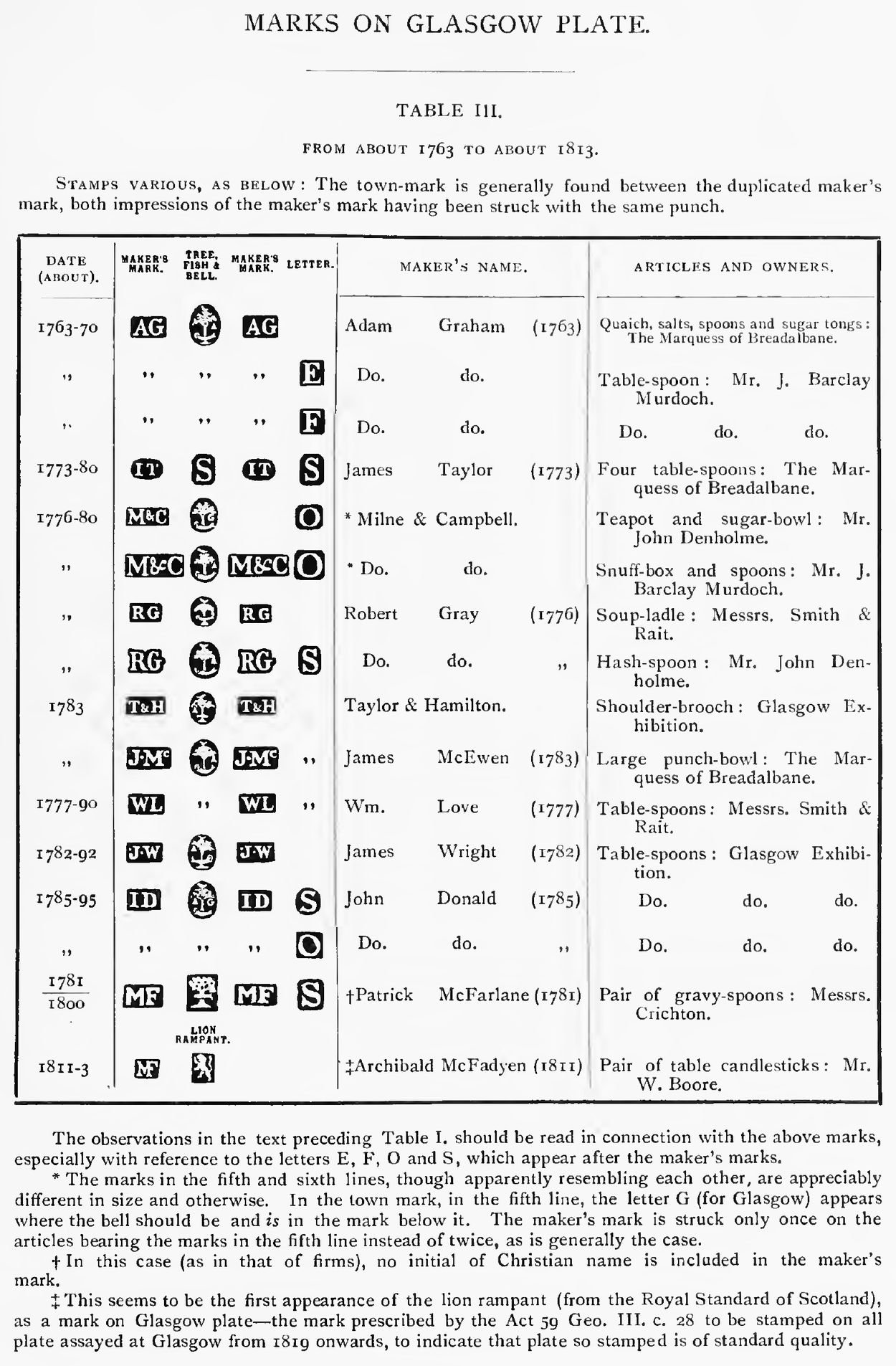
The Column Jackson Refused to Call a Date Letter
Look at the plate above and then at the earlier ones. On Tables I and IV to VII the fourth column is headed Date Letter. On Tables II and III it is headed simply Letter. Jackson dropped the word deliberately, and the text explains why.
From about 1730 to about 1800 Glasgow plate frequently carries an S, in punches of many different shapes. It cannot be a date letter, because it appears across seventy years. The accepted reading is that it stands for standard or sterling — the same job the word STERLING did in full on plate marked at Chester and at Cork.
A second letter is more dangerous still. A Roman O in a square punch with clipped corners is found on all or nearly all the plate of Milne and Campbell, working between about 1760 and 1800. One firm, forty years, the same letter throughout: it cannot be annual. Jackson could not explain it and says so, offering only the guess that it may have meant old standard. The same O turns up, sloped and in a plain square, on John Donald's work of 1785–95, while other Donald pieces carry the usual S instead.
And between 1763 and 1770 the letters E and F appear on plate by Adam Graham. They may be date letters. They may be deacons' marks. Jackson's sentence is the model of how to record an uncertainty: there is, he says, no evidence to prove that they were either the one or the other.
Four letters on Glasgow silver are not date letters: S, O, E and F. If your piece has a tree, fish and bell, a maker's mark and a single letter — and no lion rampant — you are almost certainly looking at a quality mark or a puzzle, not a year. Charts that feed those letters into a date table will hand you a confident answer that is worth nothing.
What the Act of 1819 Actually Set Up
The statute is 59 Geo. III c. 28. It constituted the Glasgow Goldsmiths' Company a body corporate, gave it powers modelled on Edinburgh's, and established an assay district covering Glasgow and forty miles round it — every piece of plate made inside that ring had to be assayed at the company's office. Selling unmarked plate cost the offender the goods, and under the later Act a further £100 for every piece.
Five marks were prescribed: the lion rampant as the standard mark, the city arms as the town mark, the maker's mark, a variable letter, and the sovereign's head for the duty. Sterling was 11 oz 2 dwt fine, with a Britannia added for the higher 11 oz 10 dwt standard.
The Act also contains an instruction to the assayer that is worth quoting for its own sake: he was required to weigh the plate in water and to try the effect of magnetism on it. Neither test measures silver fineness. Both catch a base-metal core inside a silver skin, which tells you precisely what Parliament thought the Glasgow trade needed protecting from.
One detail in the tables undercuts the tidy story. Jackson's Table III records a lion rampant on a piece of about 1811–13, six years before the Act made it compulsory, and he flags it himself as apparently the first appearance of the mark on Glasgow plate. Somebody had begun using the standard mark before there was anyone with the authority to grant it.
What Each of Jackson's Glasgow Tables Contains
| Table | Printed span | Is it a cycle? | What it holds |
|---|---|---|---|
| I | about 1681–1706 | Yes, with caveats | 25 blackletter lower case, omitting j. Twelve rows conjectured. |
| II | about 1706–1765 | No | Loose specimens against date ranges. Letters out of sequence. |
| III | about 1763–1813 | No | The S, O, E and F marks. First lion rampant, about 1811–13. |
| — | 1814–1818 | Nothing at all | No table, no letter, no office. |
| IV | 1819–1845 | Yes | 26 Roman capitals, A to Z. I and J both used. |
| V | 1845–1871 | Yes | 26 blackletter capitals. Victoria's head throughout. |
| VI | 1871–1897 | Yes | 26 block capitals. Duty mark ends 1890. |
| VII | 1897–1921 | Yes | 25 script capitals, A to Y. Thistle added 1914. |
The four statutory cycles are the most regular set of tables in the whole of Jackson. Each runs a complete twenty-six letter alphabet over twenty-six years, and unusually among British offices every one of them uses both I and J. There is no letter to remember dropping, no cycle that behaves differently from its neighbours, and no ambiguity at a boundary. Glasgow after 1819 is the easiest office in Britain to date — which is exactly what makes the century before it so misleading.
Where Jackson Guessed, and Says So
Table I looks like a clean twenty-five-year cycle, 1681–2 to 1705–6 in blackletter lower case, j omitted in the usual way. Read the right-hand column and it stops looking clean. Against twelve of the twenty-five years there is no maker, no object and no owner, only the words Date-letter conjectured — or, five times, Date and date-letter conjectured. Jackson had no piece for those years. He assumed the alphabet had continued and filled in what it would have been.
Even the first row is thinner than it looks. The 1681–2 entry rests on a quaich by Thomas Moncrur which Jackson annotates without date-letter. The letter a at the top of the column is not on the object that dates the row.
None of this is a criticism of Jackson, who is scrupulous about labelling his reconstruction as reconstruction. It is a criticism of everything downstream of him. Once those twelve conjectured letters were copied into a chart the annotations fell away, and a modern table will show you 1687 = g in the same typeface it uses for 1887 = Q, as though the two were equally well attested. They are not remotely.
The lookup on this page carries Table I because the sequence is internally consistent and worth having — but it flags every answer inside it, and it puts the plate on screen so you can find your year in Jackson's own column and see whether he had a piece to go on.
Thistle, Duty Mark, and 1964
Three dates re-cut the Glasgow mark after 1819, and all three are visible on the plates.
- 28 May 1890 — the duty on plate is repealed and the sovereign's head goes. Table VI is headed five stamps till 1890, thenceforward four only. A Glasgow piece with no monarch's head is 1890 or later.
- 1914 — a thistle is added beside the lion rampant, and the count goes back to five. Table VII carries it from the 1914–15 row onward. Glasgow is the only British office to run a thistle and a lion rampant together.
- 31 March 1964 — the office strikes its last mark and closes. Scottish assaying returns to Edinburgh alone, where it had been between 1710 and 1819.
For a watch case, the useful bracket is the middle one. Scottish silver pocket watch cases are overwhelmingly Victorian and Edwardian, so a Glasgow case will nearly always sit in Table V, VI or VII — and the presence or absence of the sovereign's head splits that range at 1890 before you have looked at the letter at all.
One caution about the changeover date. Jackson says the letter was changed in the autumn of each year, and every row in his tables is printed as a straddle — 1819–20, 1885–6 — for that reason. Some modern references give July instead. This page follows Jackson and gives both years, because a Glasgow piece made in the spring belongs to the later of the two and no single-year answer can be right for all of them.
Further Reading
- English hallmarks on pocket watch cases — the five marks and every assay office symbol.
- How to read English hallmarks — the step-by-step method, with worked examples.
- Edinburgh hallmarks and the castle — the office Glasgow's silversmiths used while their own was shut.
- Sheffield hallmarks and the crown — another office whose earliest date letters cannot be looked up at all.
- Chester hallmarks — where the word STERLING was struck in full, as Glasgow's S was struck in short.
- Pocket watch cases — materials and construction.
Plates, table headings and the quoted observations on the S, O, E and F marks: Sir Charles James Jackson, English Goldsmiths and Their Marks, 2nd edn, Macmillan, 1921 — public domain. The Seal of Cause of 14 October 1536, the terms of 59 Geo. III c. 28, the forty-mile district, the assayer's water and magnetism tests and the repeal of the duty on 28 May 1890 are all from Jackson's chapter on the Glasgow goldsmiths. The addition of the thistle in 1914 and the closure of the office on 31 March 1964 are outside his 1921 record and follow the standard modern references.