
Edinburgh Hallmarks: Castle and Thistle
Scottish hallmarking is not the English system with different pictures on it. It ran under separate law, from a separate Act, and for three centuries it answered the central question — who guarantees this is sterling? — in a completely different way. England answered with a symbol. Scotland answered with a named man.
That difference is visible in Jackson's tables, because his Edinburgh plates carry a column no English office needs: Assay Master's Name. Reading an early Edinburgh mark means identifying a person, not decoding a device.
Date an Edinburgh Castle Mark
The lookup runs from 1755 to 1921, seven consecutive cycles. Years before 1755 are on the plates instead — see the last section for why they resist a lookup.
Edinburgh date-letter lookup
Before trusting any letter, check the company it keeps. A thistle means 1759 or later. A castle with a set of initials and no thistle means earlier — and those initials are the assay master, not the maker.
The Guarantee Was a Person, Not a Symbol
Scotland's hallmarking begins with the Gold and Silver Work Act of 1457, which predates any comparable English statute on date letters. Under it the deacon — the elected head of the craft — personally assayed members' work and struck his own mark on it. The mark was not a badge of the metal. It was a signature: I tested this, and my name is on it.
In 1681 the Incorporation of Goldsmiths appointed a dedicated Assay Master, and the first was John Borthwick. Jackson's Table III begins in that same year, and the column beside the date letters reads John Borthwick down the page until James Penman takes over in 1696–7. You are looking at a chain of custody in personal names, which is not something any English plate can show you.
Only in 1759 did a symbol take the job over. The thistle replaced the assay master's initials as the mark of sterling standard, and Edinburgh finally had the Scottish equivalent of England's lion passant — two hundred and fifteen years after the lion passant appeared in London.
Do not read the assay master's initials as a maker's mark. On an Edinburgh piece before 1759 you can find two sets of initials: the maker's and the assay master's. They sit in separate columns in Jackson's tables for a reason. Mistaking one for the other will send you looking for a silversmith who never existed.
Castle, Thistle, Lion Rampant
The town mark has been a three-towered castle, the arms of the city, continuously since 1485. It is the most stable element in the whole Scottish sequence — and its stability is useful, because everything beside it moved:
- Before 1681 — castle, maker's mark, and the deacon's mark.
- 1681 to 1759 — castle, maker's mark, and the assay master's initials.
- 1759 onwards — castle, maker's mark, and the thistle.
- 1784 to 1890 — the same duty stamp Westminster imposed south of the border arrives here too, and Jackson's Table VII records the arithmetic in its heading: four stamps till 1784, thereafter five.
- From 1975 — the thistle gives way to a lion rampant, shared by all Scottish-assayed metal.
So a thistle brackets a piece to 1759–1974, and the presence or absence of a duty mark narrows it further. On a nineteenth-century Scottish watch case those two marks will usually get you closer than the date letter does.
Seven Cycles, and Three That Break the Pattern
| Jackson's table | Years | Letters | Note |
|---|---|---|---|
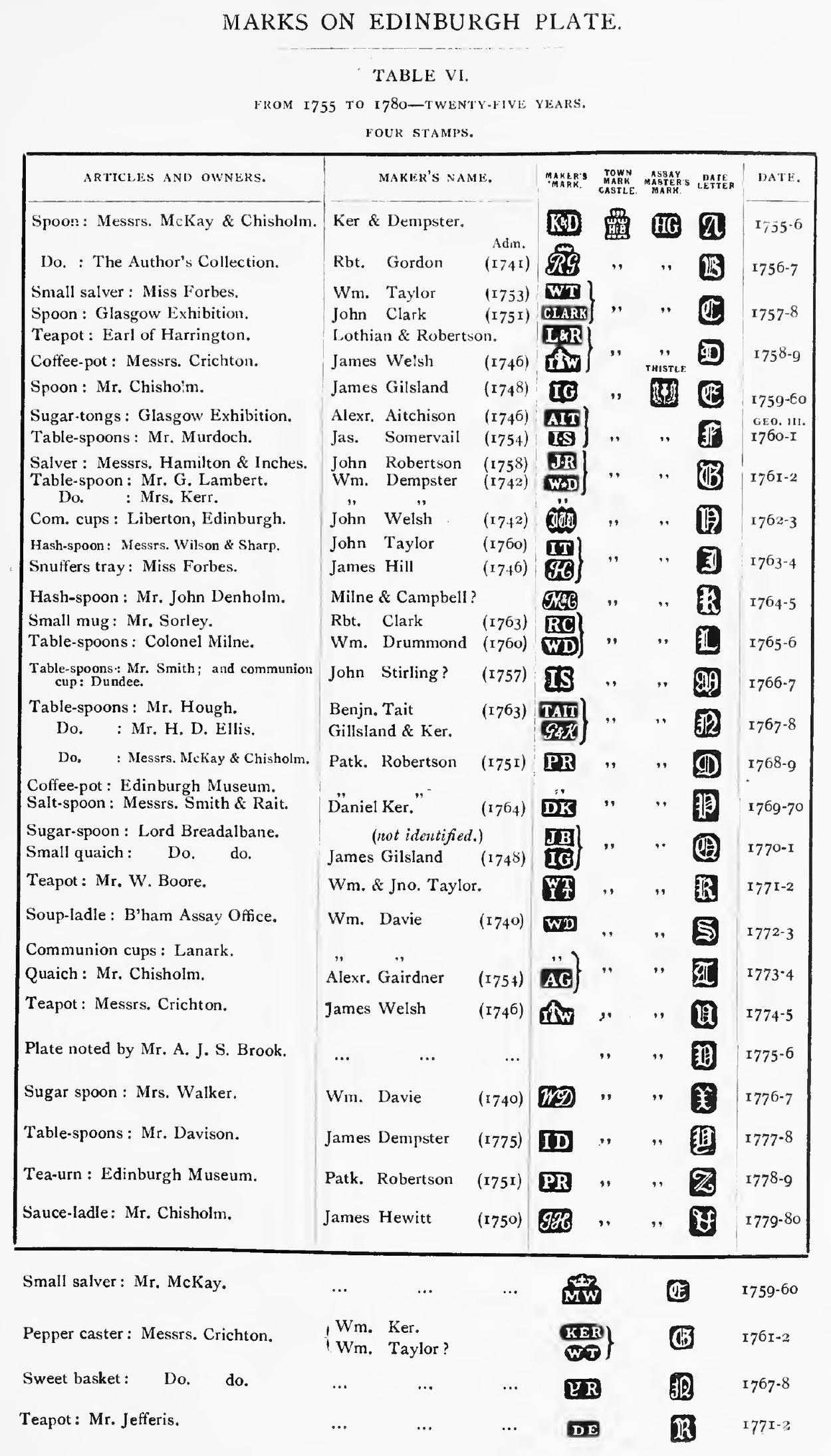
| VI | 1755–1779 | 25, capitals | Omits J. The thistle arrives in 1759. |
| VII | 1780–1805 | 26, capitals | G runs two years; I and J share one punch |
| VIII | 1806–1831 | 26, lower case | The full alphabet, i and j both used |
| IX | 1832–1856 | 25, capitals | Omits I and keeps J |
| X | 1857–1881 | 25, capitals | Omits J |
| XI | 1882–1906 | 25, lower case | Omits j |
| XII | 1907–1921 | 15 recorded, capitals | Jackson's record ends here |
Table VII is the one to watch. Its G was struck for two consecutive years, 1786–7 and 1787–8, so a Scottish G of that period cannot be resolved to a single year at all. Immediately after it, I and J appear as one combined punch for 1789–90 — which is what an office does when it cannot decide whether the alphabet has twenty-five letters or twenty-six.
Table IX then drops I and keeps J, the reverse of the usual English habit. Anyone carrying a single rule between offices will misdate Edinburgh pieces from three separate cycles.
Why the Lookup Starts at 1755
The five earlier tables are here as plates, not as data, and the reason is structural rather than photographic. Jackson's pre-1755 Edinburgh tables include letters that run across more than one year, and rows identified by the assay master's name where the letter itself is uncertain or absent. A year-to-letter map would have to invent a precision the source does not have.
Those plates are still worth opening. Table III, beginning in 1681, is where the assay master's name first appears in the record, and it is the clearest single illustration of the point this page is making — that for most of its history Scottish silver was guaranteed by somebody's reputation rather than by a stamp.
The office has never closed. It is still owned by the Incorporation of Goldsmiths of the City of Edinburgh — the same body that appointed John Borthwick in 1681 — which makes it the only assay office in Britain that has been run continuously by the guild that founded it.
Reading the Assay Master Instead of the Letter
On a pre-1759 Edinburgh piece the assay master's initials are doing the work the thistle does later, and because Jackson lists the men by name and by span, those initials date a piece without any reference to the alphabet at all.
Table III makes the method plain. John Borthwick holds the office from 1681, and his name runs unbroken down the column until James Penman replaces him at 1696–7. Two names, one change of hand, and a fifteen-year bracket established before you have looked at the date letter. On worn Scottish silver — where the letter is often the first mark to go, being the smallest and shallowest punch — that is frequently the more reliable route.
It has a practical consequence for watch cases specifically. Scottish silver pocket watch cases are mostly nineteenth-century, which places them well inside the thistle period, so the assay master's initials will not appear. If you are looking at a case with a castle, a thistle and a sovereign's head, the third mark is a duty stamp and the fourth is the maker — there is no fifth person to identify.
Further Reading
- English hallmarks on pocket watch cases — the five marks and every assay office symbol.
- How to read English hallmarks — the step-by-step method, with worked examples.
- London hallmarks and the leopard's head — where the standard mark changed twice by Act of Parliament.
- Sheffield hallmarks and the crown — the office whose first fifty years of date letters follow no order at all.
- Pocket watch cases — materials and construction.
Plates and the assay-master columns: Sir Charles James Jackson, English Goldsmiths and Their Marks, 2nd edn, Macmillan, 1921 — public domain. The 1457 Act, the appointment of John Borthwick in 1681, the castle in use since 1485, the thistle of 1759 and its replacement by the lion rampant in 1975 follow the Edinburgh Assay Office's own published history.