
Exeter Hallmarks: The Office That Served a Region
Exeter is not named in the Act of 1423. It had no assay office, no wardens, no assay master and no legal existence until 1701 — and by then its goldsmiths had been striking marks on plate for something like a hundred and fifty years.
That is the first thing to know about an Exeter mark, and it decides what the mark can tell you. After 1701 it is a hallmark in the ordinary sense and this page can date it to the year. Before 1701 it is a maker telling you who he was, on a piece that was very probably never tested by anybody.
Start by Asking Whether It Was Assayed at All
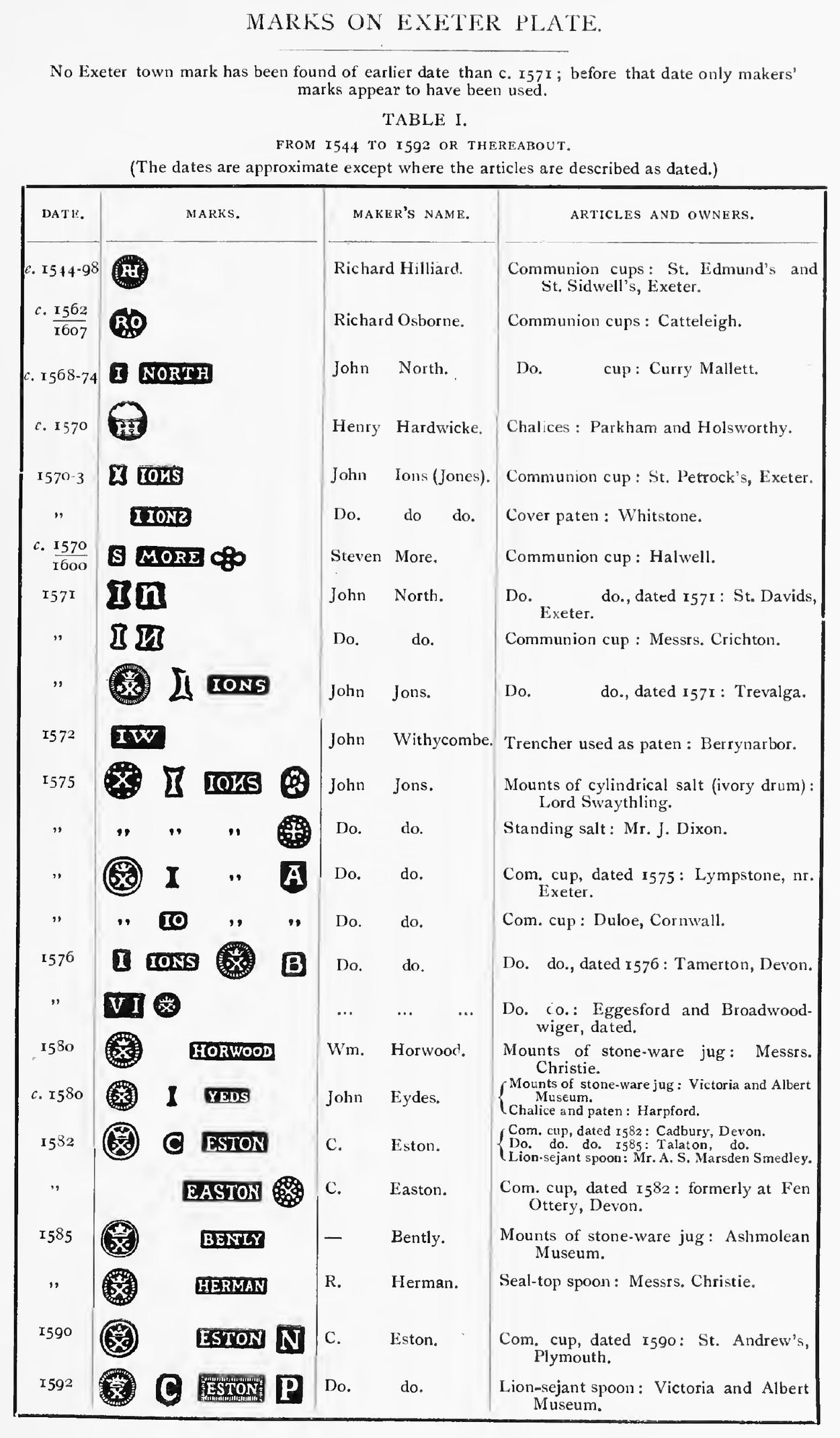
Jackson prints twelve Exeter tables. The first three cover 1544 to 1698 and have no date-letter column, because there was no cycle and no office; the remaining nine run from 1701 to 1882 and can be looked up to the year. The tool below covers the nine and tells you plainly when you have fallen into the other 154 years.
Exeter date-letter lookup
If the piece carries a crowned X rather than a castle, stop here: that is the pre-1701 mark and no year can be got out of it. Go to the first three plates instead and match the maker.
Exeter Is Not in the Act of 1423
Seven towns were given touches by 2 Henry VI, c. 14. Three of them have their own page here — York, Norwich and Newcastle — and the remaining four were Lincoln, Bristol, Salisbury and Coventry. Exeter is not on the list.
Jackson makes the omission stranger rather than simpler. Salisbury and Bristol are named, and no evidence has ever been found that either of them established an assay office at all. Exeter is not named, and produced enough plate to fill the parish churches of two counties. The Act and the silver point in opposite directions.
His own explanation is that the goldsmiths of Exeter probably worked under a Royal Charter whose existence has never been discovered, and the reasoning he gives for thinking so is the best sentence in the chapter: “A craft, from whose hands emanated the numerous examples of Elizabethan and Stuart plate with which the counties of Devon and Cornwall abound, is not likely to have continued an illegal existence for so long a period as is indicated by such evidence of their activity.”
In other words, the surviving silver is the evidence for the missing authority, not the other way round. That is worth holding onto, because it is the opposite of how a hallmark is normally read.
The craft itself is old and independently documented. A goldsmith named John de Wewlingworth was working in Exeter in the fourteenth century. And a churchwardens' account at St Petrock's in the city records a payment in 1572 “to Iohn Ions, goldsmith, for changing the chalice into a cup, 15s. 5d.” — and the cup is still there, stamped I IONS, with 1572 engraved on the knop of its paten-cover. The bill and the object match. There are not many places in this section where that can be said.
A Craft Too Busy to Have Been Illegal
Why Exeter and not, say, Salisbury? Jackson's answer is distance. Exeter was “too far removed from London for the sending of wrought plate to the Metropolitan assay office to have been practical in the 16th and 17th centuries”, and there was no nearer touch. A goldsmith in Truro or Barnstaple or Plymouth had a choice between a long, expensive and risky journey and marking his own work. He marked his own work.
What that produced is visible in the lead plate above, and it can be counted. Go through the places named in Jackson's first three Exeter tables: more than twenty-five parishes across Devon, Cornwall, Somerset and Wiltshire, against five churches in Exeter itself. Curry Mallett and Crewkerne in Somerset; Duloe, Trevalga, Gerrans, St Erth, Kenwyn, Helston, Lanteglos-by-Fowey in Cornwall; Melksham in Wiltshire; and a long tail of Devon villages — Parkham, Holsworthy, Halwell, Berrynarbor, Broadwoodwidger, Kingsnympton, Ashwater.
What that means when you are looking at a piece. An Exeter mark is not evidence that anything came from Exeter. It is evidence that the maker worked somewhere in the West Country and that Exeter was the nearest place with a punch. On later silver the makers' towns are stated outright in Jackson's own columns — William West of Plymouth, Richard Birdlake (Plymouth), J. Golding (Plymouth) — and by 1773 several of the goldsmiths using the office were not even freemen of the city.
Notices to Cornwall, Somerset and Dorset
When the office finally opened, its first commercial act was to advertise outside the county.
The Act 12 & 13 Wm. III, c. 4 authorised Exeter to assay and mark plate from 29 September 1701. Eleven members of the craft met on 7 August 1701 to put it into effect, met again on 17 September, elected William Ekins and Daniel Slade as the first wardens, took premises, ordered punches, and appointed Edmond Richards their first assay master; he was sworn before the mayor on 19 November and served until January 1707–8.
Then, early in 1702, they sent notices to goldsmiths known to be in business in other parts of Devon and in Cornwall, Somerset and Dorset, telling them the office was open. Men from Plymouth, Dartmouth and elsewhere entered their names and marks in the office books. The office was designed from its first year to serve four counties, and it is on record doing so.
One small loss is worth recording because it is the sort of thing that quietly limits every table on this page: the leaf of the register carrying the first series of entries is missing. The earliest surviving page begins with Peeter Elliott of Dartmouth, who entered his mark on 13 November 1703.
Jackson Will Not Put His Own Evidence in a Column
This is the most unusual thing in the Exeter chapter, and it is the reason the first three plates look the way they do.
Jackson believes there were date letters at Exeter before 1701. He argues it explicitly, and against Old English Plate, which had allowed that single letters on stoneware jugs and communion cups might be dating marks but insisted that “nothing at all like a date-letter is found on spoons”. Jackson answers that with spoons: several of about 1600, carrying single letters in plain angular shields.
Then he gives his evidence for four specific years, each anchored to an object with a date engraved on it by somebody who was there:
| Letter | Year he assigns | The object it sits on |
|---|---|---|
| A | 1575 | Church plate, engraved 1575 in contemporary lettering |
| B | 1576 | Church plate, engraved 1576 |
| N | 1590 | The cup at St Andrew's, Plymouth, dated 1590 |
| P | 1592 | A lion-sejant spoon in the Victoria and Albert Museum, marked C ESTON P, undated |
His conclusion is that the engraved dates and the letters agree too closely for coincidence. And then he does something no other chapter in the book does. He refuses to lay the letters out in a column, and says why:
The letters which it is contended are date-letters, are not ranged in columns as in other tables, but are set forth in the order in which they occur on the examples of plate from which they have been transcribed, so that the Author's contention may not appear to gain support from any factitious aid.
He is saying that a tidy column is itself an argument — that ruling the letters into a vertical row would make his case look stronger than his evidence makes it, and that he would rather be believed on the objects than on the layout. So Tables I to III have a column headed Marks, and the reader has to do the work.
It is worth pausing on how rare that is. Every printed date-letter chart you will ever meet, including the ones sold today, presents attested readings and reconstructions in identical type, ruled into identical columns, with no way to tell which is which. Jackson had a case he believed and declined the presentation that would have sold it. The lookup on this page therefore refuses to answer for 1544–1698 as well — not because the evidence is worthless, but because turning four argued letters into a searchable cycle would do exactly what he would not.
The Assay Master Who Had Never Read the Act
In March 1773 the Parliamentary committee inquiring into the provincial assay offices called the assay masters to give evidence. Newcastle's came out of it well. Exeter's did not.
Matthew Skinner had been assay master at Exeter for some years. Under examination, from the committee's report of 29 April 1773:
That he took an oath before Benjamin Heath, town clerk, which was not the oath directed by Act of Parliament, but thinks it was as binding as that in the Act; that he is guided in his duty by an Act passed in the Reign of King William the Third; that he has heard of the said Act from time to time, but never read it until he received an order to attend your Committee.
That he never received instructions from any man living how to assay; but when he had purchased the lanthorn, the scales, and all the other implements necessary for assaying, from the late assay master, he then made various experiments by coppelation and fire … that he has no assay tables … and that he never made an assay of gold in his life.
That he makes the assays of plate at such times as best suit his convenience, and never had any person to assist him in assaying; and when he is absent or ill the thing stops.
He was paid no salary, took a halfpenny an ounce, bought all his own plate from London, and kept the diet in a box with “three locks and two keys, one lock being spoilt”. He had heard of convoys — work contrived by a maker to fool the assayer — but had never detected one.
And then, asked what he thought of the arrangement, he said this:
That he thinks the trust too great to be reposed in one man, and apprehends such a hall as Goldsmiths Hall is safer to the public, where there are so many checks, and no temptation to dishonesty, the officers having good salaries; and he should prefer plate marked at Goldsmiths Hall, because of the sanction.
The man responsible for the Exeter hallmark told Parliament on oath that he would rather buy London-marked silver than his own. It is the most candid sentence in the whole of this section, and it should temper any confidence a modern chart invites you to place in a provincial mark of these years.
One thing he said checks out exactly. Asked which letter was in use, Skinner named Z, in Roman character, and said the next would be A. Jackson's Table VI, built from surviving plate a century and a half afterwards, ends on Z for 1772–3 and opens the following cycle at A. Whatever else was wrong at Exeter, somebody was keeping the alphabet — which is not something that can be said of every office whose assay master gave evidence that spring.
Sixty Years of London's Letters, a Year Late
Here is the practical trap, and it is a bad one because it produces an answer that looks right.
From 1797 to 1856 Exeter used the same date letters as Goldsmiths' Hall in London — but a year later. Jackson puts it flatly: apart from the shape of the enclosing shields, the letters were alike across those sixty years. So an Exeter letter will match the London letter of the previous year, and anyone reading an Exeter piece off a London chart will date it one year too early, every time, for three whole cycles.
What separates them is not the letter. It is the castle, and after 1837 the Queen's head, and the outline of the shields the letters sit in — rectangular in 1797–1816, clipped at the top corners and rounded at the base in 1817–36.
There is a second timing trap in the same period. The duty mark arrived in 1784 and the head on it was supposed to change with the monarch, but at Exeter the change of stamp was considerably delayed — in the case of William IV succeeding George IV, by as much as four years. A sovereign's head at Exeter dates the punch, not the reign.
Twelve Tables, and What Each One Is Worth
| Table | Years | Letters | What it will and will not do |
|---|---|---|---|
| I | 1544–1592 | none | No date-letter column. Match a maker's mark; do not expect a year. |
| II | 1600–1640 | none | As above. The single letters on the spoons are Jackson's argument, not a cycle. |
| III | 1640–1698 | none | As above. Some marks here were later reallocated to Barnstaple. |
| IV | 1701–1724 | 24 | Roman capitals. Omits J and U. Britannia period: five marks, maker's mark from the first two letters of his surname. |
| V | 1725–1748 | 24 | Small letters, some Italic and some Roman. Omits j and v — the reverse of Table IV. |
| VI | 1749–1772 | 24 | Roman capitals in square shields. Omits J and V. Ends at the Z Skinner swore to. |
| VII | 1773–1796 | 23 | 23 rows for 24 years. Capitals to P, then small letters. Leopard's head stops after 1777–8; king's head from 1784. |
| VIII | 1797–1816 | 20 | A–U omitting J, rectangular shields. London's letters, a year late, from here. |
| IX | 1817–1836 | 20 | Small Roman a–u omitting j, clipped-corner shields. |
| X | 1837–1856 | 20 | Blackletter capitals. The castle is drawn as three separate towers from 1831 to 1837. |
| XI | 1857–1876 | 20 | Roman capitals. Fifteen of the twenty rows rest on no surviving object. |
| XII | 1877–1882 | 6 | Plain block letters A to F, and then the office shuts. |
Table VII is the one that will catch a careful reader out. Jackson prints a single row labelled 1781-2-3: the letter I served two assay years, so the cycle has twenty-three rows for twenty-four years and the arithmetic only closes if you notice. Ask the lookup for 1782 and it will give you I and tell you it cannot narrow it.
From the Assay Office Plate
The late Exeter tables are exact, and they are exact because they stopped depending on silver.
Run down the Articles and Owners column of Table XI — twenty years, 1857 to 1876 — and fifteen of the twenty rows say the same four words: From the Assay Office plate. Not a cup, not a spoon, not a collection. A plate of trial strikes kept at the office, on which each year's punch was proved. Table XII is the same for four of its six years, and five rows at the end of Table X come from the office's marks as well, supplied by a Mr J. E. Lake.
So for the last quarter-century of Exeter's working life the evidence for what the date letter was is the office's own scrap of metal, and the number of surviving marked objects Jackson could name across those twenty years is five. The lookup says which kind of answer it is giving you on every year, because the two are not the same claim: one is a record of what the punch looked like, the other is proof that somebody actually brought work in to be stamped with it.
Why It Closed, and Why That Is the Simplest Answer in This Section
The last Exeter date letter is the F of 1882–3, and Jackson can name the work it was struck on: the communion plate at St Matthew's, Exeter, by Ellis, Depree & Tucker, which he says “appears to have been some of the last work assayed at Exeter, as the office was finally closed in 1883”.
The reason is unglamorous and completely clear. The number of manufacturing goldsmiths in Exeter and in the West of England generally fell away sharply after about 1850; the work dwindled; and “the charges for assaying were found insufficient to cover the working and establishment expenses of the office”. It ran out of customers and could not pay its rent.
Later accounts add a detail Jackson does not, and it is a fitting last note for an office that spent its whole life working for other people's towns: by the end, most of the work being sent in came from Josiah Williams & Co, a firm in Bristol, and when they moved their business to London the office closed. That attribution is later research, not Jackson, and is flagged here as such.
Set that beside the other two endings in this section and the difference is worth having. At Newcastle the office was wound up in good order and the paper trail survives. At York there is no agreement even now about what went wrong. Exeter simply stopped covering its costs, said so, and shut. Of the eleven offices here, it is the only one whose ending needs no interpretation at all.
Reading an Exeter Piece
- Find the town mark first. A crowned X means before 1701 and no year can be recovered. A triple-towered castle means 1701 or later and this page can date it.
- Then count the marks. Britannia and a lion's head erased put you in 1701–1720. A leopard's head crowned puts you between 1720 and 1777–8. A sovereign's or Queen's head means 1784 or later — but do not read the monarch too literally, because Exeter was slow to change the punch.
- Do not date it off a London chart. From 1797 to 1856 the letters are London's, one year late. See London hallmarks for the letters this collides with.
- Expect church plate and expect it to be from somewhere else. Communion cups, patens and flagons from Devon, Cornwall and Somerset parishes are the bulk of what survives, and a maker described as of Plymouth or of Dartmouth is entirely normal on an Exeter mark.
- On a watch case, be careful. Exeter was a church-plate and domestic-silver office in a region with no watch industry, and its output had collapsed long before English watch cases were routinely hallmarked in quantity. Case marks belong overwhelmingly to Chester, Birmingham and London.
Further Reading
- English hallmarks on pocket watch cases — the five marks and every assay office symbol.
- How to read English hallmarks — the step-by-step method, with worked examples.
- Newcastle hallmarks — the same 1773 inquiry, and an assay master who came out of it rather better.
- York hallmarks — the other West-and-North office whose mark predates its paperwork, and whose closure nobody can agree about.
- Norwich hallmarks — the only English town Jackson ranks ahead of Exeter for the antiquity of its surviving work.
- London hallmarks — the letters Exeter shadowed a year behind from 1797.
- Pocket watch cases — materials, construction and what a case mark can and cannot tell you.
Sources. Everything dated, quoted or counted above comes from Sir Charles James Jackson, English Goldsmiths and Their Marks, 2nd edn, Macmillan, 1921 (public domain) — the twelve plates, the absence of Exeter from the Act of 1423, the St Petrock's payment of 1572, the argument for the A, B, N and P and his refusal to column them, the 1701 Act and the meetings of 7 August and 17 September, the notices sent into Cornwall, Somerset and Dorset, the missing register leaf, Matthew Skinner's evidence as reported to Parliament on 29 April 1773, the London correspondence from 1797, the delayed duty stamps, and the closure of 1883 for want of receipts. Two things are not his and are marked where they appear: the attribution of the closure to Josiah Williams & Co of Bristol moving to London, and the modern summary that Exeter became the office of choice for Devon, Dorset, Somerset and Cornwall — which is a later restatement of what Jackson describes rather than a new fact. The count of parishes in Tables I–III was made from the plates themselves.