
Norwich Hallmarks: When a Mark Is Not a Hallmark
Norwich ran a date letter for fifty years out of the hundred and thirty-eight between its first assay and its last known marks. For the other eighty-eight there is no cycle to look anything up in — and, more importantly, often no assay office either.
Jackson is blunt about what that means for the marks themselves. Of the pieces made when no local touch was operating, he writes that the Norwich marks on them were “in no sense ‘Hall marks’, but merely the marks struck by the makers”. A castle over a lion is a place, not a guarantee, and on Norwich silver the difference matters more than it does anywhere else in this section.
The Fifty Years You Can Actually Date
Three short cycles, and nothing usable between them: 1565–1584, 1624–1643 and 1688–1697. Everything outside those eighty years of coverage returns a refusal rather than a guess, because Norwich struck no letter in those years for anyone to decode.
Norwich date-letter lookup
Before using any answer, ask whether the piece has four marks or two. A castle, a crowned rose, a date letter and a maker's mark is a properly assayed Norwich piece. A castle and a maker's mark alone, with no letter, is a maker marking his own work — which is what most surviving Norwich silver actually is.
Fifty Communion Cups With the Same Letter
Norwich's surviving output is not varied, and the numbers are worth stating because they tell you what to expect. Jackson records that Norfolk holds no fewer than fifty communion cups and patens carrying the Norwich date letter C — eighteen of them dated 1567 and a dozen dated 1568.
That is one letter, two years, fifty objects, and they are all church plate. The reason is Elizabethan: parishes across Norfolk were replacing pre-Reformation chalices with communion cups at exactly that moment, and Norwich's goldsmiths made them. The rest of Jackson's Norwich column of Articles and Owners reads the same way — cups, patens, flagons, beakers, seal-top spoons.
What this means for a watch case. Norwich's last date letters are of 1697, and Jackson's Norwich chapter — which lists the article for every marked example he traced — does not record a single watch case. English watch cases were not routinely hallmarked until well after Norwich had stopped marking anything. If you are offered a pocket watch whose case is said to carry a Norwich hallmark, that is a claim to check very hard indeed, and the thing to check is whether the marks are an assay office's or a maker's own.
Appointed in 1423, and Nothing Happened
Norwich was named as one of the towns to have a touch by the Act of 1423 — 2 Hen. VI, c. 14 — alongside York, Newcastle, Lincoln, Bristol, Salisbury and Coventry. Being named and being in operation are different things. Jackson's judgement is that the goldsmiths there “either omitted to put the provisions of that Act into operation or the Act was allowed to fall into abeyance”, and that by 1565 Norwich goldsmiths were working “wares of all sorts of qualities”.
What fixed it was local, not national. A petition to the city assembly produced a working system, and Jackson dates its start precisely: the date letter began on 29 September 1565 and changed at Michaelmas each year thereafter. He spells out the awkward consequence, which is why every early Norwich year on this page is written as a straddle: each letter “served for three months of one year and nine months of the next”.
The Say Master's Oath
The Mayor's Book preserves the oath the Norwich assay master swore, and it is the shortest statement of what an assay office is for that this site has found anywhere:
You shall sweare that you will well and truly execute the office of a Say Master to the Company of Silver Smithes within the City of Norwich, & not sett the stampe of the Rose and Crowne upon any Plate but what is according to the standard. And allsoe doe & execute All other matters & things relating to the said Office according to your best skill & cuninge. So helpe you God.
The crowned rose is therefore Norwich's standard mark — the equivalent of London's lion passant — and the oath binds one named man not to strike it on substandard metal. It first appears in the tables at 1581–2, sixteen years into the first cycle. Jackson notes that the oath's mention of the Rose and Crown means the entry must postdate 1574–5, which is a nice piece of dating a document by the mark it names.
Two Gaps, and What Fills Them
The gaps are not gaps in Jackson's research. They are gaps in the institution, and he says so in one flat sentence: “After 1643 no cycle of date-letters is found until 1688.”
| Table | Years | Usable? | What is there |
|---|---|---|---|
| I | 1565–1584 | Yes | 20 Roman capitals, A–V, omitting J and U. The crowned rose arrives in 1581. |
| II | c.1585–c.1623 | No | Stamps various. Columns are Date (about) and Marks. No date letter. |
| III | 1624–1643 | Yes | 20 letters, A–V, the same set as Table I sixty years later. |
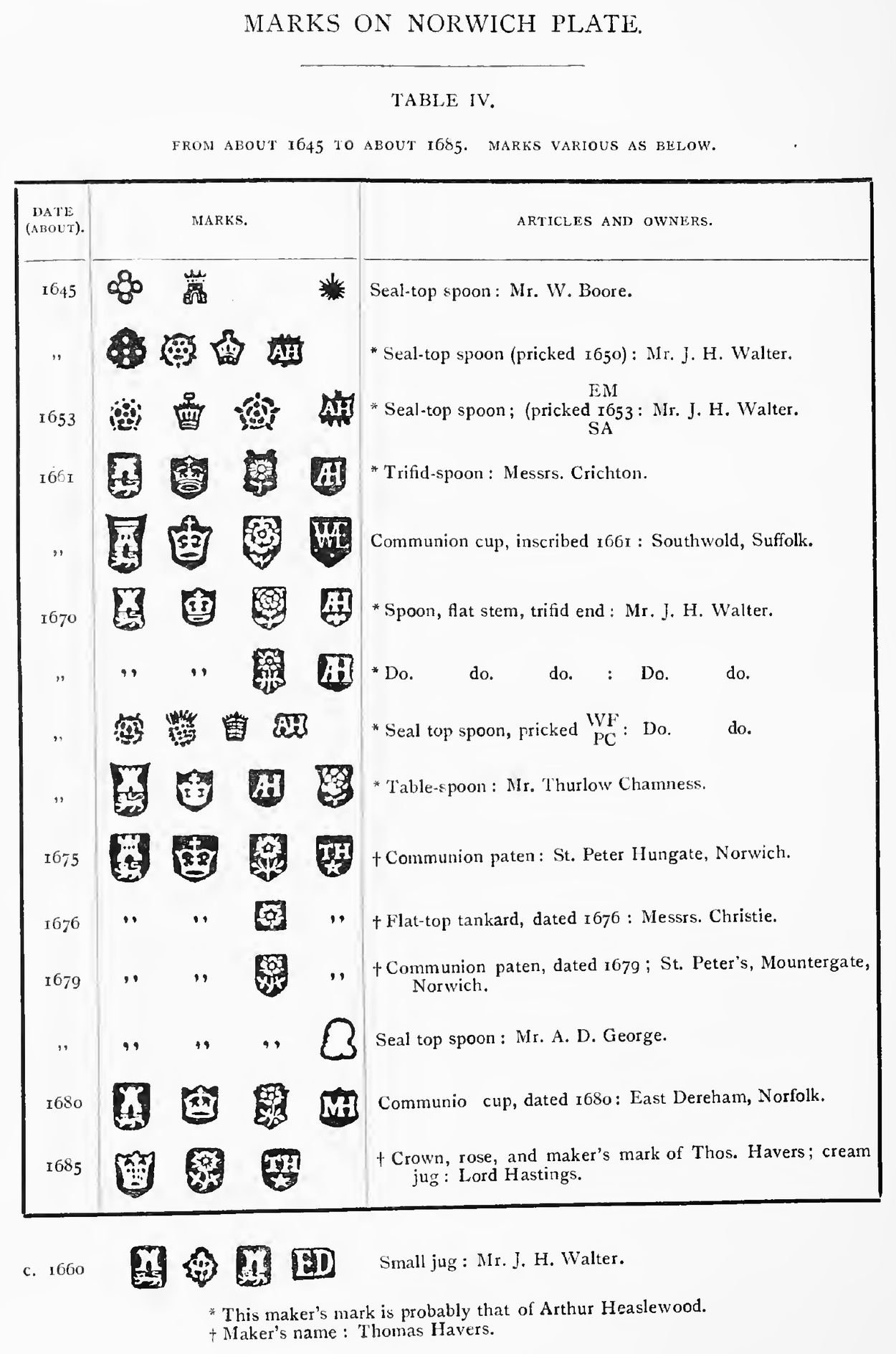
| IV | c.1645–c.1685 | No | Marks various. Forty years with no cycle at all. |
| V | 1688–1697 | Yes | Ten letters. The form changes mid-cycle: a–d blackletter, then E–K Roman. |
Table IV is the one to look at, and it is this page's lead figure for that reason. Its columns are Date (about) and Marks — there is no date-letter column, because for those forty years there was no date letter. Jackson goes further about what the marks in it actually are: they vary so much, he writes, that “it might be suggested that every individual maker struck all the marks on his own plate with his own puncheons”.
That is a remarkable admission in a reference book of hallmarks, and it is the reason this page exists in the form it does. On Norwich silver of the middle seventeenth century, the castle, the rose and the crown may all have come out of one workshop's own box of punches. Nothing independent tested the metal.
Ten Years, Two Alphabets, Then Silence
The last cycle is the strangest. It runs 1688 to 1697 — ten years, and the letters change character halfway: a, b, c and d in blackletter lower case, then E, F, G, H, I and K as Roman capitals. Nowhere else in this section does a single cycle switch case at all, let alone in its fifth year.
The rows are also plain single years — 1688, 1689, 1690 — not the Michaelmas straddles of the first two cycles, so the changeover had moved as well.
Then it stops. Jackson records Norwich marks of about 1697 with no date letter at all, and a further set at 1701–2, and that is the end of it. The office had ninety years earlier been the one that supplied half of Norfolk with communion plate.
How to Read a Norwich Piece Honestly
Work in this order, and the ambiguity resolves itself more often than you would expect.
- Count the punches. Four — castle, crowned rose, date letter, maker — means an assayed piece from one of the three cycles. Two or three, with no letter, means a maker's own marking.
- Look for the letter before anything else. If there is one, this page can date it. If there is not, no chart can, and any source that offers you a year is inventing it.
- Expect church plate. Communion cups, patens, flagons, beakers and seal-top spoons are what Norwich made and what survived. Anything else deserves a harder look.
- Do not read the crowned rose as a date. It runs from 1581 right through to the end, across all three cycles and both gaps, and its form varies because the punches were recut — and sometimes because a different person cut them.
Norwich also keeps the same twenty-letter alphabet in both of its long cycles: A to V, omitting J and U. That consistency is unusual — Birmingham used four different conventions, Edinburgh and Dublin three each, Newcastle two — but do not mistake it for a rule that travels. It is simply what Norwich did, twice, sixty years apart.
Further Reading
- English hallmarks on pocket watch cases — the five marks and every assay office symbol.
- How to read English hallmarks — the step-by-step method, with worked examples.
- How to spot fake pocket watches — the same habit of mind, applied to movements and dials.
- Newcastle hallmarks — the other office named in the Act of 1423 whose story ends in closure.
- Sheffield hallmarks and the crown — another office whose earliest letters cannot be looked up at all.
- York hallmarks — the town the Act of 1423 names first, and the one that already had a mark before it.
- Exeter hallmarks — the town Jackson places next after Norwich for the antiquity of its surviving work, and which the Act of 1423 does not name at all.
- Pocket watch cases — materials and construction.
Plates, table headings, the Act of 1423, the start of the date letter on 29 September 1565 and the Michaelmas changeover, the Say Master's oath from the Mayor's Book, the fifty communion cups marked C, the sentence that after 1643 no cycle is found until 1688, and the observation that every maker may have struck all the marks with his own puncheons: Sir Charles James Jackson, English Goldsmiths and Their Marks, 2nd edn, Macmillan, 1921 — public domain. The statement that Jackson's Norwich chapter records no watch case is an observation about that chapter, checked against it, and not a claim that no such piece could exist.