
Chester Hallmarks on Antique Pocket Watch Cases
If you have opened an English silver pocket watch and found three wheatsheaves and a sword stamped inside the case back, your watch was not assayed in London. It went to Chester — a small office in a small city that, for most of the nineteenth century, marked a very large share of the silver watch cases made in Britain.
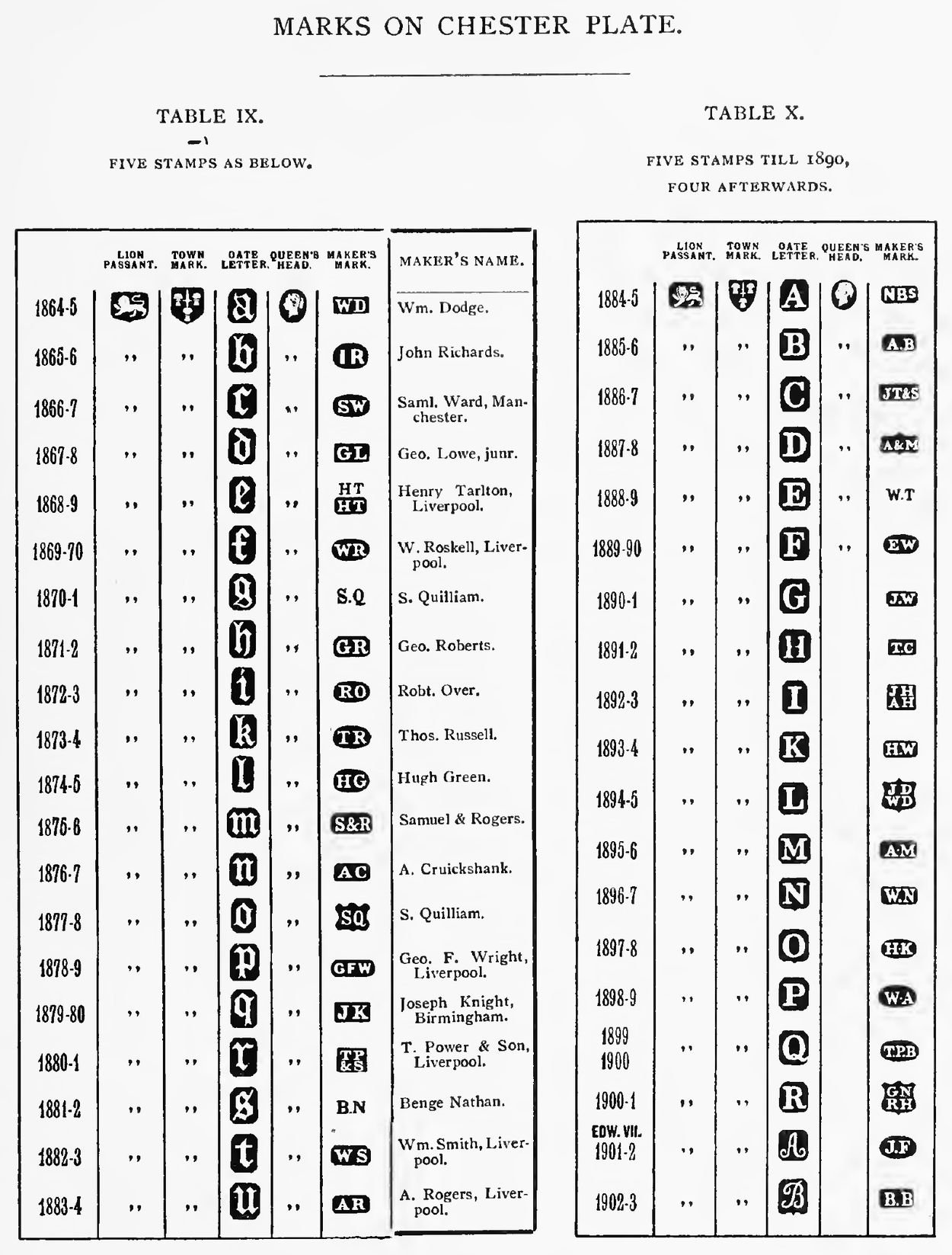
This page does one job properly: it dates a Chester date letter. The tables below are photographs of Sir Charles Jackson's English Goldsmiths and Their Marks of 1921, which recorded the Chester cycles year by year from the assay office's own records. You can look a letter up, then check your answer against the plate the answer came from.
Look Up a Chester Date Letter
Two ways round. If you know the year, find the letter; if you have the letter, find the candidate years. Covers 1668 to 1921 — all eleven of Jackson’s Chester tables. The nineteenth-century end of that range is where nearly every collectable English silver pocket watch case falls; the earlier tables are for church plate and domestic silver, and they behave much less tidily. The lookup tells you which kind of answer it is giving you: an attested letter, a year Jackson marks conjectured, a letter taken from the office’s own plate rather than from surviving silver, or a year he does not record at all.
Chester date-letter lookup
A date letter alone can never be conclusive. The same letter comes round in every cycle, so the shield outline and the letter’s style are what separate 1875 from 1913. That is why the lookup shows you the plate. Compare your punch against the printed one; do not take a number on trust.
Why So Many Watch Cases Were Marked at Chester
The answer is Liverpool. From the late eighteenth century the Lancashire watch trade — movement makers at Prescot, casemakers and finishers in Liverpool itself — was one of the largest concentrations of watchmaking in the world. Liverpool had no assay office of its own. Chester did, about twenty miles away, and it was the nearest place a casemaker could legally get silver tested and struck.
You do not have to take that on trust either, because Jackson recorded the names. His table for the cycle beginning 1864 lists, against the year each man's mark was entered: Henry Tarlton of Liverpool, W. Roskell of Liverpool, Geo. F. Wright of Liverpool, T. Power & Son of Liverpool, Wm. Smith of Liverpool and A. Rogers of Liverpool — six Liverpool names in a single twenty-year cycle, alongside Samuel Ward of Manchester and Joseph Knight of Birmingham. The firm of Samuel & Rogers, whose S&R mark appears against 1875–6, registered at Chester as watchcase manufacturers of Wood Street, Liverpool.
So a Chester mark on a watch case is not an oddity to be explained away. For a great many English silver watches it is the expected mark, and a London leopard's head would be the surprise.
The Chester Town Mark
Chester's town mark is the city arms: three wheatsheaves, or garbs, with a sword set upright between them. That form came in with an entirely new set of punches in 1779. Before that the office used a different device altogether — three demi-lions and a wheatsheaf — so a pre-1779 Chester piece does not look like the mark most collectors picture.
Regular marking at Chester, with a town mark and a date letter, begins on 1 February 1686–7. The office was then formally established as an official assay town by Act of Parliament in 1701, in the same statute that recognised York, Exeter, Bristol, Norwich and Newcastle. It is worth being clear that Chester was not created in 1773: that Act founded Birmingham and Sheffield, which is a different story and a common confusion.
The Eleven Tables, 1668 to 1921
Jackson prints eleven Chester tables. They are not eleven tidy alphabets: the first is not a cycle at all, the fourth is a mess by any standard, and the letter each cycle drops is not consistent even within this one office.
| Jackson's table | Years | Letters | Style | What to know |
|---|---|---|---|---|
| I | c.1668–1700 | 3 only | Blackletter capitals | Not a cycle. Mark and letter share one column; dates approximate. Only 1695, 1696 and 1697 carry a letter, and all three are conjectured |
| II | 1701–1725 | A–Z (25) | Roman capitals | Omits J. Britannia standard to 1719, when the headings change mid-table |
| III | 1726–1750 | A–Z (25) | Script capitals | Omits I, uses J. 1745 and 1746 conjectured |
| IV | 1751–1775 | a–Y (24) | Mixed case | The awkward one. Seven rows printed in both cases; no row for 1770 or 1772; ends at Y |
| V | 1776–1796 | a–v (21) | Small letters | Omits j. King's head duty mark arrives inside 1784–5 |
| VI | 1797–1817 | A–V (21) | Roman capitals | Omits J. Watch cases become conspicuous |
| VII | 1818–1838 | A–U (20) | Roman capitals | D covers two years; most rows come from the office's own records, not from silver |
| VIII | 1839–1863 | A–Z (25) | Gothic capitals | Omits J |
| IX | 1864–1883 | a–u (20) | Gothic lower case | The Liverpool casemakers' cycle |
| X | 1884–1900 | A–R (17) | Roman capitals | |
| X and XI | 1901–1921 | A–V (21) | Cursive capitals | One cycle running across two printed tables |
Where the early tables stop being able to answer
Before 1695 there is no Chester date letter to find. Table I gives the maker's mark, the town mark and the date letter in a single column, dates its rows only approximately — c. 1683, 1686–90, 1692–4 — and several of its entries carry the word STERLING struck as a punch in its own right, doing the job the lion passant does elsewhere. A Chester mark of that period tells you who made a piece, not when. The lookup says so rather than offering a year.
Table IV cannot be read as twenty-six tidy rows, and any chart that shows it that way has invented some. It prints seven of its years in both cases at once — B or b, D or d, F or f, I or i, K or k, L or l, Q or q — so in that cycle the case of the letter dates nothing. It has no row at all for the assay years beginning 1770 or 1772. Three of its rows abandon the straddled form and are printed as single years. And its last two rows are labelled 1775 and 1775–6, both beginning in the same year, so 1775 has two competing letters and Jackson does not resolve them. The lookup discloses that rather than picking one.
Table VII is exact for the opposite reason to the tables before it. Its final column is headed Source of Marks rather than Articles and Owners, and most of its rows read Assay Office Plate and Records. From 1818 the evidence is the office's own record instead of surviving silver — which makes the letters reliable while telling you nothing about whether anyone was bringing work in. The 1818–9 row rests on a wax impression. Knowing what a punch looked like and knowing that it was used are two different claims, and the lookup keeps them apart.
The last cycle in that list is worth a second look. It begins at the foot of Jackson's Table X, with 1901–2 and 1902–3, and then continues on the next plate as Table XI. A cycle and a printed table are not the same thing, and reading one table as one cycle is the quickest way to land a case twenty years out.
Two Cycles That Look Alike
The cursive letters used from 1726 to 1750 were used again from 1901 to 1925. The letter will not tell you which is which. The other marks will: the town mark differs between the two periods, and the later cycle has no crowned leopard’s head. If your case has a cursive letter, settle it on the leopard’s head before you settle it on the letter.
This is the general lesson in miniature. A date letter is one mark of four or five, and it is the least self-sufficient of them. The standard mark tells you the metal, the town mark tells you the office, and only then does the letter mean anything at all. Our step-by-step guide to reading English hallmarks works through the sequence in full.
When the Assay Year Changed
Chester's date letter did not change on 1 January, which is why every entry in the tables spans two years — 1875–6, not 1875. The changeover moved twice:
- From the early 1700s, the new punches came into use in July.
- From 1839 to 1889, the change moved to 5 August.
- From 1889 onwards it moved again, to 1 July.
The practical consequence: a case marked in the first half of a calendar year carries the previous assay year's letter. A watch hallmarked in March 1876 shows the 1875–6 letter, not the 1876–7 one. Where a precise year matters — dating a presentation watch, say — the honest answer is usually a span of two calendar years rather than one.
What the Tables Themselves Tell You
Jackson's Chester tables carry a column most reference charts leave out: Source of Marks. Row after row reads From Assay Office Records, and where a mark was taken from a surviving object he says so — a sauce-boat, a piece of assay office plate. It is the difference between a chart of letters and a body of evidence, and it is the reason these plates are worth reproducing at full size rather than redrawing.
It also means the tables are honest about their own gaps. The early Chester record is patchy; Jackson notes that the letter was not changed every year in the period after 1687, and that he found no Chester-marked plate at all that can be placed between 1695 and 1701. A reference that admits where the evidence runs out is worth more than one that fills the gap with a guess.
The End of the Office
The Chester Assay Office closed on 24 August 1962, after some two and a half centuries of formal operation. The Lancashire watch trade that had sustained it was long gone by then, killed off by Swiss and American factory production in the decades either side of 1900 — the same collapse traced on our page on the Swiss watch industry and the American watch industry.
For collectors the closure is a useful boundary. A Chester mark places a case before late 1962, and in practice nearly always a good deal earlier: the office's watch-case work had largely dried up by the 1920s. Nothing you are likely to find in a silver pocket watch case was marked at Chester after the First World War.
Further Reading
- English hallmarks on pocket watch cases — the five marks, the standards, and every assay office symbol.
- How to read English hallmarks — the step-by-step method, with worked examples.
- Birmingham hallmarks and the anchor mark — the office created by Act of Parliament in 1773, and why its cycles break the usual J rule.
- Pocket watch cases — materials, construction and what the case tells you about the watch.
- Pair-cased pocket watches — where both cases should carry marks, and what it means when they disagree.
- What your pocket watch is worth — how a confirmed date affects value.
Date-letter plates reproduced from Sir Charles James Jackson, English Goldsmiths and Their Marks, second edition, Macmillan, 1921 (public domain). Changeover dates and the closure date follow the Chester tabulation at silvermakersmarks.co.uk.