
Birmingham Hallmarks and the Anchor Mark
An anchor stamped inside a silver case is a Birmingham mark, and Birmingham is the one English assay office that exists because somebody argued it into being. It was not granted by a medieval charter or inherited from a guild. It was won in Parliament in 1773, against the open opposition of the London Goldsmiths' Company, by a manufacturer who wanted to stop sending his silver to Chester.
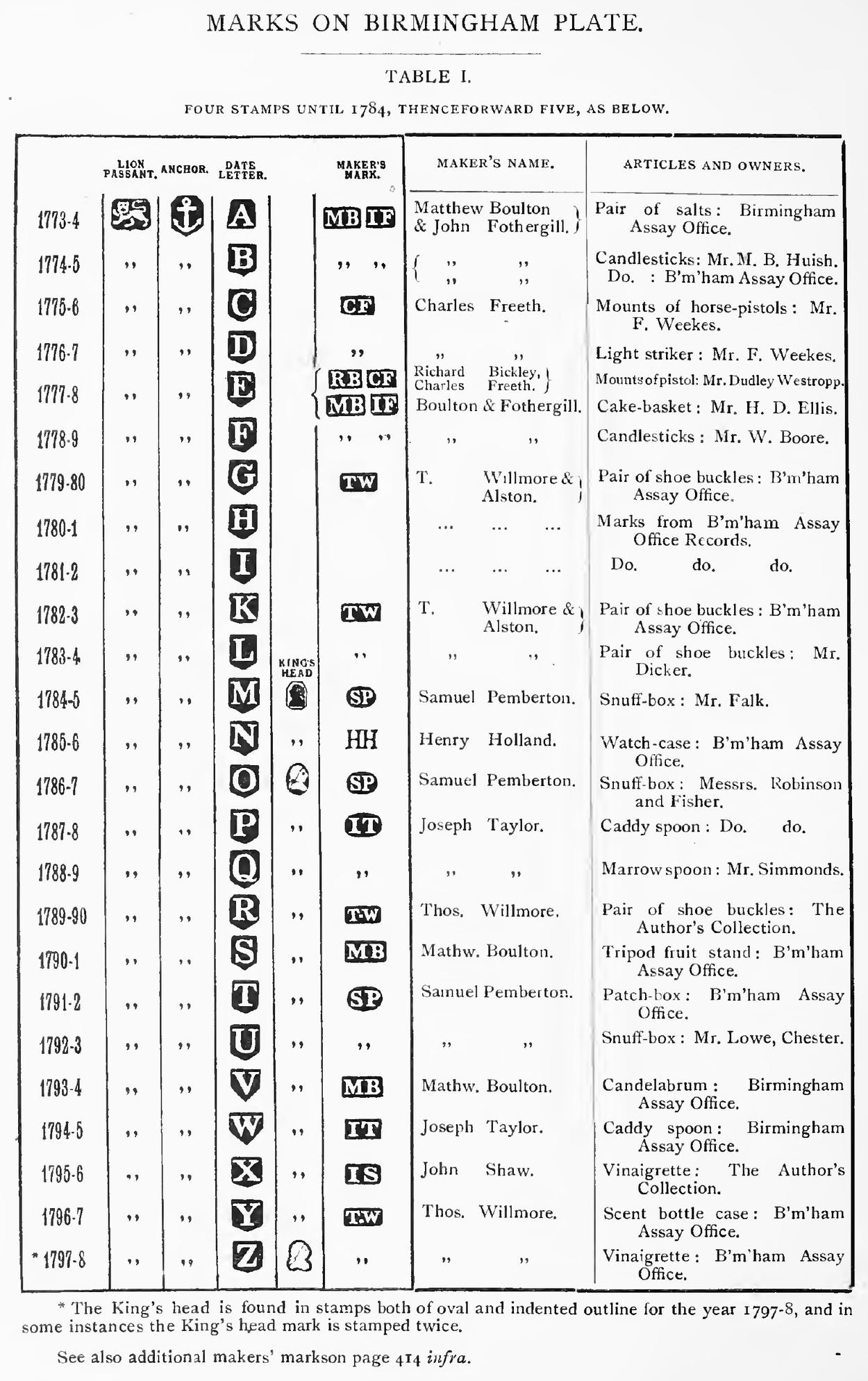
Everything below rests on Jackson's 1921 tables, compiled from the office's own records and from surviving plate he had examined. The lookup gives you a year; the plate underneath it shows you the punch that year was struck with, so the answer can be checked rather than believed.
Find the Year on a Birmingham Mark
Covers 1773 to 1924 — the whole of the office's first six cycles, from its opening year to the end of Jackson's record.
Birmingham date-letter lookup
Six cycles in 152 years means most letters come round six times. The letter alone will not date a piece; the shield outline, the letter’s style and the presence or absence of a duty mark are what separate them. The lookup shows the plate so you can make that comparison yourself.
The Office That Had to Be Lobbied Into Existence
By the 1760s Birmingham was making metal goods on an enormous scale — buttons, buckles, boxes, the small wares the trade called toys. Matthew Boulton of the Soho Manufactory wanted to work in solid silver, and there he hit a wall: silver could not legally be sold until an assay office had tested and struck it, and the nearest office was Chester, seventy-two miles away. Every piece had to make a round trip of a week or more, at risk of damage and loss.
At the end of 1772 the Birmingham makers resolved to apply to Parliament. The Sheffield cutlers, who had the same problem, prepared their own petition, and the two were laid before the House of Commons on 1 and 2 February 1773. The London Goldsmiths' Company opposed them outright: a provincial office was a threat to a monopoly that had held since the Middle Ages.
Boulton's answer, circulated to Members as a printed Memorial, is worth quoting in substance because it is such a modern argument. He conceded that the existing offices would object, but pointed out that Birmingham was nowhere near their markets, so the only way Birmingham could take their trade was by working better and more cheaply — and that price and quality, not inherited privilege, were the proper grounds on which to compete.
It worked. The Bill was read in March, survived the Goldsmiths' opposition through every stage, and on 28 May 1773 the Lords agreed to it. Royal Assent came the same day, creating the Birmingham and Sheffield offices together.
Why an Anchor
Birmingham is about as far from the sea as anywhere in England, which makes an anchor an odd choice of town mark. The explanation usually given is that while Boulton and the Sheffield men were in London working on the Bill, they conducted much of their business at the Crown & Anchor Tavern in the Strand, a well-known haunt of politicians — and took the two halves of the tavern's sign as their marks. Birmingham took the anchor; Sheffield took the crown.
The coin toss is a story, not a record. It is often said the two delegations tossed for which mark they would take. That detail is tradition rather than documented fact, and it is worth separating from the tavern itself, which is well attested. The marks are certain either way: anchor for Birmingham, crown for Sheffield, both from 1773.
The First Entry in the Register
Jackson's Table I opens at 1773–4 with the date letter A, and against it stands the maker's mark of Matthew Boulton & John Fothergill, recorded on a pair of salts held by the Birmingham Assay Office itself. The man who fought the Bill through Parliament is the first name in the register of the office he created, on an object that still exists.
Read a little further down the same plate and the trade begins to show itself: Samuel Pemberton, Joseph Taylor, Thomas Willmore, John Shaw. Against 1785–6 there is an entry for Henry Holland, and the article is recorded simply as a watch-case. Cased watch work was in Birmingham's register within twelve years of the office opening, and it never left.
Six Cycles, 1773 to 1924
Six cycles cover the period in the lookup. The guardians of the assay office met annually in July, and that is when the punches changed — which is why every row in the tables spans two calendar years. Anything sent for assay between January and June therefore wears the letter of the year that began the previous July.
| Jackson's table | Years | Letters | Style |
|---|---|---|---|
| I | 1773–1797 | A–Z, no J (25) | Roman capitals |
| II | 1798–1823 | a–z, all 26 | Roman lower case |
| III | 1824–1848 | A–Z, no I (25) | Gothic capitals |
| IV | 1849–1874 | A–Z, all 26 | Roman capitals |
| V | 1875–1899 | a–z, no j (25) | Gothic lower case |
| VI | 1900–1924 | a–z, no j (25) | Roman lower case |
Birmingham Changed Its Alphabet Four Times
Almost every guide to English hallmarks will tell you that date-letter cycles omit the letter J. Birmingham is the office that shows why you should not lean on that rule:
- 1773–1797 and 1875–1924 behave as expected, and skip J.
- 1798–1823 and 1849–1874 run the full alphabet, using both I and J — twenty-six letters, twenty-six years.
- 1824–1848 does the opposite of the convention entirely: it drops I and keeps J.
The consequence is practical rather than academic. Assume the usual rule on an 1824–1848 Birmingham piece and every letter after H is out by a year. This is precisely why these pages are built one office at a time: the offices did not agree with each other, and a single national table of date letters quietly hides that.
For contrast, Chester is consistent — all four of its cycles in the lookup period omit J.
What Birmingham Marked
The articles column in Jackson's tables is an inventory of what the town actually made, and it is strikingly small-scale: snuff-boxes, vinaigrettes, caddy spoons, patch-boxes, shoe buckles, nutmeg graters, scent-bottle cases. Birmingham's silver trade grew out of the toy trade and kept its habits. Where Sheffield ran to flatware and London to hollow ware, Birmingham made things that fit in a pocket — which is exactly the manufacturing culture that takes naturally to watch cases.
Two details in the tables are worth knowing before you read a mark:
- The King's head duty mark appears from 1784–5, when a duty on silver was imposed, and disappears after 1890 when it was repealed. Its presence or absence brackets a piece immediately, independent of the letter.
- For 1797–8 the King's head is found in both oval and indented outlines, and is sometimes struck twice. Jackson flags it on the plate. A doubled duty mark is not necessarily a fault or a fake.
The office is still working today, which makes the anchor unusual among provincial marks: unlike Chester, which closed in 1962, an anchor gives you no upper bound at all. Everything narrowing the date has to come from the letter, its style, and the duty mark.
Further Reading
- English hallmarks on pocket watch cases — the five marks and every assay office symbol.
- How to read English hallmarks — the step-by-step method, with worked examples.
- Chester hallmarks and date letters — the office Birmingham's silver had to travel to before 1773.
- Pocket watch cases — materials and construction.
- What your pocket watch is worth — how a confirmed date affects value.
Plates: Sir Charles James Jackson, English Goldsmiths and Their Marks, 2nd edn, Macmillan, 1921 — public domain. The 1773 campaign, the Memorial to the Commons and the Crown & Anchor follow the Birmingham Assay Office's own history via Revolutionary Players; the July changeover follows the Birmingham tabulation at silvermakersmarks.co.uk.