
Dublin Hallmarks: Hibernia, Harp and Date Letter
Hibernia — the seated woman with her harp and her spear — is the mark everyone recognises on Irish silver, and the one most often described as Dublin's town mark. For the first ninety-two years of the office she does not appear at all. When she does appear, in 1730, it is because a sixpence an ounce duty had been imposed on Irish plate and somebody had to stamp the pieces that had paid it.
The mark that actually says Dublin assayed this and found it sterling is the crowned harp, and it has said so since the first assay on 6 April 1638. Read the harp first. It is the older mark, the prescribed mark, and the one that is on every piece.
Start With the Harp, Not the Date Letter
The lookup below covers 1638 to 1920, but it has three holes in it, and they are not oversights — they are places where Jackson's tables stop being year-by-year. Ask about a year inside one and the tool will say so and put the plate on screen instead.
Dublin date-letter lookup
A working order for an Irish piece: harp (is it Dublin at all?), then Hibernia present or absent (before or after 1730), then a monarch's head present or absent (1807–1890), and only then the letter. Three of those four are symbols you can read at a glance on a worn case; the letter is the smallest punch and the first to go.
Hibernia Is a Tax Stamp That Became an Office Mark
The Act of 1729 laid a duty of sixpence an ounce on all plate wrought in or brought into Ireland from and after 25 March 1730. Hibernia was struck to show it had been paid.
Jackson is careful about who introduced her, and corrects an older authority in the process. Old English Plate had said the mark was added in 1730 by order of the Commissioners of Excise; Jackson finds no evidence for that, and concludes the stamp was adopted by the Dublin Goldsmiths' Company itself, probably on its own initiative, because the Company was the body held responsible for collecting the duty.
He also cannot date her first use, and says so. The goldsmiths' books carry the entry “21 April, 1730, Duty came on this day”, which may mark the first payment. But there is, he writes, as much plate carrying that year's date letter without Hibernia as with it — so the punch came into use gradually, and may not have been adopted until 1 January 1731. An Irish piece of about 1730 with no Hibernia is not necessarily untaxed or suspect.
Then the story inverts. The duty was repealed in 1890 and the mark stayed. Today the Dublin Assay Office — still in Dublin Castle, still assaying — lists Hibernia as a compulsory mark and the crowned harp as an optional “traditional” one. The tax stamp outlived the tax and became the office's own mark; the mark the Charter prescribed became a decoration.
So both readings are right, but not at the same time. On anything made before 1890, Hibernia is a duty mark and tells you the piece was taxed, not where it was assayed — the harp tells you that. On a modern Irish piece Hibernia is the office mark. Since 2002 it is struck on everything hallmarked in Dublin whatever its origin. A chart that gives you one sentence for both periods will mislead you about one of them.
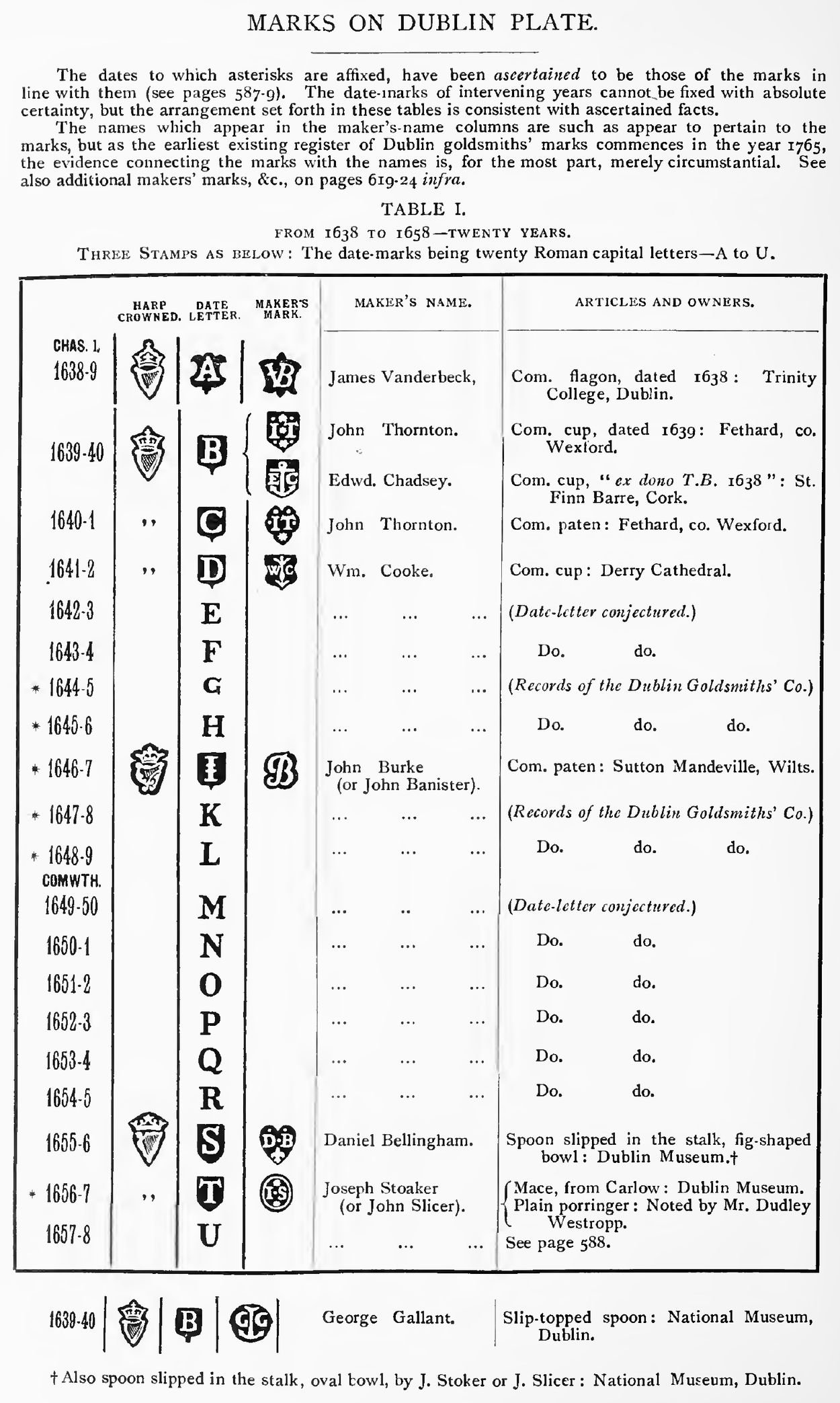
What the Charter of 1637 Actually Prescribed
Charles I's Charter of 1637 created the Company and named two marks, no more: the harp crowned — which Jackson glosses as the King's Majesty's stamp, and the standard mark — and the goldsmith's proper mark. The first assay under it was made on 6 April 1638, and from that day no Dublin-made gold or silver could legally be sold or exchanged without both.
The date letter is not in the Charter. Jackson notes it plainly: the third mark “is not prescribed; in fact, it is not mentioned in the Charter”, yet it was in use from 1638 anyway. So Dublin's letters are a house convention that outlived the document that omitted them — and they were used loosely. Jackson observes that through the second half of the eighteenth century the date letter was very frequently left off larger articles altogether, while spoons nearly always carry one.
The marks arrived in this order, and the count of punches on a piece is a rough clock:
| Mark | From | What it means |
|---|---|---|
| Harp crowned | 1638 | Sterling standard. Prescribed by the Charter. |
| Maker's mark | 1638 | The goldsmith. Also prescribed. |
| Date letter | 1638 | Used from the start, but never prescribed, and often omitted. |
| Hibernia | 1730 or 1731 | The sixpenny duty. Oval stamp until 1794. |
| Sovereign's head | 1807–1890 | The British duty mark. Gone with the duty. |
The harp's outline is a second clock, and a useful one on a rubbed case: from 1638 until 1787 the stamp followed the shape of the harp itself; from 1787 to 1794 it was oval; from 1794 it became an upright parallelogram with the corners clipped.
Where the Alphabet Stops Behaving
Jackson prints fourteen numbered tables for Dublin. Only nine of them are cycles you can look a year up in, and it is worth knowing which is which before trusting any chart.
| Table | Years | Usable? | Why |
|---|---|---|---|
| I | 1638–1657 | Yes | 20 Roman capitals, A to U, one per year. |
| II | 1658–1677 | Yes | 20 small italics, a to u. |
| III & IV | 1678–1716 | No | One 39-year cycle across two tables. Rows read 1685-6-7, 1693-4-5, 1696-9, and one bracket holds two letters for 1688 to 1692. |
| V & VI | 1717–1746 | No | The alphabet restarts mid-table: Court-hand A–C for 1717–20, then a fresh A in 1720–1. One row covers 1741-2-3; 1744 has no row at all. |
| VII | 1747–1772 | No | The heading claims 26 years; the table prints 24 rows, four of them straddles, and nothing for 1755 or 1756. |
| VIII | 1773–1796 | Yes | 24 capitals, omitting both J and V. |
| IX | 1797–1820 | Yes | 24 capitals, omitting J and V. Sovereign's head from 1807. |
| X | 1821–1845 | Yes | 25 capitals. V is back. The first cycle taken from a register. |
| XI | 1846–1870 | Yes | 25 small letters. Omits i and uses j — the reverse of every Dublin cycle before it. Q and Y struck large. |
| XII | 1871–1895 | Yes | 25 block capitals. Duty mark ends 1890. |
| XIII | 1896–1915 | Yes | 20 blackletter capitals, A to U. |
| XIV | 1916–1920 | Yes | Five letters, A to E. Jackson's record ends with the book. |
Table VII is the one that should make you cautious about any printed Dublin chart. Its own heading says twenty-six years. Count the rows and there are twenty-four. Four of them are written as straddles, and between the H of 1754–5 and the I of 1757 the table simply skips two calendar years. Every chart that renders Dublin 1747–1772 as twenty-six tidy rows has silently invented the two that Jackson left out.
Jackson's Asterisks, and Why They Matter More Here
At the head of the Dublin tables Jackson sets out a convention he uses nowhere else so systematically. An asterisk against a year means that date has been ascertained — he had a dated or recorded piece for it. Of everything else he writes that the date-marks of intervening years cannot be fixed with absolute certainty, though the arrangement is consistent with the facts he does have.
That is a per-row confidence rating printed in a 1921 reference book, and it is more than most modern hallmark charts offer. This page carries it through: ask for a year and the answer tells you whether Jackson could pin it down or was interpolating.
The proportions are worth knowing. In Table VIII (1773–1796) eight of the twenty-four years are asterisked. In Table IX the run from 1798 to 1807 is asterisked almost solidly, then the marks thin out again. And from 1821 the question stops arising: Jackson notes that from that year every mark and its date is recorded, so Table X onward is transcription from a register rather than reconstruction from surviving objects.
There is a second caution in the same preamble, and it bears on maker attributions rather than dates. The earliest surviving register of Dublin goldsmiths' marks begins in 1765. Before that, Jackson says, the evidence connecting a mark to a name is “for the most part, merely circumstantial”. A confident maker attribution on a pre-1765 Irish piece is worth treating as a proposal.
Dublin Changes Its Mind About I, J and V
Nothing on this site has produced a rule about the letter J that survives contact with a second office, and Dublin breaks the pattern in both directions inside a single century.
- Tables VIII and IX (1773–1820) omit both J and V, giving 24-letter cycles.
- Table X (1821–1845) omits J but brings V back, giving 25.
- Table XI (1846–1870) does the opposite of all of them: it omits i and uses j. A lower-case Dublin j is 1854–5, and there is no i in that cycle to confuse it with.
- Table XI also strikes Q and Y as capitals in an otherwise lower-case alphabet, so a large letter in the middle of a small-letter cycle is not a different cycle.
Seven offices now have a page here, and the tally is: Birmingham used four conventions, Edinburgh three, Sheffield none consistently, Glasgow exactly one, Dublin three. There is no general rule about J. Anyone applying one office's habit to another will misdate pieces, and the error is always a year or more.
What a Dublin Watch Case Should Carry
Irish silver pocket watch cases are mostly nineteenth-century, which puts them in Tables X, XI or XII, and that is a comfortable place to be: those three are register-based, regular, and twenty-five letters each.
Expect the harp crowned, Hibernia, a maker's mark and a date letter — plus a sovereign's head if the case is between 1807 and 1890. Five punches to 1890, four after. If a case has four marks and a Victorian look, the missing one is the duty stamp and it dates the case to 1890 or later.
Two practical warnings. Jackson records that the date letter was frequently omitted on larger eighteenth-century Irish articles, and while a watch case is not a salver, the habit tells you the letter was treated as optional in a way it never was in London — so a Dublin case without one is not automatically wrong. And the crowned harp is not a lion passant: Irish sterling was never marked with a lion, and a lion on a case with an Irish maker's name usually means the case was assayed across the water.
Further Reading
- English hallmarks on pocket watch cases — the five marks and every assay office symbol.
- How to read English hallmarks — the step-by-step method, with worked examples.
- Edinburgh hallmarks and the castle — the other office that ran under its own law rather than England's.
- Glasgow hallmarks — where the source flags its guesses too, in the opposite direction.
- London hallmarks and the leopard's head — where the standard mark changed twice by Act of Parliament.
- Pocket watch cases — materials and construction.
Plates, table headings, the asterisk convention, the Charter of 1637, the first assay of 6 April 1638, the 1729 Act and its sixpenny duty from 25 March 1730, the correction of Old English Plate on who introduced Hibernia, the 1752 Act, the changing outline of the harp stamp and the 1765 start of the makers' register: Sir Charles James Jackson, English Goldsmiths and Their Marks, 2nd edn, Macmillan, 1921 — public domain. The present status of the marks — Hibernia compulsory, the crowned harp and the date letter optional, Hibernia struck on all work since 2002 — is from the Dublin Assay Office's own published description of its hallmarks, and postdates Jackson by a century.