
London Hallmarks and the Leopard’s Head
London is the oldest assay office in Britain and the one every other office copied. It is also the one where the marks themselves keep changing — not because the goldsmiths grew tired of them, but because Parliament kept rewriting the law. A London mark is a fossil of whichever statute was in force the year it was struck.
That makes London harder to read than a provincial office and more informative once you can. Twice the standard mark was replaced outright, once the town mark lost its crown, and gold was progressively separated from silver by a series of Acts between 1798 and 1854.
Put a Year to a London Mark
Thirteen consecutive cycles are searchable, running from the reign of Charles II to the close of Jackson's record in 1919. Anything struck before 1678 falls outside that range; ask for such a year and the page hands you the plate to read instead of inventing an answer.
London date-letter lookup
London cycles are twenty letters long and alternate rigidly between capitals and lower case, and between roman and blackletter. That regularity is a help: the style of the letter narrows the century before the letter itself narrows the year. The date letter changed at the end of May, so every entry spans two calendar years.
Britannia, 1697 to 1720: When the Standard Itself Changed
In the 1690s the coinage was in crisis. Silver coin was being clipped and melted, and one reason was that sterling plate and sterling coin were the same alloy — a silversmith could buy coin and work it. Parliament's answer was to make plate a different, higher standard so that melting coin no longer paid.
From 27 March 1697 silver wares had to be 95.84% fine instead of 92.5%. The new standard needed new marks, and the old ones were withdrawn from silver entirely:
- The lion passant was replaced by the figure of Britannia.
- The leopard's head crowned was replaced by the lion's head erased — a lion's head in profile with a ragged neck.
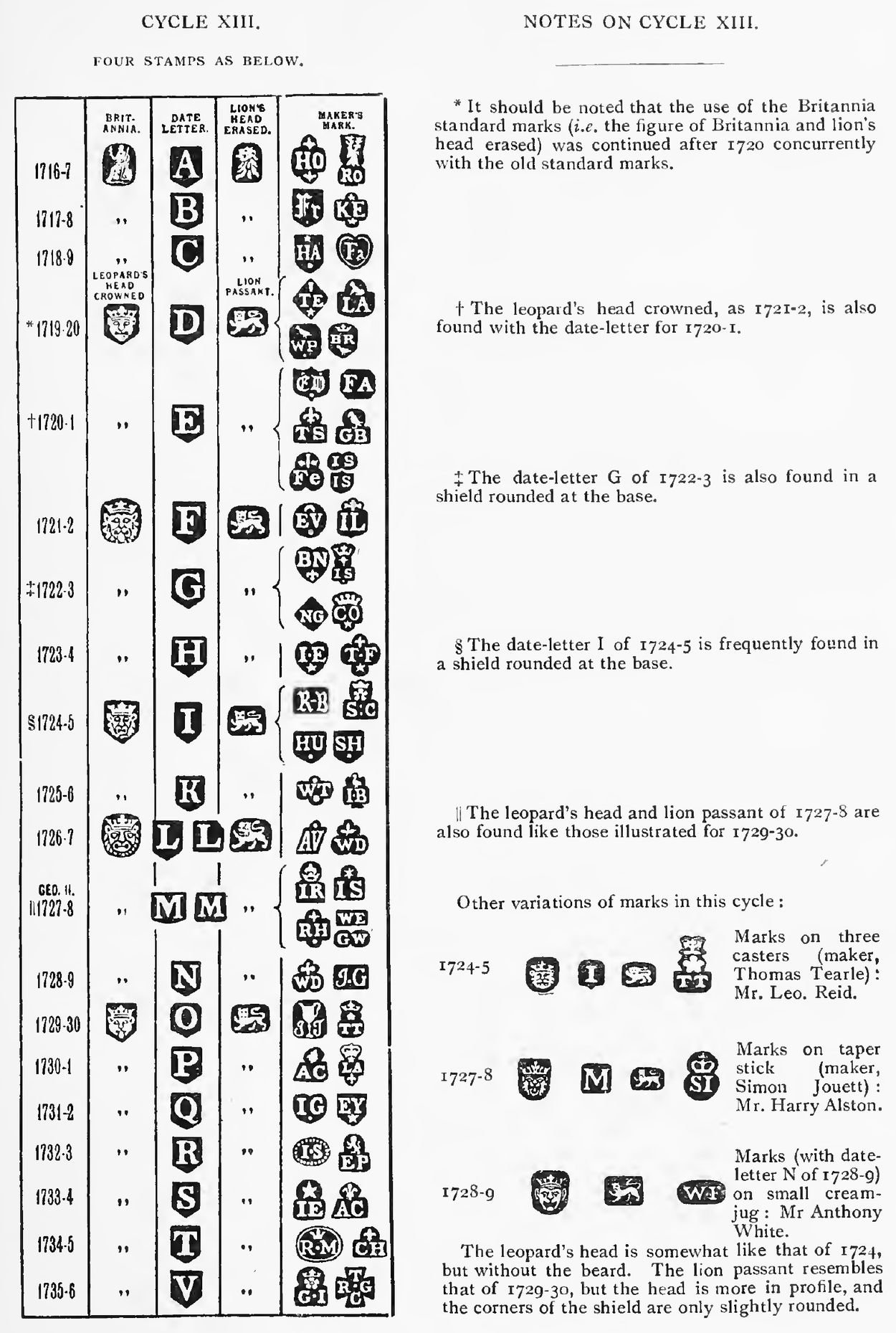
You can watch it happen in Jackson's tables. Cycle XI is headed Leopard's Head Crowned and Lion Passant; Cycle XII, beginning in 1697, is headed Britannia and Lion's Head Erased. The column headings change because the law did.
The Act of 1719 restored the old standard from 1 June 1720, and Cycle XIII shows the reversal mid-table: Britannia marks to 1718–9, then leopard's head and lion passant from 1719–20. Britannia was not abolished, though — it became optional, and a piece marked with it after 1720 is higher-standard silver by choice.
Gold was exempt, and this catches people out. The Britannia standard applied to silver only. Jackson notes on the plate that solid gold articles of 1697–1720 continued to be marked with the leopard's head and lion passant, exactly as in 1696. A leopard's head on a piece of that period does not mean it escaped the new law — it may simply mean the piece is gold.
The Two Years You Cannot Tell Apart by the Letter
Jackson thought this important enough to interrupt his tables for it, and it is the best worked example on this page.
The London date letter for 1718–9 is a Roman C. So is the date letter for 1738–9. Jackson calls the two "indistinguishable, except by the very slight truncation of the corners of its shield". Twenty years apart, and the letter will not separate them.
What separates them is the law. In 1718–9 the Britannia standard was in force exclusively, so that C is accompanied by Britannia and the lion's head erased. By 1738–9 the old standard had returned, so the same C sits beside the leopard's head and lion passant. Read the company the letter keeps, not the letter.
He gives the same warning about the marks of 1722–3, which closely resemble those of 1692–3, and of 1726–7, which resemble 1680–9 — in both cases because the makers went on using the punches they had owned before 1697.
And rather than leave the reader to take that on trust, he stopped his tables and printed the comparison. Supplementary Table XIII.A interposes four complete sets of marks — 1692–3, 1722–3, 1726–7 and 1738–9 — expressly so the resemblances can be seen rather than described:
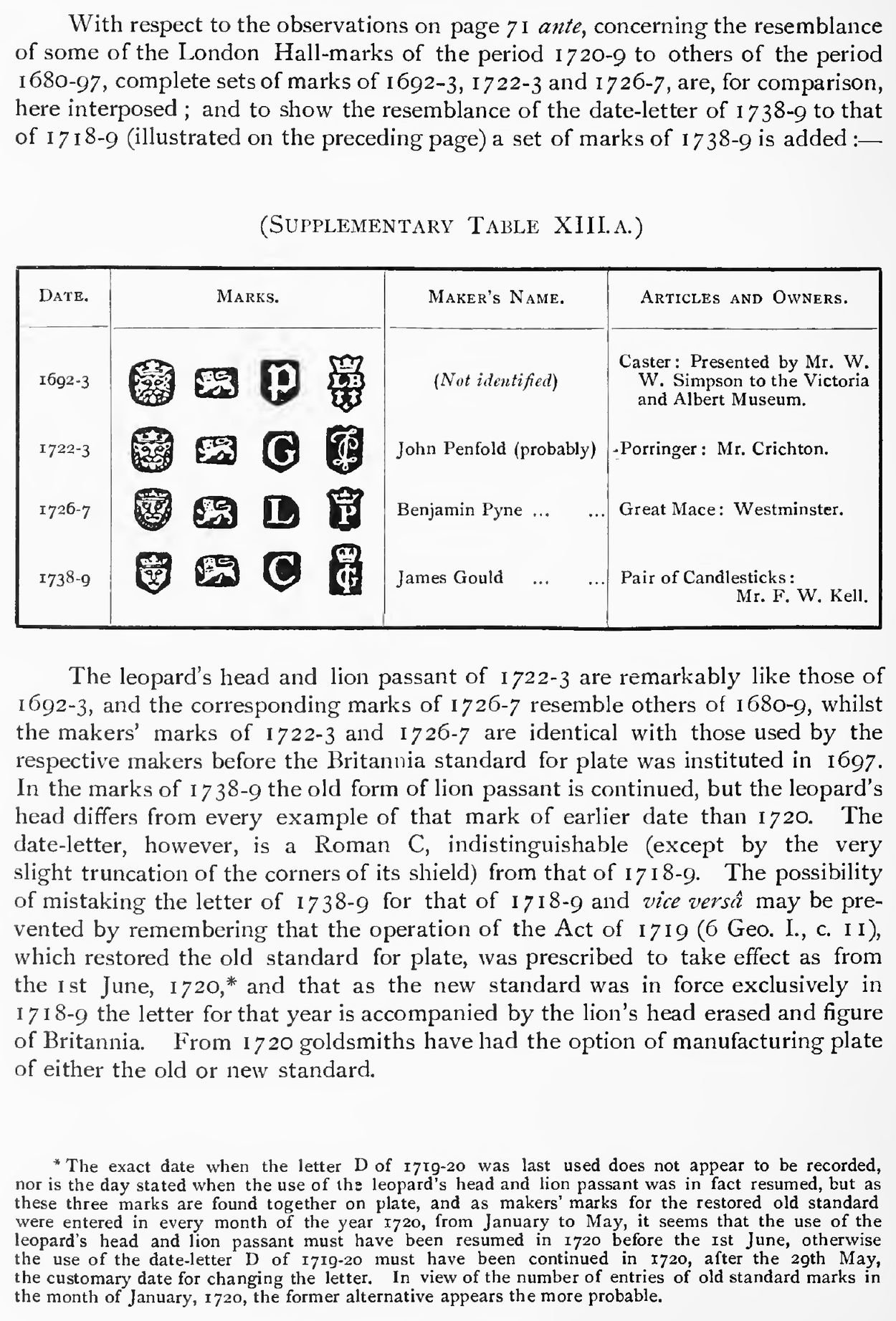
The four rows are a caster in the Victoria and Albert Museum (1692–3, maker not identified), a porringer probably by John Penfold (1722–3), the Great Mace at Westminster by Benjamin Pyne (1726–7) and a pair of candlesticks by James Gould (1738–9). What makes them resemble one another is not coincidence: the makers’ marks of 1722–3 and 1726–7 are identical with those the same men had used before the Britannia standard came in in 1697. They had simply gone back to their old punches.
Note what the plate does not show. The C of 1718–9 is on Jackson’s preceding plate, not this one. So the pair he warns about cannot be compared side by side even in his own book — the 1738–9 row is the half you can see, and the other half is a page turn away. That is worth knowing before you go looking for a comparison the figure does not contain.
His footnote to that table is a small model of showing your working. The exact day the D of 1719–20 was last struck is not recorded, and neither is the day the leopard’s head and lion passant were resumed. But because all three marks are found together on plate, and because makers entered their marks for the restored old standard from January to May 1720, he reasons that the resumption must have happened before 1 June 1720 — otherwise the D would have run on to 29 May, the customary day for changing the London letter. He gives the alternative, says which he thinks the more probable, and leaves the reader the evidence.
The Crown Comes Off the Leopard, 1821
For five centuries London's town mark was a crowned leopard's head. In 1821 the crown was removed, and the mark has been an uncrowned leopard ever since.
It is the single most useful dating fact about a London mark, because it needs no table at all. A crown on the leopard means before 1821; no crown means after. Jackson's plates make it visible: Cycle XVIII is headed simply Leopard's Head, and the illustration changes at 1821–2. He adds that on plate of the second quarter of the century the head is frequently found without whiskers, which is a style variation and not a different mark.
The other bracket is the duty mark. A sovereign's head was added from 1784, when duty was charged on silver, and stopped after 1890, when it was repealed. Between them the sovereign changes with the reign, so the head alone will often place a piece within a decade or two.
Gold Stopped Being Marked Like Silver
Until the end of the eighteenth century gold and silver of the old standard were marked identically, which meant a hallmark told you the piece had passed assay but not which metal it was. Three Acts fixed that, and each one added a mark:
| Year | What changed | The mark |
|---|---|---|
| 1798 | A new 18-carat gold standard authorised | A crown and 18, in place of the lion passant |
| 1844 | 22-carat gold distinguished from silver-gilt | A crown and 22, in place of the lion passant |
| 1854 | 15, 12 and 9 carat standards authorised | The figures 15·625, 12·5 and 9·375 — and no crown or sovereign's head |
That last row matters for watch cases more than any other. A late Victorian or Edwardian gold case marked 9·375 carries no crown and no duty mark, which can look to an untrained eye like an incomplete or suspect hallmark. It is neither — it is exactly what the 1854 Act prescribed for the lower standards.
Twenty-Three Cycles, and What the Lookup Covers
Jackson records twenty-three London cycles, running from 1478 to 1919. The lookup covers the last thirteen, 1678 to 1919.
The earlier ten are here as plates rather than as data, for two reasons. Their letters are Lombardic and black-letter forms that cannot be read reliably at plate scale — and unlike a modern cycle there is no second copy of the alphabet to check a doubtful letter against. More practically, English silver watch cases barely exist before the 1670s, so a lookup that guessed at 1553 would be risking an error to answer a question nobody asks. Enter an early year and the page shows you the plate to read it from.
Within the covered range the cycles are strikingly regular — twenty letters each, alternating capitals and lower case, alternating roman and blackletter — with one exception worth knowing: Cycle XIII (1716–1735) omits both J and U and ends at V, where every other cycle of the period omits only J or j.
Further Reading
- English hallmarks on pocket watch cases — the five marks and every assay office symbol.
- How to read English hallmarks — the step-by-step method, with worked examples.
- Chester hallmarks and date letters — the office the Liverpool watch-case trade used.
- Birmingham hallmarks and the anchor mark — the office created by Act of Parliament in 1773.
- Sheffield hallmarks and the crown — where the first fifty years of date letters follow no order at all.
Plates and the quoted notes on Cycles XII, XIII and XVIII: Sir Charles James Jackson, English Goldsmiths and Their Marks, 2nd edn, Macmillan, 1921 — public domain. The statutory dates for the Britannia standard, the 1719 Act and the gold standards of 1798, 1844 and 1854 are Jackson's own, given in his notes to those cycles.