
Newcastle Hallmarks: Three Castles and a Leopard
Newcastle upon Tyne struck more marks than London did. From 1721 a piece assayed there carried five punches — three castles, a lion passant, a leopard's head, a date letter and the maker's mark — and from 1784 six. London, in the same years, was using four.
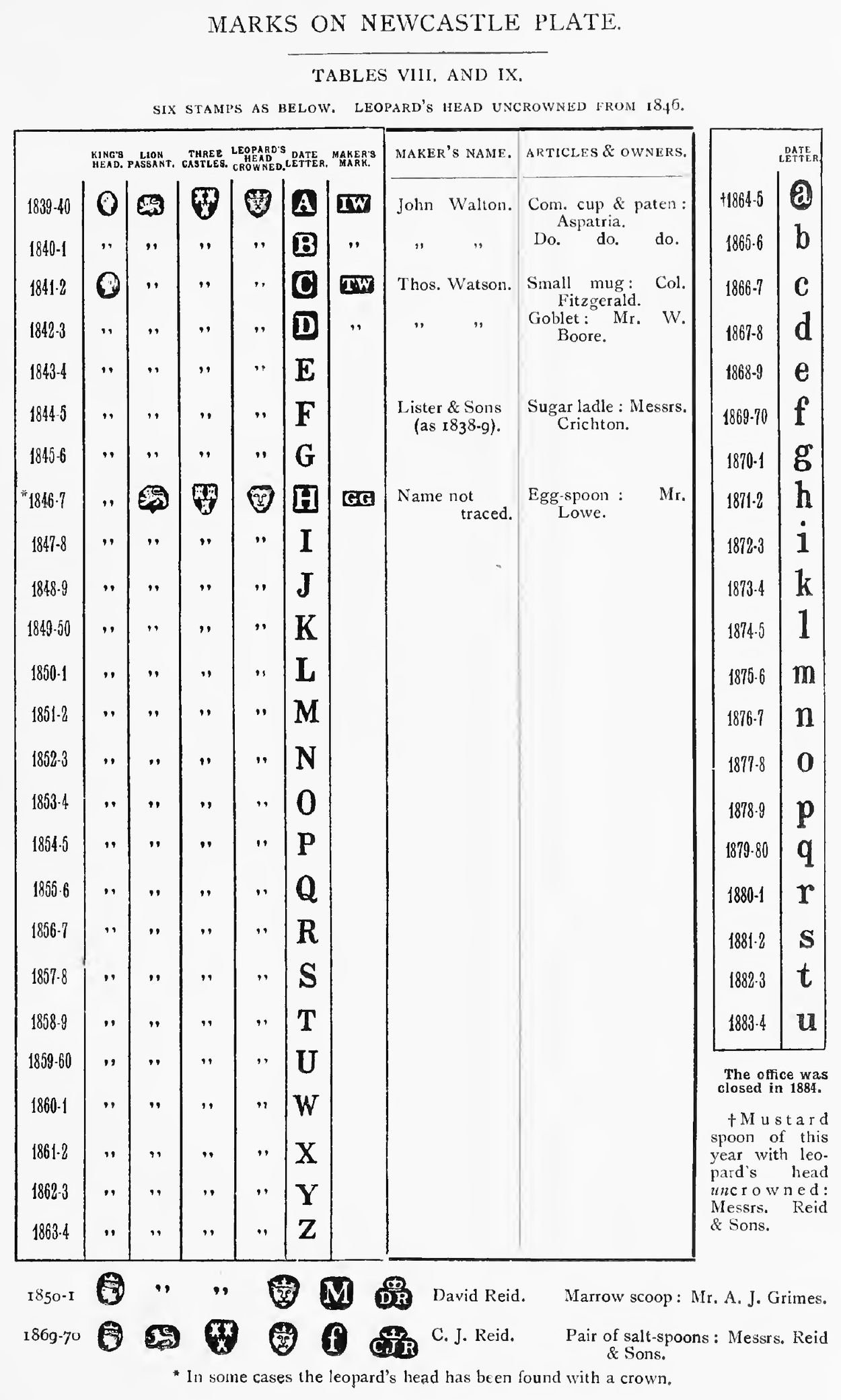
That excess is the first thing worth understanding about Newcastle, and the last cycle is the second. It runs a to u and simply stops. Jackson prints a single line under it: “The office was closed in 1884.” There is no v, w, x, y or z, and there never was.
Count the Marks, Then Look Up the Letter
The lookup covers 1721 to 1883, which is every year the office ran a countable cycle. The two tables before that are on the plates instead, for reasons given further down.
Newcastle date-letter lookup
Two marks bracket a Newcastle piece before you touch the alphabet. A monarch's head means 1784 or later — the duty mark arrived in the middle of Table V. Britannia and a lion's head erased instead of a lion passant means 1702–1720, the higher-standard period. Everything else needs the letter.
The Office Was Closed in 1884
Jackson records the end in more detail than he gives any other office, because the company's own minute books survived. The last assay of silver was thirty teaspoons, on 22 April 1884. The last assay of gold was thirty rings, on 2 May. Both parcels belonged to the same customer, a Mr R. M. Craig. At the annual meeting that year the company resolved to discontinue, and on 20 May 1884 the stamps and dies were handed over. James Robson was the last assay master.
What survived is a short list: the books and papers, the round copper plate carrying 287 makers' punches struck into it from shortly after 1702, a square plate on which the date letter was impressed from 1864 to 1884, and two old oaken boxes — one of which had held the diet, the scrapings kept back from every assay as a check on the assayer. They went to the Society of Antiquaries of Newcastle-upon-Tyne.
Beware the two closing dates. Jackson writes elsewhere that the minute books run to “the time when the assay office was closed in 1885”. Both dates are his, and both are right about different things: assaying stopped in 1884, and the company's tenancy of its room in Dean Court — rent one pound a year — ran until 1 May 1885. If you meet 1885 in a hallmark guide, this is where it came from.
Why Newcastle Wore London's Leopard
The leopard's head is London's town mark. Newcastle struck it too, from 1721, beside its own three castles — so a Newcastle piece of that period carries two town marks, one of which belongs to a city three hundred miles away.
It is not a mistake, and it is not provincial deference. Through the eighteenth century the leopard's head functioned less as London's badge than as a general mark of English sterling, and the provincial offices that were licensed to strike it did so as a guarantee rather than as an address. The practical consequence for a collector is direct: a leopard's head does not mean London. Look for the castles.
The Crowned Leopard Is Not a Reliable Date
London took the crown off its leopard in 1821, and it is tempting to use the crown as a quick date test on any English piece. On Newcastle silver it does not work, and the reason is that the source contradicts itself.
- Jackson's heading to Table VIII reads six stamps as below. Leopard's head uncrowned from 1846.
- His prose about the same cycle, a few pages earlier, says the marks of 1839 to 1863 are recognisable by the monarch's head, “the leopard's head being generally crowned”.
- His footnote to Table IX singles out a mustard spoon of 1864–5 “with leopard's head uncrowned” — which only reads as worth remarking if uncrowned was still unusual.
- Modern references generally say Newcastle kept the crown until it closed.
Those four statements cannot all be true. This page does not pretend to know which is wrong; it does say, firmly, that you should not date a Newcastle piece by whether its leopard wears a crown. Use the castles to place it, the monarch's head to bracket it after 1784, and the letter to fix the year.
The Letter B Ran for Nine Years
Table V is the one that gives the office away. It covers 1759 to 1791 — thirty-two calendar years — in twenty-four rows, because a single row is labelled 1760-8. One punch, one letter, nine consecutive years.
A date letter exists to change annually. An office that leaves the same B in the box for nine years is not running an annual cycle; it is marking whatever comes in with whatever is already cut. That is not carelessness so much as arithmetic — recutting a punch every year is only worth it if there is enough work to justify it.
The lookup handles this honestly. Ask it for 1764 and it returns B, and tells you that eight other years return the same letter and cannot be separated from it. That is the true answer, and a chart that gives 1764 a private letter of its own is guessing.
Matthew Prior's Evidence, 22 March 1773
In 1773 Sheffield and Birmingham petitioned Parliament for assay offices of their own. The London Goldsmiths' Company opposed them, and suggested that “great irregularities, if not frauds” were practised at the provincial halls. A committee was appointed, and Newcastle's assay master — Matthew Prior, who had taken the job over from his father — travelled to London and was examined on 22 March.
His evidence is the best description on this site of how a small assay office actually worked:
- He assayed two days a week, Tuesdays and Fridays, from nine in the morning until the assaying was done, with one or both wardens present throughout.
- He had no salary. He was paid a halfpenny an ounce by the owners of the plate.
- The punches were kept in a box with three locks. Each warden kept a key at his own house and Prior kept the third in his pocket; the box could not be opened without all three.
- The diet — eight grains held back from every pound of silver marked — lived in the same box, and was drawn out annually to pay the office's expenses.
- He passed plate at 11 oz 0 dwt though the standard was 11 oz 2 dwt, allowing a remedy of two pennyweight, “and the London office does the same”.
- Asked about fraud, he said he had never heard of convoys, but had known one parcel to contain “some plate better, and some worse, than standard”, and could not say whether that came from fraud or mistake.
One detail in that evidence does not fit the tables. Prior told the committee that “the letter for the present year is D”. On 22 March 1773, Table V puts Newcastle on F; its D belongs to 1770–1. Both statements are printed in the same chapter of the same book, and no arrangement of the assay year reconciles them. It is worth knowing that the table containing that D is also the table with the nine-year B — but that is an observation, not an explanation, and this page will not manufacture one.
Eighteen Examples in Sixty-Nine Years
Jackson quantifies the decline himself, and the number is startling. Of the last three cycles — 1815 to 1884, sixty-nine years — he writes that he “has not found more than eighteen different examples”, because “there were not many goldsmiths or silversmiths working at Newcastle after 1815”.
And then he adds the sentence that makes those tables trustworthy anyway: “as the date-letters are all recorded, actual examples are not necessary for the framing of the tables.”
This inverts the usual relationship between evidence and confidence, and it is worth holding on to. Newcastle's best-documented cycles are its emptiest ones. The early tables rest on surviving objects and are ragged; the late tables rest on the office's own registers and are exact, even though almost nothing survives to check them against. A table can be reliable and the trade behind it can be dying at the same time.
| Table | Years | Usable? | Letters |
|---|---|---|---|
| I | before 1702 | No | No date-letter column at all. Dates taken from inscriptions on the objects, and Jackson calls them approximate. |
| II | 1702–1720 | No | The Britannia period. Letters out of order, several years blank. |
| III | 1721–1739 | Yes | 19 blackletter capitals, A–T, omitting J. |
| IV | 1740–1758 | Yes | 19 Roman capitals, A–T, omitting J. |
| V | 1759–1790 | Yes, with one caveat | 24 letters over 32 years. B covers 1760–1768. Duty mark from 1784. |
| VI | 1791–1814 | Yes | 24 capitals, omitting J and V. |
| VII | 1815–1838 | Yes | 24 capitals, omitting J and V. |
| VIII | 1839–1863 | Yes | 25 capitals. The only Newcastle cycle that uses J. |
| IX | 1864–1883 | Yes | 20 small letters, a–u, omitting j. Unfinished. |
Notice what the last column does with J. Seven of Newcastle's eight lettered cycles leave it out; the eighth, 1839–1863, puts it in. An office can therefore contradict itself without changing anything else about its marks — same castles, same lion, same leopard, one extra letter. Whatever rule about J you carry in from another office, Newcastle will break it in one cycle out of eight, and the error costs you a year.
An Office Built Because York Was Too Slow
Newcastle's office was re-established by petition, and the petition is worth reading because it explains what a provincial assay office was for. The goldsmiths complained that being compelled to send their plate to York put them in “danger of losing the greatest part of their trade, which chiefly consists of plate bespoke to be wrought up in a short time, and they cannot have it returned from York in less than a fortnight's time”.
The Act — 1 Anne, Stat. 1, c. 9 — received the royal assent on 30 March 1702. An assay office existed to keep a fortnight out of the bespoke trade.
The wheel then turned. From 1717, when the York office was temporarily closed, two York goldsmiths — John Langwith and Joseph Buckle — paid Newcastle an annual fee to have their plate assayed and stamped there instead. Their punches are on the Newcastle copper plate. Newcastle absorbed York's work in 1717 and was itself gone by 1884, and both events have the same cause: not enough silver being made nearby to keep an office alive.
Further Reading
- English hallmarks on pocket watch cases — the five marks and every assay office symbol.
- How to read English hallmarks — the step-by-step method, with worked examples.
- London hallmarks and the leopard's head — the office whose town mark Newcastle also struck, and where the crown came off in 1821.
- Birmingham hallmarks — the 1773 petition that put Matthew Prior on the road to London.
- Glasgow hallmarks — another office whose tables record a trade too small to sustain an annual cycle.
- York hallmarks — the office that shut in 1717 and sent its goldsmiths here, and whose own tables then stop for fifty-nine years.
- Exeter hallmarks — the third office called before the same 1773 committee, and the one whose evidence went badly.
- Pocket watch cases — materials and construction.
Plates, table headings, Matthew Prior's evidence of 22 March 1773, the petition quoted from the company's archives, the Act of 1 Anne Stat. 1 c. 9 of 30 March 1702, the York agreement of 1717, the count of 287 makers' punches on the copper plate, the eighteen surviving examples of the last three cycles, the last assays of 22 April and 2 May 1884 and the deposit with the Society of Antiquaries: Sir Charles James Jackson, English Goldsmiths and Their Marks, 2nd edn, Macmillan, 1921 — public domain. Where Jackson contradicts himself, on the crowned leopard and on 1884 versus 1885, this page says so rather than choosing quietly.