
Pocket Watch Case Markings: What the Stamps Inside Actually Mean
You have the back off, and there is a row of stamps inside: a word, a fraction, a number, perhaps a small animal in a shield. Somewhere among them is the answer to the only question most people are actually asking — is this gold, and if so how much of it?
The marks answer it, but not in the way people expect, and the commonest reading of the commonest mark is wrong. This lookup recognises 34 markings in 155 different spellings and it will tell you what each one means, what it does not mean, and roughly when it was struck.
America Never Had an Assay Office. Britain Had Eleven.
Everything else on this page follows from that difference. American and English cases have to be read in completely different ways.
In Britain a case had to be sent to an independent assay office, which tested the metal, and, if it passed, struck its own marks into it: a town mark, a standard mark, and — the crucial one — a date letter that changed every year. The maker did not choose those marks and could not apply them. That is what a hallmark is: the residue of a compulsory test by somebody with no interest in the answer.
The United States never had such a system. There is no such thing as an American hallmark. Every mark inside an American case was put there by the company that made the case, about its own product, with nothing but its reputation and eventually the law standing behind it. That is not an accusation — most were honest, and the big firms guarded their names carefully — but it explains why American case marks read like advertising, because that is partly what they were.
Decode a Marking
Type in what is stamped inside the case — a word, a fraction, a number, a maker’s name. Case and punctuation do not matter.
What does this marking mean?
Enter one marking at a time, exactly as it reads or as near as you can get.
Try one of these: 1/20 14K Warranted 20 Years Silveroid 14K Warranted U.S. Assay Dennison Keystone Coin
The Mark That Is Misread More Than Any Other
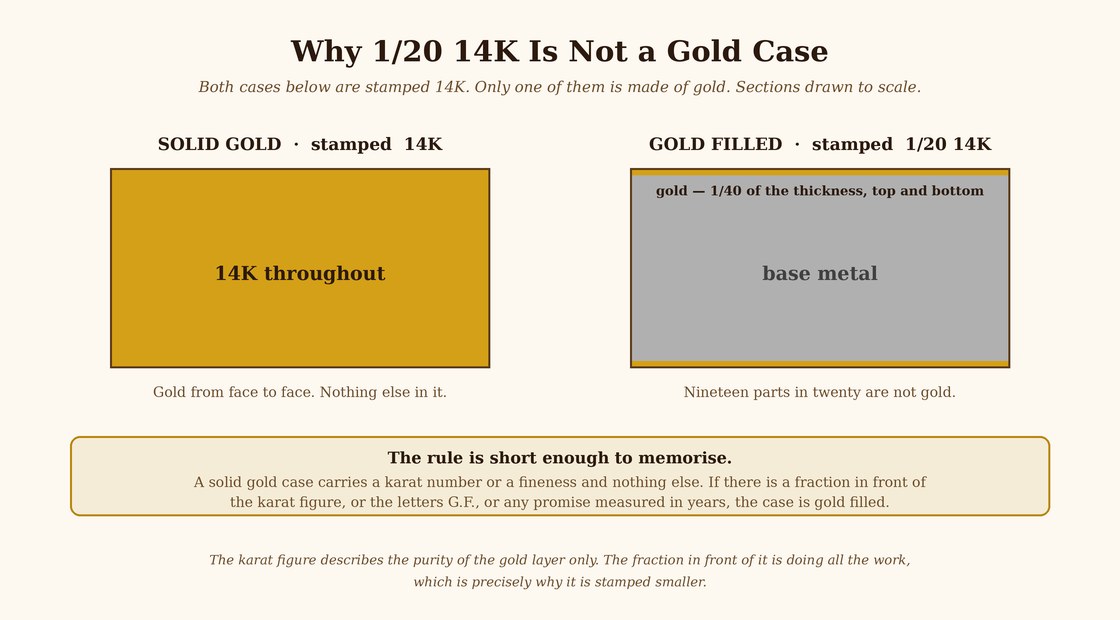
If a case is stamped 1/20 14K, it is not a 14 karat gold case. It is a gold-filled case in which one twentieth of the total weight is 14 karat gold, and the other nineteen twentieths are base metal.
The karat figure in that mark describes the purity of the gold layer only. The fraction in front of it is the part that tells you how much of the case is gold at all, and it is doing all the work. Read without the fraction, 14K is exactly what somebody hoping to have found a gold watch wants to see — which is precisely why the fraction is stamped smaller.
The rule is short enough to memorise. A solid gold case carries a karat number or a fineness and nothing else. If there is a fraction in front of the karat figure, or the letters G.F., or any promise measured in years, the case is gold filled.
What “Warranted 20 Years” Actually Promised
It promised that the gold would not wear through to the metal underneath for twenty years. That is all. It is a durability guarantee, not a statement of what the case contains, and it appears only on cases that have something underneath the gold to wear through to. A case carrying a year guarantee is never solid gold.
Within gold-filled cases the number is genuinely informative, because a longer guarantee required a thicker layer: a twenty-five year case has more gold on it than a ten year case. Collectors are right to prefer the higher numbers. They are simply not choosing between gold and not-gold when they do it.
The wording began with James Boss, who patented the gold-filled process in 1859, and whose business was renamed the Keystone Watch Case Company in 1883. Boss cases became the most popular gold-filled cases in America, and the year guarantee was the reason.
Three Dates That Changed What Case Backs Say
Because there was no date letter, the marks themselves have to date the case — and they can, because the federal government intervened three times, and each intervention changed the vocabulary.
| Date | What changed | What it tells you |
|---|---|---|
| 1859 | James Boss patents the gold-filled case process. | Gold-filled cases in any quantity are later than this. |
| 1883 | The J. Boss business becomes the Keystone Watch Case Company. | A case carrying the J. Boss name and the Keystone mark is later than 1883. |
| 1905 | Marks implying a guarantee backed by the government are outlawed. | Warranted U.S. Assay and similar wording generally indicates a case earlier than this. |
| 1906 | The National Gold and Silver Stamping Act: a karat mark must be within half a karat of the truth. | A karat mark after 1906 is a regulated claim. Before it, it is only a claim. |
| 1924 | Year guarantees are driven off case backs by trade-practice action. | Warranted 20 Years indicates a case earlier than about 1924. |
Warranted U.S. Assay deserves its own sentence, because it is the most misleading phrase in the whole vocabulary. It implies that the United States Assay Office tested the gold. It did not. Case companies assayed their own gold in their own works and warranted the result themselves, and the wording was outlawed in 1905 precisely because of what it implied.
The Names That Contain No Silver At All
A large family of American cases carry names built around the word silver and contain none of it. They are nickel-copper alloys — hard, white, and remarkably good at surviving a century in a waistcoat pocket. Each of the big case houses had its own name for essentially the same thing, which is useful, because the trade name identifies the maker.
| Marked | Case company | What it actually is |
|---|---|---|
| Silveroid | Keystone Watch Case Co. | Cupronickel. No silver. |
| Silverode | Philadelphia Watch Case Co., later Keystone | Cupronickel. No silver. |
| Silverine | Dueber Watch Case Mfg. Co. | Cupronickel. No silver. |
| Oresilver | Joseph Fahys & Co. | Cupronickel. No silver. |
| Nickel silver, German silver | Generic | Copper, nickel and zinc. No silver. |
None of this makes such a watch worthless. It means the value is in the movement rather than the case, which is worth knowing before anybody weighs it for scrap. A Silveroid case in good order is a better-looking thing than a worn gold-filled one, and it will still be there in another hundred years.
Why a Case Number Cannot Be Looked Up
Nearly every case carries a number of its own, usually the largest and most legible thing inside the back — so it is the number people write down, and the number they search for. It will not do what is usually asked of it.
A case number counts cases, not watches. Each case factory ran its own sequence for its own output. A Keystone number counts Keystone cases; a Fahys number counts Fahys cases. The sequences were never coordinated with each other, and they were certainly never coordinated with the movement factories, who were separate businesses selling into the same trade.
That is why searching a case number turns up nothing. The great published tables — the ones that turn a number into a year — were compiled from movement factory records, and those records have nothing to say about a case that some other firm made and a jeweller fitted at the counter. For most case makers no equivalent table was ever compiled at all, and for several the factory records no longer exist to compile one from. A lookup that promises to date a watch from its case number is promising something the surviving evidence cannot support.
The number is not useless. It identifies the case maker’s own batch, and where a firm’s records or catalogues do survive it can place a style. But if you want the year the watch was made, you need the number on the movement, and our serial number tables are keyed to those.
Dennison: The American Who Made English Cases
There is one name that belongs to both systems at once, and it is the most useful thing on this page for anybody holding an English watch.
Aaron Lufkin Dennison is the man usually called the father of American mass-production watchmaking; he was there at the beginning of what became the Waltham Watch Company. He left, came to England, and set up making watch cases in Birmingham. The Dennison Watch Case Company went on to supply Rolex, Omega, IWC and Jaeger-LeCoultre.
Because it was an English works, its cases went to an English assay office. A Dennison gold or silver case carries the sponsor’s mark A.L.D., the anchor of the Birmingham Assay Office, and a date letter — which means that unlike any American case, it can be dated to the year. If that is what you are holding, take the letter to our Birmingham date letter tables and you will have the exact year. If the town mark is something else, start at English silver hallmarks, which answers all eleven offices at once.
Further Reading
- Pocket watch cases — types, construction and sizes: open-face, hunter, half-hunter and pair-cased, and how each one opens.
- English silver hallmarks — the lookup that answers all eleven assay offices at once, 1559 to 1924.
- Birmingham hallmarks — where every Dennison case was assayed, with date letters from 1773.
- How to read English hallmarks — the four marks and the order to read them in.
- Pocket watch serial numbers — movement tables for six American makers, and why the case number will not date a watch.
- How to identify and date a pocket watch — the whole order, movement first, with the case markings as step three.
- What a pocket watch is worth — where case metal does and does not affect value.
Sources for the regulation dates and the case-company trade names are listed in
case-markings.json, which this page reads directly. Where collectors’ sources
disagree, the lookup says so rather than choosing.