
Repeater Watches and Clocks — A History of Striking Time on Demand
A repeater is a watch or clock that will strike the time on demand — at the pull of a cord, the push of a button or the stroke of a slide — chiming out the hours, the quarters and, in the finest examples, the very minute. It should not be confused with an ordinary striking clock or watch, which sounds of its own accord at fixed intervals whether anyone is listening or not: the repeater strikes only when asked, and "repeats" the time as often as its owner cares to hear it.
The repeater was born of darkness. In an age before matches, friction lights or electricity, discovering the time on a black winter's night meant striking flint and steel to light a candle — a tedious and even hazardous business. A clock or watch that could tell you the time by sound solved the problem at a stroke, and for a century and a half the repeater was the most useful complication a timepiece could possess. It also served, then as now, the blind and partially sighted, and — in its ingenious "dumb" form, which taps the time silently against the case — those who wished to know the hour discreetly in meetings, concerts and courtrooms. When gas light and then the electric switch finally made midnight illumination trivial, the repeater ought by rights to have died; instead it lived on as what it remains today, the most admired and most demanding achievement in mechanical horology.
Contents of this page
- The invention: Barlow, Quare and the patent contest of 1687
- From quarters to minutes: the repeater perfected
- Bells, gongs and Breguet's "all-or-nothing" piece
- How a repeater works
- The types of repeater
- Repeating clocks: bracket, carriage and sonneries
- The repeater wristwatch, 1892 to today
- Collecting repeaters
- Sources and further reading
The invention: Barlow, Quare and the patent contest of 1687
The repeating mechanism was invented for the clock before the watch. In 1676 the English cleric and mechanician the Reverend Edward Barlow (1636–1716) devised the rack-and-snail striking system, in which a stepped cam (the "snail") rotating with the hour wheel measures out, by the depth of a feeler's fall, exactly how many blows the hammer must strike. Unlike the older locking-plate (count-wheel) striking, the rack and snail always strikes the number proper to the position of the hands — which means it can be triggered at any moment and will faithfully repeat the current time. Barlow's mechanism made the repeating clock possible, and it has remained the foundation of practically every repeating clock and watch made since.
Compressing such a mechanism into a pocket watch was a far harder task, and it produced one of the most famous rivalries in horology. About 1686–87 Barlow arranged for his repeating-watch design to be made by the great London maker Thomas Tompion, and sought a patent on it. The Quaker watchmaker Daniel Quare (1649–1724), who claimed to have contrived a repeating watch some years earlier, opposed the grant, and the Clockmakers' Company backed him. The matter went before King James II in 1687, each party submitting a watch for trial. Barlow's watch repeated the hours and quarters by two separate pushpieces; Quare's repeated both with a single push of the pendant. The King, trying both, preferred the one-push simplicity of Quare's watch, and the patent question was decided in Quare's favour — notice of which was published soon afterwards in the London Gazette.
These first repeaters were quarter repeaters — striking the hour on a bell, then the quarters past the hour — and for the wealthy of the late seventeenth century they were miracles: the time, to fifteen minutes, in perfect darkness, from a machine small enough to carry in the fob.
From quarters to minutes: the repeater perfected
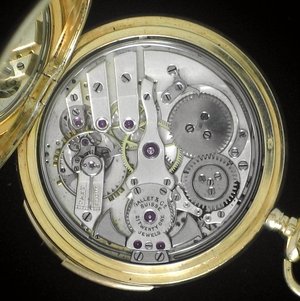
The eighteenth century steadily sharpened the repeater's resolution — how finely it could divide the hour by sound:
The half-quarter repeater. The finest London-made repeating work of the early eighteenth century used the system of Matthew Stogden (also spelled Stockten, Stockton or Stogdon), a brilliant workman employed by Daniel Quare and later associated with George Graham. Stogden's motion-work struck the hours, the quarters, and then a single extra blow if more than half the current quarter had elapsed — placing the time within 7½ minutes.
The five-minute repeater. First made in 1710 by Samuel Watson, the English maker best remembered for his early physicians' pulse watches, the five-minute repeater strikes the hours and then the number of five-minute intervals past the hour, placing the time within five minutes.
The minute repeater. The crowning achievement: hours, quarters, and then the exact number of minutes past the quarter. German examples are recorded from as early as about 1710, but the minute repeater entered the mainstream of fine watchmaking around 1750, when Thomas Mudge — the inventor of the lever escapement — is generally credited with its introduction in England; his contemporary John Ellicott appears to have been the first to make minute repeaters in any numbers. A minute repeater tells its owner the time, in total darkness, to the very minute — using nothing but tiny hammers, racks, snails and springs.
The dumb repeater. In the period roughly 1750–1820 many "dumb" (silent) repeaters were made, an idea credited to the great French maker Julien Le Roy. Instead of a bell, the hammers strike solid blocks or the case band itself, producing a dull thud felt in the hand rather than heard across the room. The dumb repeater let its owner count out the time under the table at dinner, in the concert hall, or at the bedside without waking anyone — and it served blind users just as well as a chiming one.
Bells, gongs and Breguet's "all-or-nothing" piece
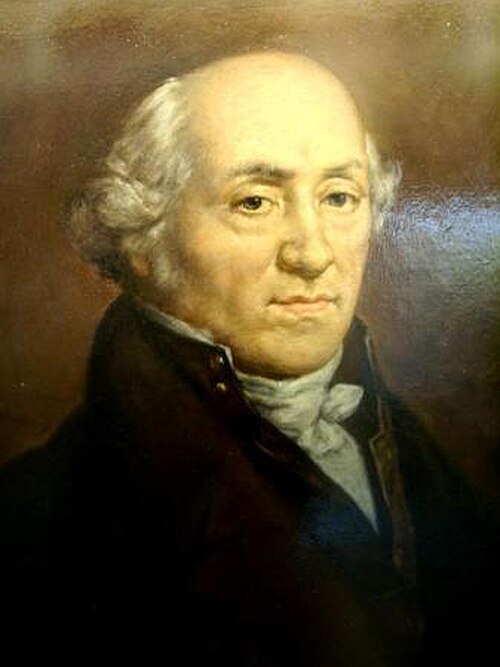
The repeating watches of the eighteenth century struck a small bell of bell-metal fitted inside the back of the case — sonorous, but bulky, and demanding a deep case. The solution that made the slim repeaters of the nineteenth century possible was the wire gong: a long, hardened steel wire coiled right around the inside of the case band, against which the hammers strike. The gong-spring is generally credited to Abraham-Louis Breguet (1747–1823), the greatest watchmaker of his or perhaps any age, who was fitting them to his repeaters from about 1783; by the early 1800s wire gongs had entirely displaced the bell. Two gongs, tuned to different notes and usually formed from the two ends of a single length of wire, allow the classic "ding", "dong" and "ding-dong" tones of the modern repeater.
Breguet also cured the repeater's most embarrassing vice: mis-striking. On early repeaters, if the pendant or slide was not pushed fully home, the striking work would be only partly wound and would drop only part of its sequence — chiming, say, five o'clock when it was a quarter to eight, and leaving its owner more confused than before. Breguet's "all-or-nothing" piece, perfected around 1820, is a safeguard which holds the entire striking train out of action unless the actuating slide has been pressed completely down: the watch either strikes the full, correct sequence, or it strikes nothing at all. This simple-sounding refinement made the repeater trustworthy at last, and every quality repeater since has carried some form of it.
How a repeater works
However grand the name, every repeater answers three questions by feel: what hour is it, what quarter is it, and how many minutes past the quarter? The mechanism reads the answers directly off the motion work behind the dial:
Winding the strike. Pressing the slide (or, on early watches, depressing the pendant) winds a small separate spring — the repeater train never borrows power from the mainspring that keeps the watch going. Releasing the slide lets this spring drive the striking sequence through a governor that regulates its pace.
Reading the time. Three stepped cams — snails — turn with the hour, quarter and minute wheels. Spring-loaded feelers called racks fall against them, and the depth of each fall fixes precisely how many teeth pass the hammer levers: one tooth, one blow. The hour rack reads its snail of twelve steps; the quarter rack a snail of four; the minute rack a snail cut with steps for the minutes past the quarter.
Striking. Two hammers strike the two wire gongs: the low note counts the hours, a high-low "ding-dong" pair counts the quarters, and the high note alone counts the minutes. At 2:49 a minute repeater therefore strikes "dong, dong" (two hours), "ding-dong, ding-dong, ding-dong" (three quarters), then "ding, ding, ding, ding" (four minutes). The longest possible announcement, 12:59, takes a well-regulated repeater around twenty seconds to deliver.
The types of repeater
| Type | Strikes | Resolution | Notes |
|---|---|---|---|
| Hour repeater | Hours only | 1 hour | The simplest form; also the basis of most "dumb" repeaters. |
| Quarter repeater | Hours, then quarters | 15 minutes | The original form of Barlow and Quare, 1680s; the commonest antique repeater. |
| Half-quarter repeater | Hours, quarters, then one blow for the half-quarter | 7½ minutes | The Stogden system of the early 1700s, favoured by the best London makers. |
| Five-minute repeater | Hours, then five-minute intervals | 5 minutes | First made by Samuel Watson in 1710; revived by Kelek and others in modern times. |
| Minute repeater | Hours, quarters, then minutes | 1 minute | From c.1750 (Mudge, Ellicott); the summit of the striking watch. |
| Decimal repeater | Hours, ten-minute intervals, then minutes | 1 minute | A rare variant counting in tens rather than quarters. |
| Dumb repeater | As above, but on blocks in the case | — | Silent; the time is felt, not heard. c.1750–1820, credited to Julien Le Roy. |
| Petite sonnerie | Strikes quarters in passing (not the hour count at each quarter) | — | A striking, not a true repeating, function; usually combined with a repeater. |
| Grande sonnerie | Strikes hours and quarters in passing, every quarter | — | The "clock-watch" par excellence, with repeater on demand; the most complex of all striking work. |
Curiosities exist outside every classification: a student of the École Technique de la Vallée de Joux even built a mechanical ten-minute repeater in the 1930s.
Repeating clocks: bracket clocks, carriage clocks and sonneries
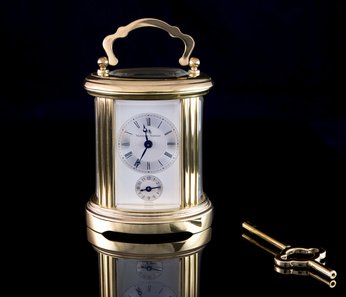
Barlow's invention found its first home in the English bracket clock. A repeating bracket clock kept at the bedside carried a cord at its side; a pull upon it — the "pull repeat" — wound and released the striking train, which sounded the last hour and quarters on its bells. The best examples, by Tompion, Quare, Graham, Knibb and their contemporaries, are among the most valuable English clocks in existence; Joseph Knibb's economical Roman-notation striking and the double-six systems of the period were all attempts to wring the most information from the fewest blows. Because the pull wound the strike directly, many of these clocks could repeat without disturbing the going train at all.
The repeating clock reached its most familiar form in the nineteenth-century French carriage clock (pendule de voyage). Almost every good carriage clock carries a button on the top of its case: pressed at night in a coaching inn or a railway sleeper, it strikes the last hour — and on quarter- and minute-repeating examples, more — on a gong coiled beneath the movement. Grande sonnerie carriage clocks strike the hour and quarter automatically every fifteen minutes and repeat on demand as well, commonly with a selection lever in the base for grande sonnerie, petite sonnerie or silence. The same striking scheme appears in the German and Austrian Vienna regulator wall clocks of the grande sonnerie type, whose quarter and hour gongs announce the time every fifteen minutes, and which may also be tripped to repeat at will.
In England the repeating clock faded during the nineteenth century: cheap French, German and American imports undercut the trade, and once gas lighting reached the bedroom a clock that could strike in the dark became an unnecessary luxury. The carriage clock, ironically a French invention perfected for travellers, kept the repeating clock alive well into the twentieth century, and fine sonnerie clocks are still made today.
The repeater wristwatch, 1892 to today
By the 1890s the repeater no longer had a practical excuse to exist — the electric light had seen to that — and yet it was precisely then that it achieved its most astonishing miniaturisation. In 1892 the firm of Louis Brandt & Frère of Bienne — the house that would shortly adopt the name Omega — unveiled the world's first minute repeater wristwatch. Its 13-ligne movement, based on a Lépine ébauche from LeCoultre & Cie and finished with the repeating work by Audemars Piguet, chimed the hours, quarters and minutes at the stroke of a slide at 3 o'clock. Only the one example was made; it survives today in the Omega museum collection, still striking, a full generation ahead of the wristwatch's general acceptance.
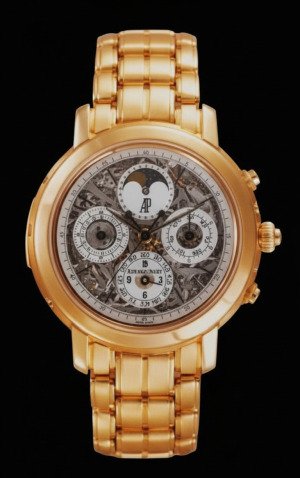
The repeater wristwatch never became popular in its first era. The cost was far beyond ordinary buyers, and repeaters often sat unsold for years; most makers built them only against firm orders, paid in advance. Those that were made bore the greatest names — Patek Philippe, Audemars Piguet, Vacheron & Constantin and the specialist workshops of the Vallée de Joux that supplied them all. Around the early 1930s the Driva repeater attempted series production on a scale never before seen for such a watch, yet only about 1,500 left the line before production ceased: even an affordable repeater, it seemed, could not find buyers in the age of the light switch. Angelus tried again after the war with its quarter-repeating "Tinkler" of the 1950s — the first self-winding, waterproof repeater wristwatch — and it, too, failed commercially, with only around a hundred made. Oh, with the benefit of hindsight! Those commercial failures are today among the rarest and most sought-after wristwatches of their century.
The modern revival began in the late 1980s, when the mechanical watch returned as a luxury art. Patek Philippe's calibre R 27, introduced in 1989 — the firm's 150th anniversary year — put the minute repeater back into regular (if tiny) production, and the great houses followed: Audemars Piguet, Vacheron Constantin, Blancpain, Jaeger-LeCoultre, IWC and, more recently, independents of the highest rank. In the 1980s and 1990s the Swiss firm Kelek offered five-minute and quarter repeater wristwatches built on Dubois Dépraz striking modules — for many collectors still the most attainable route to a true repeating wristwatch. At the other extreme, today's grande sonnerie wristwatches, which strike the passing hours and quarters of their own accord and repeat the minutes on demand, stand with the most complicated watches ever made. The complication that darkness created, electricity should have killed, and passion kept alive is now the supreme test of the watchmaker's art.
Collecting repeaters
A few practical notes for anyone drawn to these wonderful machines:
Listen before you buy. A repeater must strike its full sequence, crisply, at the correct count, several times in succession. Mis-striking, dragging hammers, a dead gong or a slide that needs coaxing all point to expensive specialist repair — repeating work is the most demanding job on any watchmaker's bench.
Quarter repeaters are the accessible classics. Sound Swiss quarter-repeating pocket watches of the late nineteenth century remain surprisingly affordable for so complex a mechanism; minute repeaters, and anything signed by a great house, occupy an altogether higher plane. See our companion page on the repeater pocket watch and our guide to pocket watch values.
Beware "quarter repeater" descriptions on musical watches. Musical and repeating work are different complications, though sometimes combined — see our musical pocket watch page.
Condition and originality rule. As with all fine watches, an untouched movement with its original gongs, hammers, case and dial is worth far more than a "restored" composite. If in doubt, have any prospective purchase examined by a specialist — and when buying at auction online, read our guide to buying watches on eBay.
Sources and further reading
Willis I. Milham, Time and Timekeepers, Macmillan, 1945 — the classic general reference on striking and repeating work.
François Crespe, Essai sur les montres à répétition, Geneva, 1804 (English translation by Richard Watkins, Essay on Repeater Watches).
J.H. Francis Wadsworth, A History of Repeating Watches, Antiquarian Horology, 1965–66.
Richard Watkins, The Repeater, 2017 — a detailed technical study of repeating and grande sonnerie watches.
François Lecoultre, A Guide to Complicated Watches, Neuchâtel, 1952.
Omega Museum — "1892: the world's first minute-repeating wristwatch".
Related Pages
- The Repeater Pocket Watch — the companion guide
- Musical Pocket Watches — a different, sometimes-confused complication
- Chronograph Pocket Watches
- Wrist Watches
- Pocket Watch Values