
Thomas Mudge and the Lever Escapement
Almost every mechanical watch made in the last two hundred years — from a two-dollar pocket watch to a chronometer-grade wristwatch — beats to a mechanism invented by one man around 1754. His name was Thomas Mudge, and his creation, the detached lever escapement, is one of the most important inventions in the whole history of horology. Yet Mudge barely promoted it, never patented it, and never grew rich from it. This is the story of the quiet genius behind the mechanism inside your pocket watch — and an explanation of exactly how it works.
A Pupil of George Graham
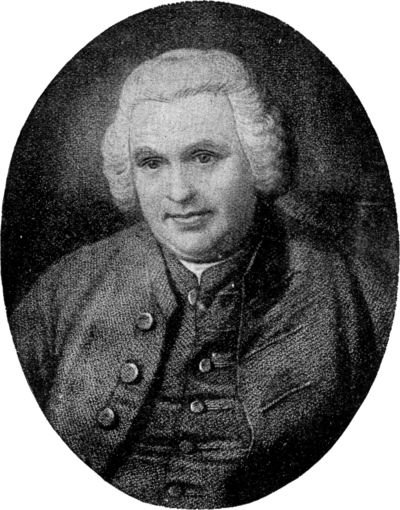
Thomas Mudge was born in Exeter, Devon, in 1715, the second son of the Reverend Zachariah Mudge, a clergyman and schoolmaster. His mechanical gifts appeared so early that at around fourteen he was sent to London and apprenticed to the finest watchmaker of the age, George Graham. Graham had himself trained under the legendary Thomas Tompion, so the young Mudge inherited a direct line of English craftsmanship reaching back to the very greatest names in the trade.
Graham was no ordinary master. He had already given horology the cylinder escapement and the deadbeat escapement for precision clocks, and under him Mudge absorbed a way of thinking about mechanisms that prized accuracy above all else. After Graham's death in 1751 Mudge set up on his own, later taking his fellow Graham apprentice William Dutton into partnership. Watches and clocks signed Mudge & Dutton became prized across Europe for their quality — but Mudge's lasting fame rests not on any single watch, but on an idea.
What an Escapement Does
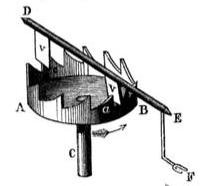
Every mechanical watch is built around its escapement. It has two jobs. First, it releases the wheel train one small step at a time, so that the hands advance at a controlled rate rather than the mainspring simply unwinding in an instant. Second, on each swing it delivers a tiny push — an impulse — to the balance to keep it oscillating. Everything a watch achieves for accuracy depends on how cleanly the escapement performs these two tasks.
The escapements that came before Mudge all shared a fatal weakness: the balance was never truly free. In the ancient verge escapement, the escape wheel stayed in constant contact with the balance staff, dragging on it, causing recoil, and leaving the rate hopelessly sensitive to every change in the mainspring's force. Graham's own cylinder escapement was a great improvement, but its escape teeth still rubbed continuously against the balance, so friction and wear were always present. What was needed was an escapement in which the balance could swing freely — detached from the train — for almost the whole of its arc.
How the Detached Lever Escapement Works
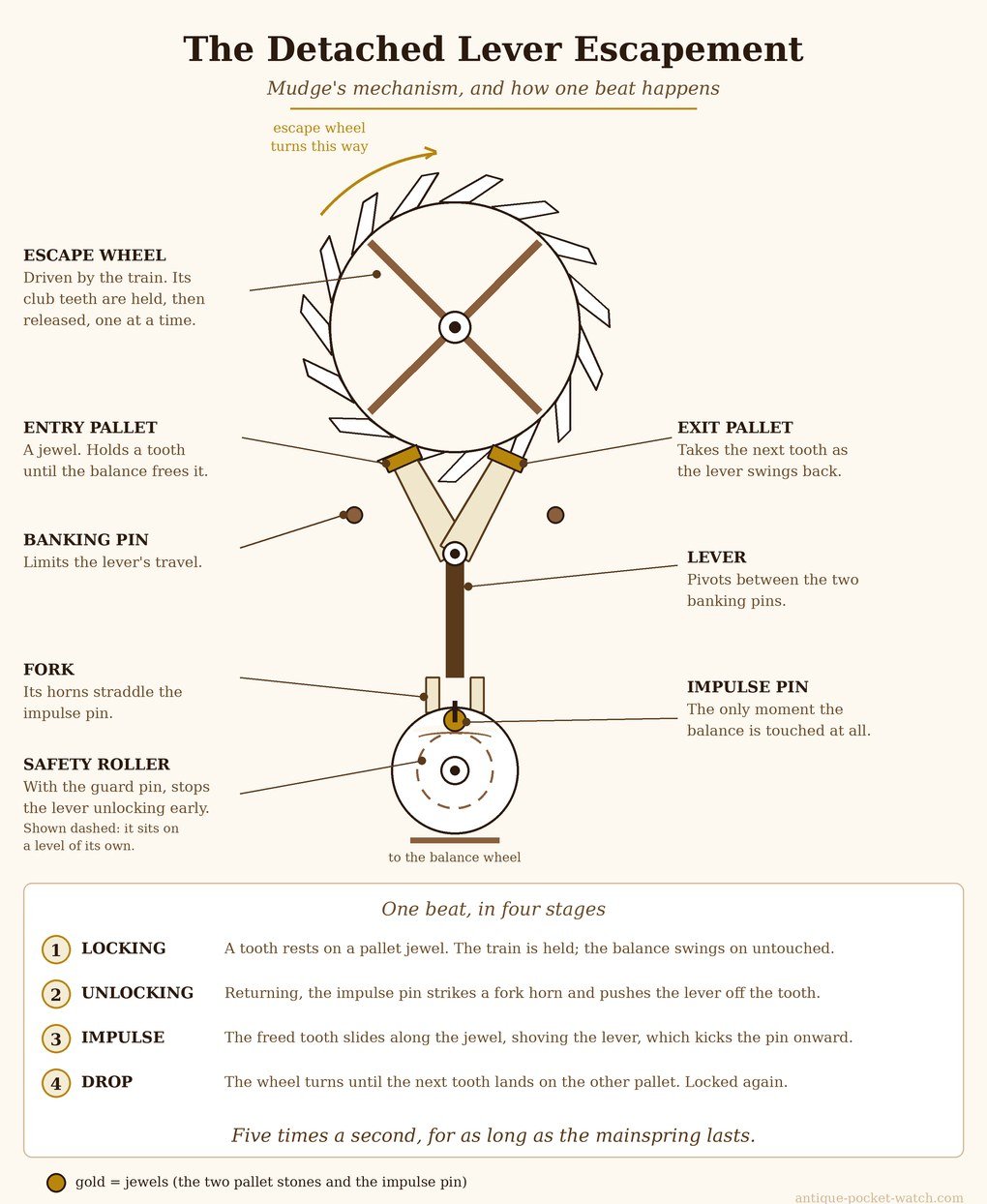
Mudge's insight was to place an intermediate part — the lever, or pallet fork — between the escape wheel and the balance, so that the two never touch directly. The mechanism has three main players:
- The escape wheel — driven by the going train, its specially shaped teeth deliver the impulse and are alternately locked and released.
- The lever (pallet fork) — a pivoted, T-shaped lever carrying two jewelled pallet stones, an entry pallet and an exit pallet, with a notched fork at its far end.
- The balance — which carries a small impulse pin (a ruby jewel) on a roller fixed to its staff. This pin is the only point of contact between balance and lever.
The action repeats in a four-part cycle:
- 1. Locking. For most of the time a tooth of the escape wheel rests against the flat locking face of one pallet stone. The train is held still and the lever is pinned against one of its banking stops. Crucially, the balance is now completely free, swinging on its balance spring with nothing touching it.
- 2. Unlocking. As the balance swings back, its impulse pin enters the notch of the fork and knocks the lever sideways, lifting the pallet stone clear of the escape tooth and freeing the wheel.
- 3. Impulse. The released escape wheel drives its tooth along the angled impulse face of the pallet. The lever swings across and, through the same notch, gives the impulse pin a brisk push — the tiny kick of energy that keeps the balance alive. This is the only instant in the whole cycle when power reaches the balance.
- 4. Drop and re-locking. The wheel turns just far enough for the next tooth to fall onto the other pallet stone, which has by now swung into its path. The lever bangs against the opposite banking stop, everything locks again, and the balance flies off on its free swing to repeat the story on the return.
Two refinements make the system reliable. The pallet locking faces are cut at a slight angle so that the escape wheel actually pulls the lever harder against its banking stop while locked — a self-securing effect the trade calls "draw", which stops the lever drifting away and mis-firing if the watch is jolted. And a safety arrangement — a guard pin working against a small roller with a single crescent-shaped passing hollow — ensures the lever can only be unlocked at the correct moment, and never accidentally when the watch is knocked.
The result is exactly what earlier makers had dreamed of. Because the balance is detached — free and untouched for the great majority of its swing, and disturbed only briefly at unlocking and impulse — its natural oscillation is far less corrupted by the train. The rate becomes remarkably steady, the escapement is self-starting, and it tolerates a little dirt and a little wear without stopping. These are precisely the qualities that make an escapement fit for a watch that must survive a lifetime in a waistcoat pocket.
Three Escapements Compared
| Escapement | Introduced | Balance Contact | Verdict |
|---|---|---|---|
| Verge | 14th century | Constant — with recoil | Robust and long-lived, but poor timekeeping; very sensitive to mainspring force |
| Cylinder (Graham) | c. 1726 | Constant — no recoil | Thinner, better watches, but continuous friction and wear on the cylinder |
| Detached Lever (Mudge) | c. 1754 | Brief — only at impulse | Balance runs free; accurate, self-starting and durable — the modern standard |
The Queen Charlotte Watch
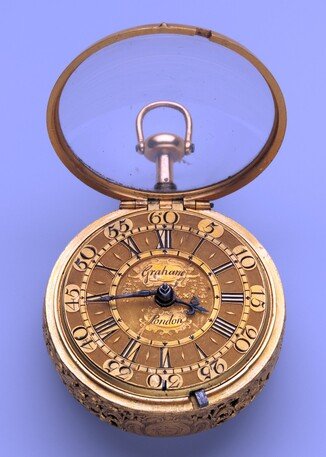
Mudge first tried his new escapement in a clock, but its true home was always going to be the watch. Around 1769–1770 he completed a watch fitted with the detached lever escapement which was purchased by King George III and given to his wife, Queen Charlotte. That watch survives to this day in the Royal Collection — a working monument to the birth of the modern escapement.
Remarkably, Mudge did not rush to exploit his invention. He took out no patent, made only a handful of lever watches, and was soon absorbed in what he considered a far greater prize: the marine timekeeper. In 1771 he moved to Plymouth and devoted himself to building precision marine chronometers to help solve the problem of finding longitude at sea, following in the footsteps of John Harrison. His marine timekeepers were superb performers, and in 1793 Parliament voted him a reward of £2,500 in recognition of the work. In 1776 he had been appointed Watchmaker to the King, the highest honour his trade could bestow. Yet through all of this the lever escapement was left largely on the shelf — admired by a few connoisseurs, ignored by the wider trade.
A Slow Triumph
It would take another generation for Mudge's idea to conquer the world. In the 1780s the Swiss-born London maker Josiah Emery began producing lever watches of superb quality that at last showed the trade what the escapement could do. Makers such as Leroux, Pendleton, Grant and Taylor took it up, and through the nineteenth century the design was steadily simplified and perfected into the English lever and, most successfully of all, the Swiss club-tooth lever that could be made in enormous numbers.
By the late Victorian era the detached lever escapement had swept away nearly all its rivals. It became — and for well over a century remained — the standard escapement in the mechanical watch, from cheap mass-produced pocket watches to the finest wristwatches. The overwhelming majority of mechanical watches ever made owe their beating hearts to the mechanism Thomas Mudge sketched out around 1754.
Legacy
Thomas Mudge died on 14 November 1794, aged 79. He never grew wealthy from his great invention, and for most of his life the lever escapement was treated as a curiosity rather than the breakthrough it was. History has been kinder: today he is remembered as the father of the mechanism that made the accurate, robust, everyday watch possible. Every collector who winds an antique lever watch is, in a small way, keeping his genius alive.
Further Reading
- Tompion & Graham — the master and grand-master who trained Mudge
- The Cylinder Pocket Watch — Graham's escapement that Mudge improved upon
- Verge & Fusee Pocket Watches — the escapement the lever replaced
- John Harrison & the Longitude Problem — the marine-timekeeper quest Mudge also joined
- Pocket Watch Parts A–Z — the lever escapement in the modern movement