
Tompion & Graham: Fathers of English Watchmaking
For a golden half-century, from roughly 1680 to 1750, the finest watches and clocks in the world were made within a few hundred yards of London's Fleet Street. Two men, more than any others, put them there: Thomas Tompion, the blacksmith's son who became the "Father of English Clockmaking", and George Graham, the Quaker apprentice who inherited his workshop, his numbering system, and eventually his grave. Their story is the story of how London, for a few glorious generations, out-made the world.
They were master and pupil, then partners, then successors — a single unbroken line of workmanship running from the reign of Charles II to the eve of the Industrial Revolution. Between them they refined the escapements that made a pocket watch trustworthy, built the instruments that let astronomers measure the heavens, and set a standard of honest dealing that gave English horology its reputation. To understand why a Tompion or a Graham signature still commands six and seven figures at auction, you have to understand the two lives behind the names.
Two men, one workshop. Thomas Tompion (1639–1713) and George Graham (1673–1751) ran what was, in its day, the most celebrated horological workshop on earth, at the sign of the Dial and Three Crowns on Fleet Street.
Tompion trained Graham; Graham married Tompion's niece and became his partner and heir. When Graham died he was laid in the same tomb as his old master in Westminster Abbey — a rare honour for tradesmen, and a fitting end to the closest partnership in the history of the craft.
From an Ickwell Forge to Fleet Street
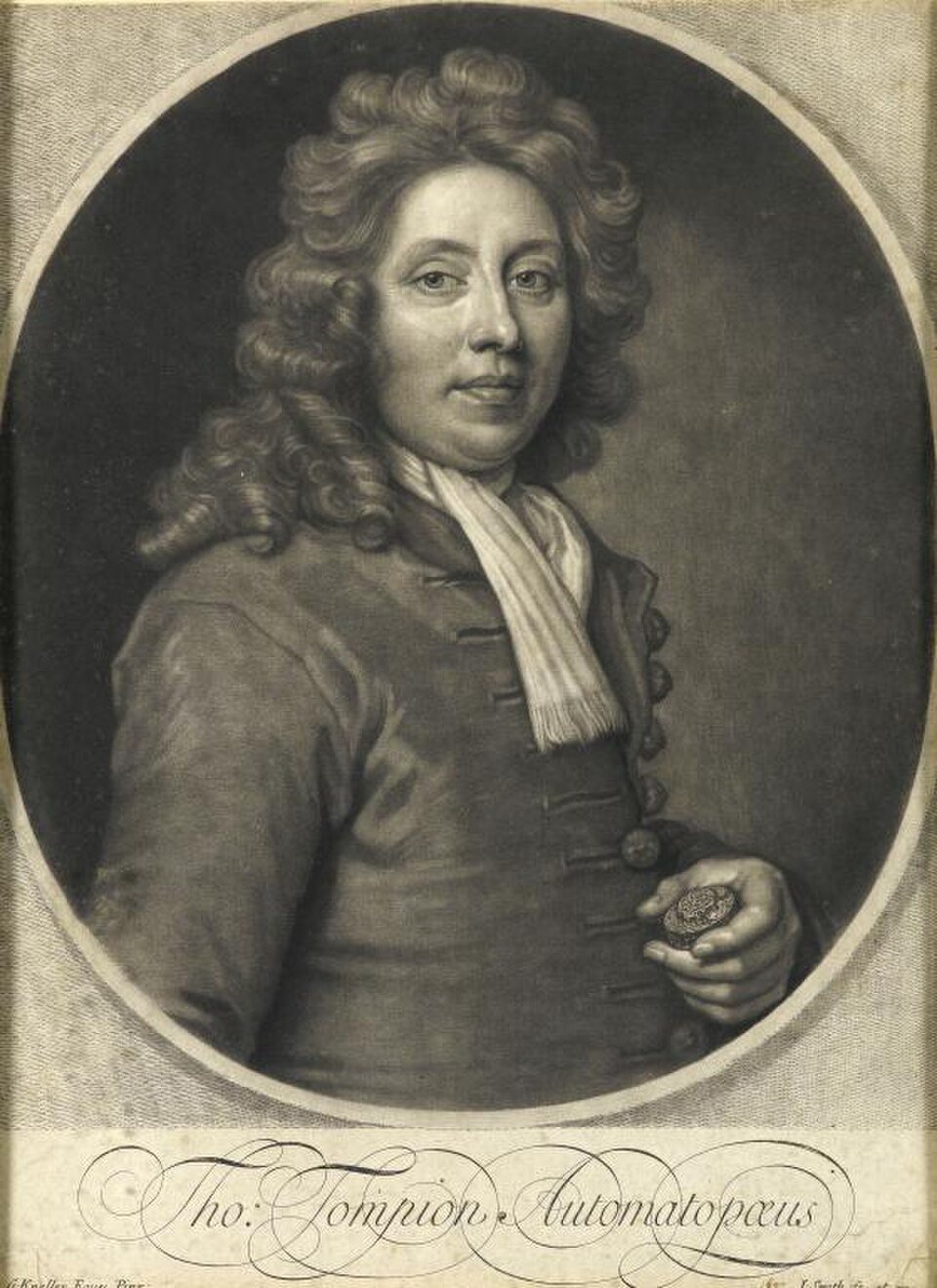
Thomas Tompion was baptised on 25 July 1639 at Northill in Bedfordshire, the eldest son of a village blacksmith of the same name. He grew up in the hamlet of Ickwell, and by all accounts worked at his father's forge well into his twenties. It is a detail worth pausing on, because the skills of the blacksmith — the feel for metal, the patient shaping of iron and steel by hand — were the very skills that would later set his clockwork apart. The man who would supply kings had no grand apprenticeship in a fashionable trade; he learned his hands at an anvil.
He appears in London around the end of 1670, working in Water Lane, off Fleet Street, and in 1671 he was admitted to the Worshipful Company of Clockmakers as a "Great Clockmaker". Exactly where and with whom he trained in the craft remains a mystery, but his earliest work shows a strong kinship with that of Joseph Knibb, one of the leading makers of the day. From the start, Tompion's clocks stood out not for decoration but for the soundness of their engineering and the quality of their materials. He surrounded himself with the best workmen he could find — many of them Huguenot refugees from France, skilled in the decorative arts — and drove them to a standard nobody else in London could match.
Hooke, the King, and the Birth of the Precision Watch
The turning point in Tompion's career was his friendship with the scientist Robert Hooke, the restless genius of the early Royal Society. Hooke needed a craftsman who could turn his ideas into working metal, and in Tompion he found the perfect pair of hands. The relationship opened every door that mattered: through Hooke came access to the newest scientific thinking, and through the Royal Society came the patronage of the court itself.
The most consequential idea Hooke brought was the balance spring — the fine coiled spring that, fitted to a watch's balance wheel, gave it a natural rhythm and transformed the watch from an ornament that kept time to within perhaps half an hour a day into something approaching a precision instrument. Around 1675 Tompion made an experimental watch for King Charles II, signed "Robert Hooke invent. 1658. T. Tompion fecit, 1675", bearing an unusual twin-balance arrangement intended to cancel out errors of motion. That particular watch has not survived, and Hooke's priority in the invention of the balance spring was fiercely disputed by the Dutch scientist Christiaan Huygens — a quarrel that belongs to the wider story of the invention of the balance spring itself. Whoever devised it, Tompion built the watches on which the new idea was tested, and that put his workshop at the centre of the leap to accuracy.
When the Royal Observatory was founded at Greenwich in 1676, King Charles II chose Tompion to build its two great regulator clocks. Based on Hooke's idea of a very long pendulum swinging through a very small arc, and needing to be wound only once a year, they were fitted with the recoil-free dead-beat escapement and proved accurate enough for the first Astronomer Royal, John Flamsteed, to map the heavens by them. It is hard to overstate the prestige of that commission: the nation's flagship scientific instruments, at the very spot from which the world would one day set its time, were entrusted to a blacksmith's son from Bedfordshire.
5,500 Watches and a Revolution in Record-Keeping
Over his career Tompion's workshop turned out roughly 5,500 watches and 650 clocks — an astonishing output for the age, and one only possible because he organised his shop like a small manufactory, with specialist hands for movements, cases, dials and springs. His three-train grande-sonnerie bracket clocks are among the most complex mechanisms of the seventeenth century, and his repeating watches, which chimed the hour on demand in the dark, were marvels of miniature engineering.
But Tompion's quietest innovation may have been his most far-reaching. He gave his clocks and watches serial numbers — a running sequence that let him and his successors identify, date and service any piece the workshop had ever made. It is thought to be the first time a serial-numbering system was applied to manufactured goods anywhere, a full century before the idea became standard in industry. For the modern collector it is a gift: a genuine Tompion can often be placed in his output with real precision, and the numbers are a powerful weapon against the fakes and "married" pieces that inevitably gather around so valuable a name.
The "Tompion regulator" myth. A common form of balance-spring regulation — curb pins on a rack, moved by a small numbered dial — is often called the "Tompion regulator". He used it, but he did not invent it: similar devices were already in use on French balance-spring watches by the 1670s. It is a good example of how a great name attracts credit for things it never claimed.
By the turn of the eighteenth century Tompion was without rival, "the King's watchmaker" in reputation if not always in title, his pieces exported across Europe and prized as far as the courts of Russia and the Ottoman Empire. He needed a successor worthy of the name. He found one in a young Quaker from the far north of England.
The Quaker from Cumberland
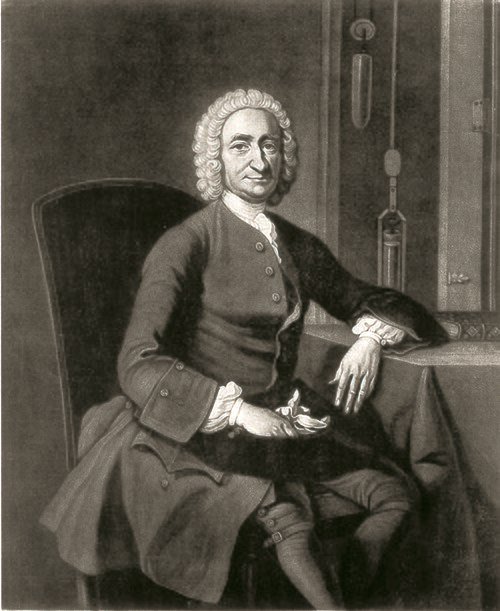
George Graham was born in 1673 at Kirklinton, in Cumberland, near Carlisle, into a Quaker family. Orphaned young and raised by relatives, he left the north in 1688, at about fifteen, to be apprenticed to a London clockmaker. In due course he entered the workshop of Thomas Tompion — a fellow Friend — and there his gifts were quickly recognised. In 1704 he married Tompion's niece, Elizabeth, binding pupil and master into a single family, and from around 1711 the two men were formal partners, their finest pieces jointly signed "Tho. Tompion & Geo. Graham".
When Tompion died in 1713, Graham inherited the business outright — the premises, the workmen, the clientele and, tellingly, the numbering system, which he simply continued where his master had left off. Continuity of that kind was itself a mark of respect: Graham saw himself not as a rival brand but as the keeper of a tradition. Under him the workshop's reputation, far from fading, rose to new heights, and its influence spread deeper into the world of science than Tompion had ever taken it.
A Reputation Worth More Than a Patent
Graham was known throughout the trade as "Honest George Graham", and the nickname was earned, not given lightly. He had a habit, remarkable in any age, of sharing his discoveries freely rather than locking them behind patents, believing that the advance of the craft mattered more than the advantage of one shop. He charged fair prices, dealt squarely with rivals and customers alike, and was as generous with money as with knowledge. He was made Master of the Worshipful Company of Clockmakers in 1722 and elected a Fellow of the Royal Society, moving as easily among astronomers and natural philosophers as among fellow artisans.
That reputation had consequences far beyond good feeling. It made Graham the man to whom others brought their problems — and, as we shall see, the man who quietly bankrolled the most important horological project of the century.
The Cylinder Escapement
An escapement is the mechanism that lets the driving power escape tooth by tooth, giving the balance or pendulum its regular push and counting out the beats. The quality of a watch depends above all on the quality of its escapement, and it is here that the Tompion–Graham workshop left its deepest mark.
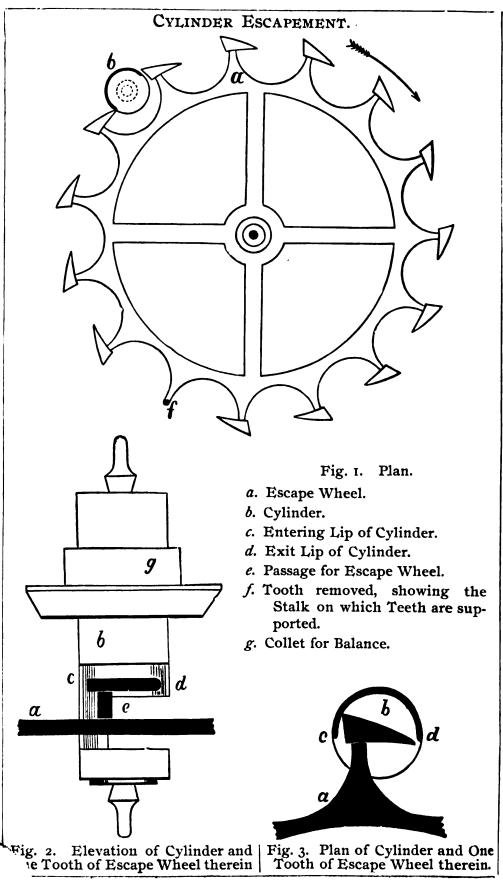
The cylinder escapement — sometimes called the horizontal escapement — was one of the first serious attempts to replace the crude, friction-heavy verge that had driven watches since the Middle Ages. Its origins lie in a patent of 1695 taken out by Tompion together with Edward Barlow and William Houghton, but the design as first conceived was not yet practical. It was Graham who, in 1726, redesigned and perfected it into a form that worked reliably, allowing watches to be made flatter and to keep better time. For much of the eighteenth and early nineteenth centuries the cylinder escapement was the mark of a good-quality watch, and it remained in wide use — especially in the Swiss and French trade — long after. Our dedicated page on the cylinder pocket watch covers how to recognise and collect these movements.
The Dead-Beat Escapement — and an Honest Correction
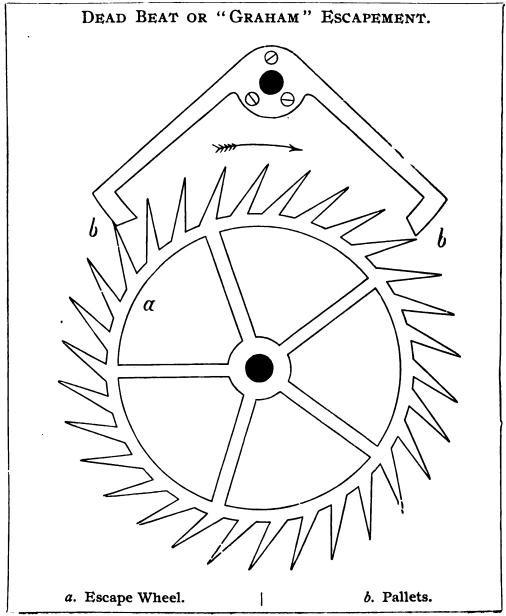
For clocks rather than watches, the workshop's signature was the dead-beat escapement, which eliminated the slight backward "recoil" of earlier designs and so allowed pendulum clocks to keep time to within a second or two a day. It became the standard for precision regulators and observatory clocks and has never really been bettered for the purpose; it is still used in the finest pendulum clocks today.
It is almost always credited to George Graham, who introduced it in his precision regulators around 1715. But horological history rewards honesty over tidy attributions, and the truth is more tangled. The dead-beat principle was worked out around 1675 by the astronomer Richard Towneley, and it was first put into a clock not by Graham but by his own master — Tompion used it in the two year-going regulators he built for Greenwich in 1676, decades before Graham took it up. Graham's real achievement was to refine and popularise it so thoroughly that his name became attached to it. It is a neat illustration of the whole Tompion–Graham story: the ideas ran continuously from master to pupil, and it is often impossible — and a little beside the point — to say where one man's work ended and the other's began.
The Mercury Pendulum, the Orrery, and the Instruments of Science
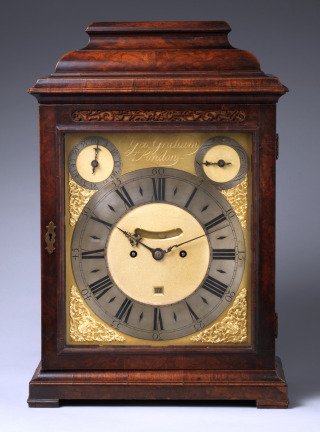
Graham's curiosity ran well beyond the watch. In 1721 he devised the mercury pendulum, a beautifully simple answer to an old problem: as temperature rises, an ordinary pendulum rod lengthens and the clock loses time. Graham hung a jar of mercury as the pendulum bob; when the rod expanded downward, the mercury expanded upward, keeping the pendulum's effective length — and the clock's rate — constant. It was adopted across the trade and remained a fixture of precision clocks for two centuries.
He was, in effect, the instrument-maker to British science. For the astronomer Edmond Halley he built the great mural quadrant at Greenwich; for James Bradley he made the zenith sector with which Bradley discovered the aberration of light and the nutation of the Earth's axis — two of the most important astronomical findings of the century, made possible by Graham's precision. He supplied the French Academy of Sciences with the apparatus used to measure the length of a degree of the meridian, and for Charles Boyle, fourth Earl of Orrery, he built the elaborate clockwork planetarium that has borne the earl's name ever since: the orrery. As if that were not enough, his careful magnetic observations of 1722–23 revealed the daily variation of the Earth's magnetic field, an early landmark of geophysics.
Graham, Harrison and Mudge
The measure of a great workshop is not only what it makes but whom it nurtures, and here Graham's generosity shaped the whole future of the craft. When a self-taught Lincolnshire carpenter named John Harrison arrived in London seeking backing for his revolutionary sea clock, he was sent to Graham. The two men, strangers at breakfast, talked clockwork until evening; and at that first meeting Graham lent Harrison around £200 — interest-free, on no security but his own judgement — to continue his work. He later presented Harrison to the Board of Longitude and spoke on his behalf. Without "Honest George", the solution to the longitude problem, and the marine chronometer that flowed from it, might never have got off the bench.
Graham also trained the next great mind of English horology. Between about 1730 and 1738 his apprentice was Thomas Mudge, who would go on to invent the lever escapement — the mechanism that still rules the mechanical watch three centuries later. So the line runs unbroken and astonishing: Tompion trained Graham, Graham trained Mudge, and between the three of them they gave the watch its precision, its escapements and its place at the centre of science. It is one of the great apprenticeship dynasties in the history of technology. (Mudge and the lever have a page of their own, coming soon in this History Library.)
Buried Together in Westminster
Thomas Tompion died on 20 November 1713 and was buried in the nave of Westminster Abbey — an extraordinary honour for a tradesman, granted for sheer eminence in his craft. George Graham lived on another thirty-eight years, dying at his home in Fleet Street on 16 November 1751, and was laid in the very same grave as his old master. A single ledger stone in the Abbey floor marks the two of them together, the master and the pupil who between them had made London the capital of horology. Few partnerships in any trade have ended so fittingly.
Their afterlife is everywhere for those who look. Tompion's statue stands among the craftsmen on the façade of the Victoria and Albert Museum; his "Mostyn" clock is a treasure of the British Museum, and two of his year-going clocks still run at Buckingham Palace. Graham's instruments survive in observatories and museums across Europe. And their shared name lives on, somewhat awkwardly, in a modern Swiss watch brand called "Tompion" and another called "Graham" — neither of which has any connection to the original firm, a point worth remembering when reading a sales catalogue.
Collecting Tompion and Graham Today
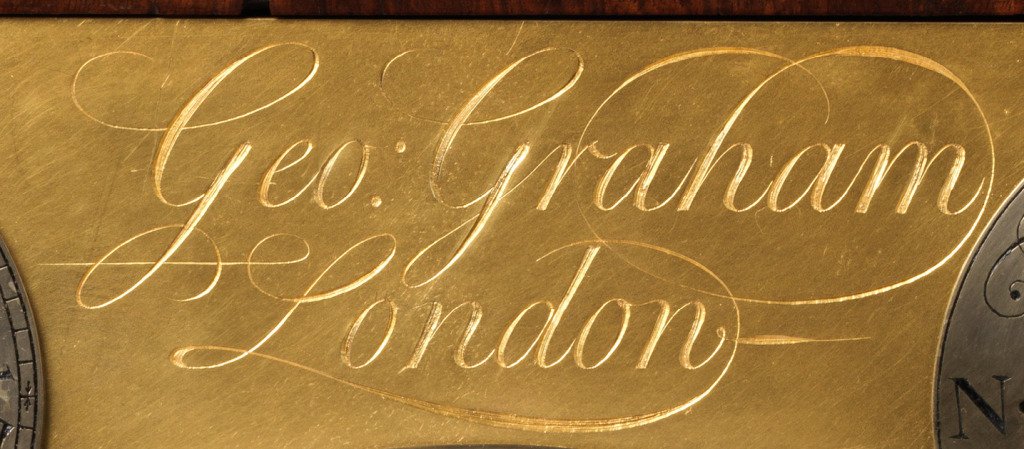
Let us be honest about the odds: a genuine Tompion or Graham is a museum-grade object, and when good examples appear at auction they change hands for tens or hundreds of thousands of pounds, occasionally more. These are not watches one stumbles on at a fair. But the collector benefits from knowing the names all the same, because so much of what surrounds them is instructive — and because their story shapes how we read every lesser English watch of the period.
A few practical points are worth carrying away. First, the numbering system is your friend: genuine Tompion and Graham pieces carry serial numbers that specialists can check against surviving records, so a piece "by Tompion" with no number, or an implausible one, deserves deep suspicion. Second, beware the "married" watch — a period movement reunited with a later or unrelated case, or a genuine movement wearing a forged signature; the value of these names has attracted forgers for three hundred years. Third, do not confuse the antique makers with the unrelated modern brands that borrow their names. And finally, if you simply want to see their work, you can: the British Museum, the Science Museum and the Clockmakers' Museum in London hold outstanding examples, and there is no better education for the eye than time spent in front of the real thing.
Continue exploring. Read how their escapement lived on in the cylinder pocket watch, follow the trade Tompion founded in our history of the pocket watch, and see how Graham's protégé changed everything in the story of John Harrison and the longitude problem. Return to the History Library for the full collection of articles.