
Abraham-Louis Breguet: The Greatest Name in Watchmaking
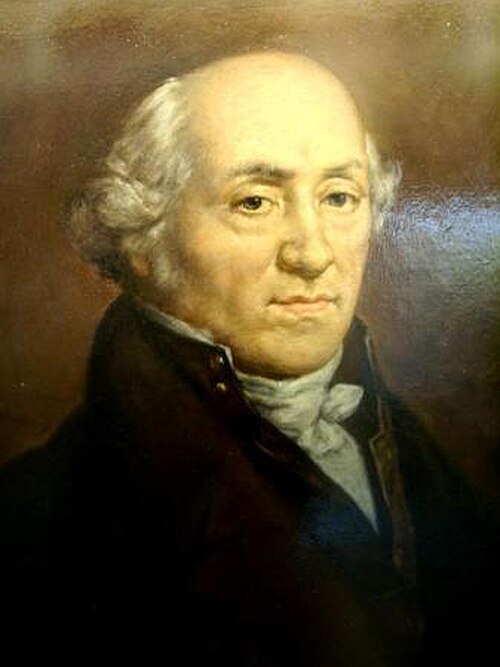
No name carries more weight in the history of horology than Breguet. In a career spanning half a century, Abraham-Louis Breguet invented or perfected an astonishing share of the mechanisms that define the fine watch even today — the tourbillon, the self-winding watch, the modern shock-protection system, the overcoil balance spring — while simultaneously creating a style so distinctive that "Breguet" became an adjective for elegant restraint. His contemporaries called him the Leonardo of watchmaking, and the comparison was not idle flattery: like Leonardo, Breguet combined the instincts of an engineer with the eye of an artist, and the watches that left his workshop on the Quai de l'Horloge were at once the most accurate and the most beautiful of their age.
For the collector, Breguet is both a summit and a cautionary tale. His genuine watches are among the most coveted objects in the world; his style was so admired that it was imitated, copied and outright forged within his own lifetime — a problem he solved with one of the cleverest anti-counterfeiting measures ever devised. To understand Breguet is to understand why a pocket watch can be a work of art, an instrument of science, and a historical document all at once.
At a glance. Abraham-Louis Breguet was born in Neuchâtel on 10 January 1747 and died in Paris on 17 September 1823. He founded the house that still bears his name, today part of the Swatch Group. His inventions include the perpétuelle self-winding watch, the gong spring for repeaters, the pare-chute shock protection, the Breguet overcoil, and — most celebrated of all — the tourbillon, patented in 1801.
A Watchmaker's Beginnings
Breguet was born in Neuchâtel, then a principality ruled by the King of Prussia and not yet part of the Swiss Confederation, which it would join only in 1814. His family were Protestants of long standing in the region. The comfortable circumstances of his early childhood did not last: his father, Jonas-Louis Breguet, died when the boy was about eleven, and his mother subsequently married Joseph Tattet, a member of a family already established in the watch trade with a sales office in Paris. It was a connection that would shape the rest of his life.
The young Breguet showed little patience for conventional schooling but a marked aptitude for things mechanical. In 1762, at the age of fifteen, his stepfather's family arranged for him to go to France, where he was apprenticed to a watchmaker at Versailles — the identity of this first master is now unknown. Versailles, in the orbit of the court, was a shrewd place to learn the trade: the finest and most demanding customers in Europe were close at hand. Breguet supplemented his bench training with evening classes in mathematics and physics, an education that set him apart from the great majority of working watchmakers, who learned by imitation rather than principle.


In 1775 Breguet married Cécile Marie-Louise L'Huillier, the daughter of a prosperous French bourgeois family, and in the same year established his own workshop at number 39, Quai de l'Horloge, on the Île de la Cité — an address that would become synonymous with the finest watchmaking on earth. The marriage brought social standing and capital; the workshop brought independence. Within a few years Breguet was producing watches of such originality that they attracted the attention of the court itself. Cécile died young, in 1780, leaving Breguet with their son Antoine-Louis, who would one day carry on the business.
Early Success and the Self-Winding Watch
Breguet's first great commercial success was the perpétuelle, or self-winding watch — a watch wound automatically by the movements of its wearer through an oscillating weight. The idea was not entirely his own (Abraham-Louis Perrelet and Hubert Sarton both have claims to the principle), but Breguet refined it into a reliable, saleable product as no one before him had. The first perpétuelle was sold in 1780 to the Duc d'Orléans, one of the richest men in France, and from that moment Breguet's reputation was made. It is estimated that some ninety perpétuelle watches were made and sold before his death.
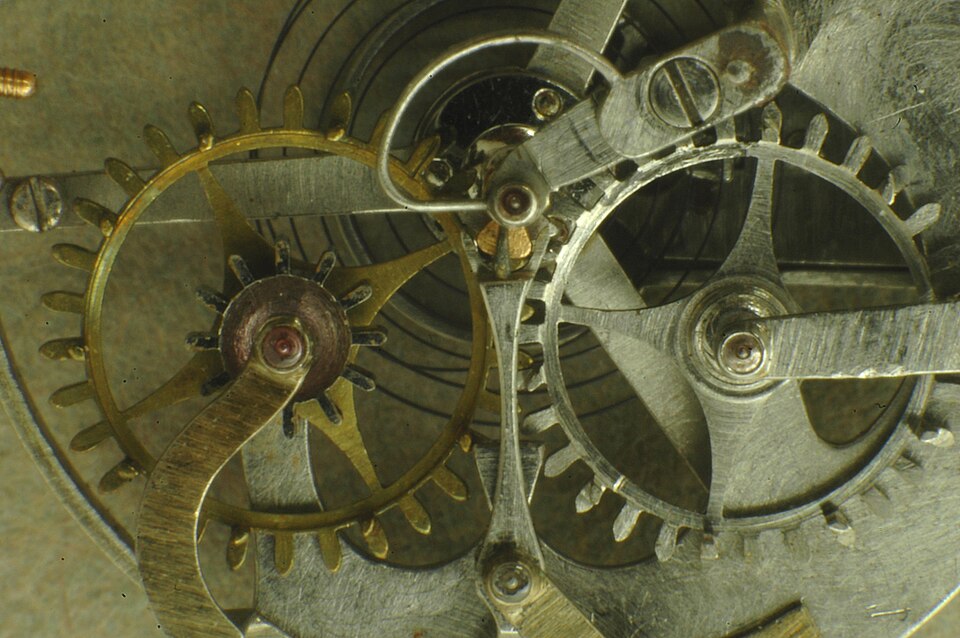

A stream of inventions followed in quick succession. Breguet devised the gong spring for repeating watches — replacing the bulky bell of earlier repeaters with a slender steel wire coiled around the movement, which allowed striking watches to be made far thinner. He developed his own form of perpetual calendar, capable of tracking the date, day and month and correcting automatically for the leap-year cycle. He produced the first carriage clocks — the pendule de voyage, or travelling clock — one of which he sold to Napoleon. And he refined the manufacture and finishing of his movements to a standard that became the benchmark of the trade.
By the late 1780s Breguet's clientele included the highest ranks of the French aristocracy and the royal family itself. Queen Marie-Antoinette was an enthusiast; King Louis XVI, who had a genuine interest in mechanics, gave him commissions. In 1787 Breguet formed a business partnership with Xavier Gide, which lasted until 1791. He was, by any measure, the most fashionable watchmaker in Europe — and then the Revolution came.
Flight to Switzerland
The French Revolution was mortally dangerous for a man so closely associated with the court. As the Terror gathered force in 1793, Breguet's royal connections made him a target. According to the traditional account, his life was saved by an unlikely benefactor: the revolutionary Jean-Paul Marat, a fellow native of the Neuchâtel region whom Breguet had reportedly helped in earlier years, intervened to obtain him a passport. Whatever the precise circumstances, Breguet fled Paris with his family and returned to Switzerland, settling for a time in his native region and at Le Locle.
Exile was not idleness. Breguet used the interval to refine ideas that he would patent or perfect on his return — among them the Breguet balance spring and the conception that would become the tourbillon. He came back to Paris in 1795 to find his workshop intact and his reputation, if anything, enhanced by his absence. He had become a French citizen in 1792, a status he retained for the rest of his life. The remaining three decades of his career would be the most inventive and the most celebrated.
The Mechanisms That Defined Fine Watchmaking
Breguet's reputation rests above all on a sequence of inventions, several of which remain in use, essentially unchanged in principle, more than two centuries later. They are worth taking in turn, because for the collector each one is a marker of authenticity and a key to understanding what a Breguet watch actually does.
- The perpétuelle (self-winding watch, 1780s)
- An oscillating weight winds the mainspring as the wearer moves — the direct ancestor of every automatic watch made today. Breguet's were the first to be produced and sold in any number.
- The gong spring for repeaters (1780s)
- A coiled steel wire struck by hammers to sound the hours and minutes, replacing the cumbersome bell. It made slim repeating watches possible and is still used in minute repeaters today.
- The pare-chute shock protection (c. 1790)
- The balance staff's fragile pivots are mounted in a spring-cushioned setting, so that a knock is absorbed rather than snapping the pivot — the ancestor of the modern Incabloc and similar anti-shock systems. Breguet famously demonstrated it by dropping a watch to the floor and showing that it still ran. He fitted it to his perpétuelles and, in time, to every watch he made.
- The Breguet overcoil (balance spring, 1795)
- By lifting the outer end of the balance spring up and curving it inward over the body of the spring, Breguet caused the spring to "breathe" concentrically, greatly improving timekeeping in different positions and reducing wear. The "Breguet overcoil" is still specified in the finest mechanical watches and is one of his most enduring contributions to precision.
The Tourbillon (patented 1801)
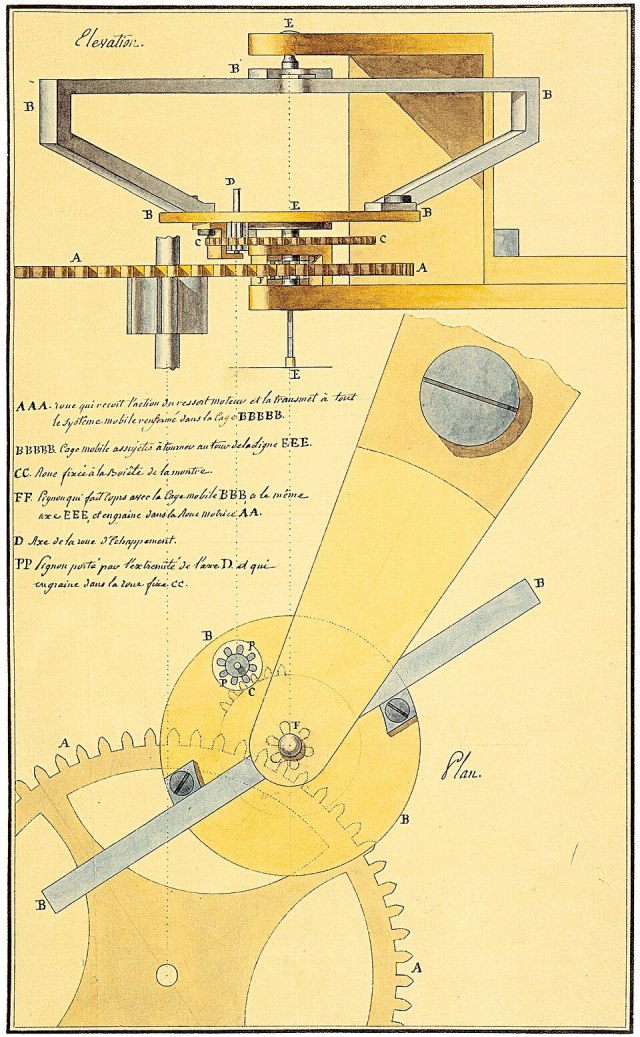
Of all Breguet's inventions, the tourbillon — French for "whirlwind" — is the most celebrated and the most misunderstood. Breguet observed that a pocket watch spends most of its life in a single vertical position, hanging in a waistcoat pocket, and that gravity acting always in the same direction on the balance and escapement introduced small but persistent rate errors. His solution was as audacious as it was elegant: mount the entire escapement — balance, balance spring, lever and escape wheel — inside a light carriage that rotates, typically once a minute. As the carriage turns, the positional errors are continuously averaged out, so that they cancel rather than accumulate.
Breguet petitioned for the patent in 1801, writing to the Minister of the Interior that he had "the honour of presenting… a new invention… that I call the Tourbillon Regulator." The patent (brevet) was granted on 26 June 1801 for a period of ten years. Characteristically, Breguet did not rush the device to market; the first tourbillon watches were sold only some years later, around 1805–1806, after he had satisfied himself that the mechanism could be made to work reliably. They were, and remain, extraordinarily difficult to construct — which is precisely why the tourbillon became, and remains, the supreme demonstration of a watchmaker's skill.
It is worth being clear about what the tourbillon does and does not do, because collectors are often sold romance in place of fact. In a pocket watch carried in a constant vertical orientation, the tourbillon genuinely improves timekeeping. In a wristwatch, which moves through every position throughout the day, its practical benefit is largely theoretical — today it survives as a tour de force of craftsmanship and a hypnotic visual spectacle rather than a necessity. Either way, Breguet's "whirlwind" is the single invention most responsible for his immortality. The mechanism has a longer story than can be told here — the patent chronology, the rival English karrusel, and what the observatory trials actually measured — set out on our dedicated page, The Tourbillon: Breguet's Answer to Gravity.
The Montre à Tact and the Sympathique Clock
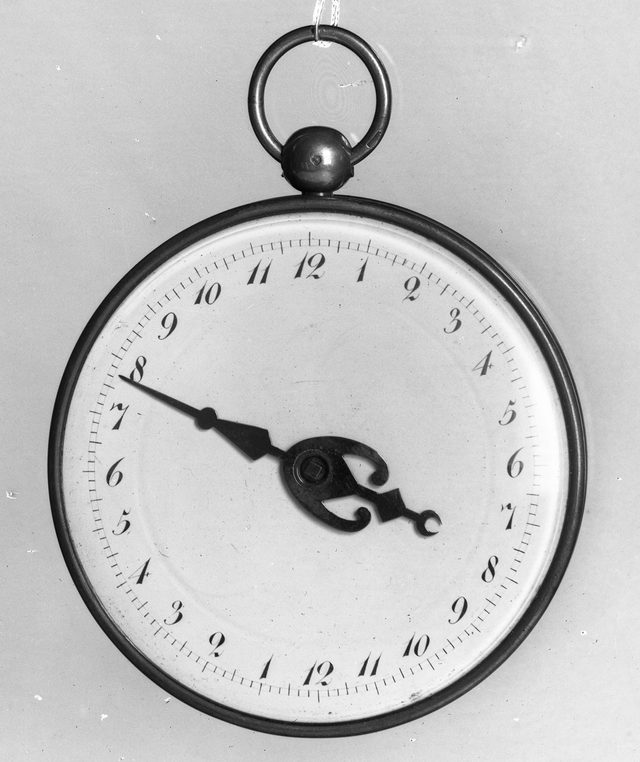
Not every Breguet invention was about precision. The montre à tact, or "tact watch", allowed its owner to read the time discreetly by touch — an arrow on the outside of the case could be felt against studs around the band, so that one might learn the hour during a candlelit dinner or a tedious sermon without the rudeness of pulling out a watch. The pendule sympathique, or sympathetic clock, was a marvel of a different order: a bedside clock into which a special pocket watch could be docked at night, whereupon the clock would automatically wind and reset the watch to perfect time. These were the most luxurious of toys for the most demanding of clients.
How to Recognise a Breguet
Breguet's mechanical genius is matched by an aesthetic so coherent that it amounts to a design language — one that the house still follows and that collectors can read at a glance. Where his rivals heaped on ornament, Breguet pursued clarity and restraint, and the result looks startlingly modern even now.
The signatures of the style include the Breguet hands — slender, blued-steel hands with a hollow, off-centre "moon" or "apple" (pomme) near the tip, instantly legible and endlessly copied; the Breguet numerals, a graceful slanted Arabic figure of his own devising; and the engine-turned dial, decorated with fine repeating guilloché patterns cut on a rose engine, which both beautified the dial and reduced glare. His cases were typically slim and understated, often with a finely milled "coin-edge" band, and his dials were frequently silver or gold rather than the white enamel then in fashion. The overall effect — quiet, legible, beautifully made — is the foundation of what we still call good taste in watch design.
The secret signature. Breguet's work was so admired that it was forged within his lifetime. His response was ingenious: on many dials he added a signature secrète — his name and the watch's serial number engraved so finely, just off the centre, that they are invisible except under raking light or magnification. The secret signature is one of the first authentication devices in the history of manufacturing, and it remains a key test for collectors today.
The Most Famous Watch in the World
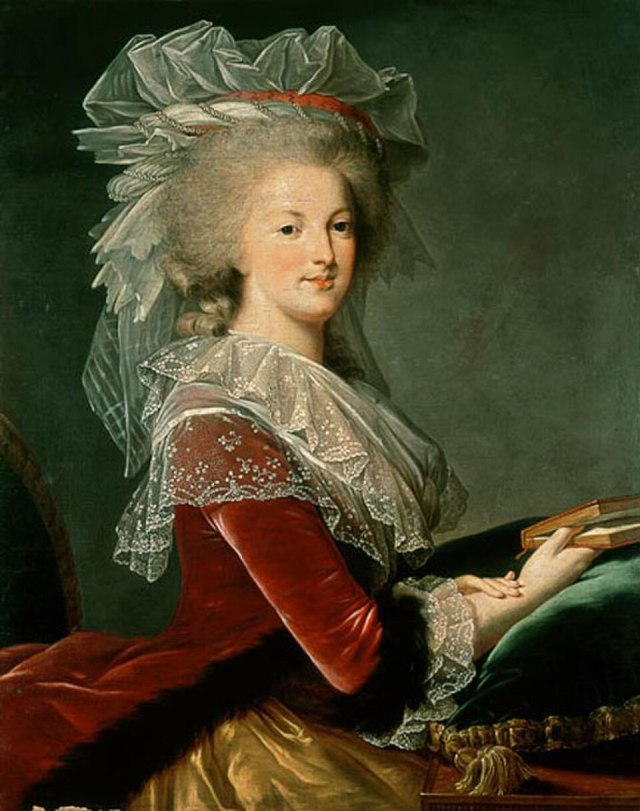
In 1783 Breguet received the most extraordinary commission of his career. An officer of Queen Marie-Antoinette's guard — whose identity has never been confirmed, though legend has long held him to be the Queen's admirer, the Swedish count Axel von Fersen — ordered a watch as a gift for the Queen. The instructions were without precedent: the watch was to contain every complication and refinement then known to horology; gold was to replace other metals wherever possible; and no limit whatsoever was placed on either the cost or the time required to complete it.
The resulting watch, Breguet No. 160, became known simply as the "Marie-Antoinette". It is a self-winding grande complication of some 823 parts, combining a minute repeater, perpetual calendar, equation of time, independent (jumping) seconds, a power-reserve indicator and a metallic thermometer, with extensive use of gold and sapphire throughout the movement. It was the most complicated watch made up to its time, and it cost a fortune even by the standards of Breguet's grandest pieces.
The watch's history is as remarkable as its mechanism. Work dragged on through the Revolution and Breguet's exile. Marie-Antoinette was executed in 1793, never having seen it. Breguet himself died in 1823 with the watch still unfinished. It was finally completed in 1827, forty-four years after it was ordered and four years after its maker's death, under the direction of his son Antoine-Louis. Thereafter it passed through several hands — sold to the Marquis de la Groye, returned for repair in 1838 and, strangely, never collected; sold by the Breguet house in 1887 to an English collector; and eventually acquired in the 1920s by Sir David Lionel Salomons, the greatest Breguet collector of his age, who bequeathed it to the museum that would become the L. A. Mayer Institute for Islamic Art in Jerusalem.
There the story takes its final turn. In 1983 the watch was stolen, along with dozens of other treasures, in a daring museum burglary. For twenty-four years it vanished. Only in November 2007 was it revealed that the entire haul had been recovered; the thief, it emerged, had been the Israeli criminal Naaman Diller, who had died in 2004. By a neat historical irony, the modern Breguet house — revived under Nicolas G. Hayek, who had bought the company in 1999 — had in the meantime painstakingly reconstructed the lost watch from the archives, presenting the replica in 2008 in a case made from an oak from Marie-Antoinette's own garden at the Petit Trianon, just as the original resurfaced. Few objects in the decorative arts can claim a stranger biography.
Watchmaker to Emperors and Kings
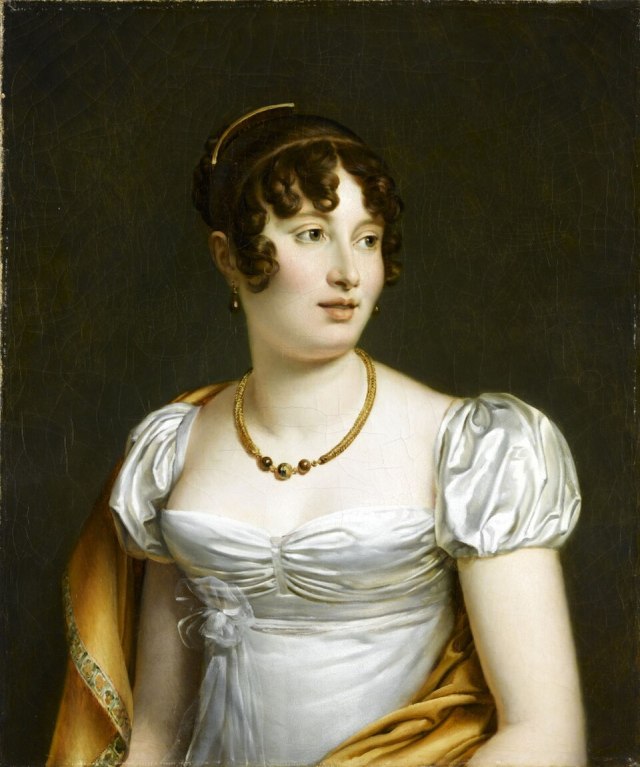
Breguet's client list reads like a roll-call of the age. Napoleon Bonaparte acquired three Breguet timepieces before his Egyptian expedition of 1798 and remained a patron; members of the Bonaparte family bought freely. Tsar Alexander I of Russia, the Duke of Wellington, and a long succession of European royalty and statesmen owned his watches. So did the scientific and artistic elite. To own a Breguet was to announce both wealth and discernment.
Among the most historically significant of these commissions came in 1810 from Caroline Murat, Napoleon's sister and Queen of Naples, who ordered from Breguet a repeating watch made to be worn on the wrist on a wristlet of hair and gold thread. Delivered in 1812, it is widely regarded as one of the first wristwatches ever made — more than a century before the wristwatch became commonplace. The original has been lost, but the order survives in the workshop registers.
Honours accumulated in Breguet's final years. He was made watchmaker to the French Royal Navy (Horloger de la Marine), succeeding Pierre-Louis Berthoud in 1815; he was appointed to the Bureau des Longitudes; he received the Légion d'Honneur from King Louis XVIII; and in 1816 he was elected to the Académie Royale des Sciences — rare recognition for a man of the workshop. By the time of his death his firm's assets were valued at some 800,000 francs, an immense sum.
The House That Breguet Built
Abraham-Louis Breguet died in Paris on 17 September 1823, aged seventy-six, and was buried in the Père Lachaise cemetery. His funeral was attended by the scientific and artistic establishment of France; his eulogy was delivered before the Académie. He left behind not only a body of work unmatched in his field but a living business and a son, Antoine-Louis, capable of carrying it on.
The firm passed down through the Breguet family for several generations. His grandson, Louis Clément François Breguet, became a distinguished physicist and pioneer of electric telegraphy; in a further twist, that line of the family produced Louis Charles Breguet, one of the founding figures of French aviation in the early twentieth century. The watchmaking house itself eventually left family hands, was acquired by the Parisian jeweller Chaumet and later by the finance group Investcorp in 1987, and since 1999 has been the flagship of the Swatch Group — which, in reviving the Marie-Antoinette and the historic Breguet complications, has consciously returned to its founder's archives for inspiration.
Breguet's deepest legacy, however, is not corporate but conceptual. The overcoil still governs the finest balance springs; the tourbillon remains the ultimate test of the watchmaker's art; the anti-shock principle of the pare-chute protects every watch on every wrist; and the clean, legible Breguet style is the template against which elegant watch design is still measured. More than any other individual, Breguet defined what a fine watch should be.
What the Collector Should Know
Genuine period Breguet watches are among the rarest and most valuable of all collectable timepieces, and they sit far beyond the reach of most pockets — the finest examples command millions at auction. But the subject rewards study by any collector, because Breguet is the key to understanding the vocabulary of fine watchmaking, and because his influence is everywhere once you learn to see it.
A few practical points are worth carrying away. First, the secret signature is the collector's friend: a genuine period Breguet will carry its finely engraved signature and number, and learning to look for it under raking light is the first lesson in authentication. Second, beware the word "Breguet" used loosely: the firm's success spawned countless "Breguet-style" watches by other makers — Breguet hands, Breguet numerals and guilloché dials on perfectly honest watches that were never near the Quai de l'Horloge. These are not fakes, but they are not Breguets either. Third, the firm's own archives survive, and the house will research the history of a genuine piece — provenance that adds enormously to both interest and value.
For the great majority of us, the pleasure of Breguet lies in recognition: in spotting his inventions and his style in the watches we can actually own and handle. Every blued-steel apple-tipped hand, every slanted numeral, every engine-turned dial, every overcoil and anti-shock setting is a small inheritance from the man on the Quai de l'Horloge.
Continue exploring. Breguet's tourbillon has its own dedicated story in our forthcoming article on inventions and complications. For the grand complications that followed in his tradition, see our page on Patek Philippe, and for the broader sweep of the craft, return to the History Library or the history of the pocket watch.