
The Tourbillon: Breguet's Answer to Gravity
The tourbillon is the most famous mechanism in watchmaking and the hardest to justify. It is the thing auction catalogues put in bold, the thing that turns a five-figure watch into a six-figure one, and the thing most likely to be described in prose that a physicist would find embarrassing. It is also a serious piece of engineering, devised by a serious engineer, to solve a problem that genuinely existed. Both of those things are true at once, and separating them is the whole business of understanding it.
This page is about the mechanism rather than the man. If you want the life, Abraham-Louis Breguet has a page of his own. What follows is the narrower question: what fault was the tourbillon built to correct, whether it corrected it, and what a collector encountering one — or its cheaper English cousin — should actually think.
The Fault Breguet Set Out to Cancel
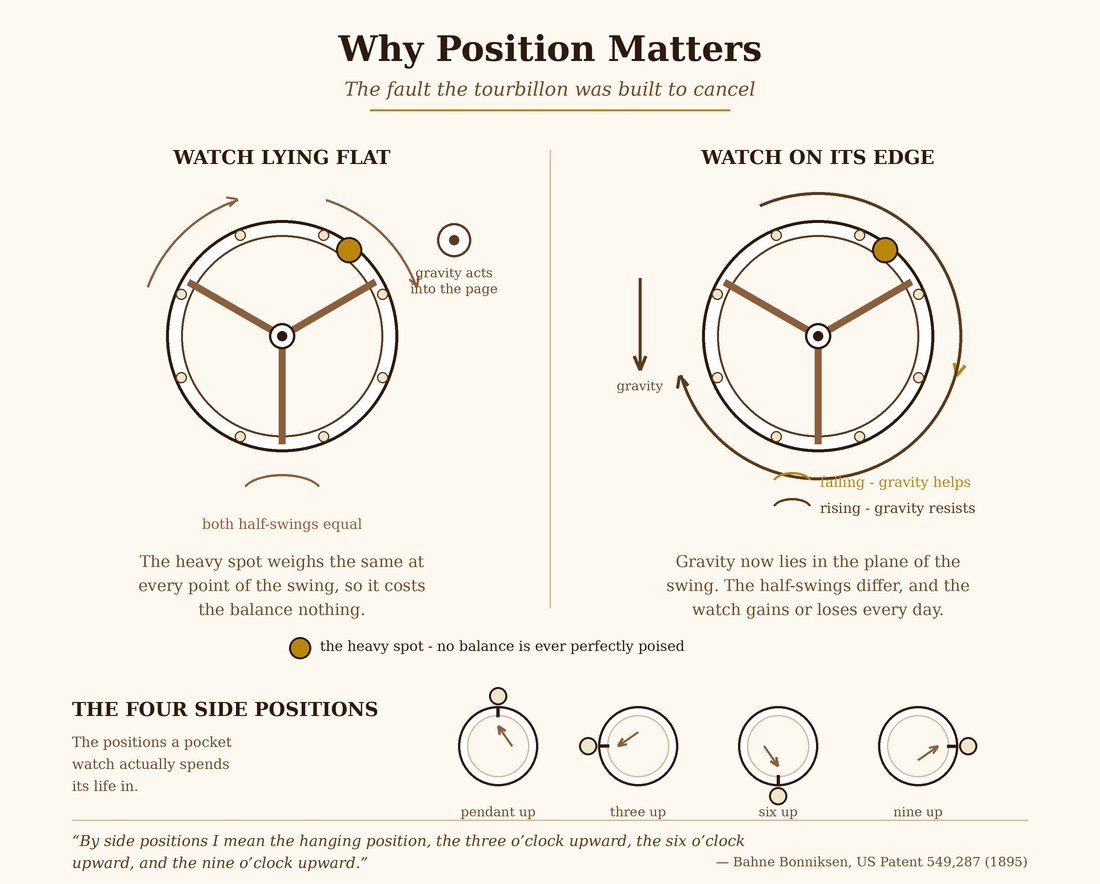
A balance wheel is a weighted rim spinning back and forth on a thin pivot. In a perfect watch the mass of that rim would be distributed with absolute evenness about its axis — it would be, in the trade's word, perfectly poised. No balance ever is. There is always a heavy side, however slight: a fractionally thicker section of rim, a timing screw driven a half-turn deeper than its opposite number, a trace of surplus solder.
Lay that watch flat and the imperfection costs you nothing, because the heavy side is swinging in a horizontal plane and gravity pulls equally on it wherever it happens to be. Stand the watch on edge and everything changes. Now the heavy side is being helped downhill on one half of its swing and hauled uphill on the other. The balance no longer takes the same time to travel out as it does to travel back, and the watch gains or loses depending on which edge it is standing on. A watchmaker measures this as positional error, and in an ordinary nineteenth-century watch it could easily amount to twenty or thirty seconds a day between the flat and vertical positions.
The error was worth attacking because a pocket watch does not experience those positions in anything like equal measure. It hangs in a waistcoat pocket, pendant uppermost, for fifteen or sixteen hours a day, and it lies flat on a nightstand for the rest. The error is therefore not random and does not average itself away over time — it accumulates, every day, in the same direction. The watch does not merely run inaccurately; it runs consistently inaccurately, which for a precision instrument is the worse fault.
A first-rate maker could reduce the problem by painstaking adjustment, poising the balance on knife-edges and correcting it screw by screw until the rates in each position converged. That work was slow, expensive, and never quite finished. Breguet's insight was that the error might be dealt with mechanically instead: if the escapement could not be made indifferent to its orientation, then it could be made to occupy every orientation in turn.
Seven Messidor, Year Nine
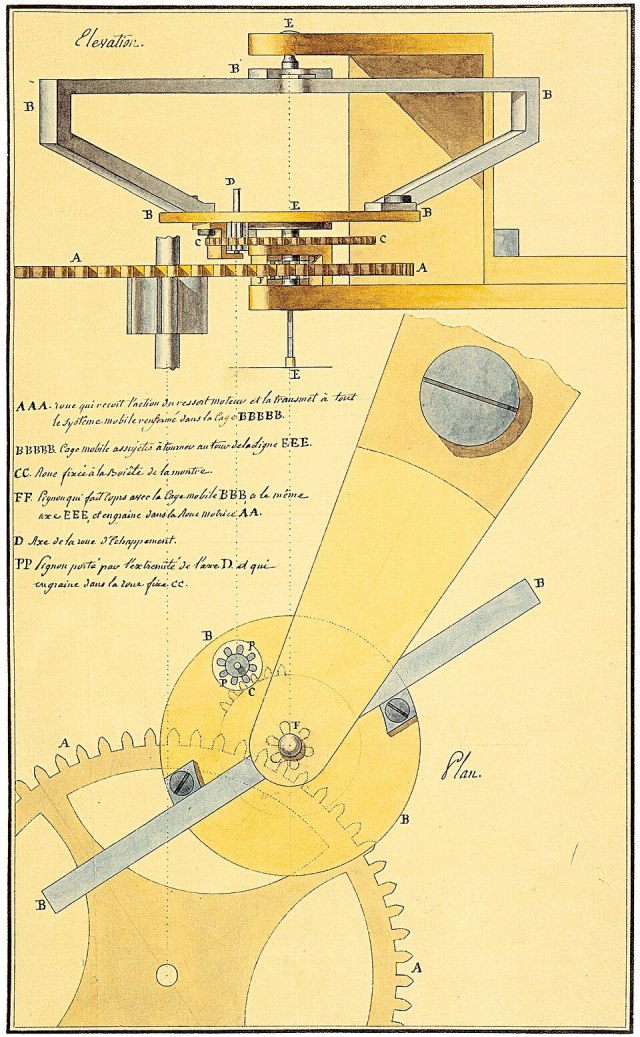
Breguet submitted his technical file — a written description with a watercolour drawing — on 24 December 1800. In the French Republican calendar still in force at the time, that was 3 Nivôse, year IX. The patent itself was granted six months later, on 26 June 1801, or 7 Messidor, year IX, and ran for ten years. The original document survives in the archives of the Institut National de la Propriété Industrielle in Paris.
The word he chose was tourbillon — whirlwind. It was not a marketing flourish so much as a description of the eighteenth-century astronomical vortices then familiar to educated readers, and Breguet used it to name a régulateur, a regulating device, rather than a decorative feature. He was claiming a method of governing a watch, not an ornament to hang in one.
What is striking about the ten-year term is how little of it he used. Breguet held the patent from 1801 but did not sell a tourbillon watch until about 1805, and by the time the monopoly lapsed in 1811 he had parted with only a handful. The gap was not commercial caution. The mechanism was simply extraordinarily difficult to build to a standard he would put his name to, and he was not prepared to release one that merely rotated.
What Actually Turns
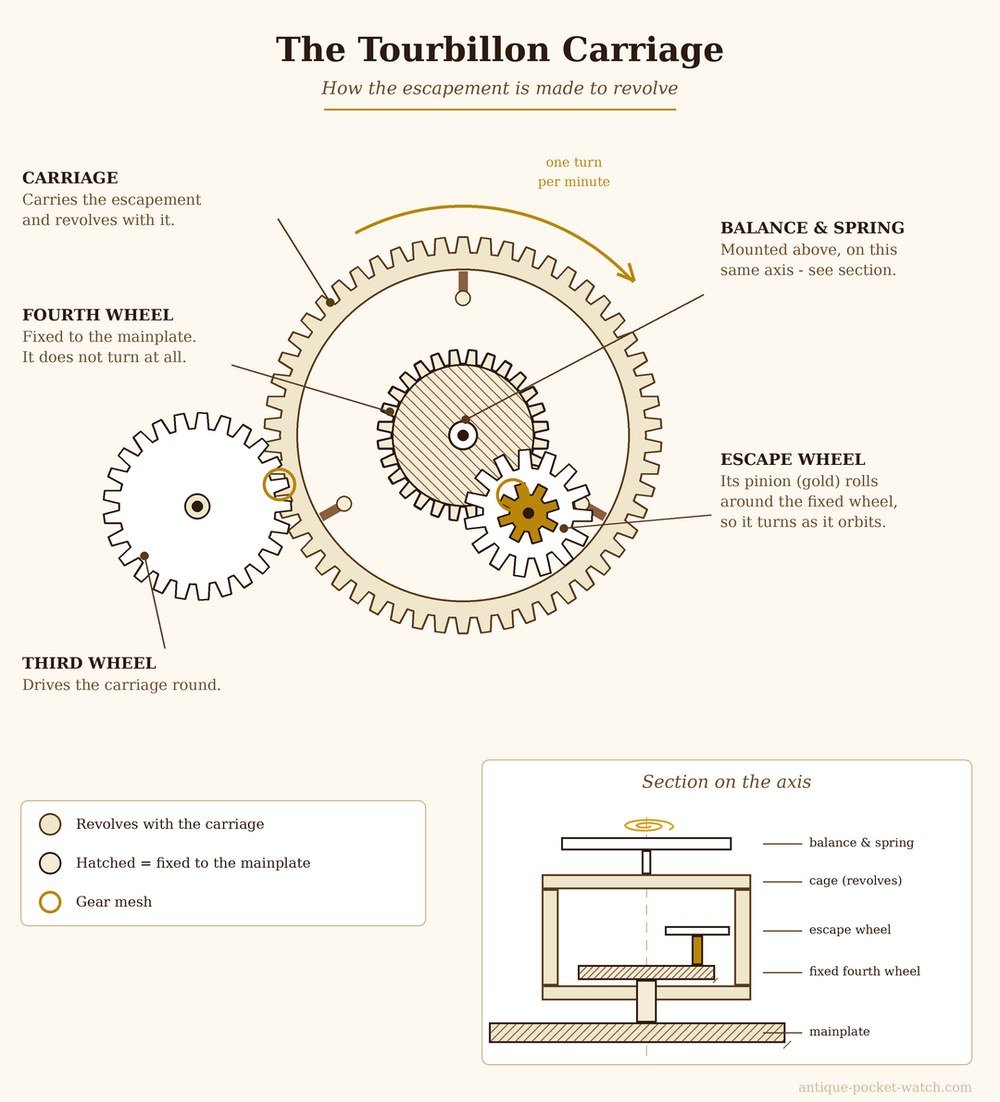
The commonest misconception about a tourbillon is that the movement revolves. It does not. What revolves is a small, light cage — the carriage — carrying four things: the balance, the balance spring, the pallets, and the escape wheel. Everything else in the watch stays exactly where it was.
The arrangement that makes this possible is a neat inversion of the usual gearing. In an ordinary watch the fourth wheel drives the escape wheel pinion. In a tourbillon the fourth wheel does not turn at all: it is fixed rigidly to the mainplate, and the escape wheel pinion is mounted in the carriage so that it rolls around the outside of that stationary wheel, like a planet gear around a sun. The carriage is driven from the third wheel, and as it goes round, the escape wheel is forced to rotate on its own axis at the same time. One component is therefore doing two jobs: unlocking the escapement as usual, and orbiting.
Breguet set the carriage to complete one revolution per minute, which is why the carriage pivot so often carries the seconds hand — a happy consequence rather than the purpose. A minute is short enough that the vertical errors are averaged within a single reading of the dial, and slow enough not to squander power. The cost of the arrangement is that the carriage itself must be built to the same tolerances as the balance it carries, and must be poised as carefully, because an out-of-poise carriage simply introduces a new error in place of the old one. This is precisely why a tourbillon is difficult: it does not remove the need for fine adjustment, it moves that need somewhere harder to reach.
Thirty-Five Watches in Eighteen Years
Between the first sale in 1805 and his death in 1823, Breguet sold thirty-five tourbillons. That figure deserves a moment's thought. Over the same period the workshop on the Quai de l'Horloge produced watches by the hundred, so the tourbillon was never a product line; it was closer to a series of individual demonstrations, each one made when a suitable commission and a suitable craftsman coincided.
One of them is worth singling out, because it says something about the man. Breguet had been a friend of the English chronometer maker John Arnold, who died in 1799. A decade later Breguet took one of Arnold's own movements, fitted it with an early tourbillon regulator, and presented it to Arnold's son. As a gesture it was pointed: here is my invention, installed in your father's work, given back to you. The watch is in the Breguet Museum in Paris and remains one of the few instances of a great maker paying tribute by rebuilding a rival's watch rather than outdoing it.
The Coventry Answer: Bonniksen's Karrusel
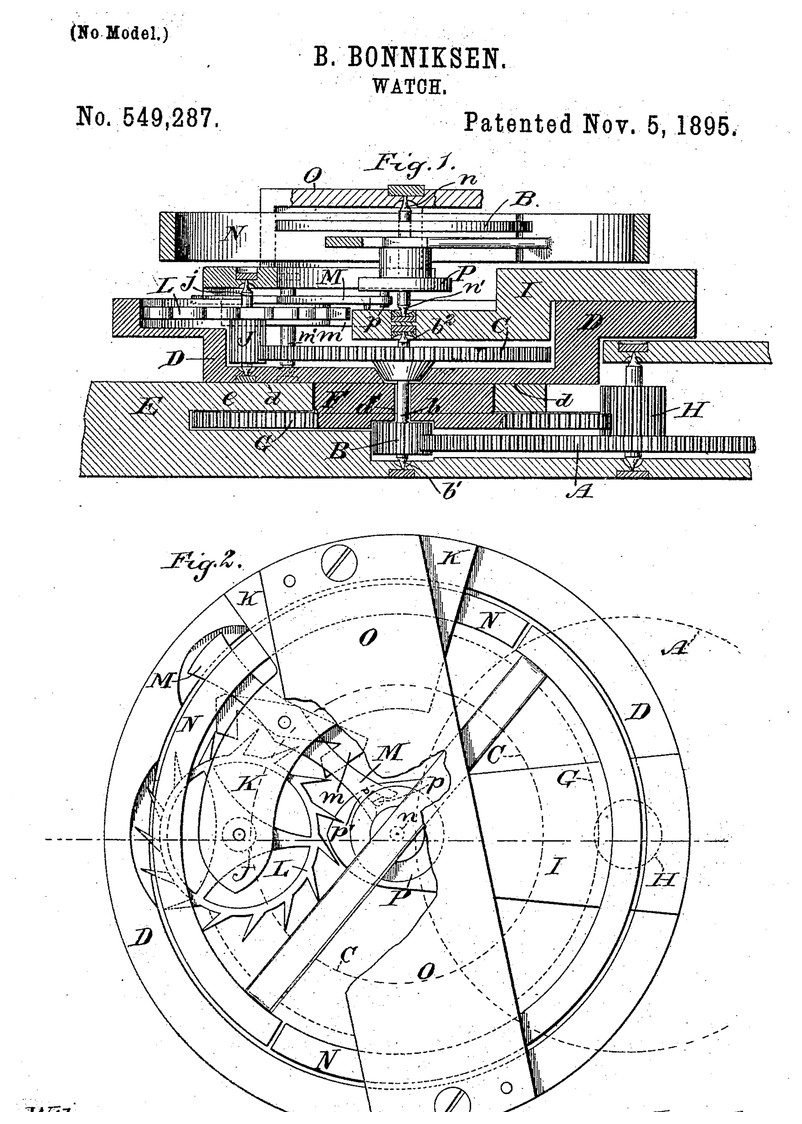
For ninety years the tourbillon stayed what Breguet had made it: rare, costly and French. Then a watchmaker working in Coventry patented an alternative that did much the same job for a fraction of the effort. His name was Bahne Bonniksen (1859–1935), and he called his device the karrusel.
Bonniksen was born in Denmark, apprenticed in Copenhagen, and came to England in 1882, finishing his training in London before setting up on his own in Coventry. He is almost always described as Danish; his own American patent declares him “a citizen of Germany, residing at No. 16 Norfolk Street, Coventry” — the Danish–German border having moved under a good many people in that generation. The Norfolk Street address is the workshop where he employed around twenty-five hands.
He described the problem in plainer terms than Breguet ever did. His patent is for “a Means of Making a Watch, a Clock, or a Chronometer Keep Time to the Same Precision on All its Side Positions”, and he then defines his terms, which is more than most inventors bother to do:
— Bahne Bonniksen, US Patent 549,287 (1895)
Bonniksen's simplification was to abandon the fixed fourth wheel. In a karrusel the whole escapement sits on a platform — his patent calls it a cup-shaped plate — driven from the third wheel through a train of its own, and nothing is anchored to the mainplate; the seconds wheel turns within the revolving platform rather than being replaced by it. His own account of why this matters is the clearest statement of the karrusel's advantage anyone has managed: his method, he wrote, “leaves the present arrangement of wheels unaltered, and none of the pinions or arbors have anything extra to carry… It has no forces to transmit. Therefore the friction upon its axle or trunnion is merely that due its weight, and it can be made to turn so slow that its inertia will be of no objection, even if it be made of strong and heavy material.”
That last clause is the whole design. Because the platform transmits no force, it may be built heavy, coarse and slow — and a heavy, coarse, slow component is one an ordinary workshop can make, where a tourbillon carriage is not.
The trade-off is speed. Where Breguet's carriage turns once a minute, a karrusel platform typically takes fifty-two and a half minutes to complete a revolution, and even the quicker later versions need something over half an hour. Purists objected, reasonably enough, that a rotation slower than most people wear a watch in one position averages the errors far less effectively. It was, as the trade nicknamed it, the poor man's tourbillon.
Whether that nickname was deserved is a question the period actually settled with evidence, which is unusual and worth following.
Whirlwind, Carousel or Neither
| Tourbillon | Karrusel | Fixed escapement | |
|---|---|---|---|
| Introduced | Patented 1801, sold from c. 1805 | GB patent 21,421, 24 Nov 1892 | Universal before 1801 and after 1930 |
| What revolves | Carriage holding balance, spring, pallets and escape wheel | Platform holding the whole escapement, seconds wheel included | Nothing |
| Driven from | Third wheel, rolling around a fixed fourth wheel | Third wheel, through its own train; no fixed wheel | Fourth wheel drives the escape pinion directly |
| Rotation period | Typically 1 minute | Typically 52½ minutes | — |
| Difficulty and cost | Very high; the carriage must itself be poised | Moderate; tolerant of heavier construction | Low, but demands slow hand adjustment for position |
| Best suited to | A watch carried consistently in one vertical position | The same, at a price a working professional could meet | Everything else, then and now |
The Verdict of the Observatories
From the 1880s the British trade could submit watches to Kew Observatory for a punishing forty-five-day trial: multiple positions, temperatures from near freezing to blood heat, and a published score out of 100. It was the closest thing watchmaking has ever had to a controlled experiment, and it ran for decades, so the results are not anecdote.
The rotating escapement did well — conspicuously so. By the mid-1890s English watches had taken over the upper reaches of the Kew results, and the reason was Bonniksen. In 1896, sixty of the ninety-six watches rated “specially good” at Kew were karrusels. A device dismissed as the cheap imitation was, in the only public test that mattered, comprehensively beating the field.
The true tourbillon held the individual record. The highest mark ever awarded at Kew to an English watch went to a Charles Frodsham tourbillon, No. 09182, which scored 93.9. But the overall record tells the more useful story: the best score in the trials' history, 97.8 marks in 1936, was set by an Omega deck watch with an entirely conventional fixed escapement. By the 1930s, better balance materials, better springs and better adjustment had closed the gap and then some. The rotating carriage had been overtaken not by a rival mechanism but by ordinary metallurgical progress.
So the honest summary of the evidence is a sequence rather than a verdict. In the nineteenth century, rotating the escapement was a genuinely effective way to beat positional error. By the twentieth, it was no longer the most effective way, and it had never been the cheapest.
When the Mechanism Became the Ornament
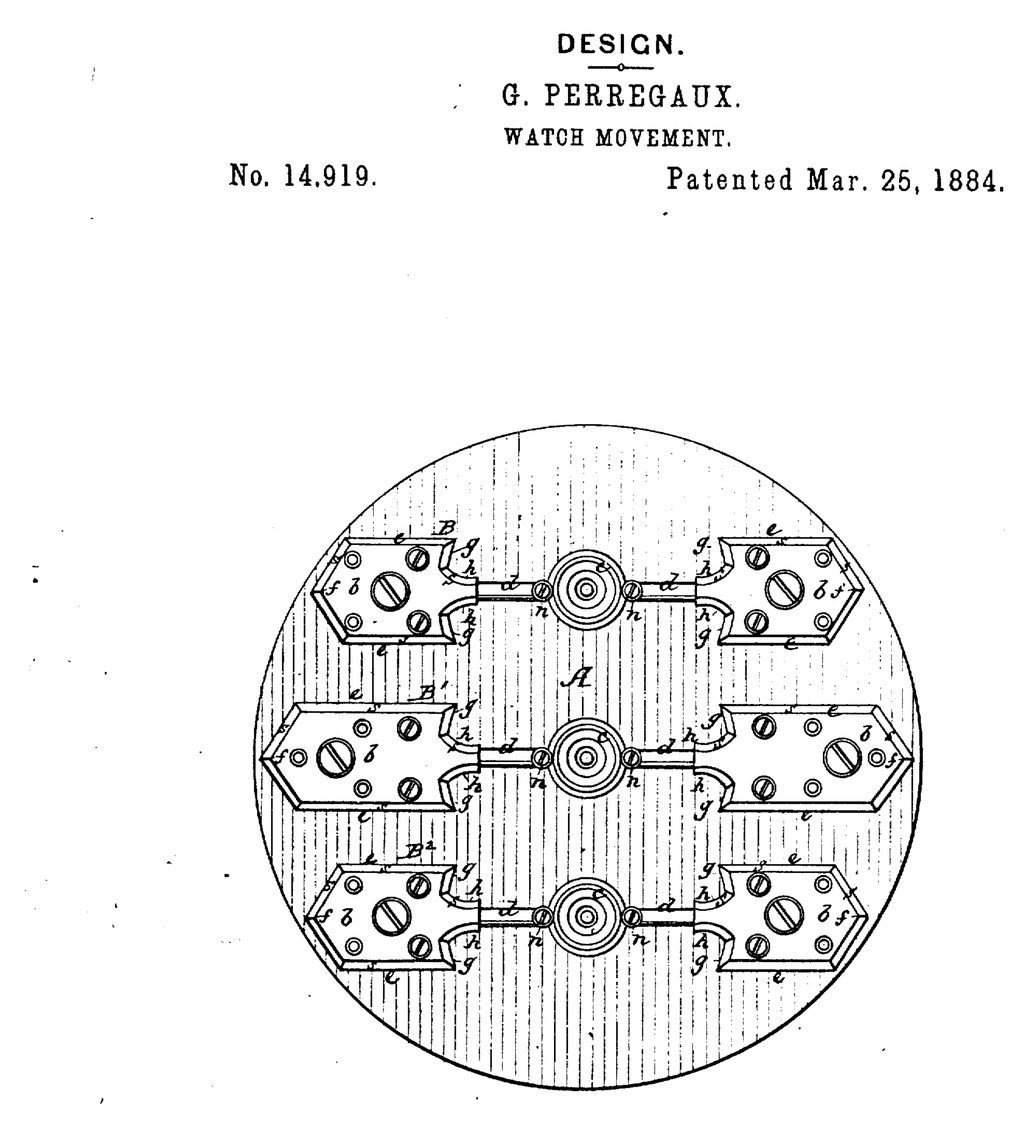
The moment the tourbillon stopped being purely an instrument is reasonably easy to date. At the Paris Universal Exhibition of 1867, Constant Girard of Girard-Perregaux showed a pocket watch whose movement was laid out under three straight parallel bridges. He spent the next seventeen years refining it, and on 15 December 1883 filed for protection in the United States — not a mechanical patent but a design patent, granted as No. 14,919 on 25 March 1884. That distinction is the entire point of this section. What Girard registered was an appearance: the specification claims simply “three parallel bridges, each having a central annular portion, spread-out ends, and bar-like portions between said annular portions and ends, and at equal distances apart”. In 1889 he brought to the Paris Exposition Universelle the watch known as La Esmeralda — a tourbillon beneath three arrow-shaped gold bridges, which took a gold medal.
The bridges do real work. But their symmetry, their finish and the deliberate exposure of the revolving carriage were choices made for the eye, and they established the idea that a tourbillon is something to be seen. Every skeletonised tourbillon since, and every modern watch with a window cut in the dial, descends from that decision. It is covered from the other direction on our page about skeleton pocket watches, where the same instinct is applied to the whole movement.
So Did It Work?
In the object it was designed for, yes. A pocket watch spends its working life hanging in one orientation, its errors compound in one direction, and a carriage revolving once a minute genuinely cancels them. Breguet identified a real defect and built a real remedy, and the Kew results a century later bear him out.
In the object it is mostly sold in today, no. A wristwatch is never still. It goes vertical, horizontal, inverted and back within a minute of ordinary movement, so positional errors are already being averaged by the wearer's arm — the tourbillon is solving a problem that has solved itself. Worse, the carriage adds mass to the escapement, consumes power, and introduces its own poise error. Independent testing has repeatedly found modern tourbillon wristwatches performing no better than good conventional movements, and sometimes worse.
None of which makes it a swindle, provided nobody claims otherwise. A tourbillon is now what an eighteenth-century automaton was: proof that someone could do a very difficult thing very well. That is a legitimate reason to admire an object and a legitimate reason to pay for one. It is not a reason to expect it to keep better time than your grandfather's Hamilton.
Buying a Rotating Escapement
Genuine antique tourbillon pocket watches are rare enough that most collectors will never be offered one. Breguet's thirty-five are accounted for and museum-held or in serious private hands; the later French and Swiss examples, and the English tourbillons by makers such as Frodsham, appear at specialist auction and are priced accordingly. If you are shown one casually, at a fair or on an online marketplace, the overwhelming likelihood is that it is not what it is being called.
Three things are worth knowing before you look:
- The word on the dial proves nothing. “Tourbillon” printed on a dial is not a mechanism. Plenty of ordinary watches, then and now, carry the word as a model name or an outright deception. The mechanism is visible from the movement side or it is not there.
- A karrusel is the attainable version, and it is not a consolation prize. English karrusels by Bonniksen and his licensees turn up far more often than tourbillons, cost a small fraction as much, and — on the Kew evidence — were superb timekeepers. For a collector who wants a revolving escapement to own and understand rather than to boast about, this is the sensible object.
- Servicing is a specialist matter. A tourbillon carriage or karrusel platform is not something to hand to a general repairer, and a botched intervention is both expensive and irreversible. Establish who will service it before you buy it. Our repair guide covers how to find a watchmaker competent to take it on.
As with everything else in this field, condition and originality decide the value. An unmolested karrusel with its original dial and case will reward you more, in both pleasure and money, than a tourbillon that has been rebuilt, remarried or over-polished. The values guide sets out the general principles, and they apply here with unusual force, because the pool of competent buyers is small and it notices everything.
Further Reading
- Abraham-Louis Breguet — the life and the rest of the inventions
- Arnold & Earnshaw — the friend whose movement Breguet rebuilt
- Thomas Mudge & the Lever Escapement — the escapement a tourbillon carriage usually carries
- Skeleton Pocket Watches — where the tourbillon became something to display
- Pocket Watch Movements — trains, wheels and how the parts relate
- The Marine Chronometer After Harrison — the observatory trials that judged positional error in earnest
- Grades & Jewels Explained — how precision was graded in ordinary watches