
The Marine Chronometer After Harrison
The hard part was over by 1770. John Harrison had shown that a mechanism could carry Greenwich time across an ocean, and Arnold and Earnshaw had shown that such a mechanism could be built by ordinary workmen in useful numbers. Everything that usually counts as the story of the marine chronometer — the prize, the escapement, the feud — was finished.
And yet in 1800 the Royal Navy still had almost no chronometers. A captain who wanted one bought it himself. There was no standard for what a good one was, no way of comparing two, no repair arrangement, and nobody in the Admiralty whose job it was to think about the question. The instrument existed; the institution that could use it did not.
What follows is the second half of the story, and the half that is almost never told: how the British state taught itself to buy time. It is a history of clerks, ledgers, annual reports and a scoring formula rather than of inventors, and it is the reason a merchant skipper in 1880 could walk into a shop and buy, off the shelf, an instrument better than anything Harrison ever made.
A Post Nobody Wanted
The first move was administrative. A new Longitude Act of 1818 created the post of Superintendent of Chronometers, with a salary of £100 a year. It went initially to the Hydrographer of the Navy, Captain Thomas Hurd, and on 23 July 1821 it was transferred to the Astronomer Royal, John Pond — which is how the Royal Observatory at Greenwich, an institution built to observe stars, acquired the business of testing, rating, storing, issuing and accounting for the Navy's clocks.
That transfer is the hinge of the whole story. It put the assessment of chronometers in the hands of the one body in Britain that already knew the true time to a fraction of a second, and it made the assessment public. A maker's reputation would no longer rest on his own claims.
Thirteen Public Trials
A month before Pond took the post, on 25 June 1821 and following a suggestion from the chronometer maker W. J. Frodsham, the Admiralty announced a series of annual trials at the Observatory ‘for the purpose of further encouraging the improvement of chronometers’. The inducement was blunt: the Admiralty would purchase, at the end of each year, the chronometer which kept the best time, at the price of £300, and the second best at £200.
These became known as the Premium Trials. The first ran from February 1822, each lasted twelve months, and thirteen were held. From 1828 the terms changed: instead of two chronometers the Admiralty bought the best three, at £200, £170 and £130. That revision is worth pausing on, because it is the state marking down its own valuation of the top prize by a third inside seven years. Supply was improving, and the Admiralty knew it.
The trials were discontinued in 1836, at the end of the thirteenth, for three stated reasons: there had been no marked improvement after about the first four; no new invention or discovery had emerged; and — the awkward one — some entrants had abused the system by submitting chronometers they had not made. A competition to identify the best maker had turned into a competition to obtain the best instrument by any route.
What Greenwich Actually Measured
A new series of trials in a different format was begun by George Airy in 1840, and it is Airy's system, running until 1914, that shaped the Victorian chronometer trade. Makers lodged instruments at Greenwich on speculation; the Astronomer Royal ranked them and recommended purchase prices to the Board of Admiralty.
The testing was severe and, more importantly, it was specified. Competing chronometers were compared against the Observatory's standard clock every day, government ones weekly. Every instrument spent at least one period of three or four weeks at a temperature approaching 100°F. Cold was taken as it came — in 1875 Airy noted that some were simply exposed to the open air, and that no artificial cold was ever used. New chronometers were rated in four positions relative to the magnetic meridian, described in the reports as being tried with the XII hour north, east, south and west.
The results were published as three tables. The first listed each chronometer's weekly rates in order of time. The second listed the same rates re-ordered by temperature, coldest week first, using a device the Observatory called a chronometrical thermometer. The third gave the greatest and least weekly rate and the largest change between one week and the next. The first table exposed a bad mainspring or bad oil; the second exposed a failure of temperature compensation; the third decided the outcome.
A Specification in One Line
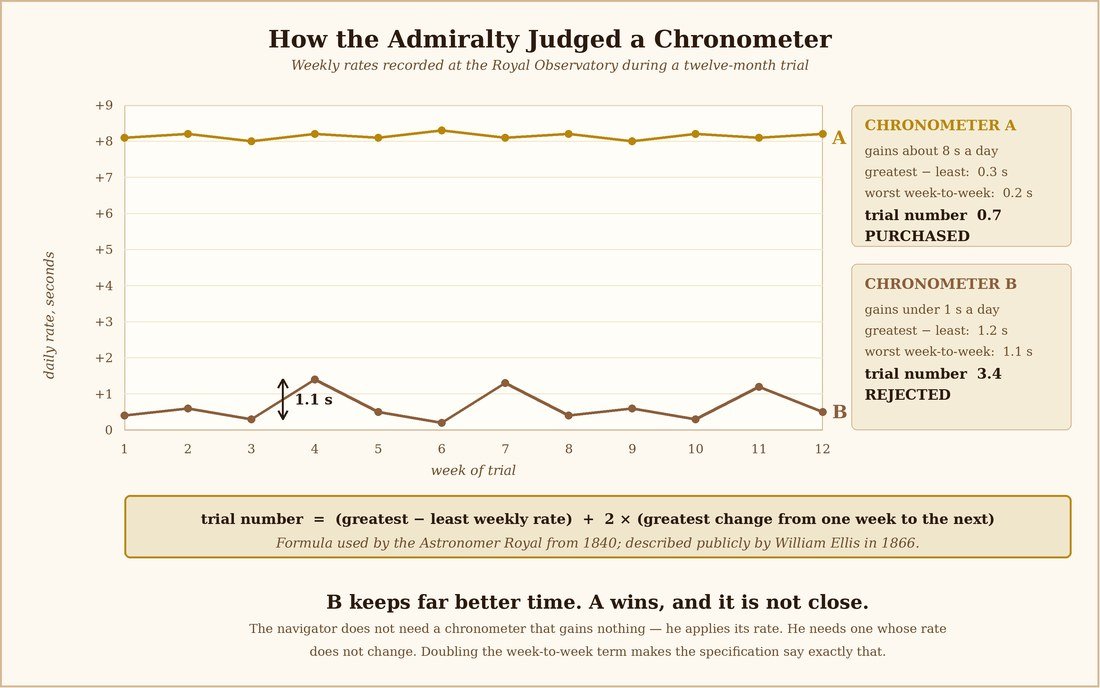
Airy reduced the third table to a single figure, the trial number:
Trial No. = Difference between the Greatest and Least weekly rates, + 2 × Greatest Difference between one week and the next. William Ellis, Airy's assistant, explaining the method in The Horological Journal, 1866
Nothing in that formula measures accuracy. A chronometer gaining eight seconds a day is not penalised at all, provided it gains eight seconds every day; the navigator simply applies the rate. What is penalised is change in the rate, and a sudden change is penalised twice as heavily as a gradual one, because a gradual drift can be spotted and allowed for at sea whereas a jump cannot. Ellis put the reasoning plainly: of the two evils, the sudden change is ‘evidently the worst’.
This is the single most consequential sentence the British government ever wrote about watchmaking. It told every maker in the country exactly what to optimise, in a form that could not be argued with, and it rewarded consistency over showmanship for seventy-four years. The trial numbers themselves were never printed — only the resulting order of merit — and no explanation of the method appeared publicly until Ellis gave his lecture, twenty-six years after the system began.
Not Clerks, but Observers
The arrangement was resented at Greenwich almost from the start. Pond had been made responsible not only for the trials but for the entire administration of issuing and receiving the Navy's chronometers, and when Airy succeeded him he set about shedding the parts he considered beneath the institution. His report to the Board of Visitors in June 1836 is remarkably undiplomatic:
… the persons of this establishment are astronomical observers and calculators, not clerks; … the Observatory is an astronomical institution, not a storehouse; and … any regulation which makes the account-keeping and storekeeping department predominant over the astronomical is an unjustifiable and injurious diversion of its powers. George Biddell Airy, Astronomer Royal, Annual Report, June 1836
Airy was careful to say that he did not object to the rating or the experimenting — the scientific work — but to the money accounts, the stores and the physical delivery of instruments to ships. He largely got his way, and the routine issuing was progressively pushed out to the naval dockyards. The interesting point is what he kept: he held on to the judging, and by holding on to it he kept the power to define what a good chronometer was.
One Instrument, Sixty-Four Years
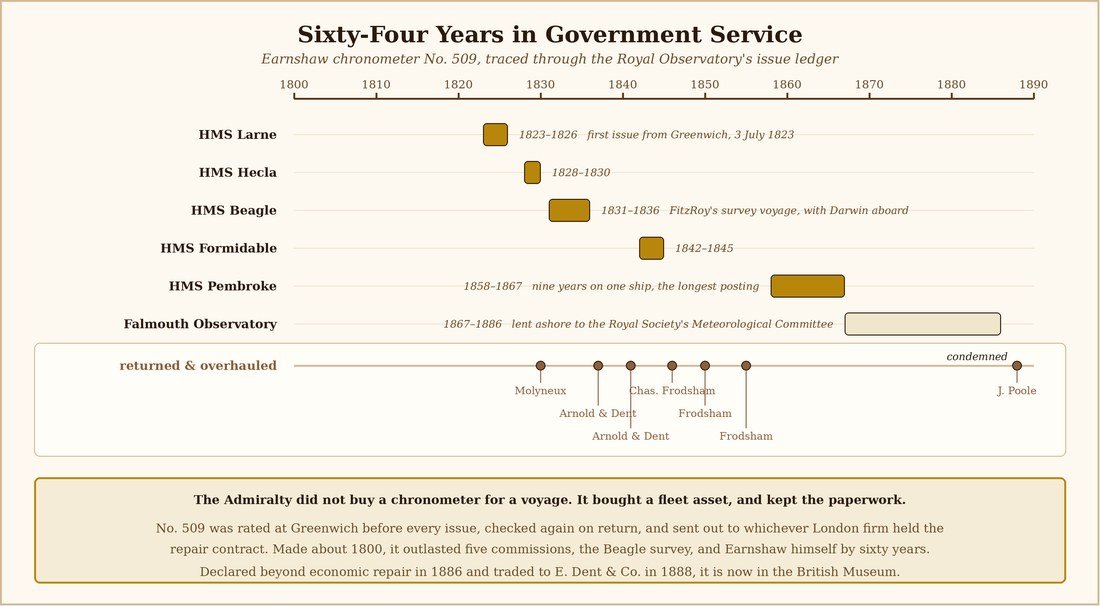
Because the Observatory kept ledgers, individual instruments can be followed through the system, and one of them makes the point better than any argument. Thomas Earnshaw's chronometer No. 509, made around 1800, was the subject of the first recorded issue from Greenwich: on 3 July 1823 it went to Captain Frederick Marryat of HMS Larne.
It came back in 1826 and went to the maker for servicing. It went out again in 1828 to HMS Hecla, back in 1830 for cleaning by Robert Molyneux, to Devonport in 1831 to have its rate checked, and on 6 December 1831 it was issued to HMS Beagle. It sailed with Robert FitzRoy and Charles Darwin, returned on 7 November 1836, and was cleaned by Arnold and Dent. Then HMS Formidable from 1842 to 1845; Charles Frodsham for service; Portsmouth; Rattlesnake and Odin for further overhauls; and finally HMS Pembroke from 1858 to 1867. Lent ashore to the Royal Society's Meteorological Committee at Falmouth for nineteen years, it was declared beyond economic repair in 1886 and traded to E. Dent & Co. in 1888 against a newer instrument. It is now in the British Museum.
Sixty-four years of continuous government service, five commissions, at least six overhauls by four different London firms, and a paper trail for all of it. That is not how a marvel is treated. It is how a fleet asset is treated, and the difference is the whole subject of this article.
Three, Never Two
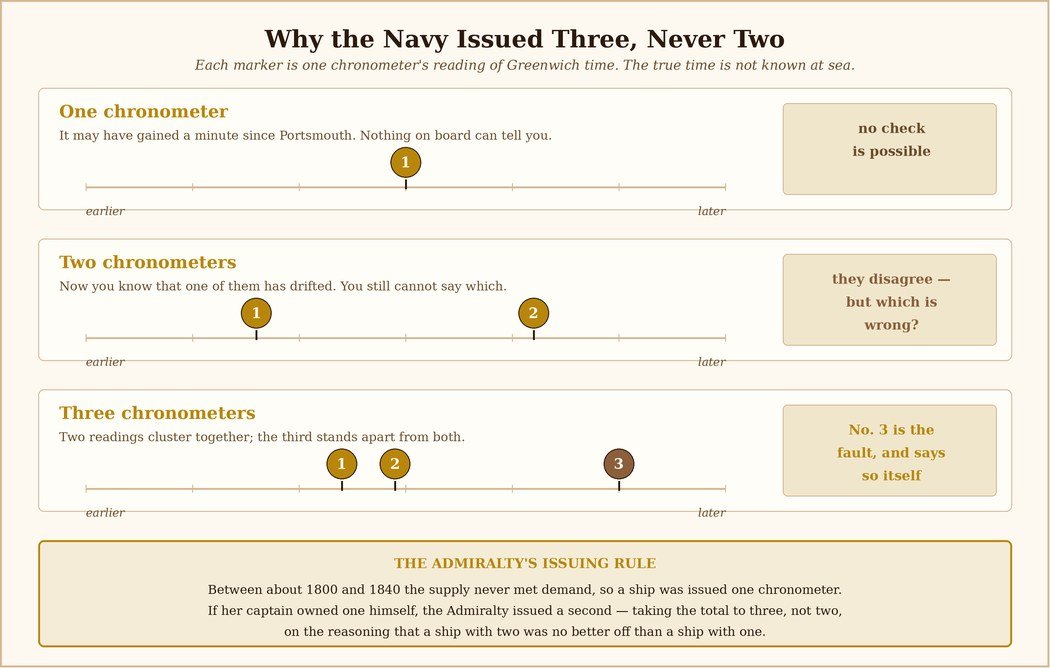
General issue of chronometers to HM Ships began in 1825, but between roughly 1800 and 1840 supply never caught up with demand, and the Admiralty had to ration. The rule it adopted is a small masterpiece of practical reasoning. A ship received one chronometer. If her captain owned one privately, the Admiralty issued a second, bringing the total to three — on the ground that a ship carrying two was no better off than a ship carrying one, since a disagreement between two instruments tells you that something is wrong but not which of them is wrong.
Three was therefore the working minimum, and survey vessels went far beyond it. HMS Beagle carried an extraordinary twenty-two on her second voyage, in a dedicated cabin, packed in sawdust, with access restricted to the few men who needed it. Some belonged to the Navy, some were on loan from makers, and six were FitzRoy's own. He also paid out of his own pocket for an instrument maker, George James Stebbing, to keep them running, the Admiralty having refused the expense while conceding that Stebbing might be fed from the ship's rations. When the voyage closed the accumulated error over five years and a circumnavigation was thirty-three seconds — about 8¼ nautical miles — which FitzRoy considered inexplicably large.
The Chronometer Room, Counted
The Astronomer Royal's annual reports record the contents of the chronometer room year by year, and they show the shape of the system: a standing government stock cycling through repair and reissue, plus a floating population of makers' instruments competing for purchase.
| Report year | Government stock | On competitive trial | Total in the room |
|---|---|---|---|
| 1869 | 142 | 46 | 188 |
| 1870 | 182 | 37 | 219 |
| 1871 | 157 | 44 | 202 |
| 1875 | 94 | 49 | 143 |
| 1882 | 168 | 46 | 214 |
| 1886 | 81 | 34 | 115 |
Between thirty and fifty instruments a year were being submitted speculatively by the trade for a handful of purchases — a level of unpaid effort that only makes sense if the ranking itself was commercially valuable, which it plainly was. The 1886 report captures the mechanism neatly: thirty-seven chronometers were entered that year, but three of them, having placed highly in the previous trial, were bought by the Admiralty in February and withdrawn.
The stock was also elastic in ways a modern reader would recognise. In 1874 three chronometers were transferred to the War Office for the Gold Coast Expedition and replaced by three the War Office paid for, and the Transit of Venus expeditions required forty-six — a demand large enough that the Observatory leaned on the trade to return repaired instruments faster.
Rating for the World
Once Greenwich had a published order of merit and a reputation for severity, other states began buying through it. The reports record chronometers on trial for the Mauritius Observatory and tested for the Japanese government in 1882, for the new Hong Kong Observatory in 1883, and on trial for purchase by the Austrian government in 1884 and 1885.
The same thing happened with the distribution of time itself. The Greenwich time ball, and its telegraph-driven twin at Deal, let a ship in harbour set her chronometers against the national standard before sailing; Airy reported their reliability annually to the decimal point, including the days the wind was too high to hoist the ball and the occasions when a stray railway telegraph signal dropped it early, upon which a black flag was hoisted to warn the watching ships that the drop had been false. By 1874 the German Empire was asking Greenwich for plans in order to establish time balls in its own ports, and demand within Britain had grown enough that the Post Office published a tariff of annual charges for the signal.
The Signal That Ended It
What eventually dissolved this system was not a better chronometer. It was radio. Time signals were first transmitted to ships at sea from the United States in 1905, and from 23 May 1910 the Bureau des Longitudes broadcast twice daily from the top of the Eiffel Tower, on a 2,000-metre wavelength, referenced to the clocks of the Paris Observatory.
The consequence was quiet but total. A chronometer's rate had mattered so much precisely because, once a ship left harbour, nothing could correct it — the rate was the only bridge between the last known time and today. A daily wireless signal turned an uncheckable instrument into a checkable one, and a chronometer that could be checked every day no longer needed to hold its rate for months. The Greenwich trials were suspended in 1914 and never resumed; as late as 1926 the Astronomer Royal still intended to restart them, but the department's work had settled into rating instruments the Admiralty already owned. Even so the machinery survived long enough to matter one final time: evacuated to a requisitioned house at Bradford on Avon, the chronometer staff issued some 21,023 tested instruments in the last year of the Second World War.
What the Record Leaves for a Collector
This history is unusually useful when you are looking at an actual instrument, because so much of it was written down.
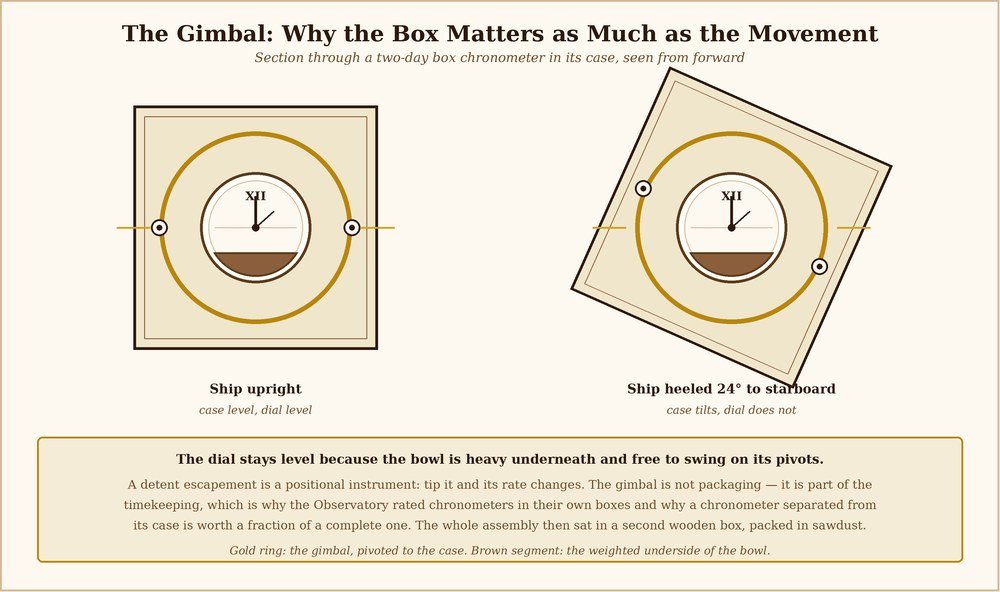
A chronometer that passed through the system may carry a government broad-arrow mark, a service number, or a maker's number that can be matched against surviving Greenwich ledgers and the published trial tables — and a documented placing in an Airy trial is provenance of a kind almost nothing else in horology can offer. Equally, the record explains why a movement separated from its gimbals and box is worth so much less than a complete instrument: the case was never an accessory, and the Observatory never rated one without the other. It explains why the finest-sounding claim on a dealer's listing is often the weakest, and why a plain two-day box chronometer by an unfashionable maker with an intact rating history can be the better buy.
Above all it explains the strange shape of the trade's history. English makers dominated marine chronometry for a century not only because Arnold and Earnshaw were brilliant, but because Britain built a customer that could tell the difference — and published the answer every year. The instrument on the shelf at Prescot or Clerkenwell was, in a real sense, designed by a formula written at Greenwich.
Further Reading
- John Harrison and the Longitude Problem — the invention that made all of this possible.
- Arnold & Earnshaw: The Rivalry That Democratised the Chronometer — the spring detent escapement and the compensation balance.
- Deck Watches — how Greenwich time actually got from the chronometer to the sextant.
- The Tourbillon — the other great attempt to defeat positional error, judged by the same kind of observatory data.
- Pocket Watch Movements — escapements and calibres explained.
- The History of the Pocket Watch — the full Horological History library.