
Arnold & Earnshaw: The Rivalry That Democratised the Chronometer
When John Harrison at last won the longitude prize, he had proved that a clock could keep time at sea. What he had not done was make that clock buildable in numbers. His masterpiece, H4, was a jewel of hand-fitted micro-engineering that only a handful of craftsmen on earth could reproduce, and then only at ruinous cost and over years of work. A navy needs an instrument on every ship, not a single miracle in a museum. The men who bridged that gap — who turned the marine chronometer from a bespoke marvel into a reliable production instrument — were two Englishmen with very different temperaments: John Arnold and Thomas Earnshaw. Their overlapping work, and the bitter priority dispute it triggered, settled the form of the chronometer for the next two hundred years.
After Harrison: The Problem That Remained
Harrison's approach belonged to the world of the precision clock. His sea watches were crammed with ingenious but complicated devices — a remontoir, a grasshopper escapement, bimetallic gridiron compensation — each demanding the skill of a master and the patience of a saint. When the Board of Longitude asked Larcum Kendall to copy H4, his near-identical K1 took over two years and cost £450, a fortune at the time. A simplified version, K2, was cheaper but less accurate. The lesson was plain: brilliance alone was not enough. The chronometer needed to be redesigned around production — simple, conventional in layout, easy to adjust and repair, and above all repeatable.
That is exactly the problem Arnold and Earnshaw set out to solve. Rather than pile complexity on complexity, they stripped the timekeeper back to essentials: a large balance and balance spring left as free as possible; a detached escapement that touched the balance only for a fraction of each swing; and temperature compensation built into the balance itself. The three ingredients sound simple. Perfecting them, and making them cheap, took both men their lives.
John Arnold: The Great Simplifier
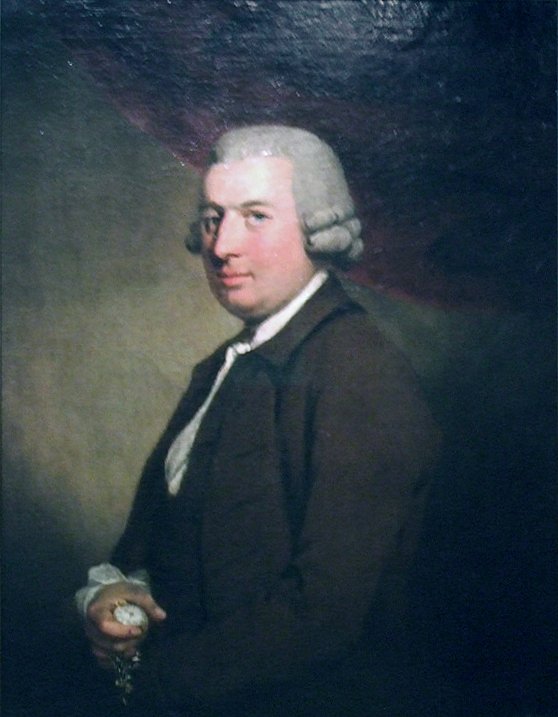
John Arnold was born in Bodmin, Cornwall, in 1736, the son of a clockmaker, and learned the trade at his father's bench before working abroad in The Hague and returning to set up in London. His break came in 1764, when he presented King George III with an astonishingly small half-quarter repeating watch mounted in a ring — a tour de force of miniature work that made his name overnight. But Arnold's real ambition lay elsewhere. Encouraged by the Astronomer Royal, Nevil Maskelyne, who gave him a copy of the Board's published description of Harrison's timekeeper, he began around 1770 to build precision timekeepers of his own.
Arnold's genius was for reduction. Where Harrison elaborated, Arnold pared away. In March 1771 he showed the Board of Longitude a marine timekeeper in a plain mahogany box, offering to make them at 60 guineas apiece — a fraction of Kendall's price. Three of his timekeepers sailed with Captain Cook on his second voyage (1772–75); their early performance was patchy, but Arnold learned fast. Over the following decade he introduced, in a series of patents, the elements that still define the mechanical watch: a helical balance spring whose force is uniform along its length; the overcoil terminal curve that confers isochronism (equal timekeeping whatever the swing) and which survives in almost every fine watch today; and a bimetallic compensation balance that corrects for the effect of heat and cold.
The triumph came with a chronometer he numbered 36 — the first watch he ever called a “chronometer,” a word he effectively brought into its modern meaning. The Royal Observatory at Greenwich tested Arnold 36 continuously for thirteen months, from February 1779 to July 1780. Its greatest error in any twenty-four hours was just four seconds — about one nautical mile of longitude at the equator. From his factory at Well Hall, Eltham, Arnold went on to make chronometers in genuine quantity: several hundred pocket and marine pieces before he had any serious commercial rival. He was, by his death in 1799, the most famous watchmaker in the world, and a close friend of Abraham-Louis Breguet, to whom he sent his own son to be trained.
Thomas Earnshaw: The Man Who Made It Affordable
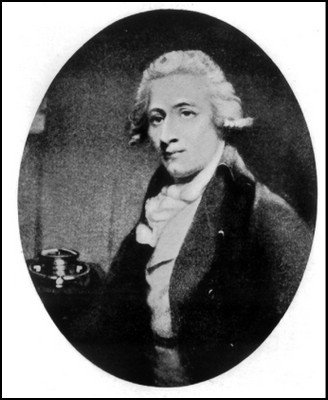
Thomas Earnshaw was born in Ashton-under-Lyne, Lancashire, in 1749, and rose the hard way — not as a celebrated proprietor but as a supremely skilled escapement maker, the specialist craftsman other firms hired to make the most delicate part of a chronometer. He worked for the trade, including the makers John Brockbank and Thomas Wright, and it was in that workshop world, around 1780, that he made his decisive contribution. It is Earnshaw's forms — more than Arnold's, more than anyone's — that the world's chronometers ultimately adopted.
Earnshaw's overriding gift was for simplification for manufacture. He refined the spring detent escapement into something a good workman could make repeatably, and he devised a compensation balance made by fusing brass directly onto a steel rim — quicker and cheaper to produce than the riveted assemblies of his rivals. The effect was to bring the price of a working marine chronometer within reach. Where Arnold's early boxes had been offered at 60 guineas, Earnshaw could supply reliable timekeepers for a fraction more than a fine watch: in 1791 Captain William Bligh bought Earnshaw's chronometer No. 1503 for the Providence expedition for just 40 guineas. He also built superb precision clocks, including the celebrated transit clock for Armagh Observatory in 1794, long reckoned among the most accurate in the world.
Earnshaw was combative, proud, and convinced he had been robbed of credit — a conviction he poured into a famous 1808 pamphlet, Longitude: An Appeal to the Public. Whatever the justice of his grievance, the technical verdict of history is on his side: the bimetallic compensation balance and the spring detent escapement, in the forms Earnshaw settled, became the essentially universal fittings of the marine chronometer from about 1800 until the quartz age.
How the Spring Detent Escapement Works
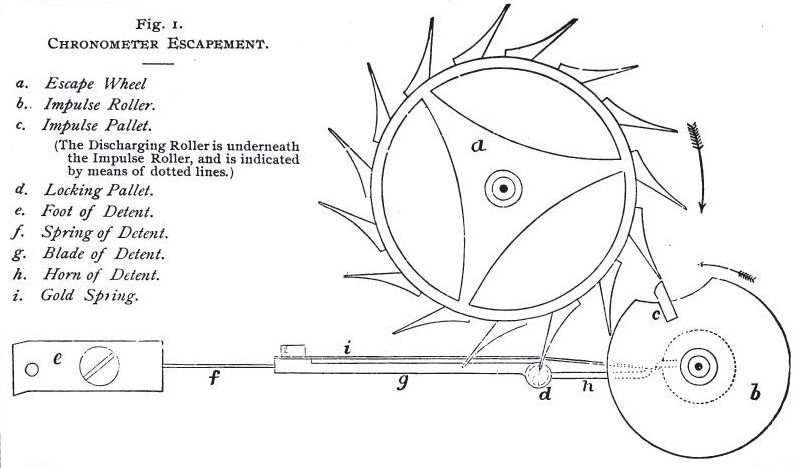
The reason the chronometer keeps such extraordinary time lies in its escapement. Like Mudge's lever, the spring detent is a detached escapement: for almost the whole of each swing the balance is entirely free, disturbed by nothing. But the detent goes further than the lever in one crucial respect — it gives the balance an impulse on only one of its two swings, and it does so through a dead push with almost no sliding friction. That is why, on land and in observatory trials, the detent chronometer out-performed everything else for generations.
The mechanism has three key parts:
- The escape wheel — driven by the train, its teeth are alternately locked and released, and deliver the impulse.
- The detent — a slender blade carrying a jewelled locking stone. In Earnshaw's design the blade is fixed at one end and flexes on its own elasticity (the “spring” detent), dispensing with the pivots and oil of Arnold's earlier pivoted detent.
- The balance — which carries two jewels on its staff: a stout impulse pallet (a roller jewel) that receives the push, and a delicate discharging or passing jewel that trips the detent.
The cycle runs like this. For most of the time an escape-wheel tooth rests against the locking stone on the detent, and the balance swings freely with nothing touching it. As the balance turns in one direction, its passing jewel gently pushes the tip of the detent aside, just far enough to lift the locking stone and free the wheel. The released wheel drives a tooth against the balance's impulse pallet, delivering a single brisk kick of energy, and immediately the next tooth drops back onto the locking stone. On the return swing the passing jewel meets the detent from the other side, but here a light passing spring lets the jewel slip by without unlocking the wheel — so no impulse is given, and, vitally, the balance is not disturbed on its free return.
Two features explain its accuracy. First, because impulse is given directly to the balance and only once per double swing, there is almost none of the sliding friction that plagued earlier escapements; the acting surfaces barely need oil, so the rate stays stable for years — a decisive advantage in an age when only quick-degrading vegetable oils were available. Second, the balance spends the overwhelming majority of its cycle genuinely detached, governed by nothing but its own spring. The price of this precision is fragility: the detent will not tolerate shocks or being carried in the pocket as happily as a lever, which is why the detent ruled the ship's chronometer and the observatory clock, while the lever conquered the everyday watch.
The Compensation Balance and the Overcoil Spring
An escapement, however clean, is only half the battle. A balance spring is maddeningly sensitive to temperature: heat weakens the spring and expands the balance, and a chronometer left uncorrected could lose several seconds a day for every rise of a few degrees — enough to wreck a landfall. The answer was the bimetallic compensation balance. Its rim is made of two metals — brass on the outside, steel within — and cut open, so that as temperature rises the brass, expanding more, curls the free ends of the rim inward, carrying small timing weights toward the centre and speeding the balance up by just enough to cancel the error. Both makers built such balances; Earnshaw's fused-construction version was the one that could be made in numbers, and it, with minor changes, remained standard into the twentieth century.
Arnold's other lasting gift was to the balance spring itself. His helical spring with terminal overcoils — a small in-curved coil at each end — made the balance swing isochronously, keeping equal time whether the swing was large or small. This “overcoil,” refined by Breguet, is still found in most precision mechanical watches today. Because Arnold's spring patents ran for fourteen years each, Earnshaw was legally barred from using the helical spring until they lapsed; only after about 1800 did practically every chronometer, his included, carry the helical overcoil spring.
Arnold and Earnshaw at a Glance
| John Arnold | Thomas Earnshaw | |
|---|---|---|
| Born–died | Bodmin 1736 – 1799 | Ashton-under-Lyne 1749 – 1829 |
| Role in the trade | Celebrated proprietor & manufacturer | Master escapement maker; later proprietor |
| Key escapement | Pivoted detent; own spring-detent variant (1782 patent) | Spring detent, c.1780 — the form that became standard |
| Signature contributions | Helical spring, the overcoil, quantity production | Simplified spring detent & fused compensation balance |
| Coined “chronometer” | Yes — in its modern sense | — |
| 1805 Board of Longitude award | £1,672 (to his son, John Roger Arnold) | £2,500 |
The Great Dispute — and Why It Is Overstated
Around 1780 Earnshaw, working on chronometers for John Brockbank, mounted the detent's locking piece on a spring instead of on pivots. Arnold, who saw the idea, took out a patent in 1782 that included his own spring-detent form; Earnshaw's design was patented (through Thomas Wright) in 1783. Each man believed the other had stolen his invention, and Earnshaw in particular waged a decades-long campaign of pamphlets and public letters to establish his priority. Horological historians — most famously Rupert Gould — have argued the case back and forth ever since. The honest answer is that the priority of the spring detent cannot be settled: both men reached it within a year or two, and the surviving evidence does not prove who was first.
It is worth being equally honest about the word “rivalry.” The popular image of two firms locked in commercial combat is largely a myth. In the years that mattered, the two operated on utterly different scales: between 1783 and 1796 Arnold produced hundreds of pocket chronometers and a stream of marine boxes, while Earnshaw — still chiefly a maker's maker — turned out only a few dozen. There was no real market contest between them; the quarrel was about credit, not customers. What history rewarded, in the end, was not who shouted loudest but whose designs proved most makeable. On that test both men won, which is why the Board of Longitude eventually paid both — £2,500 to Earnshaw in 1805, and £1,672 to Arnold's son — and why the modern chronometer is, quite literally, a marriage of their ideas: Arnold's spring and overcoil, Earnshaw's escapement and balance.
Chronometers That Changed History
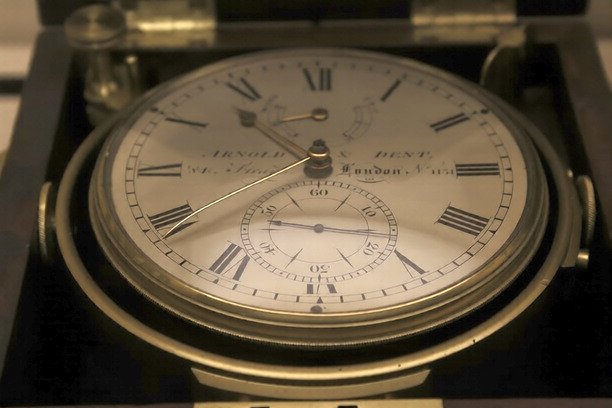
Because Arnold and Earnshaw made the chronometer buildable, it could go to sea on the great voyages of exploration and survey. Earnshaw's timekeepers sailed with Captain Bligh aboard the Providence, and two of them (E520 and E543) accompanied Matthew Flinders on HMS Investigator during the first circumnavigation of Australia; E520 was the only timekeeper still running at the journey's end, prompting Flinders to call it “this excellent timekeeper.” Most famous of all, an Earnshaw chronometer, No. 509, was among those carried by HMS Beagle on the 1831–36 voyage that charted a chain of longitudes around the globe — and carried the young Charles Darwin. That very chronometer is now in the British Museum, chosen as one of the hundred objects in the BBC's A History of the World in 100 Objects.
These were not one-off marvels like Harrison's H4, but instruments off a production line, accurate enough to fix a ship's position within a mile or two after months at sea. In making the chronometer ordinary, Arnold and Earnshaw did more for navigation than any single spectacular timekeeper ever could.
Legacy
John Arnold died in 1799, the most renowned watchmaker of his day; Thomas Earnshaw lived on until 1829, still nursing his grievances but universally acknowledged as a father of the modern chronometer. Their combined legacy is easy to state and hard to overstate: they turned the longitude timekeeper from an unrepeatable masterpiece into a trustworthy tool of empire, science and commerce. Every ship's chronometer that ticked in its gimballed box for the next century and a half — and, through the overcoil spring, a great many of the fine wristwatches made today — carries something of Arnold and Earnshaw inside it. The quarrel between them has faded to a historical footnote; the machine they perfected changed the world.
Further Reading
- John Harrison & the Longitude Problem — the marine timekeeper Arnold and Earnshaw made producible
- Thomas Mudge & the Lever Escapement — the detached escapement that conquered the everyday watch
- Tompion & Graham — the English tradition Arnold and Earnshaw inherited
- Abraham-Louis Breguet — Arnold's friend, who refined the overcoil and trained his son
- The Marine Chronometer After Harrison — how the Admiralty tested, rated and issued the instruments they made
- The Deck Watch — the chronometer's portable cousin
- Pocket Watch Movements — escapements and balances in context