
Who Really Invented the Chronograph?
For almost two centuries the answer seemed settled. The chronograph — the watch that measures elapsed time at the press of a button — was born at a Paris horse race in 1821, the work of a royal watchmaker named Nicolas Rieussec. Every history book said so. Then, in 2013, a watch that had lain forgotten for a century and a half resurfaced and quietly rewrote the story.
It is one of the great detective tales in horology, and like all good detective tales it turns on a question of definitions. What exactly is a chronograph? Who built the first one? Who gave it its name? And who made it into the practical, reusable instrument we recognise today? The answers, it turns out, belong to three different men in three different decades — and untangling them is far more interesting than any tidy single "inventor".
Chronograph, chronometer or stopwatch? These three are constantly confused, even in auction listings.
A chronometer is a high-precision timekeeper — it is about accuracy, not elapsed time. A stopwatch measures intervals only and does not tell the time of day. A chronograph is a watch that does both: it shows the running time and can start, stop and reset an independent elapsed-time measurement. By that strict definition the earliest "chronographs" were really stopwatches; the fully modern chronograph took several decades to arrive.
The Meaning Hidden in the Name
The word itself is a clue, and a slightly misleading one. "Chronograph" comes from the Greek chronos, time, and graphein, to write: literally, a "time writer". That sounds odd for a modern stopwatch, which writes nothing at all — until you learn that the instrument that first bore the name really did write the time, in drops of ink on a rotating dial. The name is a fossil, preserving the memory of how the earliest marketed chronograph worked.
What unites every chronograph, ancient or modern, is the idea of measuring an interval independently of the running of the watch. A timekeeper tells you what o'clock it is; a chronograph lets you start a measurement at the instant a horse leaves the line, stop it as it crosses the finish, read off the elapsed seconds, and — crucially — return the hand to zero to do it all again. That last step, the reset, is the part that took longest to solve, and it is the key to the whole story.
Writing Time in Ink
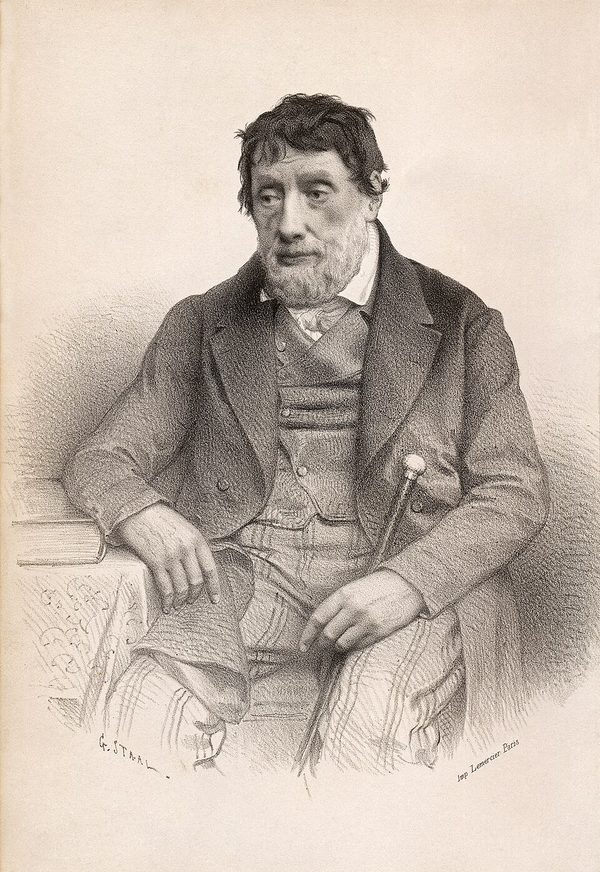
Nicolas Mathieu Rieussec (1781–1866) was a gifted Parisian watchmaker who had risen to become the sixth royal watchmaker to the King of France. Appointed horologist to Louis XVIII in 1817, he ran the royal furniture depository — the office responsible for the clocks and furnishings of the royal residences — and kept a shop on the Île de la Cité. He was, in the manner of the best watchmakers, also a shrewd businessman, and he saw an opportunity in a very modern problem: how to time a horse race fairly.
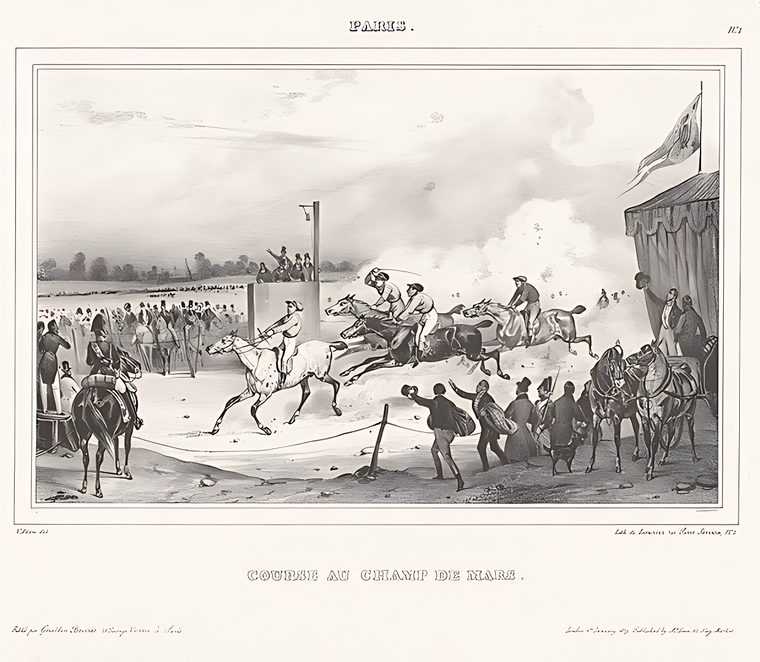
Parisian racing was big business, and disputes over finishing times were endless. On Saturday 1 September 1821, at the races on the Champ de Mars, Rieussec tested his answer. It was not a pocket watch but a boxed instrument resembling a marine chronometer, containing two rotating enamel dials — one for seconds, one for minutes — turning beneath a fixed, ink-filled stylus. At the press of a button the nib dropped and left a small dot of ink on the dial, marking the precise instant. By inking a fresh dot as each horse crossed the line, a single operator could record the time of every runner in a race, not merely the winner.
A few weeks later, on 14 October 1821, Rieussec presented the device to the Royal Academy of Sciences. In its minutes the Academy recorded it as a chronographe à secondes — a "seconds chronograph" — and so, for the first time, the Greek word for "time writer" was attached to an instrument of this kind. Rieussec secured a patent on 9 March 1822 for his chronographe à cadran tournant, the "rotating-dial chronograph". For the better part of two centuries he would be remembered as the inventor of the chronograph.
His machine was ingenious but cumbersome. The ink needed constant refilling, the dials needed cleaning, and the whole apparatus was a desk instrument rather than something to carry. Rieussec was not quite alone, either: in the same period Frederick Louis Fatton, a pupil of Breguet, took out an English patent in 1822 for a very similar inking chronograph, a sign that the idea was in the air. But it was Rieussec's device that the Academy named and history remembered — until the record was overturned by a watch he never knew existed.
The Watch That Changed the Story
In May 2012 an anonymous pocket watch came up for sale at Christie's in Geneva. It had spent some 150 years in the collection of a Northern European noble family, untouched and unregarded, and it passed almost unnoticed among the grander lots. Its buyer was Jean-Marie Schaller, head of the modern watch house that bears the name Louis Moinet. When the watch was cleaned and studied, it proved to be something extraordinary.
Louis Moinet (1768–1853) was a French horologist of the first rank, a friend and occasional collaborator of Abraham-Louis Breguet, and the author of a celebrated Traité d'Horlogerie of 1848. He had, in fact, described the watch himself: by his own account he came to Paris in 1815 for the express purpose of building a compteur de tierces — a "counter of thirds", a third (tierce) being the old name for one-sixtieth of a second. He completed it in 1816, intending it to time the passage of stars across the meridian for astronomical work.
What stunned the experts — the watch was authenticated by the independent specialist Arnaud Tellier, former curator of the Patek Philippe Museum, and unveiled at the observatory in Neuchâtel on 21 March 2013 — was how advanced it was. The compteur de tierces has a start, a stop and a zero-reset, operated by two pushers, exactly like a modern chronograph. Its balance beats at 216,000 vibrations an hour, a frequency of 30 hertz, allowing it to measure to one-sixtieth of a second. To put that in perspective, an ordinary mechanical watch today beats at 4 hertz; nothing would beat Moinet's frequency for another century.
The implications were immediate. Moinet had built a working chronograph in 1816 — five years before Rieussec's horse race — and, more startling still, he had solved the zero-reset some forty-six years before the patent long credited with that achievement. The day after the announcement, encyclopaedias were being rewritten. Moinet had not set out to "invent the chronograph"; he had simply built the instrument he needed. But built it he had, and it is, on the present evidence, the earliest chronograph known to survive.
From Curiosity to Practical Instrument
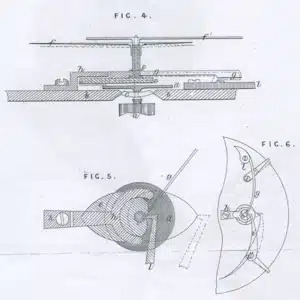
Whoever built the first chronograph, the complication only became genuinely useful once it could be reset cleanly and used again and again. The elegant solution was the heart-shaped cam: when the reset is pressed, a lever falls against the edge of a heart-shaped piece on the hand's arbor and, whatever position the hand is in, the lever forces the cam — and so the hand — back to zero in an instant. It is one of the prettiest ideas in all of watchmaking, and every mechanical chronograph still relies on it.
The Swiss watchmaker Adolphe Nicole, working in London, patented a reset mechanism of this kind in 1844. The fully modern chronograph — a watch that tells the time of day and carries a start-stop-reset seconds counter — followed at the London International Exhibition of 1862, shown by Nicole's firm and made by a watchmaker in his employ, Henri Féréol Piguet. In 1868 Auguste Baud moved the chronograph work to the movement side of the watch rather than the dial side, and counters for elapsed minutes were added soon after. The split-seconds, or rattrapante, complication — a second hand that can be stopped to take an intermediate time while the first runs on — had already been pioneered by Joseph Thaddeus Winnerl in the 1830s.
By the closing decades of the nineteenth century, then, the pocket chronograph had become everything we expect of one: a reliable, resettable instrument for timing anything from a race to a medical pulse. (Many antique chronograph dials carry a "pulsations" scale for exactly that purpose.) The complication that began as an astronomer's tool and a bookmaker's aid had become a standard of the trade.
Three Men, Three Firsts
The honest answer is that "the inventor of the chronograph" is the wrong question, because there is no single first. There are three distinct firsts, and each belongs to a different man:
Louis Moinet (1816) built the earliest chronograph known to survive — a high-frequency instrument with a working zero-reset, made to time the stars. It was a private tool, unknown to the wider world until 2013, and so it influenced nobody at the time; but as a physical object it came first.
Nicolas Rieussec (1821) built the first chronograph that was publicly demonstrated, patented and put to practical use, and his instrument gave the complication its enduring name. Whatever the order of invention, the word "chronograph" and the public history of the device begin with him.
Adolphe Nicole (1844–1862) gave the chronograph the clean, repeatable reset and combined it with normal timekeeping, turning a clever curiosity into the modern complication that every later maker would build upon.
For the collector, this is the satisfying part. Depending on how you define "chronograph" — earliest surviving example, first named and marketed, or first in fully modern form — the answer is Moinet, Rieussec or Nicole. All three are correct; none is the whole story. It is a useful reminder that horological history is rarely a line of tidy "firsts", and that a single forgotten watch in an auction lot can overturn what everyone thought they knew.
What the Collector Should Look For
Genuine early chronographs of the Moinet or Rieussec type are museum pieces, effectively unobtainable. But the antique pocket chronograph of the later nineteenth and early twentieth centuries is very much a collectable, and a rewarding one. A few points are worth bearing in mind.
First, mind the terminology, especially in online listings: a watch described as a "chronometer" is making a claim about precision, not about elapsed-time function, while a true chronograph will have the start-stop-reset pushers (often a single button through the crown on early examples). Second, look at the dial scales, which tell you what the watch was made to do: a tachymetre scale converts elapsed time to speed, a pulsations scale was for doctors taking a pulse, and a telemeter scale gauged distance by sound. Third, condition of the chronograph work matters greatly — the reset mechanism is delicate, and a hand that does not fly cleanly to zero is a sign of wear or a tired heart cam. As always, an honest dial and an unpolished case are worth more than a watch that has been over-restored.
Continue exploring. See our dedicated page on the chronograph pocket watch for buying and identification, and the story of Abraham-Louis Breguet — friend of Louis Moinet and the towering figure of the age. Return to the History Library for more, or read about John Harrison and the longitude problem.