
Jean-Antoine Lépine and the Birth of the Flat Watch
For nearly three hundred years, from the first Nuremberg drum watches to the height of the Georgian era, a pocket watch was a fat, deep object. It bulged in the waistcoat because of the way it was built inside — a way no one thought to question. Then, in the 1760s, a French watchmaker quietly threw out two of its most sacred components and produced a movement so thin that the modern slim watch became possible for the first time. His name was Jean-Antoine Lépine, and the calibre he devised is, in its essentials, still the way a mechanical watch is put together today. If Breguet is the most celebrated name in horology, Lépine — Breguet's own teacher — is arguably the most influential, because almost every watch you will ever pick up is built on his idea.
From Challex to the King's Bench
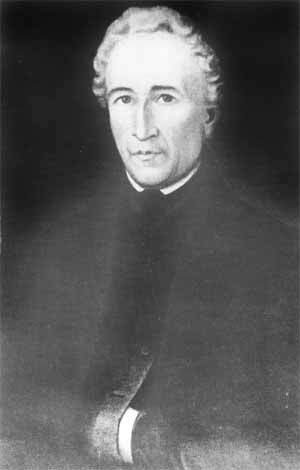
He was born Jean-Antoine Depigny on 18 November 1720 at Challex, in the French Pays de Gex, a stone's throw from the Swiss border and the great watchmaking city of Geneva. A boy with a gift for mechanics, he learned his trade under a Monsieur Decroze, a watchmaker at Saconnex near Geneva, before setting out for Paris in 1744 at the age of twenty-four. There he entered the workshop of André-Charles Caron (1698–1775), clockmaker to Louis XV. It was a fateful connection. In 1756 Lépine married Caron's daughter, Madeleine-Françoise, and became his father-in-law's business partner under the style Caron et Lépine. (Caron's son, Lépine's brother-in-law, was Pierre-Augustin Caron — better known to history as the playwright Beaumarchais, author of The Marriage of Figaro, who had himself trained as a watchmaker.)
Lépine became a maître horloger — master watchmaker — on 12 March 1762, and about the same time began teaching a young apprentice who would eclipse every name of the age: Abraham-Louis Breguet. Around 1765 he was appointed Horloger du Roi, watchmaker to the King, succeeding Caron the following year; he would keep royal favour through the reigns of Louis XV, Louis XVI and, later, Napoleon I. He presented Louis XV with an astronomical watch showing equation of time and a perpetual calendar, and for a period around 1770 he directed the watch manufactory that the philosopher Voltaire had established at his estate in Ferney, where many of Lépine's movement blanks were made. By any measure he had reached the very top of his profession — but it is not his royal patrons or his complications that secured his place in history. It is what he did to the ordinary movement.
The Problem of the Fat Watch
To see why Lépine's idea mattered, you have to picture the watch he inherited. The traditional movement was built like a little drum. Two circular brass plates — a bottom plate and a full top plate — were held apart by turned pillars, and the entire going train, from the mainspring barrel to the escape wheel, was sandwiched between them. Every wheel had to be dropped into its hole in the bottom plate and then the whole top plate lowered over the lot at once, threading a dozen delicate pivots into their holes simultaneously — a fiddly, exasperating job. The balance sat on top of this plate under an ornate cock, adding yet more height.
Worse for slimness was the fusée. A mainspring pushes hard when fully wound and feebly when nearly run down, and early escapements could not cope with such uneven force. The fusée was the ingenious cure: a cone-shaped pulley linked to the barrel by a tiny chain, its varying radius evening out the pull as the spring unwound. It worked beautifully — but a cone plus a barrel plus a full plate plus a balance stacked on top made for a deep, heavy watch, the sort that needed a generous verge and fusée pocket in the waistcoat. This architecture had gone essentially unchallenged since the sixteenth century. Lépine's insight was to ask what would happen if you simply removed the two culprits.
The Lépine Calibre: Bridges Instead of Plates
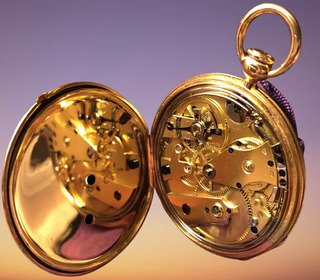
Around 1764–65 Lépine introduced the movement that horologists call the calibre Lépine or calibre à ponts — the bridge calibre. Its logic is beautifully simple. He abolished the full top plate altogether. In its place he fixed to the single remaining plate a set of separate bridges and cocks (French ponts), each a small bracket that carried the upper pivot of just one wheel or of the barrel. Now the watchmaker could drop in one wheel, screw down its own little bridge, check that it ran free, and move on to the next — assembling and adjusting the train piece by piece instead of wrestling the whole top plate on at once. Repair became far easier for the same reason: a single wheel could be reached without dismantling everything above it.
Freed of the full plate, Lépine could also move the balance down beside the train rather than perch it on top, shaving away more height. And to be rid of the tall fusée he took a second bold step: he drove the train straight from a going barrel — a barrel whose mainspring pushes the wheels directly, with no cone and no chain. To make the more uneven power of a going barrel acceptable, he paired the calibre with the compact cylinder escapement (and its cousin the virgule), which tolerated the variation far better than the old verge. The result of all this — no full plate, no fusée, balance lowered, cylinder escapement — was a movement dramatically thinner than anything before it, and the slim, elegant pocket watch was born.
How the Lépine Calibre Works
Strip a Lépine movement down and the cleverness is in what is missing. Three old certainties have gone, and each subtraction buys thinness or convenience.
First, the going barrel replaces the fusée. The mainspring lives in a toothed barrel that meshes directly with the first wheel of the train, so the power reaches the escapement by the shortest possible path. You lose the fusée's perfect force-levelling, but you save its whole vertical stack — and by keeping the watch wound daily, before the spring's pull falls off, the loss of even running is slight. Nearly every mechanical watch made since uses a going barrel for exactly this reason.
Second, the full plate becomes a set of bridges. Instead of one continuous top plate pierced with holes for every pivot, each wheel gets its own bridge, anchored to the base plate at one end and carrying the pivot at the other. Because the bridges sit at different heights and cover only what they must, the movement can be laid out flatter and the parts reached individually. This is the single feature that most defines a modern movement: look through any display-back wristwatch today and you are looking at Lépine's descendants — a base plate dressed with separate bridges.
Third, the balance moves off the top and to the side. In the old drum the balance and its cock sat proud of the full plate, the tallest thing in the watch. Lépine set it in the same plane as the train, so the profile dropped again. Paired with the low-built cylinder escapement, whose escape wheel and balance lie almost flat, the whole assembly could be made astonishingly slender for its day. None of these three changes was, on its own, a dazzling invention. Their power lay in how they combined: a coherent system for building a thin, serviceable watch, which is why it swept France within a generation and never really left.
The Old Watch and the Lépine Watch
| Feature | Traditional full-plate watch | Lépine calibre (c. 1765) |
|---|---|---|
| Frame | Two plates and pillars; full top plate over the whole train | One base plate with separate bridges and cocks |
| Power source | Fusée and chain evening out the mainspring | Going barrel driving the train directly |
| Balance position | On top of the plate, under a raised cock | Beside the train, in the plane of the movement |
| Usual escapement | Verge (tall, deep) | Cylinder or virgule (low, flat) |
| Assembly & repair | Whole top plate fitted at once; awkward | Wheel by wheel, each under its own bridge |
| Result | Deep, bulky “pair-cased” watch | Thin, elegant watch — the modern template |
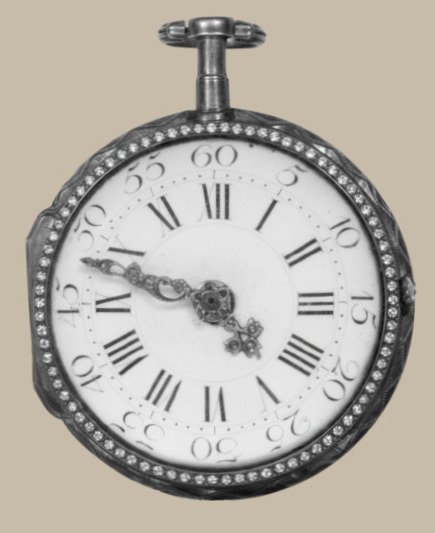
There is a second sense in which collectors use the word “Lépine.” Because the new architecture let the winding square sit in line with the small-seconds and the pendant, it gave rise to the classic open-faced watch with the winding crown at 12 o'clock and the sub-seconds at 6 — still called a Lépine layout, as opposed to the savonnette (hunter) layout, where the crown sits at 3. Every time a catalogue distinguishes a “Lépine” from a “savonnette” case, it is quietly saluting the man.
More Than a Calibre: Lépine's Other Inventions
The bridge calibre would be legacy enough, but Lépine was a restless improver across his long career. In 1763 he devised a new repeating mechanism in which pressing the pendant itself wound the repeating work and the racks sat on the winding arbor, doing away with the fragile chain that older repeaters relied on; the Académie des Sciences gave it a glowing report, and the idea, refined, survives in repeaters still. He was an early champion of keyless winding, seeking to free the owner from the loose watch key, and he developed elegant cases à charnières perdues — with concealed hinges and a secret catch released by twisting the pendant — that were wound and set from the back, so an inner cover could keep dust off the movement and fingers off the dial.
He had an eye for the face of a watch as well as its works. Lépine was among the first to put Arabic numerals on the dial for both the hours and the minutes, and the slim, hollow aiguilles à pomme (“apple” hands) he favoured were the direct ancestor of the famous hollow-moon Breguet hands that his pupil would make world-famous in 1783. He also took up and perfected Jean-André Lepaute's virgule escapement, keeping it in French use for a couple of decades. Taken together, these are the marks of a watchmaker thinking not just about mechanism but about the whole object — how it is wound, set, protected and read — in a strikingly modern way.
The Maison Lépine and the Legacy
As his eyesight failed, Lépine handed the business to his son-in-law Claude-Pierre Raguet, who became a partner in 1792 and signed his work Raguet-Lépine; the old master stayed involved almost to the end. Jean-Antoine Lépine died in Paris on 31 May 1814, aged ninety-three, having watched his calibre become the ordinary way to build a watch. The firm passed through a chain of owners — Chapuy, Descamps, Fabre, Boulay and others — but always traded under the Lépine name, and its residual stock was eventually absorbed by Louis Leroy as late as 1919. The name had become, in effect, a synonym for the thin French watch.
The deeper legacy is architectural. When the Swiss and American factories mechanised watchmaking in the nineteenth century, it was Lépine's plate-and-bridges layout — not the old full-plate drum — that lent itself to machine production and interchangeable parts, because a movement built from separate, individually fitted bridges is exactly the kind of thing a factory can make in stages. Every slim dress watch, every display-back automatic showing off its decorated bridges, every service watchmaker who lifts a single train bridge to reach a wheel, is working in the idiom Lépine set down in the 1760s. He is far less famous than his pupil Breguet, but in the quiet, structural way that matters most to how watches are actually built, Jean-Antoine Lépine may be the most consequential watchmaker of them all.
Further Reading
- Abraham-Louis Breguet — Lépine's most famous pupil, who built on the bridge calibre
- Tompion & Graham — the English tradition Lépine's calibre would eventually reshape
- Verge & Fusée Watches — the deep, fusée-driven watch Lépine replaced
- The Cylinder Watch — the low escapement that made the flat calibre practical
- Open-Face Pocket Watches — the “Lépine” layout versus the savonnette
- Pocket Watch Movements — plates, bridges and going barrels explained