
Keyless Winding: Who Owned the Crown
The mechanism was settled early. Jean-Adrien Philippe had a working crown-winding and crown-setting system by 1842, showed it at the Paris Industrial Exposition of 1844, and patented it in France as no. 1317 on 22 April 1845. What took another sixty years was not invention. It was working out whose part the crown was.
A Key-Wound Watch Has No Interface
On a key-wound watch there is nothing to own. The winding square is a bare arbor on the movement, reached through a hole in the case back or the dust cover, and the key is a loose object that lives in the owner’s pocket or on a chain. The movement maker supplies the square. The case maker supplies a hole. Neither has to consult the other, and a movement of the right size drops into any case of the right size without either firm knowing the other exists.
Crown winding destroys that arrangement. The crown sits on the pendant, and the pendant is part of the case. The stem runs inward from the case into the movement. Suddenly there is a component that spans the join, and somebody has to be responsible for it.
This is the reason adoption was slow where the trade was fragmented and fast where it was not. A firm that made a whole watch could adopt keyless winding as soon as it liked. A trade in which movements and cases were made by different companies and married by a retailer had to renegotiate the boundary between two industries first.
America Answered: the Crown Belongs to the Case
The American answer looks strange until you remember what the American trade actually was. Watch companies sold movements. Case companies — Keystone, Fahys, Dueber, Philadelphia — sold cases. A jeweller put the two together in front of the customer, choosing the case to the customer’s budget, and the whole system depended on any movement of a given size fitting any case of that size.
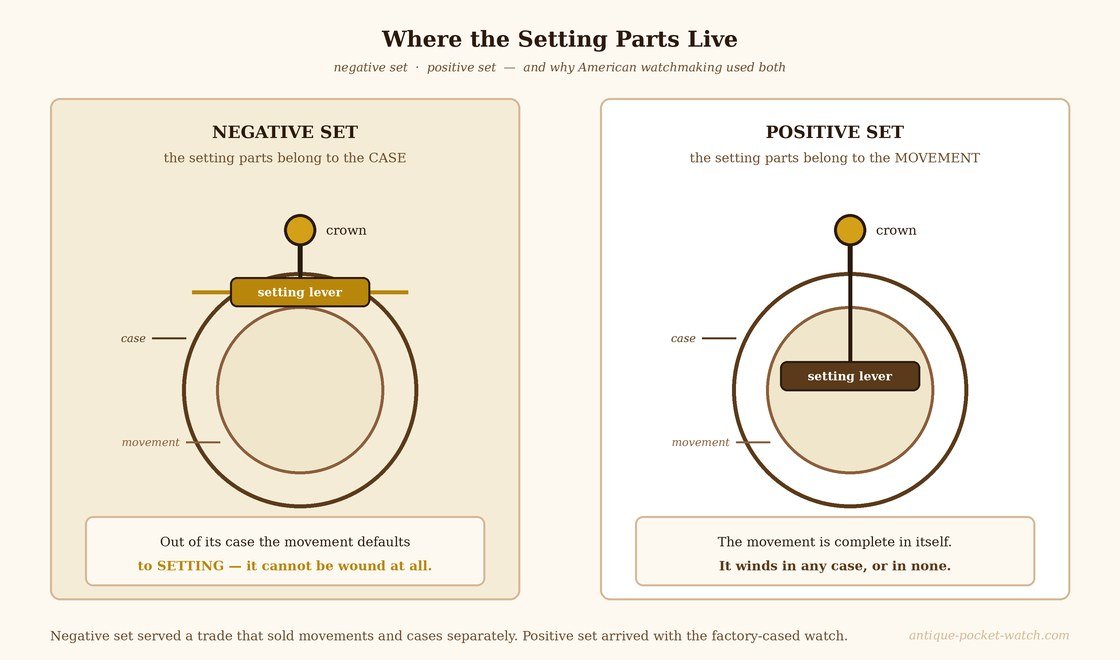
So the American trade put the stem, the crown and the setting parts in the case. That is the negative set system, and it preserved exactly the interchangeability the trade was built on: the case supplied the winding interface, the movement supplied the going train, and an 18-size movement still dropped into any 18-size case.
Negative set was not a compromise or a mistake. It was the arrangement that let keyless winding into a trade that sold movements and cases separately — and it worked precisely because the crown was the case maker’s problem rather than the movement maker’s.
What a Negative-Set Movement Does Out of Its Case
It sits in setting mode and refuses to wind. In a negative-set watch a spring holds the setting works engaged by default, and it is the case — specifically the stem pressing inward when the movement is cased — that pushes the lever across into winding mode. Take the movement out and the pressure goes, so the default reasserts itself.
A bare negative-set movement on a dealer’s bench or in an online listing therefore looks broken and is not. Turning the stem moves the hands instead of winding the mainspring, which is exactly what a fault would look like. It is the commonest way a perfectly sound movement gets described as needing work.
Then the Trade Changed, and the Answer Changed With It
From the turn of the century the American factories began selling watches already cased. Once the maker controlled both halves there was no interchangeability left to protect, and the reason for putting the crown in the case evaporated. The industry moved to positive set: stem, crown and setting parts all in the movement, winding as the default, setting only when the crown is pulled or a lever thrown.
The change was not purely technical. Elgin and Waltham held the relevant patents and used them, suing smaller makers who built pendant-setting movements of the negative type — so the transition was partly an industrial argument about who was allowed to make what, decided in courts rather than workshops.
| Negative set | Positive set | |
|---|---|---|
| Stem and crown | Part of the case | Part of the movement |
| Setting parts | In the case | In the movement |
| Default mode | Setting | Winding |
| Movement out of case | Cannot be wound | Winds normally |
| Case must match | Yes — a specific case is required | No — any case that fits |
| Suits a trade that | Sells movements and cases separately | Sells finished, factory-cased watches |
Why the Railroads Wanted Neither
Railroad service imposed a third answer for its own reasons. A crown that sets the hands when pulled can be pulled by accident in a pocket, and a watch whose hands have been nudged is worse than a watch that has stopped, because it still looks right. The requirement became lever set: the bezel must be removed and a lever deliberately drawn out before the hands will move at all.
That is a safety specification rather than a manufacturing one, and it cut across the negative and positive question entirely — which is why railroad-grade watches are the one large family where the setting system was chosen for what could go wrong rather than for how the watch was sold. The requirement hardened over the first decade of the century, and by 1908 a watch entering railroad time service was generally expected to be lever set as a matter of course, along with the jewel count, the adjustment and the dial that the same standards specified.
What It Means for a Watch in Front of You
The setting system is a dating clue of a coarse but useful kind, and it is one of the few clues that reads the relationship between movement and case rather than either on its own. A negative-set American movement points to the era when the two were bought separately. A positive-set one is consistent with a factory-cased watch, or simply with a later movement.
It also settles a question that comes up constantly with inherited watches: whether a movement and case that do not obviously belong together are evidence of tampering. Usually they are not, and the setting system explains why the question is the wrong one.
Further Reading
- How to identify and date a pocket watch — the order to work in, and why the case number will not date the watch.
- The pocket watch case — types, sizes and how they open.
- The railroad pocket watch — where lever set became a requirement rather than a preference.
- Patek Philippe — the firm Adrien Philippe joined, and what his partnership became.
- Jean-Antoine Lépine — an earlier attempt to be rid of the key, and the calibre that made thin watches possible.
- All Horological History articles.